Browsed by
Category: Vintage Treasures

The Novels of Michael Shea: The Mines of Behemoth

The Novels of Michael Shea: The Mines of Behemoth

The Mines of Behemoth-smallThe last two Michael Shea novels we discussed, The Extra and Attack on Sunrise, took his career in an intriguing and very different direction. But I still admit a greater fascination with his Nifft the Lean novels, Nifft the Lean (1982), The Mines of Behemoth (1997), and The A’rak (2000). Baen Books published the last two in attractive paperback editions, with covers by Gary Ruddell, and I’ve always thought they were some of the most eye-catching sword-and-sorcery on the market.

We lost Michael last month, but very fortunately for us, he left a fine body of work behind to remember him by, including The Color Out Of Time (1984), In Yana, the Touch of Undying (1985); and his highly acclaimed collections Polyphemus (1987), The Autopsy and Other Tales (2008), and Copping Squid and Other Mythos Tales (2010).

Nifft the Lean, and his companion-at-arms, Barnar Hammer-Hand, were often lucky. Enroute to working Costard’s sap mine — very dangerous, and sometimes nauseating work far below ground — they were shipwrecked. But this proved fortuitous, when they met Bunt, who had been seeking just such as they. If they would work the sap mine, but also bring back twenty gills of fluid, he would make them exceedingly wealthy. So it was settled. They would suck the sap from the servants of the monstrous insectile queen — and they would bring back some of the ichor that she alone exuded — and they would be rich. It seemed relatively easy. They wouldn’t have to go to hell at all, for instance.

Of course, the best laid plans sometimes do go a little astray.

The Mines of Behemoth was published in 1997 by Baen Books. It is 256 pages, with an original price of $5.99 in paperback. It is out of print and there is no digital edition.

Read More Read More

Blogging Sax Rohmer’s The Island of Fu Manchu, Part Two

Blogging Sax Rohmer’s The Island of Fu Manchu, Part Two

island cassell 1955island comic bookSax Rohmer’s Fu Manchu and the Panama Canal was first serialized in Liberty Magazine from November 16, 1940 to February 1, 1941. It was published in book form as The Island of Fu Manchu by Doubleday in the US and Cassell in the UK in 1941. The book serves as a direct follow-up to Rohmer’s 1939 bestseller, The Drums of Fu Manchu, and is again narrated by Fleet Street journalist, Bart Kerrigan.

The second quarter of the novel begins with Ardatha phoning Kerrigan just before his planned departure for his mission abroad. She shares Fu Manchu’s itinerary with him in the hopes Kerrigan will arrange for the return of Peko, Fu Manchu’s pet marmoset. After hanging up, a confused Kerrigan learns Sir Lionel managed to abduct the animal during his liberation from the clinic in Regent Park. Sir Denis explains both he and Barton understand Peko’s value as a hostage.

Read More Read More

The Public Life of Sherlock Holmes

The Public Life of Sherlock Holmes

Sherlock BBC-smallMe? Oh, why, thank you for asking. I’ve been into Sherlock Holmes since the early eighties. Columnist, contributor, reviewer, short story writer, screenwriter, newsletter editor, website creator: I’ve found many ways to express my Holmes geekiness.

I used to run a Holmes On Screen website, which I dropped just before the first Robert Downey, Jr. movie: how’s that for timing? Swing by www.SolarPons.com to see my (not one, but) two free, online newsletters inspired by the world’s first private consulting detective.

If you have a pulse, you may have noticed that Sherlock Holmes is rather popular these days. In the mid-eighties, the British TV series starring Jeremy Brett had revived interest in the detective. That interest waned as Brett’s health deteriorated and the series quality fell off towards the end. A few made-for-television movies, including ones starring Matthew Frewer (that Max Headroom guy), Richard Roxburgh and Rupert Everett, didn’t generate much excitement. Sherlock Holmes and the Vengeance of Dracula, once the hottest script in Hollywood, lost its luster and became a dead property. Sherlock Holmes was as viable as Martin Hewitt.* “Who,” you say? Exactly.

Then, on Christmas Day, 2009, Guy Ritchie’s Sherlock Holmes opened and grossed over a half a billion dollars worldwide. A sequel did even better here and abroad. Mark Gattis and Steven Moffat, deciding to expand beyond Doctor Who, grabbed Benedict Cumberbatch and Martin Freeman, put them in modern day London and helped make Sherlock Holmes even more popular than during the stories’ initial run with their simply titled Sherlock.

Read More Read More

Why Amazon Lists Books For Over $20 Million

Why Amazon Lists Books For Over $20 Million

Sandkings George RR Martin-smallIf you’ve been buying used and rare books online for any period of time, I’m certain you’ve run into strange pricing anomalies. I’m not just talking about George R.R. Martin’s paperback collection Sandkings listed for $2,000 at Amazon, or Philip K. Dick’s Flow My Tears, the Policeman Said for $7,700 (although there’s plenty anomalous about those prices, as anyone with a copy will tell you.)

No, I’m talking about the instances where prices for books inexplicably spiral out of control, as UC Berkeley biologist Michael Eisen noted on his blog:

A few weeks ago a postdoc in my lab logged on to Amazon to buy the lab an extra copy of Peter Lawrence’s The Making of a Fly … Amazon listed 17 copies for sale: 15 used from $35.54, and 2 new from $1,730,045.91 (+$3.99 shipping)… the two sellers seemed not only legit, but fairly big time (over 8,000 and 125,000 ratings in the last year respectively). The prices looked random – suggesting they were set by a computer. But how did they get so out of whack?

Intrigued, Eisen began to track the prices.

I started to follow the page incessantly. By the end of the day the higher priced copy had gone up again. This time to $3,536,675.57. And now a pattern was emerging.

On the day we discovered the million dollar prices, the copy offered by bordeebook was 1.270589 times the price of the copy offered by profnath. And now the bordeebook copy was 1.270589 times profnath again. So clearly at least one of the sellers was setting their price algorithmically in response to changes in the other’s price…

Read More Read More

The Games Plus 2013 Spring Auction

The Games Plus 2013 Spring Auction

Some of the loot I brought home from the Spring 2013 Games Plus auction
  Some of the loot I brought home from the Spring Games Plus auction last year (click for bigger version)

Tomorrow is one of the highlights of my year — the Spring Auction at Games Plus in Mount Prospect, Illinois, one of the finest game stores in the Midwest, about an hour’s drive from my house.

I’ve written about the Spring and Fall 2012 auctions (in “Spring in Illinois brings… Auction Fever” and The Paris Fashion Week of Fantasy Games, respectively) and I’ve been looking forward to returning this year.

The Games Plus auctions are just about the friendliest I’ve ever attended. The store is run by a group of dedicated and professional gamers who know their stuff and they keep the proceedings running with an experienced hand — and a quick wit. Even if I were unable to bid, I think I’d enjoy sitting in the audience, just for the entertainment value.

Of course, it’s a lot more fun to be able to bid.

As I mentioned in the previous articles, it’s important to have a budget for these things, and to conserve funds for those items you really want.

Ha, ha. A budget! Excuse me while I regain control of my writing limbs.  A budget — that’s a good one.

Let me put it another way: It’s important to keep a running total of your purchases and always to be aware of how much money you’ve spent. Why? All that constant arithmetic will distract you from non-stop bidding. Eventually, you’ll crumble up the sheet and abandon it as futile, but for a while it will help you keep a lid on things.

Read More Read More

Galaxy Science Fiction, September 1951: A Retro-Review

Galaxy Science Fiction, September 1951: A Retro-Review

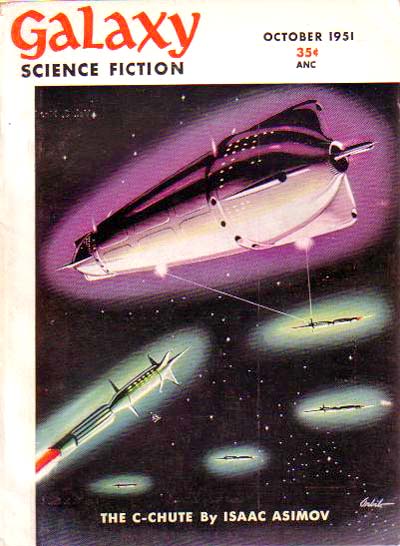
Galaxy Science Fiction September 1951-smallGalaxy concluded its first year of publication with this issue. Horace (H. L.) Gold notes some interesting stats in his opening remarks. He mentions that about 60 stories were selected from submissions of about 3,000. That’s a 2% acceptance rate, which is better than Duotrope reports for some professional magazines today.

Still, if you’re an author planning to travel back to 1951 to try your chances on getting into Galaxy, bear in mind that you’re up against some of the founders of science fiction. It’s you vs. Heinlein; you vs. Damon Knight. That might prove more difficult than inventing a time machine.

The Puppet Masters (Part 1 of 3) by Robert Heinlein — Slug-like aliens attach themselves to human hosts and take control of their minds. They begin an invasion by controlling key individuals, city by city, steadily working their way toward the President of the United States.

A government agency, led by the Old Man (as he’s called), works alongside two of his best agents, code-named Sam and Mary. The three of them try to capture a live specimen in order to learn more about the threat and to convince the President to quarantine vast areas of the country. But with so many controlled government leaders assuring the President that there is no danger, it seems impossible to defeat the puppet masters.

I’m familiar with this story from one of its movie adaptations. This story set a standard for parasite-controlling creatures. It’s a frightening concept, not too far from the notion of zombies; in both cases the individual is lost, reduced to involuntary responses.

Read More Read More

The Novels of Michael Shea: In Yana, The Touch of Undying

The Novels of Michael Shea: In Yana, The Touch of Undying

In Yana-smallAround Christmas in 1985, I walked into The House of Speculative Fiction in Ottawa, Ontario, and after browsing the shelves for a while, selected a volume. The man behind the counter that Saturday was Rodger Turner, who years later would head up the Hugo and World Fantasy Award-nominated SF Site. But back then, Rodger was a humble bookseller — and a very good one.

I asked Rodger what he thought of my selection. He shrugged. “It won’t change your life,” he said. That was one of the marvelous things about Rodger: he always gave his honest opinion. And his taste was excellent.

“You know what will change your life?” he asked. And without another word, he handed me a copy of In Yana, The Touch of Undying. That was my first exposure to the magical worlds of Michael Shea, but it was by no means my last. Today, In Yana is considered a classic of darkly humorous fantasy; it is well worth seeking out.

Bramt Hex is a student of ancient lore until a chance meeting at an inn opens infinite pathways of possibility and, touched by destiny, Bramt abandons his ivory tower for the greater world, hoping to become a maker of legends in his own right.

But the world is a fearful place peopled by cunning nobles and wily wizards, demons and ogres, vampires and vengeful ghosts, sword-wielding warriors and flesh-craving giants. And soon, Bramt’s quest for fame and wealth becomes a battle for survival — and a desperate, magic-led search for a treasure far greater than gold… the secret of immortality which can only be found in the dangerous, illusive realm called Yana…

In Yana was published by DAW Books in December 1985. It is 318 pages, priced at $3.50. The cover is by Terry Oakes. It has never been reprinted.

Read More Read More

Blogging Sax Rohmer’s The Island of Fu Manchu, Part One

Blogging Sax Rohmer’s The Island of Fu Manchu, Part One

PanamaLibFuNextSax Rohmer’s Fu Manchu and the Panama Canal was first serialized in Liberty Magazine from November 16, 1940 to February 1, 1941. It was published in book form as The Island of Fu Manchu by Doubleday in the US and Cassell in the UK in 1941. The book serves as a direct follow-up to Rohmer’s 1939 bestseller, The Drums of Fu Manchu, and is again narrated by Fleet Street journalist, Bart Kerrigan.

The previous book in the series was published just prior to the outbreak of the Second World War in Europe. Rohmer chose to portray characters such as Hitler and Mussolini under thinly disguised aliases. More critically, he chose to have these threats to world peace removed by the conclusion of the book as he naively believed a Second World War would be avoided at all costs. Over a year into the war, Rohmer had to address these issues for his readers. His excuse was a brilliant one. The prior narrative had been censored by the Home Office. Bart Kerrigan was forced to alter names and events. Hitler and Mussolini yet lived.

Interestingly, Rohmer chose to pick up the story some months after the last title and reflect changes in the lives of his characters. The Si-Fan has fallen under an unnamed pro-Fascist president who counts Fu Manchu’s duplicitous daughter among his closest allies. The Devil Doctor himself has fallen from grace within the Si-Fan, as he opposes fascism at all costs. This rift threatens to tear the secret society apart as much as the war was doing the same to governments around the world.

Read More Read More

Swords and Edgar Rice Burroughs

Swords and Edgar Rice Burroughs

Burroughs-MarsERB is probably best known to people who enjoy Fantasy and SF as the creator of the John Carter of Mars series, the Carson of Venus books, and the Pellucidar world-in-the-centre-of-the-earth stories. Then, of course, there’s Tarzan, probably second only to Dumas’s Three Musketeers as a source of movies, TV shows, and comics.

Following up on my recent sword-fighting posts, I’d like to talk about two ERB novels that are much less well-known than the ones I refer to above, and yet which have the same spirit of adventure and, for me almost more important, the same emphasis on sword play.

Both The Outlaw of Torn (1914) and The Mad King (1915) are what used to be called “romantic adventures.” This wasn’t because there was a love interest (though everyone familiar with ERB’s work knows there was), but because of the extraordinary demands placed on the hero, usually for extreme action, courage, fortitude, and sacrifice.

The Indiana Jones films are probably the closest deliberate modern equivalent to this genre, and while it’s hard for us to think of Iron Man, or Spiderman, as romantic adventurers, in the way the term was understood back then, that’s exactly what they would be.

Read More Read More

Vintage Treasures: Doc Sidhe by Aaron Allston

Vintage Treasures: Doc Sidhe by Aaron Allston

Aaron Allston  Doc Sidhe-smallWe lost prolific game designer and author Aaron Allston last week and, as often happens after we lose someone of importance in the industry, I find myself dwelling on their contributions. By the time of his death, Allston was renowned chiefly for his popular Star Wars books. But the first of his novels I ever purchased — and indeed, the one I still think of first — was his homage to Doc Savage, the 2001 novel Doc SidheDoc Sidhe is an unabashed salute to thirties pulp fiction. Here’s the book description:

Olympic kickboxer Harris Greene’s career has just self-destructed, and both his manager and his fiance, Gaby, have dumped him. While looking for Gaby, he interrupts a bizarre trio as they are kidnapping her, and he is hurled into another, very weird, universe. His only hope is Doc Sidhe, this Art Deco universe’s greatest champion of justice.

And here’s Blue Tyson’s spot-on review:

Imagine if there was a counter earth, stuck in the 30s, where, basically, elves and trolls are real. The coolest thing, however, is that Doc Savage is real, too. Except for the fact he is a Daoine Sidhe sorcerer, and has a higher mortality rate for his crew.

A down on his luck kickboxer and his girlfriend end up there, via a conjurer’s circle, and a plot to change the magical rules of relations between the two worlds. Oh, and the evil villain is Doc’s son. This is an excellent homage, a good urban fantasy, and a bit of The Untouchables, to boot…

Doc Sidhe had one sequel: Sidhe-Devil, published by Baen in 2001. It was published by Baen Books in May 2001. It is 352 pages, originally priced at $5.99. It is currently out of print; there is no digital edition. See all of our recent Vintage Treasures here.