Browsed by
Category: Vintage Treasures

Collecting Lovecraft, Part II

Collecting Lovecraft, Part II

Lovecraft Ballantine Paperback collection-small

It’s almost too easy to get the complete works of H.P Lovecraft. Barnes and Noble, just for example, sells a handsome single-volume complete edition of his work (all 1112 pages!) for just $18. So why on earth would you ever want to spend your time and money collecting vintage paperbacks containing only a fraction of his complete works?

I made a half-hearted attempt to answer that question in the first article of this series, Collecting Lovecraft. Collecting is an emotional hobby, not a rational one, so trying to fathom the collecting urge purely on a rational basis is only going to get you so far. In truth, it usually boils down to something as simple as fondness for cover art, or nostalgia for the particular edition that first introduced you to an author.

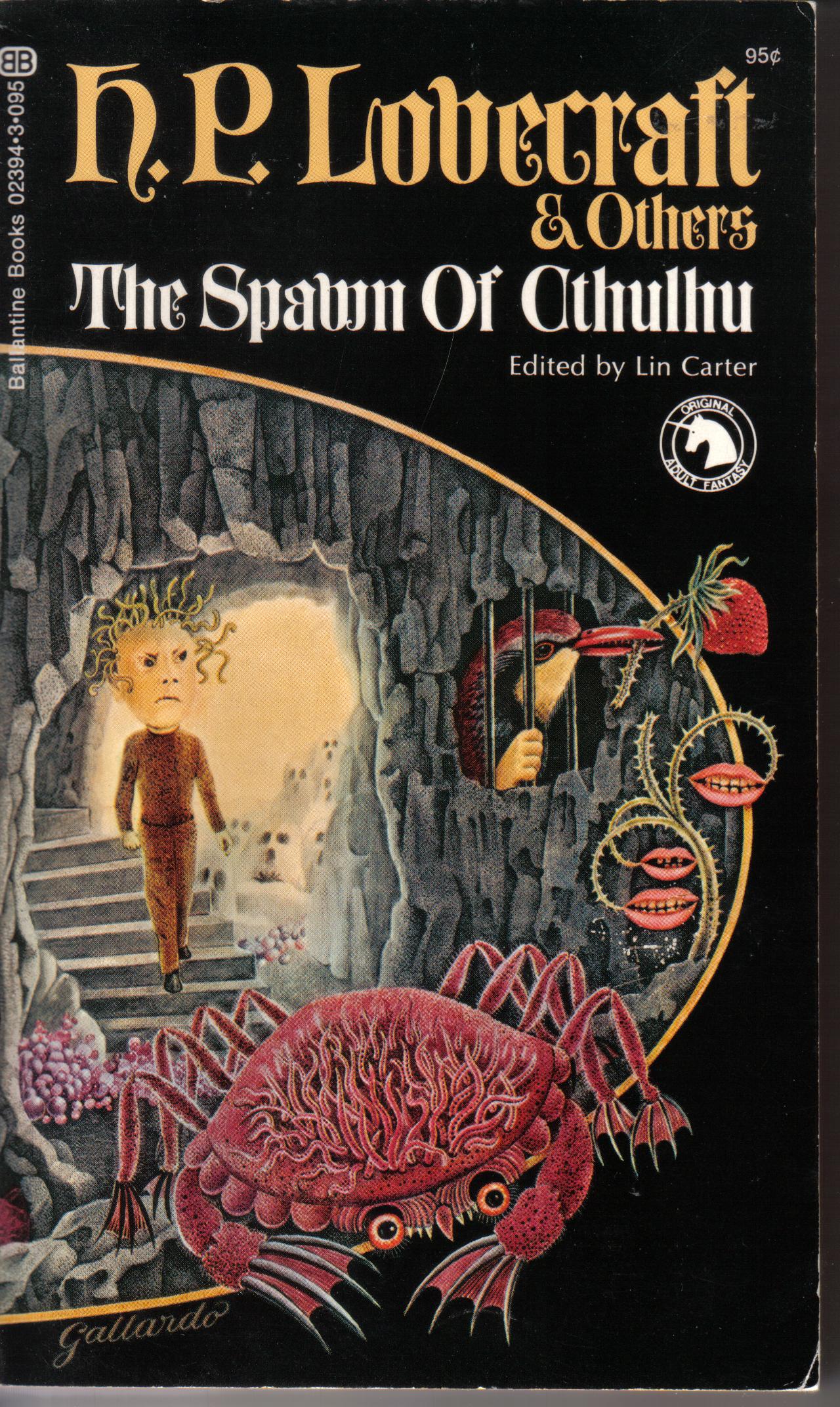
Above you can see a colorful assortment of Lancer and Ballantine paperback editions of H.P. Lovecraft originally published between 1967 and 1973: The Colour Out of Space (1967), Tales of the Cthulhu Mythos, Volume 2, edited by August Derleth (1969), The Shuttered Room and Other Tales of Horror, by Lovecraft and Derleth (1973), The Survivor and Others by Lovecraft and Derleth (1971), and The Spawn of Cthulhu, edited by Lin Carter (1971). Truthfully, I’m not too fond of these covers, and they don’t hold any particular nostalgia for me — they were all out of print long before I discovered Lovecraft. So why was I so determined to buy them?

Back in August the New York Times published a fascinating article about Zero Freitas, the Brazilian millionaire collecting every vinyl record ever made. I don’t mean one copy of every record, I mean every single piece of vinyl with music on it in the world. He’s amassed millions so far. I distinctly remember the first time I read the piece, I nodded along and thought, “Yeah, I get it.”

Read More Read More

Vintage Treasures: Silverglass by J.F. Rivkin

Vintage Treasures: Silverglass by J.F. Rivkin

Silverglass-smallThere’s no shortage of fantasy fiction with strong women heroines these days — in fact, if you’re standing in front of the urban fantasy section of your local bookstore, I wouldn’t be surprised if you assume that that’s all there is.

I do hear the occasional observation that this is entirely a modern development however, and obviously that’s not true. Yeah, adventure fantasy was largely dominated by male writers in the 20th Century (and male editors, and male art directors, but that’s a different topic.) But it wasn’t just trailblazers like C.L. Moore, Anne McCaffrey, and Joanna Russ creating popular female heroes. Even in midlist fantasy, there were popular sword-wielding women characters, many of whom are forgotten today.

Are they worth remembering? That’s a different question.

I’ve always wanted to find out. Recently I’ve been curious about the Silverglass books by J.F. Rivkin, four novels published between 1986 and 1991: Silverglass, Web of Wind, Witch of Rhostshyl, and Mistress of Ambiguities. The first one crossed my desk again last night, part of a small paperback collection I recently acquired, and I dipped into it long enough to be intrigued.

Probably the reason I’ve remembered these books so long is the colorful wraparound covers by Royo. For Silverglass, he surrounded our heroine with an interesting cast of characters in what looks like an underground tavern — a setting that immediately spoke to me of adventure in 1986. The main selling point is summarized in the Piers Anthony blurb at the top:

It’s fun to see a tall, handsome, hard-fighting, hard-drinking barbarian hero — who is female.

Here’s the book blurb, and high-res scans of the front and back covers.

Read More Read More

Vintage Bits: Icewind Dale: Enhanced Edition Available for Pre-Order

Vintage Bits: Icewind Dale: Enhanced Edition Available for Pre-Order

I have a deep fondness for old school computer games — especially classic RPGs like Wizardry, Pool of Radiance, Wasteland, Starflight, and Baldur’s Gate. Those games helped get me through my teen years (and most of grad school, now that I think about it). So when Beamdog announced an Enhanced Edition of Baldur’s Gate in November 2012, I was thrilled.

Beamdog was founded by two ex-employees of Bioware, the company that created some of the finest computer RPGs ever made, including Baldur’s Gate, Neverwinter Nights, Star Wars: Knights of the Old Republic, and Mass Effect. Co-founder Trent Oster and lead programmer Cameron Tofer formed Beamdog in July 2010 with the vision of bringing old school RPGs to modern platforms, and spent two years lovingly crafting a complete re-write of Baldur’s Gate — originally released only for Windows 95/98 — for modern versions of Windows, iPad , OS X, and Android. Their version eventually included over 400 enhancements, like new high-res cinematics, UI improvements, enhanced multiplayer, bug fixes and higher level caps, and over six hours of bonus quests & new adventures. It was, in short, the ultimate edition of Baldur’s Gate.

As excited as I was to see the Baldur’s Gate: Enhanced Edition — and its sequel, Baldur’s Gate II: Enhanced Edition, released in 2013 — I was even more delighted to learn that Beamdog’s next project was Icewind Dale: Enhanced Edition. Icewind Dale was my favorite of the Dungeons & Dragons Infinity Engine line of games (which included Baldur’s Gate I and II, Planescape: Torment, and several others), and I have very fond memories of playing it with my children over a dozen years ago.

Now Beamdog has made Icewind Dale: Enhanced Edition available for pre-order on their website for just $19.99, in a package that also includes both of the expansion packs: Heart of Winter and Trials of the Luremaster. Check out the trailer for the enhanced edition above.

Read More Read More

The Color Out of Time: Michael Shea Takes a Dip Into Lovecraftian Horror

The Color Out of Time: Michael Shea Takes a Dip Into Lovecraftian Horror

The Color out of TimeI’ll mention this first about Michael Shea’s 1984 novel The Color Out of Time: the protagonists consume copious amounts of Wild Turkey. They fortify their coffee with it; they carry hip flasks full of it. This is a fact the narrator always notes casually in passing. Never are the potentially debilitating effects of alcohol mentioned; it simply occurs to the reader that these people might well be past the point of tipsy into “whiskey-river-take-my-mind” territory through much of the central action of the adventure. Perhaps that’s how they maintain their sanity. And make no mistake: sanity is but one of the possessions at stake for our heroes, because they have waded head-deep into Lovecraft territory. If they do manage to survive with their sanity intact, though, they might want to consider rehab.

The second thing I’ll mention is that because some of my own fictional excursions overlap with Shea’s foray into Lovecraftian horror — we tread similar unhallowed ground, digging up the bones of past masters of weird horror and coating them with fresh slime, if you will — I find myself contemplating the book not just as a critic, but as a writer: appreciating moves he makes while noting missteps and potential pitfalls. Ultimately, Shea’s sequel to H.P. Lovecraft’s 1927 short story “The Colour Out of Space” is entertaining, but slightly off, a tad unsatisfying, and I’ll try to pinpoint why — to isolate the juncture at which it diverges from Lovecraft’s vision and to articulate how this impacts the effectiveness of the tale. (For a different take on the book, check out Douglas Draa’s review for Black Gate last year HERE.)

The premise is straightforward enough. Take the story that is generally regarded as Lovecraft’s first successful amalgam of science fiction and horror, a blend that became his unique trademark (“The Colour Out of Space” is one of Lovecraft’s most highly regarded and was always, according to Wikipedia, the author’s personal favorite. For the sake of full disclosure, it ranks high on my list of best horror stories and is one of my top two or three favorite works by Lovecraft). Start from the central event of that tale and then project its aftermath some sixty odd — very odd — years later.

Read More Read More

A Rogue’s Early Days: Yendi by Steven Brust

A Rogue’s Early Days: Yendi by Steven Brust

oie_28150EMzOHUFYSteven Brust has written that Yendi (1984), second in his ongoing series about gangster Vlad Taltosis his least favorite book. As it’s only the second of his novels I’ve read, I can’t tell you where it falls on a greater continuum of his work, but I can tell you it’s a pretty good book. Sure, the book is flawed, but the good bits far outweigh the bad. If this is the low point in the series, then I’m REALLY looking forward to the later volumes.

The first book in the series, Jhereg (read my review here), introduces Vlad Taltos, a human assassin in a magic-heavy world ruled by the Dragaerans (who are pretty much elves). In that book, Vlad finds himself forced into carrying out a complex assassination. Aided by his mini-dragon familiar, Loiosh, and several powerful and clever friends, he succeeds beyond his own expectations. It’s a blast and I’m grateful to Bill Ward for getting me to check it out.

Instead of taking the story forward, Brust goes back in time with Yendi. Here we learn how Vlad rose in the ranks of the mafia-like House Jhereg. By a combination of smarts, daring, and just enough violence, he secures a position in the gangland ecology of the Dragaeran Empire’s capital city, Adrilankha. By book’s end, he’s well on his way to becoming the successful racketeer we meet in the first book. Unfortunately for him, things happen between the beginning and end of Yendi that make for a lousy time for Vlad, but a fast-paced story for us.

The book begins with Vlad learning that another low-level boss, a Dragaeran named Laris, has opened a gaming parlor in his territory. When confronted, Laris is apologetic and presents a series of nearly believable excuses. After the meeting, Vlad informs his lieutenant, Kragar, that they have probably no more than two days to get ready for an all-out war. His intuition proves correct.

The war between Vlad and Laris is so violent that one of the five rulers of House Jhereg summons Vlad and tells him to handle his war with more subtlety, or else. Unfortunately, it’s too late to avoid the or else. Incensed by the steady string of fires and killings, the Dragaeran empress dispatches members of her Phoenix Guard to clamp down. There are curfews, restrictions on the size of gatherings, and all criminal operations are shut down.

Read More Read More

“Shardik, Shardik the Power Of God!”

“Shardik, Shardik the Power Of God!”

Shardik-smallMidway through Richard Adams’s doorstop of a book, Shardik (1974), I decided I had stumbled into the world’s longest parable.

Biblical parables are typically quite brief, but Adams pulls toward the opposite shore, reasoning that in thoroughness lies salvation. And why shouldn’t he? That tactic worked like gangbusters in his astounding debut, Watership Down (1972).

Shardik could indeed function as a serviceable doorstop, but to dismiss it out of hand would be a disservice to literature in general, and to fantasy novels in particular. Shardik is a brave, uncompromising examination of how “mere” mortals encounter and deify the exceptional, thus giving rise to portents, omens, prophecies, and ultimately continent-conquering religions.

In the case of Shardik, the talismanic inciting event takes the form of a gigantic bear, a bear of monstrous, prehistoric proportions, and this bear first flees a forest fire and then crashes, half-burned and exhausted, into a far-flung outpost of human civilization, Ortelga. Unfortunately – or not, depending on one’s point of view – the Ortelgans entertain a fervid belief that God’s manifestation on Earth will come in the form of a massive bear.

While Watership Down stayed locked within the heads of its rabbit characters, Shardik spends only a few pages at the outset inside the eponymous bear’s mind, just long enough to convince any alert reader that while Shardik may be a divine instrument, he is very much a bear, no more, no less, and will behave accordingly. After that, the story turns to Kelderek-Plays-With-Children, a hunter of simple tastes who first stumbles upon the injured, recovering bear-god.

Read More Read More

Vintage Treasures: The Dance of Death by Algernon Blackwood

Vintage Treasures: The Dance of Death by Algernon Blackwood

The Dance of Death Blackwood-smallAlgernon Blackwood is one of the acknowledged masters of the ghost story — and also one of its most prolific practitioners. He wrote a dozen novels and published some 34 short story collections, including John Silence (1908), Incredible Adventures (1914), Ancient Sorceries and Other Tales (1927); and Tales of the Uncanny and Supernatural (1949). He died in 1951.

In his review of Incredible Adventures, Ryan Harvey saluted Blackwood thusly:

Of all the practitioners of the classic “weird tale,” which flourished in the early twentieth century before morphing into the more easily discerned genres of fantasy and horror, none entrances me more than Algernon Blackwood. Looking at the stable of the foundational authors of horror — luminaries like Poe, James, le Fanu, Machen, Lovecraft — it is Blackwood who has the strongest effect on me. Of all his lofty company, he is the one who seems to achieve the most numinous “weird” of all…

In my view, Blackwood achieved his finest work in his earlier collections The Listener and Other Stories (1907), John Silence — Physician Extraordinary (1908), and The Lost Valley and Other Stories (1910), where he combined his weird adventures with aspects of horror and fear. These earlier classics are supernatural horror, but are also superb works of mood.

Much of Blackwood’s impressive catalog is now out of print, but not all of it. S. T. Joshi, who called his work “more consistently meritorious than any weird writer’s except Dunsany’s,” and said Incredible Adventures “may be the premier weird collection of this or any other century,” has edited two contemporary short story collections: The Complete John Silence Stories (1997), and Ancient Sorceries and Other Weird Stories (2002).

Of course, I’m most interested in the vintage paperback editions of Algernon Blackwood, and especially his 1963 Pan paperback The Dance of Death, which I recently acquired on eBay.

Read More Read More

Vintage Treasures: Orlando Furioso, the First Big Fat Fantasy Ever?

Vintage Treasures: Orlando Furioso, the First Big Fat Fantasy Ever?

1024px-Orlando_Furioso_20
Includes …a Hippogriff — winged horse born of a mare and griffin!

I’m reading Jack Campbell’s Lost Stars series — good rip-roaring Military Space Opera with a brain — and suddenly a Marfisa is talking to a Bradamante about a love interest called Ruggerio, and I almost fall out of my armchair laughing.

It’s an Easter Egg and it feels like it’s just for me, the thirteen year-old me to be precise, in the Penguin Classics section of Edinburgh’s now-defunct James Thin bookshop.

I’d made the amazing discovery that I could actually buy translations of the medieval books I’d read about.

I’d already wandered in a fervour through Malory’s Le Morte D Arthur — untranslated, actually, and I think it had an odd effect on my speech patterns at the time — and a verse translation of Beowulf. I’d discovered the French Arthurian writers, some actually pretty awful — just ‘cos it’s old doesn’t make it good! — and now I was looking for another breath of medieval air.

And there’s a black-bound book with knights on the cover. Orlando Furioso, the adventures of Charlemagne’s paladins… oh it’s Renaissance. Yuk.

But despite the late period cooties, I find myself looking at the “Characters and Devices” at the front…

Read More Read More

Vintage Treasures: The Voyage of the Space Beagle by A. E. van Vogt

Vintage Treasures: The Voyage of the Space Beagle by A. E. van Vogt

The Voyage of the Space Beagle by van Vogt, A. E. Mission Interplanetary-small The Voyage of the Space Beagle 1963-small

And now we move to one of the great SF classics of the Golden Age: A. E. van Vogt’s The Voyage of the Space Beagle, the tale of an intrepid crew of space explorers and their adventures on distant and deadly worlds, frequently cited as an obvious influence on both Star Trek and Alien.

But first, a few words about A. E. van Vogt, one of the greatest and most prolific writers of SF’s Golden Age, whom we haven’t discussed much at Black Gate (probably because he didn’t write a lot of fantasy). I read his classic novel Slan (1946) at an early age, and it had a big impact on me, pulpy and simplistic as it was. Van Vogt wrote nearly 40 SF novels between 1946 and 1985 — including the classics The World of Null-A (1948), The Weapon Shops of Isher (1951), and The War against the Rull (1959) — and published two dozen short story collections. He received the 14th Grand Master Award by The Science Fiction Writers of America in 1995.

Van Vogt has taken something of a beating from modern critics for his pulpy style and rather sloppy plotting, but he had many ardent fans, including Philip K. Dick, who said:

There was in van Vogt’s writing a mysterious quality, and this was especially true in The World of Null A. All the parts of that book did not add up; all the ingredients did not make a coherency. Now some people are put off by that. They think that’s sloppy and wrong, but the thing that fascinated me so much was that this resembled reality more than anybody else’s writing inside or outside science fiction.

Read More Read More

Beautiful Women, Alien Landscapes, and Santa Claus: An Ed Emshwiller Gallery

Beautiful Women, Alien Landscapes, and Santa Claus: An Ed Emshwiller Gallery

Science Fiction Quarterly February 1957 Ed Emshwiller-smallEd Emshwiller was one of the greatest cover artists our genre has ever known. He painted hundreds of covers for many SF digests and paperbacks, primarily Galaxy, The Magazine of Fantasy and Science Fiction, and the Ace Double line, starting in 1951 and continuing through the late 70s. His covers were filled with beautifully detailed alien settings, sultry and mysterious women, strange technology, and eye-catching fashions — frequently all at once, as in the cover of the February 1957 issue of Science Fiction Quarterly at left (click for bigger version).

The Geeky Nefherder blog has posted a gorgeous gallery of 75 Emsh cover paintings, including some of his very best work. Many of the images are available in high-resolution (click each one to see the high-res pic).

Warning: You could easily waste a lot of time on this site (I know I did).

The gallery includes cover art from Space Stories, Galaxy, Thrilling Wonder Stories, Fantastic Story, The Magazine of Fantasy and Science Fiction, Startling Stories, Planet Stories, Astounding Science Fiction, Infinity, The Original Science Fiction Stories,  Future Science Fiction, Venture, Science Fiction Quarterly, Super-Science Fiction, IF, and Amazing Stories — as well as classic covers for Andre Norton’s Daybreak — 2250, Galactic Derelict, and Star Born, Fritz Leiber’s The Big Time, Frank Belknap Long’s Space Station #1, Murray Leinster’s The Black Galaxy, Poul Anderson’s Virgin Planet, John Brunner’s Threshold of Eternity, and many others.

Even if you’re already an Emsh fan, you’re sure to appreciate having so much great art by the master together in one place. And if you’re not, this site will make you one.

See the complete gallery here. (And thanks to Charlie Jane Anders at io9 for the tip!)