Browsed by
Category: Reviews

Tarzan-on-Demand: Tarzan’s Greatest Adventure on DVD from Warner Archive

Tarzan-on-Demand: Tarzan’s Greatest Adventure on DVD from Warner Archive

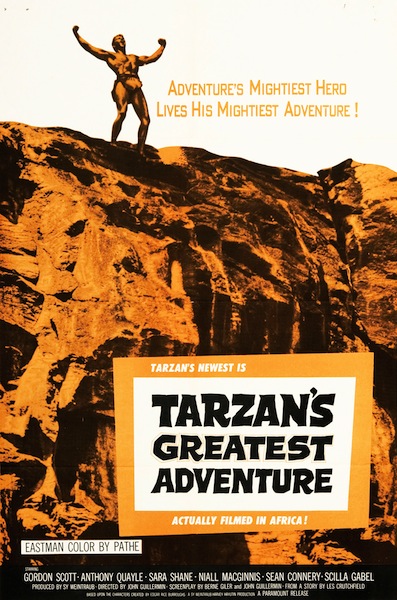
tarzans-greatest-adventure-posterI’ve discovered a way to merge my recent posts about the manufacture-on-demand DVDs of The Bermuda Depths and The Last Dinosaur with my long-running Edgar Rice Burroughs posts. Tarzan’s Greatest Adventure, the 1959 live-action film now available from Warner Archive, also gives me a reason to go back to talking about Tarzan for the first time since I reviewed Tarzan and “The Foreign Legion”.

Johnny Weissmuller played Tarzan in twelve movies from 1932 to 1948. But Weissmuller’s departure from the role didn’t bring a halt to the series. It soldiered on, switching around studios and distributors (it had already flipped from MGM to RKO during Weissmuller’s tenure) for two more decades. Lex Barker, Gordon Scott, Jock Mahoney, and Mike Henry all played the Lord of the Jungle for at least two films each, and then the movies segued into the television series starring Ron Ely, who would later play another famous pulp hero in George Pal’s unfortunate Doc Savage: The Man of Bronze in 1975.

Tarzan’s Greatest Adventure arrived in the middle of this second stage of the jungle adventures and marked a major shift in style. Producer Sol Lesser left the series, and his replacement Sy Weintraub decided to revamp Tarzan with a “New Look.” Actually, it was more of an “Old Look”: Weintraub took Tarzan back to his literary roots and made a movie more faithful to Edgar Rice Burroughs’s book series. Tarzan suddenly gained a full mastery of the English language, and the story acquired a more adult tone.

Because of Weissmuller’s continued domination of the Tarzan-on-film image to this day — even the mighty Disney machine cannot overcome him — it’s hard to imagine the latter-day movies in the series as being any good. But Tarzan’s Greatest Adventure is excellent; it’s the ERB-fan’s Tarzan film. Not that I don’t love Weissmuller’s first two movies, but this is actually something pretty damn special for any Burroughs bibliophile. Even if it isn’t based on a specific novel, Tarzan’s Greatest Adventure ranks with last year’s John Carter of Mars and The Land That Time Forgot as a movie that honestly captures the style and feel of ERB’s work. Had he been alive to see it, Burroughs would definitely have approved of the film. He might have objected to Tarzan’s non-monogamy, if it can really be called that, since Jane’s existence is questionable at this point in the movie series.

Also: a pre-007 Sean Connery as one of the villains. And it was actually shot in Africa!

Read More Read More

Red Sonja 13

Red Sonja 13

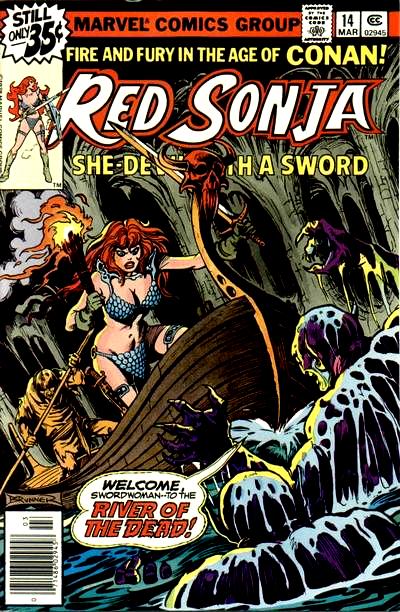
Red Sonja 13 coverSo this is the big wrap up to the storyline that began back in issue 8. Red Sonja sneaks back into Skranos in order to reinstate Suumaro as the rightful heir to the throne. Never mind that, over the last four issues, we’ve seen that Suumaro is a misogynistic momma’s boy who can’t seem to accomplish anything on his own. His half-brother Oryx (the current heir to the throne) is even worse. The first plan is to sneak past a sleeping guard.

The next step is to steal a harem girl’s outfit. More specifically, she pays the harem girl a gold coin to remove her outfit. There’s a great panel of the harem girl covering herself in shock at the thought of removing her clothes, even though, really, that must be part of the job description. So Red Sonja has to hold a dagger to the girl’s throat, urging her to forego her usual modesty and strip off the two-piece translucent outfit. Keep in mind, Sonja’s in the girl’s room, so it’s not like anyone else will even see her before she just puts on another outfit. In fact, why doesn’t Sonja just ask her for a spare outfit, since the harem girls can’t wear the same thing every day (and if they do, um, yuck).

Once again, Red Sonja takes to the streets, dressed in a harem slave outfit that leaves more to the imagination than a chainmail bikini. But she’s in disguise now. Because, apparently, no one was looking at her face the last time she was in Skranos. It’s a pretty stupid plan, but of course it works.

One page later, she walks right up to Oryx and starts flirting with him, face uncovered. Keep in mind, this is the man who ordered her to be hung just a couple weeks earlier. Red Sonja was standing at the gallows, insulting Oryx, before his half-brother swung in and rescued her. I’m just saying, she’s someone he’s going to remember. But with a worse disguise than Clark Kent, she manages to get close to him.

Read More Read More

Adventure on Film: Navigator: A Medieval Odyssey

Adventure on Film: Navigator: A Medieval Odyssey

Under a fearsome black-and-white moon, a boy, perhaps twelve, enters a fever dream of navigator2orange-fired torches whirling down infinite chasms, of men clambering up a towering church steeple, of skies moving too quickly for thought. The boy’s careworn, grubby face melts into black and white rippling water, and the nightmare — if nightmare it is — comes to a sudden end.

Welcome to Fourteenth Century Cumbria, a snowy, monochromatic waste, all bare rock and snowdrifts and blackwater lakes. In a hardscrabble mining village, young Griffin, plagued by his apocalyptic visions, waits for his idol, Connor, to return from a visit to the wider world. But even before Connor’s return, all talk is of death, for the Plague is come, marching inexorably closer.  The villagers quickly convince themselves that only a holy quest can save them, and on the slimmest of evidence — Griffin’s disjointed prognostications — Connor, Griffin and four other men set off, bound for a mineshaft so deep (it is said) that it leads straight to the other side of the world. Griffin’s band brings a copper cross that they hope to mount to a titanic cathedral as an offering, a Cumbrian plea to stave off death itself.

Griffin finds the mineshaft right enough, together with a mechanical battering ram with which the men bore a hole to the far side of reality. And what do they find once there?  Twentieth century New Zealand.

Read More Read More

Weird of Oz Considers Postbuffyism

Weird of Oz Considers Postbuffyism

old battlestarBattlestar_Galactica_poster-HBObuffy

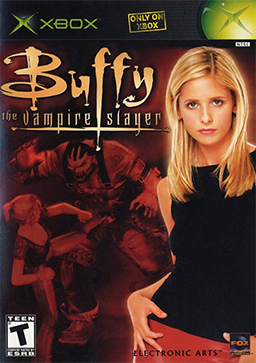
When discussing television series, especially genre shows (particularly horror, science fiction, and fantasy), my friends and I sometimes use a couple of adjectives that are pretty relevant and meaningful to us and may be of interest to readers of this blog: “pre-Buffy” and “post-Buffy.”

Most visitors to the Black Gate website will need no introduction to writer/director Joss Whedon and the “Whedonverse,” a term that encompasses all he has contributed to fantasy media over the past two decades in virtually every medium: television shows, comic books, webcasts, movies. Ranging from seminal shows like Buffy the Vampire Slayer, Angel, and Firefly to comic-book continuations of those series as well as runs on other properties like The X-Men; from the hip web series Dr. Horrible’s Sing-Along Blog to a cult horror film like Cabin in the Woods to the third-highest-grossing film of all time (2012’s The Avengers): trust me, you’ve seen his work.

In this week’s informal musing, I’ll focus in on his first television show, Buffy, which ran seven seasons from 1997-2003 — not to discuss the series per se, but to explain what I mean when I use it as a benchmark in describing a television show as being “post-Buffy.”

Read More Read More

Self-published Book Review: Chains of Loss by Robert Sier

Self-published Book Review: Chains of Loss by Robert Sier

Chains Of Loss CoverCyborgs versus Orcs.

That’s what I tell my wife that this book is about whenever she asks. Nanites, power suits, superhuman strength and intelligence versus hordes of raging orcs armed with crude weapons and dark magic. Okay, that’s not completely accurate. There’s only one cyborg, at least until the assimilating begins, and while there are plenty of orcs, most of the fights are against the same one. So, maybe “cyborg versus orc” would be more accurate.

Still, with a premise like that, there’s a lot of fodder for great stories, once you consider what else would be in a world that produces orcs and cyborgs: AIs and computers and starships, vampires and wizards and necromancy. And what happens when you combine them: orcs who can sense radio signals, flying humans created by technology? Robert Sier has managed to find a place for all of these things in his book, and the only question is with so much material, where do you begin.

So he starts with the hero. The cyborg, Derek Kazenushi, isn’t exactly military-grade: he just has the standard upgrades that any citizen of New Athens would, including enhanced speed and strength and healing, a few augments in matter fabrication, and the help of his built-in AI, Shadow. What he’s really specialized in, piloting, isn’t much help once his ship inexplicably crashes on Earth. That shouldn’t be possible, as Earth is light-years from New Athens, and faster-than-light travel doesn’t exist. New Athens lost all contact with Earth seven centuries ago, and Derek quickly learns that things have changed. There’s been a cataclysm, a merging of Earth with other worlds, bringing strange peoples and even stranger magic. Come to think of it, Earth merged with another world in the last novel I reviewed at Black Gate, too. Why doesn’t that sort of thing ever happen on this Earth?

Read More Read More

Red Sonja 12

Red Sonja 12

Red Sonja 12 coverWhere were we? Red Sonja and the polygamist exile prince Suumaro were trying to break free of a prison palace, which was built on top of a tree by Suumaro’s sorceress mother Apah Alah shortly after her husband left her. They’d met a horned centaur who used a glass-blowing pipe to create leather eggs that hatched into thumb-sized peacocks that grew to thousands of times their original size in a matter of minutes. The centaur died. The giant peacocks died. Sonja went blind for a while. And after she got her sight back, she was approached by a demon who wanted her to steal something called the Emblem. The demon’s name is Kthonn and he offers both Sonja and Suumaro great wealth if they retrieve this issue’s mystic doodad. That’s page one.

Sonja stabs him on page two. Basically, she knows he’s going to betray her, so why not cut out a lot of useless effort and kill him now? Her logic is sound, but her blade has no effect on the demon. So instead she agrees to find the Emblem. Apparently, among other things, the Emblem has the power to free them all from the prison palace.

Suumaro uses his magic to get a general fix on the talisman’s location. Turns out it’s in yet another tower of the increasingly large prison complex. So the two of them go off in search of the thing and, as soon as they’re out of earshot, Kthonn reveals that (spoiler) he’s planning to sacrifice them as soon as they return with the Emblem. Who’s he going to sacrifice them to? We’re never told. An even bigger demon, probably.

So, Sonja, Suumaro, and Kthonn all know this is a bad deal. But everyone’s going along with it anyway, presumably because seventeen pages aren’t going to fill themselves. And when they reach the (unguarded) chamber where the Emblem is kept, they find four items on a table: a wand, a sword, a coin, and a cup.

Read More Read More

The Real Argo: The Lord of Light Film and the Lost Jack Kirby Sketches

The Real Argo: The Lord of Light Film and the Lost Jack Kirby Sketches

Kirby-Lord-of-LightI was pleased to see Ben Affleck’s Argo win the Academy Award for Best Picture last night. It was the best film I saw last year, although I admit I didn’t see all the nominees.

But I was a little annoyed during parts — especially scenes which included dialog from the fake movie, Argo. It’s clear that Affleck (and his characters) have little respect for science fiction, as the script and its source material are portrayed as utterly terrible sci-fi at its pretentious worst.

Which was particuarly annoying because the source material in question — the script used by real-life CIA agent Tony Mendez, the man portrayed by Affleck — is based on my all-time favorite SF novel, Roger Zelazny’s brilliant Lord of Light. The man who wrote the original Wired article that inspired Argo, Joshua Bearman, explains it this way:

Argo was the name Tony gave to a script that was in turnaround and sitting in a pile at [makeup artist John] Chambers’ house. That script was called Lord of Light and had been adapted from a successful Roger Zelazny science-fantasy novel of the same name. A small-time self-starting dreamer… named Barry Geller had optioned Zelazny’s book himself and raised money to get the project started. He hired Jack Kirby to do concept art and Chambers to make the alien masks. But the whole project fell apart…

It was hard to see the script for Lord of Light merciliessly skewered for laughs in Argo. Still, something good has come out of it all. As a result of the recent spotlight on the film, Jack Kirby’s original sketches — thought lost for years — have come to light.

BuzzFeed has reproduced eleven of the sketches in an article by Richard Rushfield. If you’re a Kirby fan, or a fan of Zelazny’s SF masterpiece, they are well worth a look. Check them out here.

Who is the Daughter of Fu Manchu?

Who is the Daughter of Fu Manchu?

the-destiny-of-fu-manchu2The Destiny of Fu Manchu
By William Patrick Maynard
Black Coat Press (264 pages, $20.95 in trade paperback, April 2012)
A review by Joe Bonadonna

So who is the daughter of the infamous, the mysterious, the brilliant Fu Manchu? Is it the exquisite Koreani? The exotic Fah lo Suee? The lovely Helga Graumann? Who or what is the destiny of Fu Manchu? And who is “Khunum-Khufu,” and why is he in control of the Si-Fan?

The clues are there, the disguises are many, and the deception is all part of the fun in William Patrick Maynard’s sequel to his wonderful, The Terror of Fu Manchu.

I’ve become a fan of Maynard’s Fu Manchu. More importantly, I’m a fan of William Patrick Maynard. (His short story, “Tulsa Blackie’s Last Dive,” is one of the highlights of The Ruby Files, published by Airship27 Productions.) Now, in The Destiny of Fu Manchu, Bill picks up the story years after the events of his first novel, and this time he ups the ante in a tale that is far more complex and insidious than the good doctor’s previous adventure. I’ll do my best to give you a rundown without, hopefully, spoiling any of the fun.

The story opens with a prologue written by good old Petrie himself, the hero/narrator of the aforementioned The Terror of Fu Manchu. This time, however, Petrie has been abducted by Khunum-Khufu and a new faction of the Si-Fan, which plays back to the theft of the Seal of Solomon and the events related in the previous novel.

Read More Read More

A Touch of Evil: Colonial Gothic Horror Board Gaming At Its Finest

A Touch of Evil: Colonial Gothic Horror Board Gaming At Its Finest

TouchofEvilThe quiet colonial hamlet of Shadowbrook is cursed by evil and you are one of the small group of people who can investigate the growing danger, discover the evil’s source, and then collect together a group of Town Elders to destroy it!

That is the premise of Flying Frog Productions’ board game A Touch of Evil (Amazon). You move through the village, exploring various locations and getting clues and equipment. Your currency in the game are Investigation points, which you can spend to learn the secrets behind the Town Elders, or to buy new equipment from the town’s blacksmith. Each round, you uncover new mysteries … many of which result in a confrontation with the foul minions of the main villain tormenting the village and bringing it more under the sway of darkness.

The victory at the end comes from purchasing a Lair card (the price of which changes as evil gains control over Shadowbrook), gathering together a group of Town Elders, and going to confront the villain. However, the Town Elders all have secrets, and if you’re not careful, those secrets could cause them to turn on you, increasing the villain’s power during the confrontation. If you fail to defeat the villain, it escapes and play continues until another player is able to trigger a confrontation. This process continues until someone succeeds at actually defeating the villain.

Read More Read More

Heroic Fiction Quarterly 15

Heroic Fiction Quarterly 15

logoOne of an editor’s greatest pleasures is coming upon a fine story, so Adrian Simmons, David Farney, and William Ledbetter must have felt pretty delighted when they came upon the most recent batch of fiction they’ve published in Heroic Fiction Quarterly.

I’m sad to say that I’m more familiar with Heroic Fiction Quarterly e-zine in theory rather than in practice. I’ve heard good things about it for some time and I’ve read a few tales now and then, but it’s been years since I sat down for a visit. I’ve tried two of the stories in the most recent issue, “Dusts of War” by Ben Godby and “Kingdom of Graves” by David Charlton and was tremendously impressed. This is stirring, polished adventure fiction and needs to be seen by more readers. I’m looking forward to finding out what the rest of the issue holds. I’m looking forward to seeing what PREVIOUS issues hold.

Just prior to joining the Black Gate staff, I was managing the Flashing Swords e-zine. I selected and edited the tales for the first six issues. It was a small market with a small budget, and as might be expected, some of what I pulled from the submissions pile were diamonds in the rough, work from promising amateurs. It was sort of a “market with training wheels”: a place where burgeoning writers could hone their craft and start their careers. But a lot of the stories proved very fine indeed, better than such a small market had any right to be, and I can recall my frustration that more attention wasn’t being paid to them, as well as the frustration when the wrong sort of attention was paid — a reviewer tearing apart a first-time writer’s first published story with the same claws that would be used on a veteran writer in a pro market, or a fine writer’s work being dismissed by something as foolish as the old saw “first person stories have no tension because you know the narrator will survive.”

Read More Read More