MAKE THIS TRUE OR HARVEY SMASH! Planet Hulk to Come after Avengers 2
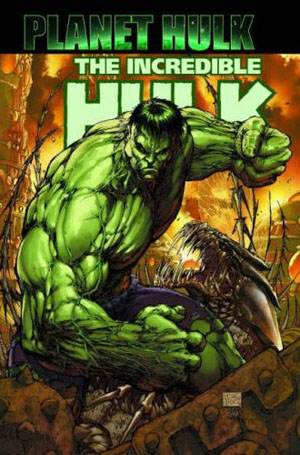 HULK SMASH MARVEL STUDIOS FOR SENDING HULK INTO SPACE!
Maybe he will and maybe he won’t, because that is how “scoops” work, and in this case we are dealing with a scoop for a film quite a few years out.
However, Latino Review and their esteemed El Mayimbe have a long history of accuracy with breaking movie news, so when El Mayimbe says that Marvel wants to make a movie version of Planet Hulk as a follow-up to 2015’s upcoming The Avengers 2, it bears serious consideration.
And, if true, damn I’m psyched and ready to Hulk-out. You should be too.
(Caution that El Mayimbe’s video may be considered mildly “spoilery” about the possible end of The Avengers 2. My comments below may also infer bits about Avengers 2.)
Planet Hulk is a long 2006 arc from The Incredible Hulk comic book (with tie-ins) by writer Greg Pak and illustrator Carlo Pagulayan. The gist: A small group known as the Illuminati, composed of the most powerful heroes on Earth, decide that the Hulk is simply too dangerous for the planet, so they shut him in a spaceship and blast his green butt off into space to land on a peaceful planet to spend the rest of his days. Only… this is a comic book and such a development would be boring. Nobody wants to see Hulk traipsing through a shady copse, smiling, and picking up alien daisies. TRA-LA-LA, HULK NO SMASH! HULK LOVE RHODODENDRONS!
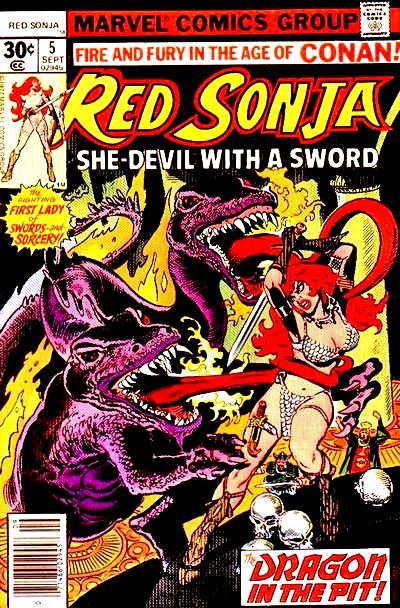
Instead, the Hulk’s ship goes through a wormhole, and he crashes on the violent planet of Sakaar. What follows is basically a sword-and-sorcery epic with the Hulk playing a Robert E. Howard hero who battles his way from gladiatorial slavery all the way to becoming the ruler of the planet. Trust me, it’s awesome — breaking away from the traditional “Hulk vs. General Ross” storylines on Earth and fulling embracing the Leigh Brackett and ERB style of muscular planetary romance. (Try to imagine Hulk as the star of The Sword of Rhiannon!) And the whole enormous thing is available digitally from Amazon.
Our own Bill Ward did an excellent write-up of the comic in 2009 if you desire more details.
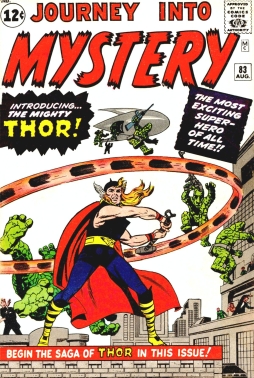 Journey Into Mystery first appeared in 1952, one of a number of anthology titles from publisher Martin Goodman’s line of comic books. Over the years, the title featured a lot of short horror, fantasy, and science fiction tales, many of them collaborations between editor/scripter Stan Lee and artists like Steve Ditko and Jack Kirby. Until 1962. At that point Goodman’s comics were beginning to change direction, following a revival of interest in the super-hero genre. A team book, The Fantastic Four, had taken off. A solo book had followed, The Incredible Hulk. Heroes would now be his company’s main product, and the line would soon come to be known as Marvel Comics. The horror anthology books would be taken over by recurring super-hero characters, and Journey Into Mystery would be the first of the bunch. So with issue 83, in August 1962, in a story credited to Stan Lee and artist Jack Kirby, it introduced its new lead: the mighty Thor, Norse god of thunder.
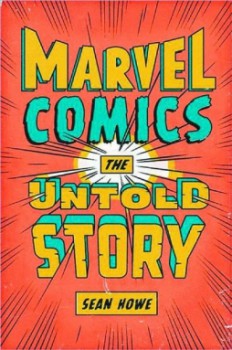 Early on in Sean Howe’s book-length history Marvel Comics: The Untold Story, the reader’s imagination is spurred by a throwaway anecdote: in 1937, New York magazine publisher Martin Goodman and his wife planned to return from a trip to Europe aboard the Hindenburg — on what would turn out to be the final tragic flight of the German dirigible, which ended with a terrifying aerial explosion and fire that led to the deaths of 36 people. Goodman, as it happened, was too late to get tickets and took a plane instead. You can’t help but wonder, though. What if he’d died then, before he’d expanded his magazine line to include comics? Before he’d hired his nephew Stanley to work in the office and do fill-in bits of writing? What if Marvel Comics, the subject of Howe’s book, had been stillborn? What would have been different in the development of comics, of popular culture, of the North American imagination? Maybe everything. Maybe nothing.