Browsed by
Category: Books

The Public Life of Sherlock Holmes: What Story Should You Read First?
The Public Life of Sherlock Holmes: What Story Should You Read First?

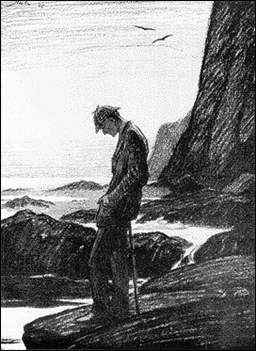
FirstStory_LionsMane
One of my favorites: Frederic Dorr Steele for The Lion’s Mane

Recently a post in a Holmes Facebook group caught my eye. A woman was a fan of one of the current TV shows (I don’t recall if it was Elementary or BBC’s Sherlock), but she loved it and wanted to read the stories. She wondered where to start.

First, I think it’s a bit interesting that there are Holmes fans that have never read Sir Arthur Conan Doyle’s stories. They only know the detective through television shows set in the modern day. I suppose this also happened a bit with the first Robert Downey Jr. movie, but that had a shorter shelf life. Anyhoo…

There’s a bit of a divide in the Holmes community these days between the ‘old school’ and the newer generation. One characterization is between those who study the stories and those who write speculative fan fiction that has little to no relationship with Doyle’s actual writings. To some extent, there’s always been an old guard/new fans distinction, but social media has exploded it.

While I’ve long been a fan of Holmes pastiches and enjoy most movies and films, I do look askance at all the doey-eyed swooning over Benedict Cumberbatch as Holmes. And they’ll pry my calabash pipe from my cold, dead hands before I recognize merit in this Sherlock Meta stuff.

But moving off the grumpy old man ruminations, the question the woman asked was a good one. The initial responses seemed to go with the standard ‘read them in the order they were written.’ That’s logical. But I don’t think it’s the best way to go.
Read More Read More

Future Treasures: The Year’s Best Science Fiction: Thirty-Second Annual Collection, edited by Gardner Dozois

Future Treasures: The Year’s Best Science Fiction: Thirty-Second Annual Collection, edited by Gardner Dozois

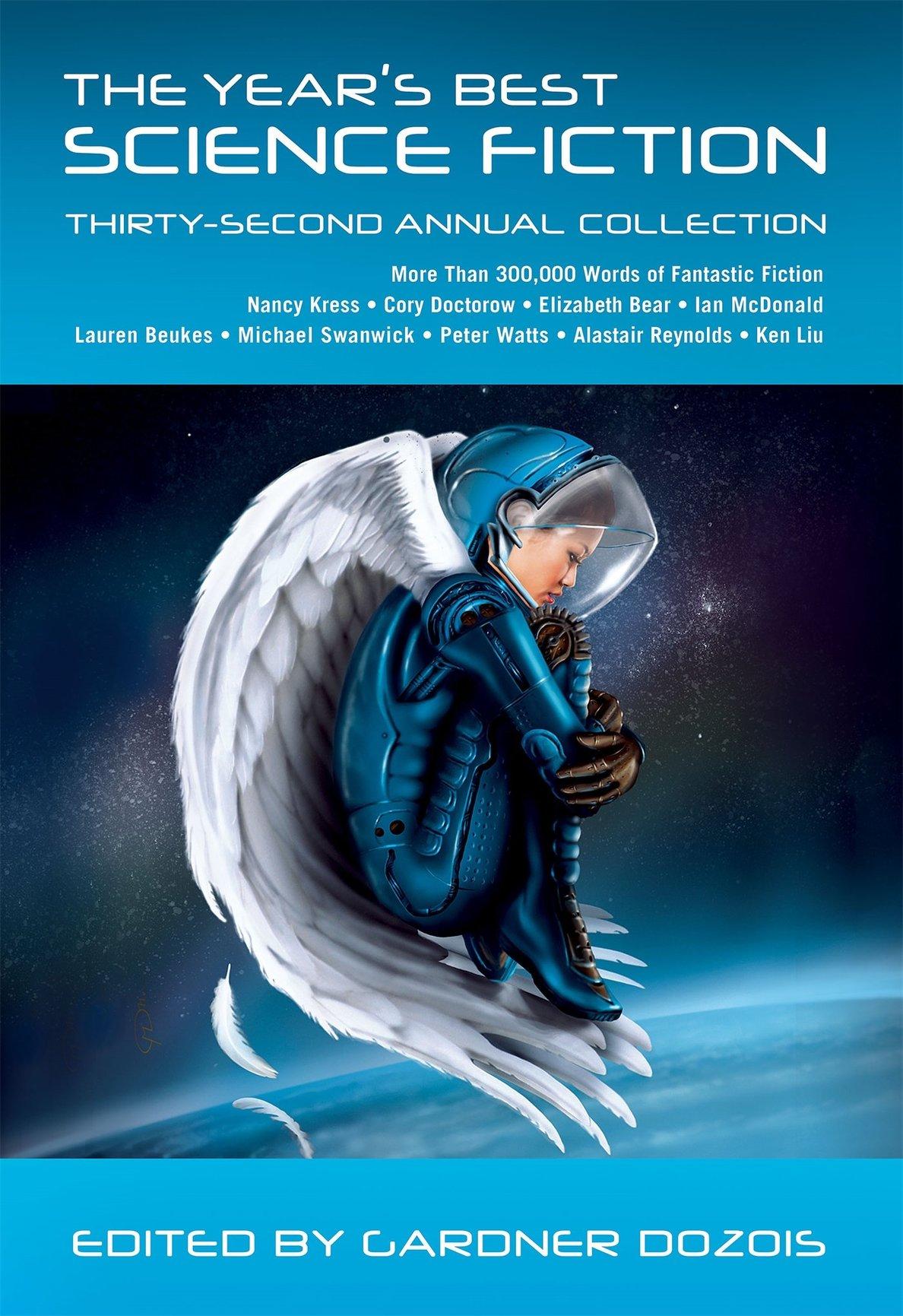
The Year's Best Science Fiction Thirty-Second Annual Collection-smallThere are roughly ten Year’s Best volumes currently being published in the speculative fiction market, but they all bow before Gardner Dozois’ The Year’s Best Science Fiction. The Thirty-Second volume in this venerable series will be published in July.

Now, believe it or not, there were Year’s Best series before Gardner. Everett F Bleiler and T.E Dikty edited the first volume of The Best Science Fiction Stories way back in 1949 (I know, right? Who knew there was good science fiction in those days!) Judith Merril edited twelve volumes of The Year’s Greatest Science Fiction and Fantasy (1956-1967), while Donald Wollheim, Terry Carr, Lin Carter, Arthur Saha, Harry Harrison and Brian Aldis, and Lester del Rey all tried their hand at it for a while, with varying success. Gardner Dozois edited the Del Rey series, taking over from Lester del Rey, from 1977-81, until starting over again with The Year’s Best Science Fiction: First Annual Collection in 1984 (There’s a nice summary of all this history in Scott Laz’s review of that very first volume here.)

Gardner’s The Year’s Best Science Fiction was exceptional right from the very beginning. For one thing, most prior books — even market leaders like Terry Carr’s The Best Science Fiction of the Year — were slender paperback originals. With his first volume Gardner delivered a massive 575-page hardcover, packed with 25 stories — including a couple of novellas, like Dan Simmons’ knockout “Carrion Comfort.”

He also began what quickly became one of the most-read columns in the entire industry: his lengthy, frank, and often highly opinionated annual summation, covering news, magazines, anthologies, movies, deaths, awards, the birth and growth of fan websites, podcasts, and much more. His first one in 1984 was a thin 17 pages, but over the decades Gardner’s comprehensive report card on the field grew to nearly 100 pages. I, for one, read them cover-to-cover.

Read More Read More

Self-published Book Reviews: The Severed Oath by Andrew J. Luther

Self-published Book Reviews: The Severed Oath by Andrew J. Luther

If you have a book you’d like me to review, please see the submission guidelines here

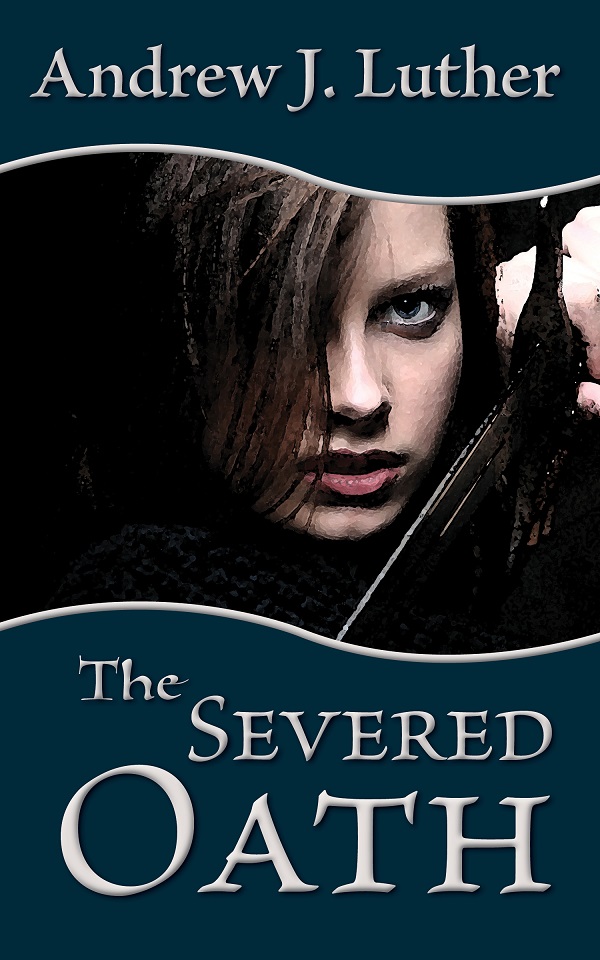
Severed-Oath-coverThe Severed Oath is the second book of The Undying Empire series by Andrew J. Luther, of which three novels are now available. However, the three work as standalone novels, so I’m only reviewing The Severed Oath here.

Leyndra is a Guild-trained Warden, a bodyguard given mystical abilities in order to protect her ward. She works for the nobleman Osho, a successful businessman for whom she has a high regard. Despite Osho’s wife’s, Tyina’s, suspicions, there is nothing romantic about their relationship—Leyndra is a professional, and her affection for Osho is, at most, sisterly.

Leyndra’s situation is contentious, but safe, until someone sends shadows to attack Osho in his sleep. Despite Leyndra’s skill and powers, she is tricked into seeing shadows where Osho stands, and it is her sword that ends his life. She is immediately branded as an Oathbreaker as the magic of the Guild marks her face, and hauled off to prison, first by the Watch, and then by the Imperial Guard. Planted evidence confirms her guilt, though she tells the true story even under torture. Even if the Emperor believed her innocent, the only ones in the city of Ythis capable of such magic are the sorcerous Five or the church of the mad god, and the Emperor does not dare confront either of them directly. So Leyndra is sentenced to be executed.

Read More Read More

Vengeful Specters, Vampires, and Monster Worms: Night Terrors: The Ghost Stories of E.F. Benson

Vengeful Specters, Vampires, and Monster Worms: Night Terrors: The Ghost Stories of E.F. Benson

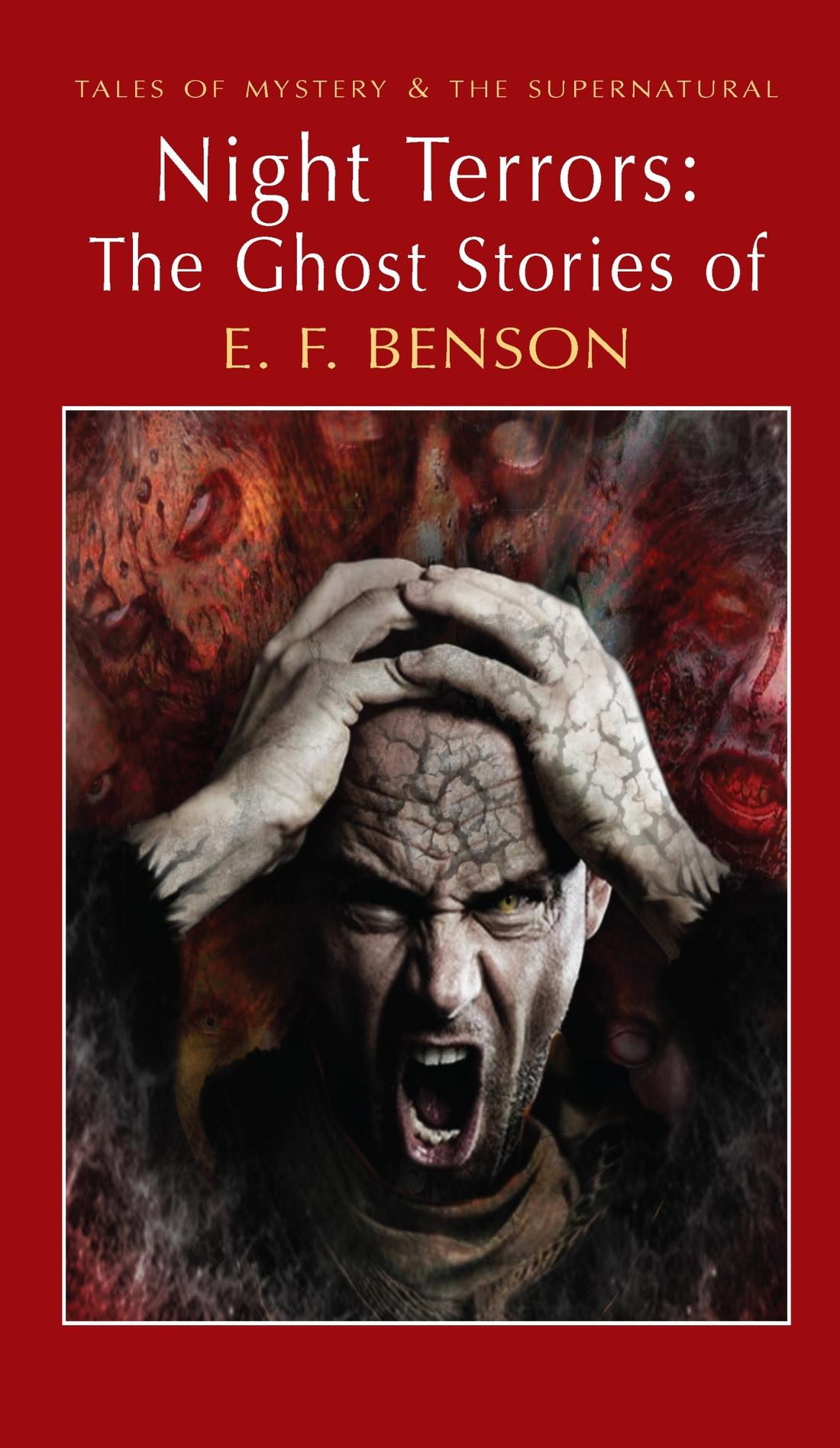
Night Terrors the Ghost Stories of E.F. Benson-smallWordsworth’s Tales of Mystery And The Supernatural volumes (or, as we like to call them, TOMAToS) have been a virtual graduate course in British horror for me, introducing me to a host of classic Nineteenth and Twentieth Century ghost story and supernatural fiction writers. But I have to admit I was a little relieved to come across Night Terrors: The Ghost Stories of E.F. Benson, since at least I’ve heard of E.F. Benson.

Benson (July 24, 1867 – February 29, 1940) was an English archaeologist and novelist who published over 60 novels between 1883 and 1934. Today he is chiefly remembered for his ghost stories, collected in The Room in the Tower and Other Stories (1912), Visible and Invisible (1923), The Horror Horn (1923), Spook Stories (1928), and Old London (1937), among others.

Unlike many of the subjects of the Wordsworth collections — who’ve been sadly neglected by modern readers — Benson is still fondly remembered. His work has seen many modern collections, including the Panther edition of The Horror Horn (1974), Desirable Residences and Other Stories (1991), The Collected Ghost Stories of E. F. Benson (1992), Fine Feathers and Other Stories (1994), and the five-volume The Collected Spook Stories from Ash-Tree Press (1998 – 2005), which collects all of his supernatural fiction.

H.P. Lovecraft thought highly of Benson’s work, especially “The Horror-Horn,” “The Man Who Went Too Far,” and “The Face,” calling him an important contributor to the weird short story. If you’re interested in a nice one-volume introduction to his work Night Terrors is an excellent option. It collects 54 of his best-known stories, and an introduction by David Stuart Davies, in a handsome and economical 718-page paperback.

Read More Read More

New Treasures: The Uncanny Reader: Stories from the Shadows edited by Marjorie Sandor

New Treasures: The Uncanny Reader: Stories from the Shadows edited by Marjorie Sandor

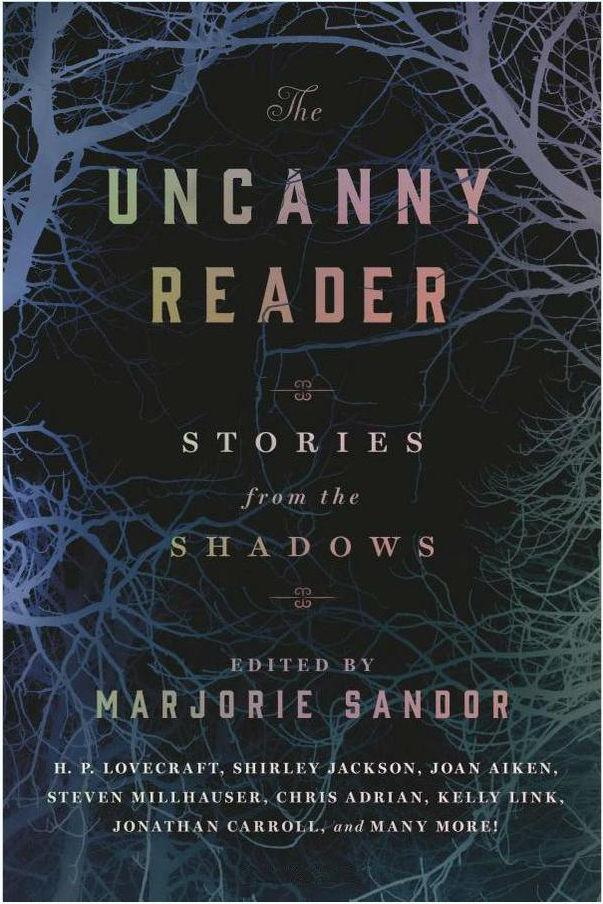
The Uncanny Reader-smallI’ve covered a handful of vintage horror anthologies recently, including Horrors in Hiding and Horrors Unseen. Those books arose out of the American pulp tradition, and include stories from the writers you’d expect.

But what if you’re looking for writers you don’t expect? What if you’re interested in uncanny fiction by some of the best writers from around the world? If that’s the case, then Marjorie Sandor may have what you’re looking for, with a generous new collection of classic and new horror fiction from the four corners of the globe.

Strange, Mysterious and Unsettling… These Stories Are Uncanny!

From the deeply unsettling to the possibly supernatural, these thirty-one border-crossing stories from around the world explore the uncanny in literature, and delve into our increasingly unstable sense of self, home, and planet. The Uncanny Reader: Stories from the Shadows opens with “The Sand-man,” E.T.A. Hoffmann’s 1817 tale of doppelgangers and automatons — a tale that inspired generations of writers and thinkers to come. Stories by 19th and 20th century masters of the uncanny — including Edgar Allan Poe, Franz Kafka, and Shirley Jackson — form a foundation for sixteen award-winning contemporary authors, established and new, whose work blurs the boundaries between the familiar and the unknown. These writers come from Egypt, France, Germany, Japan, Poland, Russia, Scotland, England, Sweden, the United States, Uruguay, and Zambia — although their birthplaces are not always the terrains they plumb in their stories, nor do they confine themselves to their own eras. Contemporary authors include: Chris Adrian, Aimee Bender, Kate Bernheimer, Jean-Christophe Duchon-Doris, Mansoura Ez-Eldin, Jonathon Carroll, John Herdman, Kelly Link, Steven Millhauser, Joyce Carol Oates, Yoko Ogawa, Dean Paschal, Karen Russell, Namwali Serpell, Steve Stern and Karen Tidbeck.

The Uncanny Reader: Stories from the Shadows was published on February 24, 2015 by St. Martin’s Griffin. It is 576 pages, priced at $21.99 in trade paperback and $9.99 for the digital edition.

Vintage Treasures: Science Fiction: The Great Years, Volume II edited by Carol and Frederik Pohl

Vintage Treasures: Science Fiction: The Great Years, Volume II edited by Carol and Frederik Pohl

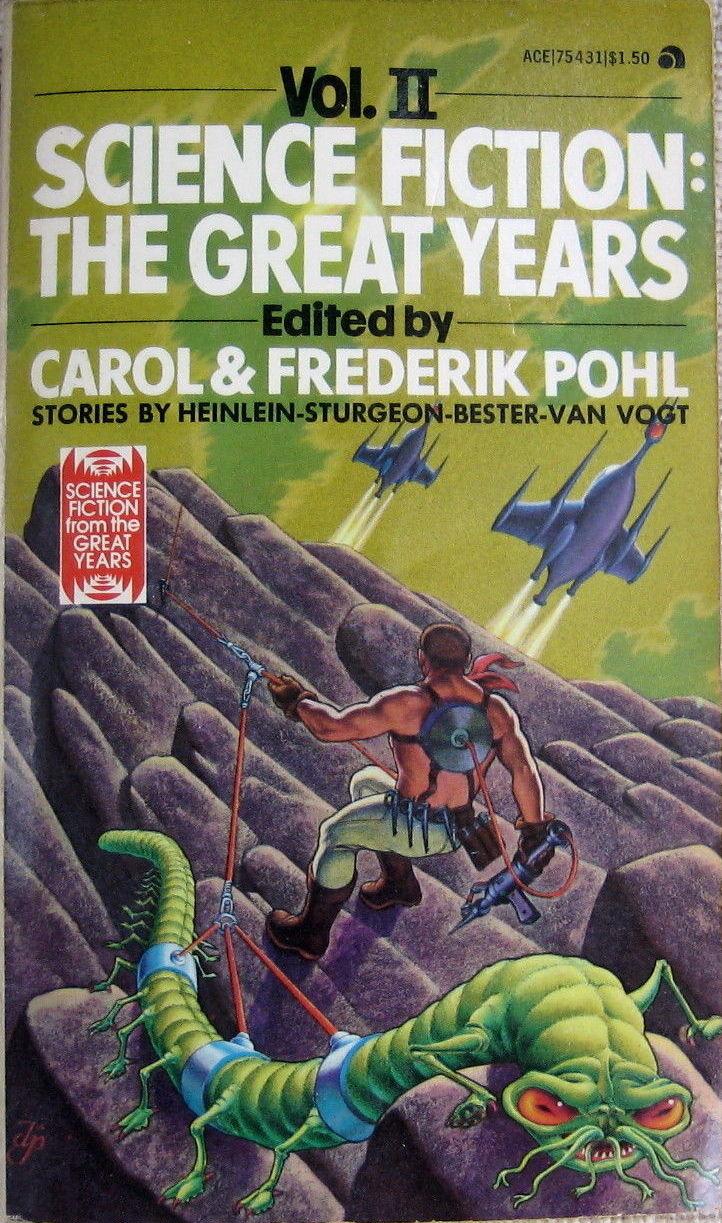
Science Fiction The Great Years Volume II-smallI think it’s kind of cool that I can remember when and where I found Science Fiction: The Great Years, Volume II, some 36 years after I bought it.

In the spring of 1976 my friend John MacMaster introduced me to science fiction, by bringing me Shakespeare’s Planet by Clifford D. Simak and Piers Anthony’s Ox when I was home sick from school. I was in the seventh grade, and I felt very adult, reading grown up books instead of Alfred Hitchcock and the Three Investigators (not that there’s anything wrong with Alfred Hitchcock and the Three Investigators — those books rule.)

I was thoroughly captivated by both novels, and afterwards began looking for anything labeled “science fiction.” One of the first items I found was Jacques Sadoul’s 2000 A.D: Illustrations From the Golden Age of Science Fiction Pulps, a dazzling art book containing hundreds of illustrations from American SF and fantasy pulps — showing stalwart men and women piloting spaceships into the dark reaches of space, curious aliens, sinister robots, mist-covered landscapes on far planets, and stranger things. It ignited a burning curiosity in me for all things pulp-related, and I began to haunt bookstores looking for any relics of that bygone era of pulp SF.

Shortly after we moved to Ottawa in 1976, I discovered that Canada’s capital was crowded with old bookstores, many of them hidden away in small shops on Bank Street and Sparks Street in the heart of downtown. I took the bus downtown every Saturday, returning home with bags filled with marvelous old paperbacks. It was in those crowded old shops that I first discovered Roger Zelazny, Robert Silverberg, Poul Anderson, H.P. Lovecraft, A. Merritt, and countless others.

Read More Read More

Future Treasures: Of Noble Family by Mary Robinette Kowal

Future Treasures: Of Noble Family by Mary Robinette Kowal

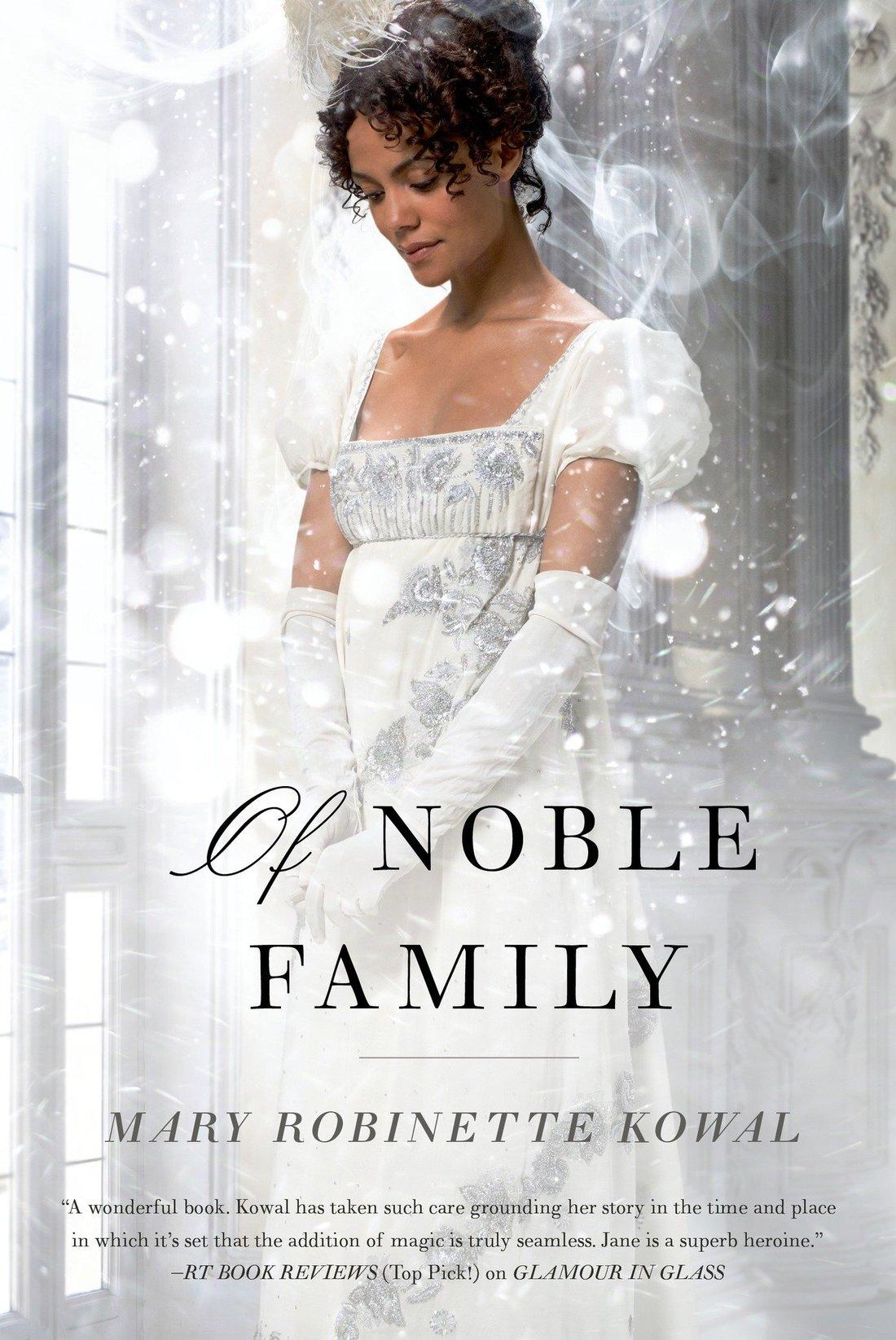
Of Noble Family-smallOf Noble Family, the fifth and final novel in Mary Robinette Kowal’s popular Glamourist Histories, is due to arrive later this month.

The first novel, Shades of Milk and Honey, was nominated for a Nebula Award. The previous four books in the series are:

Shades of Milk and Honey (2010)
Glamour in Glass(2012)
Without a Summer (2013)
Valour and Vanity (2014)

I had the good fortune to hear Mary read from Valour and Vanity at Capricon last year, where she talked about the effort involved in ensuring the language in these novels is appropriate for the time — including creating a Jane Austen dictionary, and making heavy use of the Oxford historical concordance, which lists words in the order in which they appeared in the English language.

Mary is also a high-profile author here in Chicago, and I first met Wesley Chu at the launch party for Without a Summer in 2013.

Here’s the description for Of Noble Family.

Read More Read More

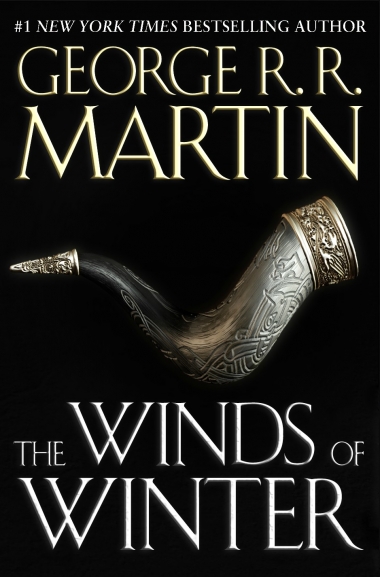
George R.R. Martin Offers a New Excerpt from The Winds of Winter

George R.R. Martin Offers a New Excerpt from The Winds of Winter

Martin The Winds of Winter-smallBack in January we reported that The Winds of Winter, the sixth book in George R.R. Martin’s epic Song of Ice and Fire series, will not arrive this year, as some readers had hoped.

But to soothe the pain a little, Martin has been releasing small bits from the novel at his website. This morning he offered up a brand new chapter, featuring the return of a character who’s been absent for a long time. Here’s a small sample.

Alayne loved it here. She felt alive again, for the first since her father… since Lord Eddard Stark had died.

She closed the window, gathered up the fallen papers, and stacked them on the table. One was a list of the competitors. Four-and-sixty knights had been invited to vie for places amongst Lord Robert Arryn’s new Brotherhood of Winged Knights, and four­ and-sixty knights had come to tilt for the right to wear falcon’s wings upon their warhelms and guard their lord.

The competitors came from all over the Vale, from the mountain valleys and the coast, from Gulltown and the Bloody Gate, even the Three Sisters. Though a few were promised, only three were wed; the eight victors would be expected to spend the next three years at Lord Robert’s side, as his own personal guard (Alayne had suggested seven, like the Kingsguard, but Sweetrobin had insisted that he must have more knights than King Tommen), so older men with wives and children had not been invited.

And they came, Alayne thought proudly. They all came.

Read the complete chapter here, and the lengthy summary of everything we know about the novel so far over at Tor.com.

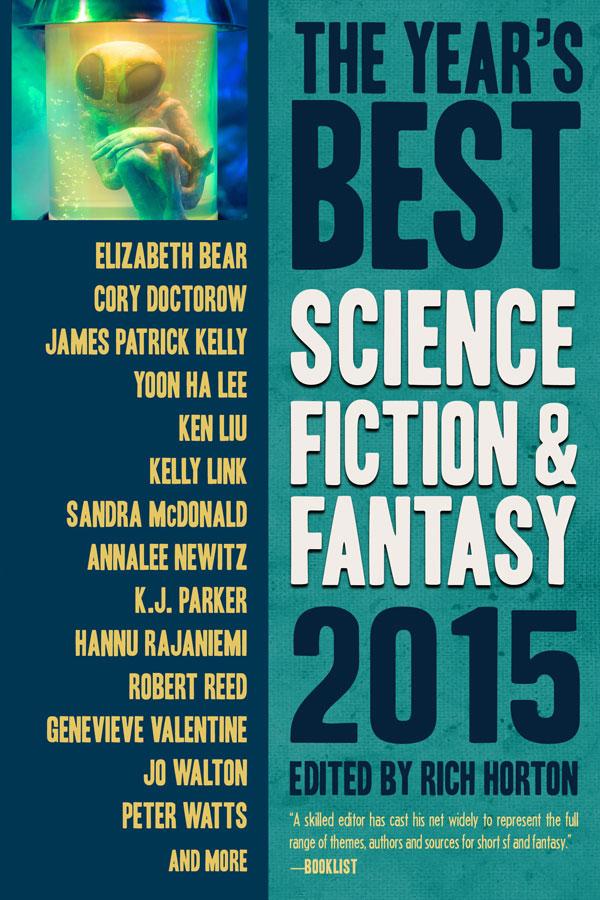
See the Table of Contents for The Year’s Best Science Fiction & Fantasy 2015, edited by Rich Horton

See the Table of Contents for The Year’s Best Science Fiction & Fantasy 2015, edited by Rich Horton

The Year's Best Science Fiction & Fantasy 2015-smallLast month Prime Books announced the Table of Contents of my favorite Year’s Best book, Rich Horton’s The Year’s Best Science Fiction & Fantasy 2015.

This is the seventh volume, and it looks like another stellar line-up, with 34 stories from the leading print magazines (Asimov’s SF, Interzone, Analog, F&SF, and others), online publications (Clarkesworld, Lightspeed, Beneath Ceaseless Skies, and more) and anthologies (Fearsome Magics, Reach for Infinity, Rogues, and Solaris Rising 3, among others).

Authors include Kelly Link, Robert Reed, James Patrick Kelly, Alexander Jablokov, K. J. Parker, Ken Liu, Genevieve Valentine, Eleanor Arnason, Cory Doctorow, Peter Watts, and many, many others.

I was also very pleased to see two Black Gate contributors made the list: Saturday blogger Derek Künsken, with his Asimov’s tale “Schools of Clay,” and website editor emeritus C. S. E. Cooney, for her story “Witch, Beast, Saint: An Erotic Fairy Tale,” from Strange Horizons.

The Year’s Best Science Fiction & Fantasy 2015 is a fat 576 pages, and goes on sale in trade paperback from Prime Books in June.

Here’s the complete Table of Contents.

Read More Read More

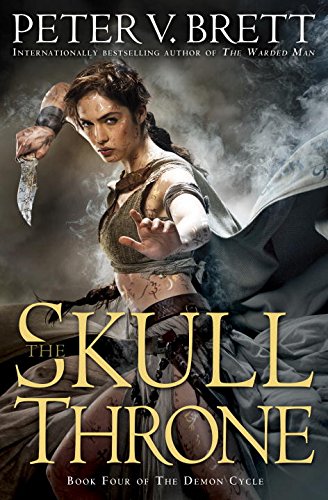
New Treasures: The Skull Throne by Peter V. Brett

New Treasures: The Skull Throne by Peter V. Brett

The Skull Throne Peter V Brett-smallThe Warded Man, the first novel in Peter V. Brett’s Demon Cycle series, was released in March 2009. His second, The Desert Spear (March 2010), became an international bestseller, and the third, The Daylight War, followed in February 2013. Now the fourth book in the series, The Skull Throne, has been released this week.

The Skull Throne of Krasia stands empty.

Built from the skulls of fallen generals and demon princes, it is a seat of honor and ancient, powerful magic, keeping the demon corelings at bay. From atop the throne, Ahmann Jardir was meant to conquer the known world, forging its isolated peoples into a unified army to rise up and end the demon war once and for all.

But Arlen Bales, the Warded Man, stood against this course, challenging Jardir to a duel he could not in honor refuse. Rather than risk defeat, Arlen cast them both from a precipice, leaving the world without a savior, and opening a struggle for succession that threatens to tear the Free Cities of Thesa apart.

In the south, Inevera, Jardir’s first wife, must find a way to keep their sons from killing one another and plunging their people into civil war as they strive for glory enough to make a claim on the throne. In the north, Leesha Paper and Rojer Inn struggle to forge an alliance between the duchies of Angiers and Miln against the Krasians before it is too late. Caught in the crossfire is the duchy of Lakton — rich and unprotected, ripe for conquest.

All the while, the corelings have been growing stronger, and without Arlen and Jardir there may be none strong enough to stop them. Only Renna Bales may know more about the fate of the missing men, but she, too, has disappeared…

The fifth (and final?) book in the series, The Core, does not yet have a release date. The Skull Throne was published by Del Rey on March 31, 2015. It is 704 pages, priced at $28 in hardcover and $12.99 for the digital version. Read the first chapter here.