Browsed by
Category: Blog Entry

Feathers on the Waves

Feathers on the Waves

491px-the_lament_for_icarus. . . And the boy thought,
This is wonderful! and left his father,
Soared higher, higher, drawn to the vast heaven,
Nearer the sun, and the wax that held the wings
Melted in that fierce heat, and the bare arms
Beat up and down in air, and lacking oarage
Took hold of nothing. Father! he cried, and Father!
Until the blue sea hushed him, the dark water
Men call Icarian now. And Daedalus,
Father no more, called “Icarus, where are you!
Where are you, Icarus? Tell me where to find you!”
And saw the wings on the waves, and cursed his talents,
Buried the body in a tomb, and the land
Was named for Icarus.

—Ovid, Metamorphoses Book VIII

Where does the love of fantasy, and of storytelling, start? For every person it’s different, of course. For me it begins with feathers on the waves.

Those feathers, the remains of Icarus’s joyful but tragic flight toward the sun when he forgot his father’s warnings, are specific for me. But the broad world of the tales of the Greeks and Romans are a gateway for many people into fantasy. Whether it started with the Minotaur, the war at Troy, the labors of Heracles, Bellerophon on Pegasus against the Chimaera, or Perseus and Medusa, the Greek’s ancient religion and the poets whose writing let it survive have introduced countless readers to the fantastic and the greatness it can achieve.

I’ve often thought about the source of the power of the Greco-Roman legends, their heroes and the gods, and why they still have such enormous affect on us today, when no one worships them any more. They were even losing their grip on religious importance in the time of Ovid, one of the greatest tellers of their exploits. In the twenty-first century, the Iliad is no less an engrossing a story, the plays of Sophocles can still ensnare an audience, and even Hesiod can infuse a sense of wonder in a modern reader as he writes about the beginnings of all things.

Read More Read More

A slash version of Charlies Angels: A review of Bitch Slap

A slash version of Charlies Angels: A review of Bitch Slap

b-slap11Bitch Slap the (unrated) film relates to fantasy fiction how, you may ask?
The cast includes Lucy Lawless (Xena), Kevin Sorbo and Michael Hurst (Hercules).  Fictionmags chum and fantasy novelist Damien Broderick passed along the intelligence back in December ’08 that the husband of a friend of his had a hand in making the film. Don’t know if it ever made the theaters, but it’s now out on DVD.

The box art has the three generously proportioned leading ladies in costume: short spandex gold-lame dress/black skirt & fishnets/low-rise jeans, stage-center. Hey, what’s not to like going in? Most of the viewer reviews on Netflix and Blockbuster panned it. The remaining 10% seemed to really like it.

I confess I liked it. It’s intentionally trashy, but it seems we haven’t had a good trashy girl-fight film since Faster Pussycat, Kill Kill.

Australian Shakespearian actor Michael Hurst is Gage, a scumbag dealer in high-priced stolen goods who has acquired at least one item of interest to each of the three kick-ass babes who, early in the film, get very medieval on him.

Read More Read More

A review of The Woman Who Loved Reindeer, by Meredith Ann Pierce
A review of The Woman Who Loved Reindeer, by Meredith Ann Pierce

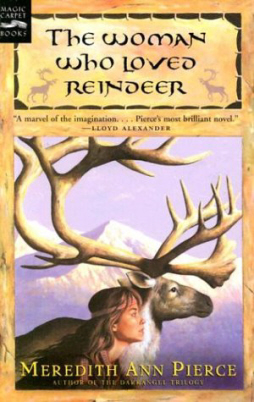
reindeer1The Woman Who Loved Reindeer, by Meredith Ann Pierce
Magic Carpet Books (256 pages, $5.95, May 2000)

To begin with, I should tell you that I adore Meredith Ann Pierce’s writing. It has a sense of fairy tale about it, a simple yet otherworldly quality. I will happily read anything she’s written and recommend it to others.

Nevertheless, I have to say that The Woman Who Loved Reindeer might push some peoples buttons for reasons that have nothing to do with the high-quality prose.

Caribou is an isolated girl of thirteen or so, living away from her people because of her true dreams and possible magic. Then her sister-in-law unceremoniously gives her a baby to care for. Although Caribou resents the request — the sister-in-law admits that the baby isn’t her husband’s — an obscure impulse makes her accept the child. And then her life starts to get both richer and stranger.

The child — Caribou names him Reindeer — is not entirely human. When he’s still a baby, a golden reindeer nearly takes him away. As he grows, Caribou dreams of him as a reindeer calf and notices that he casts a reindeer’s reflection in the water. Also, he doesn’t entirely comprehend human emotion. He’s a trangl, a shapeshifter who turns into a reindeer, a being that Caribou’s culture fears as essentially untrustworthy — a view that’s not entirely unfounded, since Reindeer seems to have a limited capacity for empathy.

Read More Read More

Saints and Shrieks: Jeff VanderMeer’s Ambergris Fiction

Saints and Shrieks: Jeff VanderMeer’s Ambergris Fiction

City of Saints and MadmenI don’t know what makes a novel great. Maybe every great book is great in its own way. I suspect, though, that a novel’s greatness resides most often either in its structure (not just its plot, but its balancing of themes and elements, its division into units like chapters, and its decision of what to describe and when) or its prose (its ability to make every word count, not only in depicting character and setting, not only in moving forward story, but in advancing the theme of the book, what it’s about, the idea that prompted the telling of the tale in the first place).

I suspect also that truly great novels fuse the two things, so that stylistic choices are an outgrowth of structure, while structural elements are visible in the voices the story uses. And all these things are always surprising the reader, even while making perfect sense.

Which brings me to Jeff VanderMeer, and his three novels of the fictional city of Ambergris: City of Saints and Madmen, Shriek: An Afterword, and Finch.

This is not a typical trilogy. The three books are very different from each other in both style and structure, although they do have some themes and characters in common. Chiefly, they have Ambergris in common.

Ambergris is a strange place, a baroque metropolis defined by wars between sprawling merchant houses, the orgiastic annual celebration of the Festival of the Freshwater Squid, and a mostly-subterranean nonhuman race called Grey Caps. The city changes over the course of the books — its technology shifts, its social structure is altered — but then the way we see the city changes as well.

Read More Read More

Whither the Bookstore?

Whither the Bookstore?

bn_logo2Following up on John’s post (and subsequent discussion) concerning the predicament of Barnes and Noble, which seems to be getting a taste of its own medicine as e-books and online book buying may relegate the superstore concept as nostalgic as the local independent book dealer, is this article from The New York Times. What’s interesting is the prediction that despite the growing acceptance of reading on handheld screens and website ordering, surviving independent stores may still flourish because of their personalized service to niche customers.

thin21Makes sense. Every time I go into an independent bookstore, I feel compelled to buy something even if I already have to many books I haven’t read yet, much less that I could get the book cheaper online (or even at Barnes and Noble). One reason I like to support these guys is that there’s something very attractive about “non-chain store” shopping, where owners have put their own individual stamp on the presentation and perusal of their wares.

True, they may not be as deep stocked as B&N (or at least used to be).  But, funny how the books they do carry in the fiction section are almost exactly the kinds of things I’m interested in.

To give B&N its due, though, I always thought it conveyed more a sense of a traditional bookshop than its much more troubled competitor, Borders. (Gone into one lately?  It’s like Waldenbooks on steroids, meaning appealing to the lowest common denominator is even more depressing when it’s bloated with stationary and puzzles).  And the people who worked there do seem to be knowledgeable and enthusiastic about books, unlike some of the clueless clerks you might find in a mall record store (do they still have those?).

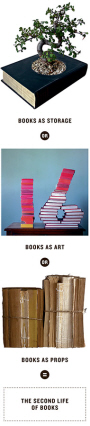
As for what will happen to the physical book once we’re all reading on our Kindles or iPads or inner eyelid digital display inlays, check out this article by Rob Walker, also from theTimes.  I particularly like the idea of using an old discarded book to house your Kindle. And that someone could actually sell it for $25.

See, all those books bending your bookshelves do have some future value.  Get ’em while you can.

Robert E. Howard: Anatomy of a Creative Crisis

Robert E. Howard: Anatomy of a Creative Crisis

kull-a“Beyond the Sunrise” is the unofficial title afforded an unfinished Kull story that did not see print until over forty years after the author’s death. Its significance is due largely to the fact that it was the first of four widely differing attempts to continue the Kull series following the publication of both “The Shadow Kingdom” and “The Mirrors of Tuzun Thune” in Weird Tales in 1929.
Robert E. Howard starts the story off with a bored Kull sitting on his throne listening to a rather dull tale of the Valusian noblewoman, Lala-ah who has run off with her foreign lover leaving the nobleman she was promised to waiting at the altar. The barbarian king’s pride is piqued once he learns the foreigner insulted him behind his back. He then readily agrees to lead a posse to retrieve the noblewoman and restore his and his nation’s honor.

I was about as enthusiastic as Kull when I first started the story and thought the Atlantean was acting like a childish oaf for getting his nose out of joint just because a foreigner called him a sissy when he wasn’t around to defend himself.

Read More Read More

Climbing Aboard the Dragon: Ten Things I Know Now…

Climbing Aboard the Dragon: Ten Things I Know Now…

Don’t bother just to be better than your contemporaries or predecessors. Try to be better than yourself.
— William Faulkner

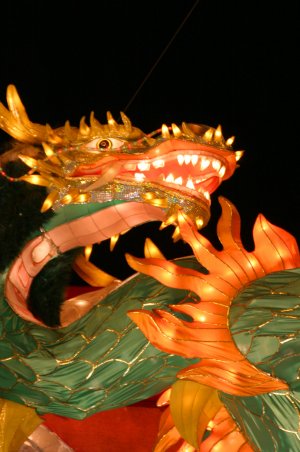
CHINA TOWN, NAGASAKI, JAPAN by June OkaBecause this series about riding about the dragon called Publishing is geared at writers just starting out writing fantasy stories and novels, I thought I’d pull together another list (I love lists!) that include all the helpful stuff I wish I’d known back in 1995, when I was just starting out.
Ten Things I Know Now That I Wish I’d Known When I First Started

YOUR FAVORITE STORY OR NOVEL THAT YOU’VE EVER WRITTEN SHOULD BE THE ONE YOU’RE WORKING ON RIGHT NOW.  Enthusiasm for your current project is priceless, in my opinion, and you should never rest on your laurels.  Always try to improve yourself as a writer, just like an athlete or musician always works to get better for the next big game or performance.

Read More Read More

Goth Chick News: The Woman in Black

Goth Chick News: The Woman in Black

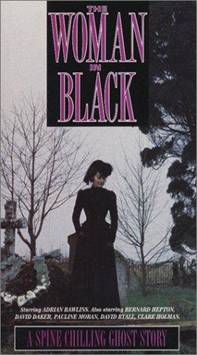
image0041Anyone who has been reading these entries with any regularity knows that the word “minimalist” will never be used in the same sentence with my name. I seem to be visually starved, needing to be perpetually surrounded by interesting if not strange things to look at. This can easily be proven by the fact I cohabitate with a voodoo doll collection and three German Shepherds.
Maybe that’s why I’ve always been drawn to Halloween.

I mean, you’ve probably heard people comment on over-the-top Christmas decorations, but I doubt you’ve heard anything but awe-struck admiration for someone who’s gone nutty with their front yard zombie display.

Or maybe my neighbors are just trying to be nice.

In any case, it’s rather odd for me to tell you that one of my all-time-favorite books, which then made it to the top of my theater list — and will eventually, I hope,  make it to my top ten movie list — is anything but visually cluttered. Speaking at least for the book and the play, The Woman in Black derives its horror from its simplicity, and that’s really what a classic fright is about, isn’t it? It’s why no blood-splattered, psychopath training film like Saw or Hostel will ever be as scary as the scare that gets in your head.

Back in 1983, author Susan Hill wrote the tale of a young lawyer summoned to settle the affairs of the deceased Alice Drablow, who had lived on a remote English estate cut off from the mainland during high tide (sounds awesome so far, right?) As he pieces together Alice’s tragic life, the lawyer begins to uncover a tragic family secret and its horrifying guardian, the Woman in Black. It’s a premise just simple enough to make your skin crawl.

Read More Read More

ON WRITING FANTASY: Character Is King

ON WRITING FANTASY: Character Is King

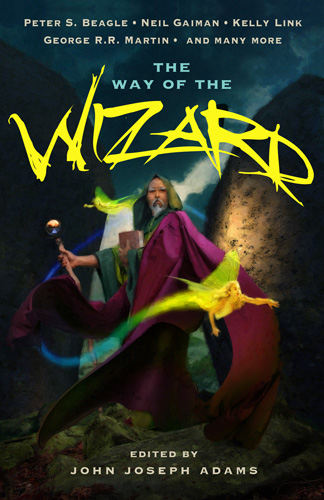
wayofthewizard2
My wizard story "The Thirteen Texts of Arthyria" appears in THE WAY OF THE WIZARD, coming from Prime Books in November.

“A character is not a simulation of a living being.
It is an imaginary being. An experimental self.”
— Milan Kundera

“Each character is a piece of the writer and
the writer’s experience of other human beings, and also a piece of the reader and
the reader’s parallel experience.”
— William Sloane

 “The job boils down to two things: paying attention to how the real people around you behave and then telling the truth
about what you see.”
— Stephen King

What a character!

This fourth installment of an ongoing series covers the role of “Character” in Fantasy Fiction. (Previous installments covered Originality, Style, and Plot.)

The heart and soul of any story are its characters. Every story, no matter what style or genre, is basically about PEOPLE. Even if these people are aliens, monsters, robots, or talking fish, they still have human personalities. Why? Because the people who write them are human. Therefore, all stories are stories about people, i.e. characters. If you don’t have believable, memorable characters, you’re not going to have a very good story.

Read More Read More

Pastiches ‘R’ Us: Conan of the Isles

Pastiches ‘R’ Us: Conan of the Isles

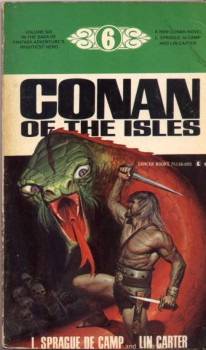
conan-of-the-isle-original-coverSo far in the entries of my informal tour through the Conan pastiches—with a great guest shot from Charles Saunders on Conan the Hero—I’ve focused entirely on the “Tor Era,” the longest and most sustained period of new novels about Robert E. Howard’s Hyborian Age hero. Because of the sheer volume of books in the Tor line, which ran uninterrupted from 1982 to 1997, as well as most readers’ and reviewers’ indifference toward them, the Tor Era provides fertile ground for fresh criticism. It contains a few gems as well among the factory-line production schedule.

But I’ve neglected the earlier Conan pastiches, from publishers Lancer (Sphere in the U.K., later Ace in the U.S.) and Ballantine. Before Tor started its Conan factory with Robert Jordan’s Conan the Invincible, the world of Conan pastiches rested mostly in the hands of two men: L. Sprague de Camp and Lin Carter. They filled in a “Conan Saga” that they had imagined through a constructed timeline, and this framework extended into the Tor Era as well, although turning more overstuffed and inconsistent as the books piled up and eventually the whole series put itself to sleep and Howard burst back into print.

One of the results of de Camp and Carter’s addenda to Conan’s history is the odd, uncharacteristic, yet hypnotically entertaining Conan of the Isles. Years ago I wrote a detailed review of this 1968 novel for a forum posting. I’ve pulled up that old review and done some dusting, revising, and re-thinking to present the first “Pastiches ‘R’ Us” installment that examines the controversial First Responders of the neo-Conan world.

Read More Read More