Browsed by
Category: Blog Entry

Art of the Genre: Orcus

Art of the Genre: Orcus

Sutherland keeps it 'real'

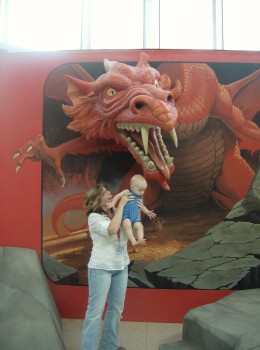
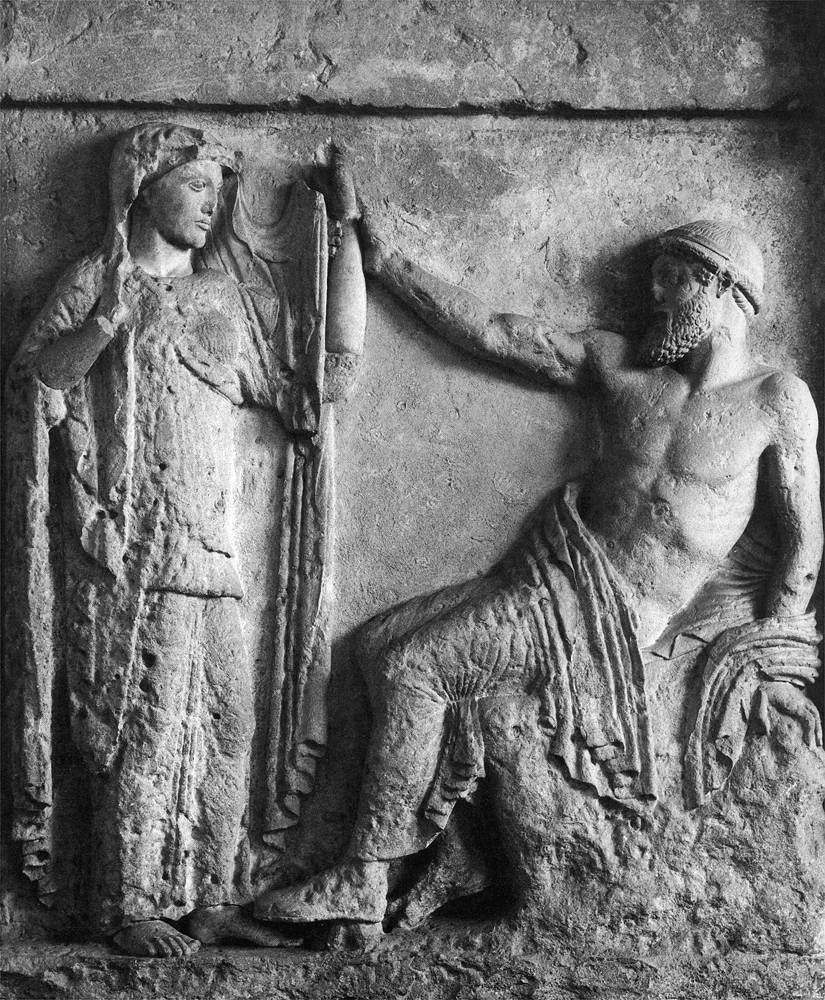
Orcus, Prince of the Undead. He’s an ancient legend, more so than any D&D text, but for the purpose of this article I’m going address the Gygaxian version and not the Etruscan.

Why Orcus? Well, because I’m upset with Orcus, that’s why. I feel like the big fella let me down. Once, back in the long, long, ago, I got the original AD&D Monster Manual, and in those pages I found the section on Demons and was captivated by it.

Here stood the tentacle-armed Demogorgon, and slime-spurting Juiblex, and the flail-wielding Yeenoghu, Demon Lord of Gnolls, but of all of them, Orcus jumped out into my imagination because he was so drastically different.

Orcus was this fat demon with a wand [I mean really, what self-respecting demon lord carries a wand?] He had the cloven hooves and legs of a goat, a beer belly, and the head of a ram. He wasn’t cool, or epic, and certainly wasn’t someone who would fill you with fear, but the reality in his visage gave me pause.

Simple but effective, I promise

Read More Read More

Andrew Zimmerman Jones Reviews Pathfinder Supplements

Andrew Zimmerman Jones Reviews Pathfinder Supplements

pathfinder_rpg_core_rulebook_coverPaizo publishing’s Pathfinder RPG is both familiar and innovative, as it brings the best of Dungeons & Dragons 3.5 into a fresh new approach. In this review, I explore the core rulebook and a couple of their supplements, explaining why you should look into the game system if you haven’t already.

Pathfinder Roleplaying Game: Core Rulebook

Jason Bulmahn
Paizo Publishing (575 pages, $49.99, Aug. 2009)

Pathfinder Module: Crypt of the Everflame

Jason Bulmahn
Paizo Publishing (32 pages, $13.99, Sept. 2009)

Pathfinder Adventure Path #25: Council of Thieves (1 of 6): The Bastards of Erebus

Edited by Sean K. Reynolds
Paizo Publishing (92 pages, $19.99, Aug. 2009)

Reviewed by Andrew Zimmerman Jones

Your first look at the massive tome that is the Pathfinder Roleplaying Game: Core Rulebook can be a bit intimidating. I first ran across it piled high on a mountainous table at GenCon’s Paizo Publishing booth in summer 2009 and, I admit, I wasn’t even sure what it was. Yet another fantasy roleplaying game? Elves, dwarves, and halflings? It sure didn’t seem worth much attention, and I didn’t really get what all the hype was about.

Then I realized what it was… this was my old mistress, Dungeons & Dragons v3.5, all dressed up in a new outfit and ready to go out on the town again.

Read More Read More

. . . (ellipsis)

. . . (ellipsis)

ellipsisMoving on from the em dash (—), my series on punctuation continues with a post guaranteed to leave you hanging.

The ellipsis, a.k.a. “those dots in a row,” are perhaps the most mysterious of the common forms of punctuation. The mystery begins in childhood, probably during a viewing of one of the Star Wars films, where a strange line of periods give the feeling of floating off into the story as the opening prologue crawl comes to an end. . . .

But it is not an end . . . because of those dots. . . . What do they do, anyway? How do I use them?

Well……….not like this……….

That was the first rule of ellipis (pl. ellipses) that I had to learn: how many of those damn dots are there supposed to be? To look at most Internet forums posts, where the ellipsis is more common than the word “the,” it would appear that some people have never learned the correct number of dots and instead lean on the period key and watch it repeat until they reach a level of satisfaction.

Read More Read More

Black Gate 15 Complete Table of Contents

Black Gate 15 Complete Table of Contents

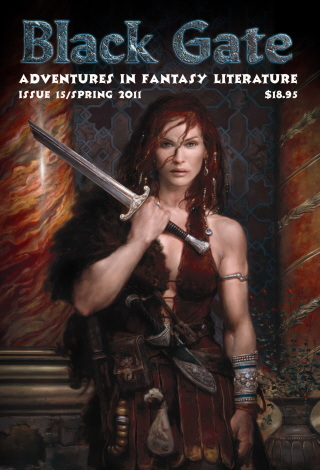
bg-15-cover2The theme of our massive 15th issue, captured beautifully by Donato Giancola’s striking cover, is Warrior Women. Eight authors — Jonathan L. Howard, Maria V. Snyder, Frederic S. Durbin, Sarah Avery, Paula R. Stiles, Emily Mah, S. Hutson Blount, and Brian Dolton — contribute delightful tales of female warriors, wizards, weather witches, thieves, and other brave women as they face deadly tombs, sinister gods, unquiet ghosts, and much more.

Frederic S. Durbin takes us to a far land where two dueling gods pit their champions against each other in a deadly race to the World’s End. Brian Dolton offers us a tale of Ancient China, a beautiful occult investigator, and a very peculiar haunting. And Jonathan L. Howard returns to our pages with “The Shuttered Temple,” the sequel to “The Beautiful Corridor” from Black Gate 13, in which the resourceful thief Kyth must penetrate the secrets of a mysterious and very lethal temple.

What else is in BG 15? Howard Andrew Jones bring us a lengthy excerpt from his blockbuster novel The Desert of Souls, featuring the popular characters Dabir & Asim. Harry Connolly returns after too long an absence with “Eating Venom,” in which a desperate soldier faces a basilisk’s poison — and the treachery it brings. John C. Hocking begins a terrific new series with “A River Through Darkness & Light,” featuring a dedicated Archivist who leads a small band into a deadly desert tomb; John Fultz shares the twisted fate of a thief who dares fantastic dangers to steal rare spirits indeed in “The Vintages of Dream,” and Vaughn Heppner kicks off an exciting new sword & sorcery saga as a young warrior flees the spawn of a terrible god through the streets of an ancient city in “The Oracle of Gog.”

Plus fiction from Darrell Schweitzer, Jamie McEwan, Michael Livingston, Chris Willrich, Fraser Ronald, Derek Künsken, Jeremiah Tolbert, Nye Joell Hardy, and Rosamund Hodge!

In our generous non-fiction section, Mike Resnick educates us on the best in black & white fantasy cinema, Bud Webster turns his attention to the brilliant Tom Reamy in his Who? column on 20th Century fantasy authors, Scott Taylor challenges ten famous fantasy artists to share their vision of a single character in Art Evolution, and Rich Horton looks at the finest fantasy anthologies of the last 25 years. Plus over 30 pages of book, game, and DVD reviews, edited by Bill Ward, Howard Andrew Jones, and Andrew Zimmerman Jones — and a brand new Knights of the Dinner Table strip.

Buy this issue for only $18.95, or as part of bundle of back issues — any two for just $25 plus shipping!

Buy this issue in PDF for only $8.95!

Buy the Kindle version at Amazon.com for just $9.95!

Black Gate 15 is another huge issue: 384 pages of fiction, reviews, and articles. It contains 22 stories, totaling nearly 152,000 words of adventure fantasy. Complete details on all the contents after the jump.

Read More Read More

2011 Hugo Award Nominations Announced

2011 Hugo Award Nominations Announced

hundred-thousandThe nominees for the 2011 Hugo and Campbell awards for best science fiction and fantasy of the year have been announced. The nominees for best novel are:

  • Cryoburn, Lois McMaster Bujold (Baen)
  • Feed, Mira Grant (Orbit)
  • The Hundred Thousand Kingdoms, N.K. Jemisin (Orbit)
  • The Dervish House, Ian McDonald (Pyr; Gollancz)
  • Blackout/All Clear, Connie Willis (Spectra)

I was particularly pleased to see The Hundred Thousand Kingdoms on the list. I heard N.K. Jemisin read at Wiscon last year, and was extremely impressed. She’s one of the best new fantasy writers we have, and no mistake.

The nominees for Best Semiprozine were Clarkesworld, Interzone, Lightspeed, Locus, and Weird Tales — deserving titles, all. It was also a great year for Asimov’s Science Fiction, which had no less than five nominations in the short fiction categories:

  • “The Sultan of the Clouds,” Geoffrey A. Landis (Asimov’s 9/10) – Best Novella
  • “The Jaguar House, in Shadow,” Aliette de Bodard (Asimov’s 7/10) – Best Novelette
  • “Plus or Minus,” James Patrick Kelly (Asimov’s 12/10) – Best Novelette
  • “The Emperor of Mars,” Allen M. Steele (Asimov’s 6/10) – Best Novelette
  • “For Want of a Nail,” Mary Robinette Kowal (Asimov’s 12/10) – Best Short Story

As well as a nod to editor Sheila Williams as Best Professional Editor (Short Form). Special congratulations to Pyr editor Lou Anders on his nomination for Best Professional Editor Long Form (go Lou!), and to Black Gate contributor Steven H Silver, on his ninth nomination for Best Fan Writer.

And of course, special commendation to Hugo voters for nominating “F**k Me, Ray Bradbury” in the Best Dramatic Presentation – Short. You folks are classy.

The winners will be announced at the World Science Fiction convention in Reno, Nevada, on August 20, 2011. You can find the complete list of nominees at Locus Online. Congratulations to all the nominees!  Except maybe “F**k Me, Ray Bradbury.”

Supernatural Spotlight – Episode 6.18 “Frontierland”

Supernatural Spotlight – Episode 6.18 “Frontierland”

Sam (left) and Dean (right) go to the Old West.

The episode starts out on Sunrise, Wyoming, March 5, 1861, with a high-noon shootout duel on the street … and one of the participants is Dean Winchester. Right as they draw, the episode cuts to a revamped old-west-themed title sequence.

The next scene takes place 48 hours earlier (or 150 years later, depending on how you look at it), and the boys and Billy are cracking into the Campbell family’s hidden stash of demon-hunting lore, which is now free for the taking since Samuel died a couple of episodes back. It’s an extensive collection and they’re looking for “anything that’ll put a run in the octomom’s stocking,” meaning Eve, the mother of all monsters.

Billy finds something indicating that “the ashes of a phoenix can burn the mother,” but they don’t know anything about a phoenix … except that, according to Samuel Colt’s journal (also part of the collection), the gun maker and demon hunter had killed one on March 5, 1861, and it left behind a pile of smoldering ashes.

The search for a Delorian is on.

Read More Read More

Goth Chick Crypt Notes: American Gods Come to HBO

Goth Chick Crypt Notes: American Gods Come to HBO

image0024I have a special place in my Goth Chick heart for Neil Gaiman, due to a distinctly unique phenomenon for which he is responsible.

He is one of only two authors who have made me laugh out loud, and though South Park can elicit a hard core chuckle from me at times, it almost never happens when I’m reading.

Up high on this personal literary pedestal, along with Mr. Gaiman, is the one and only Douglas Adams; he who is responsible for The Hitchhiker’s Guide To The Galaxy which I have read so often I can practically recite by heart, and which never, ever fails to crack me up. But honestly, I sort of take Mr. Adams as a given.

I was on vacation when I picked up a copy of Good Omens, having not been that familiar with Gaiman’s work. Hours later when I finally put it back down, I decided it was nothing short of genius on multiple levels, not the least of which was the humor.

And before I start getting letters, I realize that Terry Prachett co-authored Good Omens and Gaiman can’t be given full credit. However, I have read other Prachett stories and decided it must be the parts that Gaiman wrote in Good Omens which were the source of the hilarity; because as clever as Prachett is, he never caused me to make a public display of myself.

Gaiman followed with another classic, Neverwhere, in 1996 and Stardust in 1997. I have since adored every tale he has turned out. So it was with great interest I learned that nearly simultaneously with the premier of its epic Game of Thrones, HBO has announced that American Gods will be adapted into a new mini-series, with Gaiman himself co-piloting the writing, along with Robert Richardson.

Read More Read More

Subterranean magazine Summer 2011 Now Available

Subterranean magazine Summer 2011 Now Available

summer-20112The 19th online issue — and 26th issue overall – of one of the genre’s leading publications, Subterranean Magazine, is now available (at least in part).

Subterranean is published quarterly. It appeared in print for seven issues (some of which are still in print and are available here) before switching to the current online format in Winter 2007. It is presented free online by Subterranean Press, and is edited by William Schafer.

The Summer 2011 issue is guest edited by Gwenda Bond and focuses on young adult fiction. From her introduction:

Enter the fabulous writers whose stories you’ll find here. Each offering showcases a different facet of the many-faceted jewel that is YA. You’ll find Malinda Lo’s first short story publication, “The Fox,” a seductive tale featuring characters from her new YA high fantasy novel Huntress, alongside the best high fantasy zombie story I’ve ever read in Sarah Rees Brennan’s “Queen of Atlantis.” Both these authors–as well as Tiffany Trent (author of the Hallowmere series, and the upcoming The Unnaturalists), and Kelly Link (acclaimed short fiction author, whose YA stories were collected in Pretty Monsters)–will already be familiar to many YA readers, and to plenty of genre readers as well. If Genevieve Valentine’s story about an unusual teen pregnancy, “Demons, Your Body, and You,” is your introduction to her, I envy you; her first novel Mechanique will be out soon. Well-known SFF author Tobias Buckell provides the lone science fiction piece with “Mirror, Mirror,” while newer writer Richard Larson’s “The Ghost Party” tests the friendship of two girls against a backdrop of threats shady and eldritch. Finally, vampires: what YA issue would be complete without them? I promise you that Alaya Dawn Johnson’s hilarious, shockingly irreverent “Their Changing Bodies” is unlike any vampire story you’ve read, and that New York Times’ bestselling author Karen Joy Fowler’s “Younger Women” also opens a different, ahem, vein.

Content is released in weekly installments until the full issue is published.  As of today, Bond’s introduction and “The Fox” are available.

The Monks Are Coming: MONK PUNK

The Monks Are Coming: MONK PUNK

Static Movement Press’s new anthology of multi-genre monk tales, MONK PUNK, is finally available from Pill Hill Press Book Shoppe. It will be available from Amazon within the week.

The book features my story “Where the White Lotus Grows,” which was inspired partly by my love of the ’70s KUNG FU television show (starring David Carradine as Kwai Chang Caine).

Caine remains one of the most iconic characters in television, and for good reason. KUNG FU, which was co-developed by the great Bruce Lee, contrasted Zen and Taoist philosophy with the savage violence of the Old West. As a child, I spent hours absorbing the lessons of Caine and his venerable mentors, Master Kahn and Master Po, watching this peaceful soul wander through world of brutal conflict in search of peace. There has never been a television show with this much soul-deep wisdom at the very core of its concept.

 “Where the White Lotus Grows” reimagines this idea of the “peaceful warrior” in a dark fantasy setting. It stars Kantoh, a Disciple of the Empty Hand. Imperial soldiers and demonic forces dog his steps as he walks a dangerous path whose destination even he does not know. But the greatest threat to his cryptic mission may be his own human compassion.

TOC and other cool stuff after the jump…

Read More Read More

James Schmitz’s The Demon Breed: SF as a Test-bed for Living (With Women who Kick Alien Butt)

James Schmitz’s The Demon Breed: SF as a Test-bed for Living (With Women who Kick Alien Butt)

demon-breed1I’d like to take some time to talk about the impact of simple truths and how perceptions long thought changed need regular revisits so we don’t forget. We become comfortable after tectonic changes occur that alter the landscape, so comfortable we sometimes get caught by surprise when an example of what we believed was long gone springs up before us, not nearly as banished as we’d thought. We forget, most of us.

And yes, this is about science fiction and fantasy. Really.

I collected the original run of Terry Carr’s groundbreaking Ace Specials back when they first appeared in the late Sixties. Some truly phenomenal work came out under that imprint, work still published and read today.

Ursula K. Le Guin’s A Wizard of Earthsea, Alexi Panshin’s Rite of Passage, Keith Roberts’ Pavane, The Black Corridor and Warlord of the Air by Michael Moorcock. A number of others that were influential but you have to search for them today, work by Wilson Tucker, Bob Shaw, and Joanna Russ.

Among them was a little novel by a writer not much talked about today except in certain “knowing” circles — James Schmitz. The novel was The Demon Breed and it featured a character that just riveted me.

Tough, smart, capable, a role model for anyone who wanted to grow up competent and self-assured and substantial. Nile Etland.

Read More Read More