Browsed by
Category: Blog Entry

Black Static #25

Black Static #25

393The November Black Static features new horror fiction from Alison Littlewood (“About the Dark”), Christopher Fowler (“The Curtain Parts), Ray Cluley (“The Travellers Stay”). Nathaniel Tapley (“Best. Summer. Ever.”) and Barbara A. Barnet (“The Holy Spear”).  Nonfiction by the usual suspects, Peter Tennant, Tony Lee, and D.F. Lewis. The editor is Any Cox.

Black Static alternates monthly publication with sister SF and fantasy focused Interzone.

You can subscribe to the print version here, or the electronic edition here; there’s also a special discounted rate for a joint subscription to both Interzone and Black Static. Lifetime subscriptions are also available. What you’re buying, in essence, is a 10-year subscription at the current rate.  If you think you’re going to live for at least another decade, and you think Black Static will also be around for as long, this could be a bargain for whatever time you and the magazine have after that. If that weren’t enough, you can also opt for joint lifetime sub that gets you sister publication Interzone for a slightly reduced rate.  Sign your life away here.

Game Review: The Paizo ‘Ultimates’ both Combat and Magic

Game Review: The Paizo ‘Ultimates’ both Combat and Magic

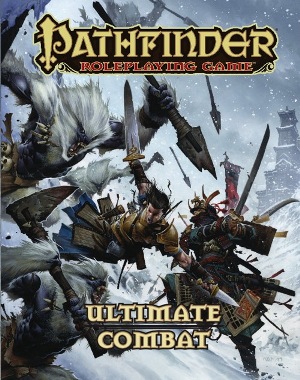
ultimate-combat-300

Ultimate… by Websters the definition [d] reads: the best or most extreme of its kind. Thus, Paizo entails that two of its creations for 2011 are the very pinnacle of gaming mechanics gold.

After spending two years in the Pathfinder universe and plumbing the depths of the system with the Pathfinder Core Rulebook and then the Advanced Player’s Guide, I wasn’t convinced that there was an obvious need for any further bulk supplementation of the system.

You see, this is the crux of ‘old gamers’, a belief that what they’ve pre-built into their own world is ‘enough’ and they can just coast on their own imagination thereafter. Now I’d never say this is a false statement, but with many Grognards, they fail to take into account that the more information you have, the better your personal worlds and systems will be.

Do you need to implement every detail of every supplement ever written? Absolutely not, but the opportunities involved in finding different wrinkles, classes, items, etc can only help to make a world richer for both players and game-masters alike.

This brings me to Paizo’s two Ultimates, those being Magic and Combat. Now make no mistake, when Paizo chose the word Ultimate they weren’t kidding around. These books are chocked full of the kind of stuff that truly needs unearthing.

Read More Read More

Blogging Sax Rohmer’s The Hand of Fu Manchu, Part Three – “Golden Pomegranates”

Blogging Sax Rohmer’s The Hand of Fu Manchu, Part Three – “Golden Pomegranates”

book1untitled2“Golden Pomegranates” was the third installment of Sax Rohmer’s The Si-Fan Mysteries. The story was first published in Collier’s on June 24, 1916 and was later expanded to comprise Chapters 10 – 14 of the third Fu-Manchu novel, The Si-Fan Mysteries first published in 1917 by Cassell in the UK and by McBride & Nast in the US under the variant title, The Hand of Fu Manchu. The US book title marks the first time that the hyphen was dropped from the character’s name, although it was retained within the text.

“Golden Pomegranates” opens with two colorful characters, Meyerstein and Lewison appraising the Si-Fan’s sealed treasure chest in Nayland Smith and Dr. Petrie’s apartment at the New Louvre Hotel. They identify the chest as a rare Tulun-Nur design dating from the sixteenth century or earlier and explain that such chests are secured using a complicated system of knobs being pressed or turned rather than relying upon a traditional lock and key. Smith refuses to allow them to attempt opening the chest and turns down Mr. Meyerstein’s offer to purchase the chest and pay Smith a percentage on its unknown contents. After the appraisers depart, Smith confides in Petrie that he has recently received a premonition not to open the chest.

Read More Read More

Worth 1000 Words: An Interview with “Comic Critiquer” John Bonner

Worth 1000 Words: An Interview with “Comic Critiquer” John Bonner

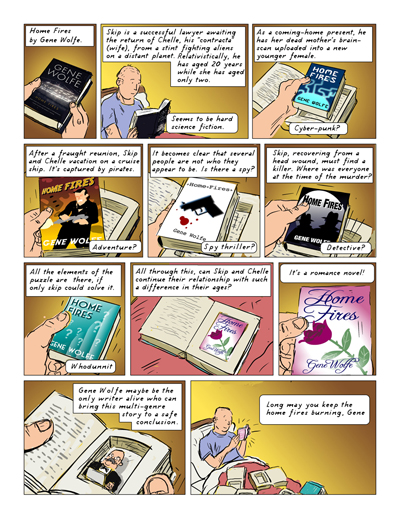
bghomefires
Click Through For LARGER IMAGE!

I don’t remember who first directed to me to John Bonner’s Comic Critique of Gene Wolfe’s latest novel Home Fires.

I think maybe I saw it on Facebook.

Partly because I adore Gene, partly because I thought the medium was so clever, I immediately contacted Bonner to beg for an interview.

He was receptive. I procrastinated. After a not-so-brief hiatus, I actually sent him my questions. He answered.

Eventually, months after it all began, now that the, uh, stars are in alignment and the entrails of my oracular pig have disported themselves with a measure of amiability, I have the interview for your reading enjoyment here.

Read More Read More

Art of the Genre: I.C.E.’s Middle-Earth Roleplaying Part One, Gail B McIntosh

Art of the Genre: I.C.E.’s Middle-Earth Roleplaying Part One, Gail B McIntosh

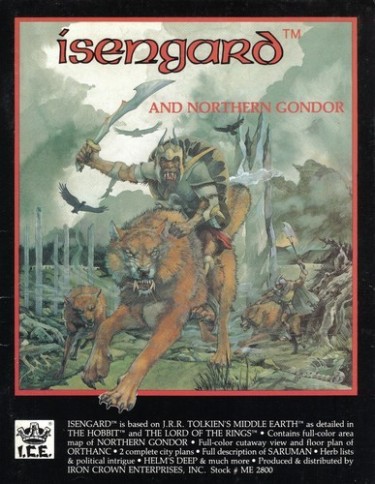
isengard

Yes indeed, I bring you another tale of art before you attempt to burst the buttons off your jeans with a hearty Thanksgiving feast. All winter holidays are something strange here in L.A., and it’s hard to think about turkey, snow, and roasting anything when the sun is bright and ocean breeze carries the promise of white-tipped surf and meditative tranquility.

Art, however, never takes a holiday [nor do we here at Black Gate L.A. since John O’Neill thinks days off are a grand waste of time]. That being said, I began a project some time ago that is very dear to my heart, so much so that Ryan Harvey doesn’t even argue with me about it which is saying something.

Below, I’ll lay the groundwork for my argument in case you who read this would like to contradict me, but I warn you, my passion is unmatched, and without vacations I’ll simply outlast you. Today, then, begins Part One of a small series dedicated to this topic, and I hope you’ll take the time to read them and educate yourself.

Part One:

I would argue that the prettiest role-playing game ever produced was Iron Crown Enterprises the Middle-Earth Role-Playing. Certainly the game’s popularity in the RPG boom decade of the 1980s was only rivaled by the gorilla in the room of TSR’s AD&D, statistics from the time indicating MERP was second in sales totals for the decade behind the RPG giant.

Read More Read More

Ten Questions for Daniel Abraham

Ten Questions for Daniel Abraham

Daniel Abraham
Daniel Abraham

Daniel Abraham and I met at the Millenium PhilCon, my first ever WorldCon. I noted that he had “Albuquerque, New Mexico” under his name on his badge, so I let him know that I was from Los Alamos, and then a few caffeine fueled day/night cycles later, I found myself invited to join his writers group. I’m very glad I did. Like me, Daniel is a Clarion West graduate, though we attended different years. He is the only person, that I know of, who has had his wedding picture in Locus with a toilet prominently displayed in the foreground. That was a gift from said writers group.

I still remember the email Daniel sent when he landed his first novel deal, a four book series with Tor. I was there when he workshopped his first Jayne Heller book, for which he adopted the pen name MLN Hanover, and I was the person he and Ty Franck, the other half of the duo who writes as James SA Corey, knew in common. Ty came to New Mexico for a visit and inevitably met the rest of the writers group, which he would later join.

In the following email interview, I got a chance to catch up with Daniel and revisit some of the stories he’s told me over the years.

An Interview with Daniel Abraham, aka M.L.N. Hanover, aka James S.A. Corey

Conducted and Edited by Emily Mah, November, 2011

Emily Mah: I always think of the story of how you became a writer as beginning pre-natally, when your mother dreamed of you becoming an architect. Care to share what followed from this?

Daniel Abraham: Well the short form of the story is that my mother wanted to be an architect from the time that she was 12, only this was the 60s.  When she got pregnant with yours truly, her first thought was “Oh well, maybe I’ll have a son and he’ll be an architect.”  Her second thought was something like “Ohmigod, did I just think that?”  What followed from that was that I spent my gentle formative years with my Spanish-fluent hippie English major father while my mother got her architectural degree.  He read to me a lot all through my childhood, and apparently some of it stuck.

Read More Read More

My Three-Year, 150th Post Anniversary . . . vs. The Giant Robots

My Three-Year, 150th Post Anniversary . . . vs. The Giant Robots

godzilla-against-mechagodzillaThree years ago this week I posted my fist official article on the new Black Gate blog. I was one the original seven bloggers who answered John O’Neill’s call to make Black Gate online a place people wanted to visit again and again.

Yes, seriously: there were only seven bloggers at the start, one for each day. At one point, we may have dipped down to three. Those were strange days.

And I’m still here after all those years, at the Tuesday spot. And not only is it my three-year anniversary this week, but this post is my one hundred and fiftieth. No, I didn’t plan these two anniversaries to coincide. In fact, if you do the math, this means that over the past three years I failed to meet the weekly Tuesday post five times. I’m sorry, but some things just happen — like giant monster attacks. (Well, I wish; I tried that as an excuse at my old day job, but it didn’t work.)

I wasn’t a newcomer to Black Gate’s website when I started the weekly spot. Before the site became a blog with a rotating team, I wrote a few articles on request for John O’Neill. I finished a series on Clark Ashton Smith that I started on another website, and those articles still get good hits: (Part I, Part II, Part III, Part IV.) I also penned a long analysis of the two version of Poul Anderson’s The Broken Sword, a piece I’m still proud of.

But it was my 25 November 2008 review of Conan the Raider that marked my first “Tuesday Blog Post.” This apparently unambitious start was actually a tip of the hat to the series that got me noticed as a blogger in the first place: reviews of Conan pastiches.

Read More Read More

Weird Fiction Review, and its Doppelganger

Weird Fiction Review, and its Doppelganger

wfrBack in August we reported that Wildside Press sold Weird Tales magazine to Marvin Kaye, leaving editor Ann VanderMeer out in the cold.

But it didn’t take long for Ann and her husband Jeff VanderMeer, World Fantasy Award-winning author of Finch and City of Saints and Madmen, to bounce back with a new enterprise: Weird Fiction Review, an online journal of fact and fiction:

WeirdFictionReview.com is an ongoing exploration into all facets of the weird, from the classics to the next generation of weird writers and international weird. Reviews, interviews, short essays, comics, and occasional fiction.

weird-fiction-reviewCool. Ann and Jeff are a creative force to be reckoned with, and together they have co-edited several fine fantasy anthologies, including The New Weird and the monumental The Weird: A Compendium of Strange & Dark Stories, a four pound, 1,152-page exploration of weird fiction over the last century. The new website looks extremely promising as well, featuring fiction by Jeffrey Thomas, Jean Ray, and Michal Ajvaz, non-fiction from Jeffrey Ford, Scott Nicolay, António Monteiro, and others, and a web comic by Leah Thomas.

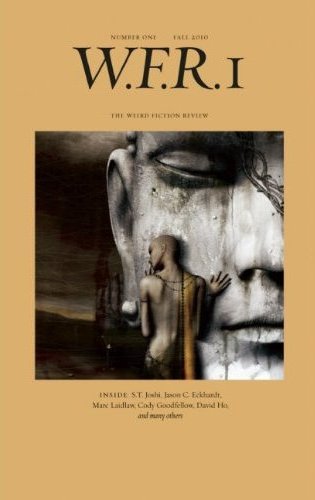
Astute genre readers will note there’s already a fine periodical with the name Weird Fiction Review, a critical journal edited by the distinguished S.T. Joshi (see right). Published annually by Centipede Press, the first issue was released in Fall 2010. According to Ann & Jeff,

This site exists in a symbiotic relationship with S.T. Joshi’s print journal The Weird Fiction Review but does not share staff.

Whatever that means. But hey, we’re just happy to have Ann back at the helm of a new fantasy magazine, doing what she does best: discovering and promoting new talent. More power to her.

Steampunk Spotlight: Kings of Air and Steam

Steampunk Spotlight: Kings of Air and Steam

iron-kingdoms-254

I was never a huge fan of history class. It wasn’t until after college that I really began to enjoy history, and then it was mostly in the form of alternate history novels. This reading motivated me to begin reading more widely in real-world history, too, though I still like the alternative stuff a little better. In 2005, I pulled some of this reading together into an essay for The Internet Review of Science Fiction on “fantastic adventure history“, stories blend alternate history with fantasy.

Definitely the most potent type of alternate history in publishing these days – with or without fantasy elements included – is the sub-genre known as steampunk. This alternate history is set in an Industrial Revolution or Victorian-era setting, but the steampowered technology is ramped up a bit beyond what was realistic for the time. The look and feel of steampunk is so enticing that even Disney has gotten into it, releasing a limited edition pin set, The Mechanical Kingdom, that features the classic Disney characters in steampunk variants.

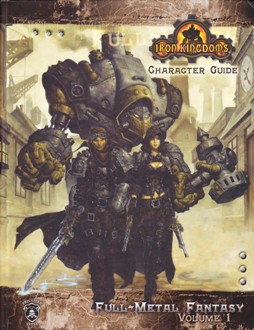
Steampunk got its start as hard science fiction, as described at the recent “Founders of Steampunk” panel from the World Fantasy Convention, but it’s definitely moved beyond that. In fact, my first writing for this magazine, back in Black Gate 10, was a review of the fantasy steam-fueled roleplaying game, Iron Kingdoms, in which powerful wizards are able to control hulking mechanized constructs called warjacks. (Interested? Check out this interview with Iron Kingdoms artist Matthew D. Wilson.)

Without really seeking them out, these steampunk games seem to keep coming across my path … probably because there are just so darn many of them. In Black Gate 15, I reviewed the Victoriana roleplaying game (available on PDF at DriveThruRPG), which also has strong fantasy steampunk themes. In that same issue, I reviewed the steampunk zombie novel Boneshaker (Amazon, B&N). Today, steampunk seems to permeate through all sub-categories of genre fiction.

It also seems to permeate my house. I’ve got several steampunk novels, collections, games, and other oddities that I have had every intention of getting around to reading and reviewing. So, in an attempt to clear through this pile of steampunk populating my bookshelves, I’ve decided to begin a series of posts on recent steampunk goodies, starting with an upcoming steampunk board game: Kings of Air and Steam.

Let’s Play White by Chesya Burke

Let’s Play White by Chesya Burke

lpw_smallChesya Burke’s new short story collection newly out from Apex Publications provides a take on the horrific and strange from, as you might expect from the title, an African-American perspective. The title comes from the opening story, “Walter and the Three-Legged King,” in which the down on his luck protagonist is advised by a talking rat, one that he’s maimed by tearing off its leg, that “let’s play white” is the only way for him to get a job and avoid getting thrown out of his apartment.  The notion that you have to “play the game” in a job interview is hardly the province of any particular race, however; moreover, the no-doubt low paying  job of doorman the protagonist hopes to land might actually have less to do with “playing white” than “playing subservient,” which is why ethnic minorities probably hold a larger percentage of these kinds of positions.

Of course, sf and fantasy have been a natural home for ethnic writers to explore the state of “otherness” in which alien creatures and societies symbolize the psychology of oppressed racial and sexual minorities.  Burke’s stories are more grounded in the everyday realities of the disenfranchised, realities that are disrupted by cultural myths such as the actually benevolent but of course misunderstood village witch (“The Teachings and Redepmtion of Ms. Fannie Lou Mason”), zombies (“Cue Change”) voodoo (“Chocolate Park”), diviner-healers (“The Unremembered” and “The Light of Cree”)  and the evil eye (“I Make People Do Bad Things”).  Some of the scariest, however, are the most realistic.

Read More Read More