Browsed by
Category: Blog Entry

Art of the Genre: The 5 Moods of Conan

Art of the Genre: The 5 Moods of Conan

A Whimsical Conan... certainly one of his moods!

In October I had a chance to head down to San Diego for World Fantasy Con. It was a good time, if not even in the same ballpark as great, and when I travelled back to L.A. I was filled with many a great topic to take on in 2012 for Art of the Genre.

I penned a list, jotting down ideas, but perhaps my favorite hadn’t come from my mind but that of Michael Stackpole as we lunched one afternoon with fellow author Nathan Long. Our lengthy discussion went to Conan, as any good fantasy discussion should at some point, as Mike had very recently penned the novel adaptation of the newest Conan reboot. [Note: My only regret here was that John R. Fultz wasn’t a part of this conversation]

I couldn’t help but ask a question that I know the bulk of Howard fans did, ‘What the hell happened?” Now, because of various journalistic integrity issues I can’t get into specifics, but will attest it was a fun and informative conversation.

The most intriguing thing inside the movie debate was Mike telling us that it [the movie] was originally intended to be a trilogy featuring Belit and the Black Coast. Mike, wonderful licensed adaptive writer that he is, had been charged with writing Belit’s back story for the books that had her and Conan freebooting and pirating the shipping lanes of Stygia.
Read More Read More

Edgar Rice Burroughs’s Mars, Part 1: A Princess of Mars

Edgar Rice Burroughs’s Mars, Part 1: A Princess of Mars

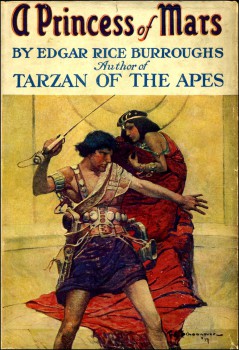
princess-of-mars-a-c-mcclurgThe year 2012 C.E. is the centenary of the Reader Revolution. Two novels published in pulp magazines that year, A Princess of Mars and Tarzan of the Apes, re-shaped popular fiction, helped change the United States into a nation of readers, and created the professional fiction writer. One man wrote both books: Edgar Rice Burroughs.

In celebration of this anniversary, and in anticipation of the upcoming Andrew Stanton film John Carter based on A Princess of Mars, I will tackle all eleven of ERB’s Martian/Barsoom novels in reviews for Black Gate. I also have something special in store for Tarzan of the Apes. This endeavor sounds a touch insane, but come on, but this is the centennial of the series! When else am I going to do it?

Let us turn back the calendar a hundred years to the beginning of all things…

Our Saga: The adventures of Earthman John Carter, his progeny, and sundry other natives and visitors, on the planet Mars. A dry and slowly dying world, the planet known to its inhabitants as “Barsoom” contains four different human civilizations, one non-human one, a scattering of science among swashbuckling, and a plethora of religions, mystery cities, and strange beasts. The series spans 1912 to 1964 with eleven books: nine novels, a book of linked novellas, and a volume collecting two unrelated novellas.

Today’s Installment: A Princess of Mars (1912)

The Backstory

In 1911, Edgar Rice Burroughs was thirty-five years old and selling pencil sharpeners out of an office in Chicago. His post-military service career was so far a series of undistinguished jobs that kept him and his family barely above poverty: an associate in a mining company in Idaho, a railroad policeman in Salt Lake City, a manager of a stenography department, an owner of a stationery store, and a partner in an advertising agency. No position lasted longer than two years.

Read More Read More

Tangent Online reviews Black Gate 15

Tangent Online reviews Black Gate 15

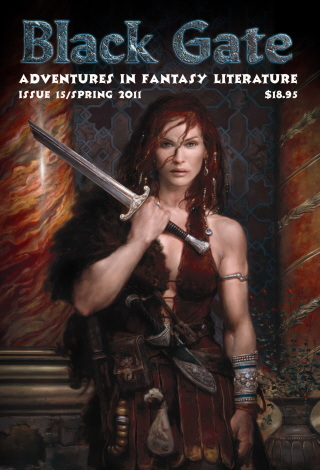
bg-15-cover2Review site Tangent Online published an extensive and extremely complementary piece on our latest issue on New Year’s Day. Author Kevin R. Tipple writes:

The Spring 2011 issue of this massive 384 page magazine delivers in a big way. Beyond the numerous review features on books, dvds, games, letters, and editorial, and other interesting columns and features, the focus is clearly on quality fiction. Complex tales with richly drawn characters of depth engaged in an adventure of some type in a detailed and complex fantasy setting is what you will find in this issue. The stories fully lived up to the subtitle and exceeded my wildest expectations…

Each and every single story in Black Gate #15 is a good one… From the distinctive cover art that pays homage to the concept of the “Special Warrior Woman Issue” to the abundance of reviews, numerous features, and other interesting content, this is a quality magazine. Fiction is what drives the issue in all aspects. Living up wonderfully to their subtitle of “Adventures In Fantasy Literature,” Black Gate 15 delivers consistently across the board with the twenty-one stories… I must say the price for what you get is incredibly reasonable and well worth it…

The fiction is tremendously varied in terms of characters, settings, and writing styles. What is constant in each story is that every one is strong and well written. The folks involved at all levels deserve your support as they have produced an incredibly good product.

Buy this issue for only $18.95, or as part of bundle of back issues — any two for just $25 plus shipping — at our online store. Also available in PDF format for only $8.95!

Or buy the Kindle version — with enhanced content and color art and images — at Amazon.com for just $9.95!

You can find the complete review here, and the complete BG 15 table of contents here.

Steampunk Spotlight: The Steampunk Bible by Jeff VanderMeer with S.J. Chambers

Steampunk Spotlight: The Steampunk Bible by Jeff VanderMeer with S.J. Chambers

steampunk-bibleOver the last couple of Steampunk Spotlight posts, I’ve focused on steampunk in games (upcoming board game The Kings of Air and Steam and the roleplaying game Victoriana), but it’s time to dive deep into the literary end of the pool, and there’s nowhere better to start than in Jeff VanderMeer’s gorgeous The Steampunk Bible (Amazon, B&N).

This book is a narrative and visual exploration of steampunk as a literary genre, a fan costuming phenomenon, and an artistic inspiration, certainly living up to its subtitle: An Illustrated Guide to the world of Imaginary Airships, Corsets and Goggles, Mad Scientists, and Strange Literature.

It’s hard to imagine an aspect of the steampunk movement that isn’t covered by this book full of full-color illustrations and photographs, mixed with interviews, anecdotes, lists, and analyses of steampunk-related themes.

Consider just a few of the fascinating articles/essays contained in this book:

  • Edgar Allen Poe: Perpetuator of the First Steampunk Hoax?
  • Brothers at Sea: Oshikawa Shunro and Verne’s Influence in Japan
  • A Young Steampunk’s Guide to Subgenres
  • Etching tins with Saltwater and Electricity
  • Steampunk Fashion: Four Styles
  • Eight Ways to Raise Your Steampunk Fashion Game
  • Can Airships Slouch Along? Can They Saunter?
  • Obscure Steampunk TV Moments

Read More Read More

Glenn Lord, Nov 17 1931 – Dec 31, 2011

Glenn Lord, Nov 17 1931 – Dec 31, 2011

glenn-lordGlenn Lord, the Father of Robert E. Howard fandom, died yesterday.

Lord was born in 1931 in Louisiana. He first discovered the work of Robert E. Howard through his first Arkham House collection, Skull-Face and Others (1946). This began a life-long interest in Howard’s work, and in 1965 he became the literary agent for Howard’s heirs. The same year he purchased Robert E. Howard’s famous literary trunk, filled with tens of thousands of pages of unpublished stories, poems, and story fragments, from pulp writer E. Hoffmann Price.

The trunk, and Lord’s private collection of unpublished Howard fiction, provided a seemingly endless trove of new material for decades, published in places such as Fantastic Stories, Zane Grey Western Magazine, The Howard Review, The Magazine of Fantasy and Science Fiction, numerous anthologies, and in his own magazine, The Howard Collector. In 1977 he worked with Karl Edward Wagner to release three seminal Conan books through Berkley, The Hour of the Dragon, Red Nails, and The People of the Black Circle, the first Conan collections to present the unaltered text of Howard’s stories from Weird Tales.

Lord received the World Fantasy Convention Award in 1978, and was the Editor Guest of Honor at the World Fantasy Convention in Austin, Texas in 2006. He received The Cimmerian‘s Lifetime Achievement Award in 2005.

Read a personal remembrance from Black Gate blogger Barbara Barrett, who attended a birthday party for Glenn Lord at the Monument Inn in LaPorte, TX in November, after the jump.

Read More Read More

Blogging Sax Rohmer’s The Hand of Fu Manchu, Part Eight – “The Shrine of the Seven Lamps”

Blogging Sax Rohmer’s The Hand of Fu Manchu, Part Eight – “The Shrine of the Seven Lamps”

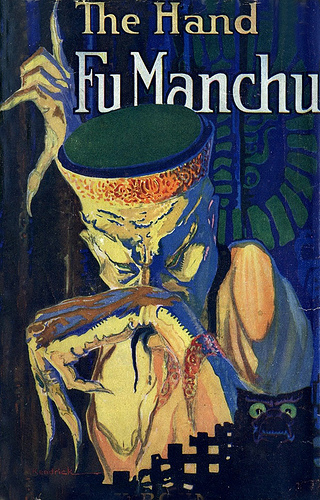
sifanmys2hand-original3“The Shrine of the Seven Lamps” was the eighth installment of Sax Rohmer’s The Si-Fan Mysteries. The story was first published in Collier’s on April 21, 1917 and was later expanded to comprise Chapters 30 – 33 of the third Fu-Manchu novel, The Si-Fan Mysteries first published in 1917 by Cassell in the UK and by McBride & Nast in the US under the variant title, The Hand of Fu Manchu. The US book title marks the first time that the hyphen was dropped from the character’s name, although it was retained within the text.

“The Shrine of the Seven Lamps” picks up the story five months after the events related in the previous installments. This narrative gap proved fortuitous for those who have helped to keep the characters alive after Sax Rohmer’s passing by affording continuation authors an opportunity to craft additional titles set during the classic early years of the series. Dr. Petrie begins the account having concluded settling the estate of a recently-deceased relative. Petrie is returning to London by rail and happens to share a berth with a beautiful and mysterious Eurasian girl. Everything about his silent traveling companion – her eyes, her skin, her perfume – leave Petrie intoxicated. Tellingly, the woman’s beauty and unique eyes evoke memories of both Petrie’s beloved Karamaneh and the insidious Dr. Fu-Manchu. The overpowering mental force Petrie feels invading his mind and fighting to master his will likewise recalls the Devil Doctor. While Petrie feels an understandable sense of relief when this fascinating woman departs the train with her silent and menacing African servants, the reader is positive that Petrie has not seen the last of her.

Read More Read More

Goth Chick News: Just When I Thought It Would Be a Slow News Week…

Goth Chick News: Just When I Thought It Would Be a Slow News Week…

image0044This time of year is always a bit slow around the Goth Chick News room.

The interns have all gone home for the holidays to convince their parents that working here isn’t the harbinger of a career spent flipping burgers.  The staff is woozy from several days of celebrating and let’s face it; reporting too many stories about projectile vomiting eventually gets old, even for me.

And with the Western world taken over, temporarily at least, with a general feeling of happiness and good will, news of the Goth Chick variety is pretty scarce.

So just when I was about to give in to a bout of shameless self-promotion by presenting you with a “Goth Chick’s Best of 2011” recap, the Brits came through.

Read More Read More

Art of the Genre: I.C.E.’s Middle-Earth Roleplaying Part Two, Angus McBride [1931-2007]

Art of the Genre: I.C.E.’s Middle-Earth Roleplaying Part Two, Angus McBride [1931-2007]

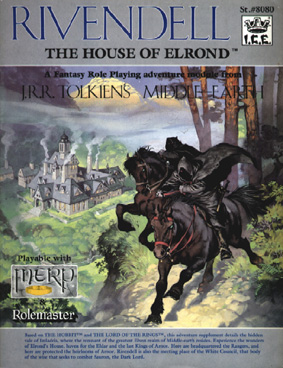
merp_rivendell

It’s the day after Christmas here in L.A. as I write this, the office quiet, but I felt like going in anyway and getting some work done. Perhaps it was because yesterday, after a wonderful feast of turkey, potatoes, and all the fixings, I took a walk with the family three miles from my home out onto the Palos Verdes peninsula. This walk, in seventy degree temperatures with a slight easterly breeze and done in shorts and a T-shirt, held an immense amount of physical beauty.

With a cloudless azure sky, and a tranquil ocean all the way to the mountainous shadows of Catalina Island, the channel is was an epic vista. Still, what strikes a writer’s soul is often the movement of it all, the flights of pelicans looking like pteranodons sailing at eye level as you walk atop the hundred foot bluffs that drop into the whitewater curls of water churning below. If you look down into the kelp fields further out from the breakers you can spy the blazing orange Garibaldi, the state fish of California, as they shine under the waves amid the deep green strands, and further out into the endless blue go the whales.

Gray’s this time of year, majestic and high breaching, they spew mist into the air in pods traveling south, their monstrous tales fully lifted from the waves before plunging down once more into the depths.

It’s a stirring event, these migrations, and as I went home I couldn’t help but think about my next article and how the artist I’d be featuring had first seen and been moved by similar events, this time humpbacks, off the western cape of South Africa.

This gift of nature, and having shared his life between England and Africa, helped shape an artist who transitioned from full-time historical military drawer to the role of visionary painter in J.R.R. Tolkien’s Middle-Earth.

So, today I bring you the next part of my argument as to why the Middle-Earth Role Playing game is the most beautiful RPG ever made.

PART TWO:

Read More Read More

The Natural History of Unicorns

The Natural History of Unicorns

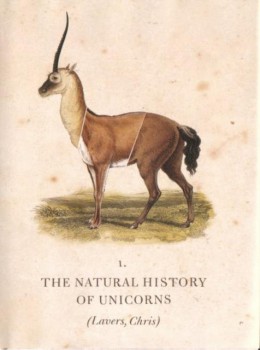
natural-history-of-unicornsThe Natural History of Unicorns (2009)
By Chris Lavers

Some book titles can grab you across a room and demand your money. Such was the case with The Natural History of Unicorns, which I discovered not in a bookstore, but in a curio shop in San Francisco specializing in . . . actually, I have no idea what the store was really selling, except that it was next to the Pirate Supply Store (no joke, this exists, although principally to fund a writing workshop in the back) and the excellent science-fiction and fantasy bookstore Borderlands. A bit of both stores rubbed off onto this one, and so in the midst of taxidermy snakes was this book promising to tell me the Natural History of a fantasy animal. Immediate sell.

Well, almost immediate. I did check to see that the book was not crazy pseudo-science making the claim that the fantasy version of the unicorn was real and scientists were refusing to admit the truth. But the book appeared to be exactly what I wanted: a multi-discipline exploration of the development and evolution of the unicorn legend.

On the surface, the unicorn is the simplest of fantastic creatures: a horse with a single horn jutting from its forehead. Of course something like that might exist! There are plenty of horned hoofed animals, a unicorn isn’t much of a stretch.

But the unicorn carries a trainload of baggage behind it: a symbol of spirituality and Christianity, emblem of British royalty, symbol of virgin purity, a creature in roleplaying games, icon of New Age thinking, and decoration on a third-grade girl’s wall. The unicorn is indeed, as legend has often claimed, tough to hunt and harder catch.

Chris Lavers, a lecturer in natural history at the University of Nottingham, writes in a friendly, humorous style that feels like an Oxford professor during the off-hours entertaining guests around the fire with brandy in ample supply. In places, Lavers seems to channel Avram Davidson and his Adventures in Unhistory, although not quite as obtusely or wittily. (Davidson’s book has a chapter on unicorns, by the by.) The book makes for fast nonfiction reading, although Lavers does go off on a dull detour from his topic in the center of the book, occasionally relies too heavily on long quotations, and fails to explore an important avenue of unicorn history that I hoped to learn more about.

Read More Read More

Osprey Adventures

Osprey Adventures

teutonic-knightWhat if one day you woke up and found yourself in charge of a publishing imprint?

You had financial backing, the support of an experienced production and marketing team, and a wide-open remit. You also had the weight of a lot of expectation.

Well, about a month ago, this happened to me.

My name is Joseph McCullough, which some of you may recognize from Black Gate. At various times I have worked as an author and an assistant editor for the magazine, and I continue to be a fan and supporter.

I have also recently been made the Project Manager for Osprey Adventures, an imprint of Osprey Publishing.

I mentioned my new position to John O’Neill, and he kindly invited me to write a series of blogs about my experiences in the publishing world, and my trials and tribulations as I attempt to bring some new, fun, semi-fantasy books to market.

For those who don’t know, Osprey Publishing is arguably the most famous publisher of military history in the English language.

Read More Read More