Browsed by
Category: Blog Entry

For the Resolute at New Year’s: Promises, Process, and Progress
For the Resolute at New Year’s: Promises, Process, and Progress

bgnanoOaths, vows, geasa, bindings–you love reading about that kind of thing, or you wouldn’t be here at Black Gate. A vow is powerful magic. A vow written or witnessed is more powerful still.

You would think, then, that the New Year’s resolutions that saturate our culture this time of year would work better than they do. There’s lots of help out there for people who make resolutions about physical fitness, but not so much for people who make resolutions about their writing. How do you come up with a writing resolution that you’ll be glad to fulfill, not just when it’s all over, but while you’re actually doing the work? If you’ve already made a resolution, how do you follow through on it? Maybe last year you tried the crazy ordeal that is Nanowrimo, and you’re looking for a way to tap into its productivity that is actually sustainable. Maybe Nanowrimo’s cheery cultishness turned you off, and you’re sure there must be another way.

There’s an abundance of other ways, thank goodness. Although I have fond memories of frenzied November write-ins, and my novella that’s slated to appear in a forthcoming issue of Black Gate got its start as the first chapter of a Nanowrimo project, my Nanowrimo survival skills are some of the least sustainable writing behaviors in my repertoire. I have some very different ones that have helped me stay in the game for years and finish some long, daunting projects. I want to tell you about some books on process that have been of enduring use to me in broadening that repertoire.


Read More Read More

Art of the Genre: Dragon Mountain

Art of the Genre: Dragon Mountain

Is it me, or do you think this dragon might be cold?

Do any of you have a gaming shelf? How about a gaming wall? Or even in the case of our fearless leader John O’Neill a ‘Cave of Wonders’ filled with literally thousands of RPGs and games?

Well if you do, then you’ll fully understand the feeling you get when you look at those shelves and feel a mix of nostalgia for times lost, and regret for games never played. With all those books, from so many companies and editions of each title, I couldn’t help wonder at what I missed, especially after the news that WotC is now in production of a 5th Edition of D&D.

Still, I always want to give folks an update on some older material, in this case 2E, even if I’m three and a half editions behind the curve. Today’s topic, the 2E AD&D ‘monster’ that is the Dragon Mountain Boxed Set. This thing is huge, and from what I can see epic, but I’ve always found it so daunting that I’ve yet to actually play it. I think I’ve used pieces in other campaigns over the years, but never as a whole.

I have to wonder if anyone else out there ever had this issue, or ever played the full box. It seems like a pretty well thought out campaign, and I have to admit that the concept of a full 2E dungeon crawl where the main obstacle to the characters are Kobolds always kept me pleasantly intrigued.

In all I counted out 12 Kobold clans in the three volumes inside the box, and you almost need a road map to understand the relationships between them. There are also sixteen player handouts, eight of the old monstrous compendium sheets, 12 full color reference cards, a full set of counters for miniature play, and six, count them SIX full-color fold out maps!

Read More Read More

Edgar Rice Burroughs’s Mars, Part 2: The Gods of Mars

Edgar Rice Burroughs’s Mars, Part 2: The Gods of Mars

gods-of-mars-1st-editionI played a bit rough with A Princess of Mars last week in my first installment of this eleven part mega-series on the Martian novels of Edgar Rice Burroughs. That book knocked me out when I first read it as a junior high school kid, but it was also the first ERB book I ever picked up. Now that I’ve read most of Burroughs’s canon, the flaws of his first book seem more obvious. For all that is wonderful about A Princess of Mars, it looks like a runt compared to the book I knew was snapping at its heels: The Gods of Mars. Also known as: “Edgar Rice Burroughs gets the knack.”

Our Saga: The adventures of Earthman John Carter, his progeny, and sundry other visitors and natives, on the planet Mars. A dry and slowly dying world, the planet known to its inhabitants as “Barsoom” contains four different human civilizations, one non-human one, a scattering of science among swashbuckling, and a plethora of religions, mystery cities, and strange beasts. The series spans 1912 to 1964 with eleven books: nine novels, a book of linked novellas, and a volume collecting two unrelated novellas.

Today’s Installment: The Gods of Mars (1913)

Previous Installment: A Princess of Mars (1912)

The Backstory

In his original proposal to editor Thomas Newell Metcalf at Munsey’s Magazines regarding a novel of Martian adventure, Edgar Rice Burroughs suggested he could write three books from the concept. But he apparently wasn’t certain about the content of the second and third volumes to follow A Princess of Mars, since it was Metcalf who gave him the idea of where to start the next book. After Metcalf rejected Burroughs’s second novel, The Outlaw of Torn, he urged the author to return to Mars and send John Carter into the Valley of Dor, the mysterious paradise mentioned a number of times in the first book. Burroughs ran with the concept, and finished the novel in the beginning of October 1912.

Read More Read More

WotC Announces Fifth Edition Dungeons & Dragons

WotC Announces Fifth Edition Dungeons & Dragons

ddMike Mearls, senior manager of D&D research and development at Wizards of the Coast, today announced the project that will become the fifth edition of the world’s most popular role playing game.

Confused by the plethora of editions? Wondering if this is really a big deal? You’re not alone.

Gary Gygax and Dave Arneson published the first Dungeons and Dragons rules in a hand-assembled boxed set in 1974; in 1977 Gygax completely revamped the game into Advanced Dungeons & Dragons, the version that catapulted it into a household name. In 1989 David “Zeb” Cook and a new team at TSR rewrote the game, releasing a Second Edition of AD&D aimed primarily at younger players. D&D 3rd Edition arrived in 2000 from new owners Wizards of the Coast; it is widely credited with saving the game — and revitalizing the entire RPG industry with the streamlined d20 System, released at the same time. Version 3.5 came along in 2003, tweaking numerous rules, and the most recent incarnation is the Fourth Edition, published in 2008.

And yes, it’s a big deal.

Wizards is putting out the call to players around the world to assist in development, with an ambitious open playtesting program starting this spring. You can help shape the future of the game by signing up for the playtest here. According to Mearls,

The ultimate goal of this next iteration of D&D a game that rises above differences of play styles, campaign settings, and editions, one that takes the fundamental essence of D&D and brings it to the forefront of the game.

You can read the complete announcement here, and read more about the genesis of the new edition in today’s New York Times.

Book Review: Jim C. Hines’ The Mermaid’s Madness

Book Review: Jim C. Hines’ The Mermaid’s Madness

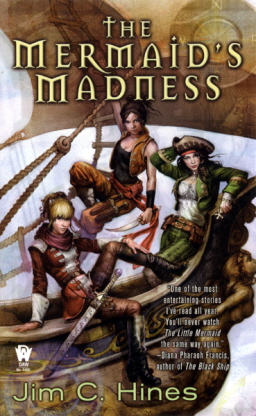
themermaidsmadnessThe Mermaid’s Madness

Jim C. Hines
DAW (339 pp, $7.99, 2009)
Reviewed by Andrew Zimmerman Jones

Jim Hines has developed a name for himself by taking traditional fantasy and warping it into a twisted, entertaining, and amusing adult fantasy storyline. His first series, the Jig the Goblin Trilogy (Goblin QuestGoblin Hero, and Goblin War), took traditional roleplaying game fantasy clichés – complete with a dwarf who is obsessed with mapping out the dungeon the protagonists are crawling – and turns it on its ear by making a goblin the hero of the series.

In his Princess Novels, he has taken the three classic princesses of fairy tales – Cinderella, Snow White, and Sleeping Beauty – and turned them into a trio of bad-ass fantasy heroines. (You may insert your own Charlie’s Angels comparison here.)

Snow and Talia (i.e. Sleeping Beauty) are living in exile, serving Queen Beatrice – the mother of Cinderella’s prince charming, Armand – as a sort of secret agent squad. Snow is a sorceress, with an emphasis on mirror-based magic. Talia is basically a weapon expert and all-around combat machine.

Read More Read More

Steampunk Spotlight: Scott Westerfeld’s Leviathan Trilogy

Steampunk Spotlight: Scott Westerfeld’s Leviathan Trilogy

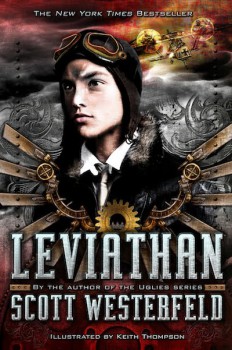
leviathan

Leviathan (Amazon, B&N)
Scott Westerfeld
Simon Pulse (440 pp, $9.99, Oct. 2009)

Behemoth (Amazon, B&N)
Scott Westerfeld
Simon Pulse (5112 pp, $9.99, Oct. 2010)

Goliath (Amazon, B&N)
Scott Westerfeld
Simon Pulse (543 pp, $19.99, Sept. 2011)

Reviewed by Andrew Zimmerman Jones

Scott Westerfeld’s Leviathan trilogy is an epic about an alternate-history version of World War I … and a great example of how steampunk can really work well when it’s firing on all cylinders (both literally and figuratively). In this, the military conflict isn’t just political, but also centers around an ideological difference about technology. The British and Russians have embraced Charles Darwin’s biological insights to breed massive war beasts, while the German alliance put their faith in mechanical (frequently multi-legged) battle machines.

In addition to the global conflict, the major tension in the story centers around two young characters – one from each side of the battle – who are living with their own secrets in the midst of the war. One is a girl disguised as a boy so that she can serve in the British military upon the living zeppelin Leviathan. The other is a prince (and secret heir to the Austrian Empire) on the run from his own people.

On top of all of that, there’s also a romance … even though one of the participants doesn’t realize it for quite some time.

Read More Read More

Apex #32

Apex #32

apexmag01This month’s Apex Magazine features new fiction from Cat Rambo (“So Glad We Had This Time Together”) and Sarah Dalton (“Sweetheart Showdown”), as well as a reprint of “The Prowl”  by Gregory Frost, who is also the featured interview. Stephan Segal provides the cover art and John Hines discusses “Writing About Rape.”
This and more of the Lynne M. Thomas edited on-line publication can be found here.

In other news, this is the time of year where”Best of” lists proliferate; I tend not to bother if only because I doubt anyone cares (and for those who might care, I just don’t want to get into an argument about why I didn’t pick the books they think should be on my list). I do find it interesting that three of the Top 5 fiction books selected by The New York Times contain elements of fantasy. Two are literary fabulism  (meaning no elves, dwarves or heroic quests) that doesn’t get shelved in genre.  I haven’t read Swamplandia! by Karen Russel yet, though I heartily recommend The Tiger’s Wife by Tea Obreht, which employs motifs of Eastern European folklore to recount a doctor’s reconstruction of her grandfather’s life in a country obviously modeled on war-torn Yugoslavia.

The third is clearly genre, 11/22/63, a time travel story by the literal king of of genre, Stephen King (and which also made other best of lists). I was a little surprised by this, as King is usually considered lowbrow by book critics.  This may be a case of being around long enough that you finally get some respectability, the sort of grudging acknowledgement that Ray Bradbury and Kurt Vonnegut earned later in their careers (though at that point their “rehabilitated” reputations rested primarily on work produced early in their careers). But it has to be more than tenure, as this same respect hasn’t been accorded to other widely popular genre writers who’ve been around such as Robert Ludlum (who continues to write from the grave) or Nora Roberts, or even the dreaded Dan Brown.  Maybe this is because these writers are formulaic hacks (caveat: I haven’t read Ludlum or Roberts, so I’m just assuming from their reputations that they are, which I concede is unfair of me, though I have read Brown who is, albeit mildly entertaining).  So perhaps King has worked hard enough, and well enough, that being popular is no longer a drawback, at least from the viewpoint of the literary sophisticates?

Robert E. Howard: The Poet and the Girl with the Golden Hair and Eyes like the Deep Grey Sea

Robert E. Howard: The Poet and the Girl with the Golden Hair and Eyes like the Deep Grey Sea

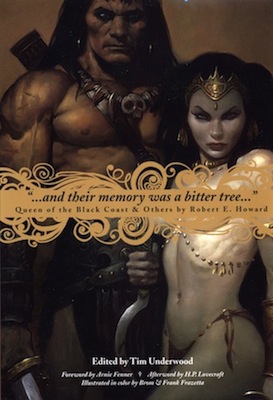
andtheirmemoryHistory, reincarnation, bloody battles, a fierce and barbaric people, and great acts of courage! Robert E. Howard’s poem “An Echo From the Iron Harp” has all that and more.

It is a tale that echoes across centuries as the ghosts of the Cimbri and their battles with the Roman legions haunt a poet who dreams of a love from ages lost in time:

Shadows and echoes haunt my dreams
with dim and subtle pain,
With the faded fire of a lost desire,
like a ghost on a moonlit plain.
In the pallid mist of death-like sleep
she comes again to me:
I see the gleam of her golden hair
and her eyes like the deep grey sea.

But she’s more than this description. Howard has created many strong female characters, among them: Dark Agnes in Sword Woman; the “Queen of the Black Coast,” Bêlit; Valeria in “Red Nails”; and Red Sonya, the heroine of “Shadow of the Vulture.”

Read More Read More

Blogging Sax Rohmer’s The Hand of Fu Manchu, Part Nine – “The Black Chapel”

Blogging Sax Rohmer’s The Hand of Fu Manchu, Part Nine – “The Black Chapel”

hand-pyramidhand-titan“The Black Chapel” was the ninth and final installment of Sax Rohmer’s The Si-Fan Mysteries. The story was first published in Collier’s on June 2, 1917 and was later expanded to comprise Chapters 34 – 40 of the third Fu-Manchu novel, The Si-Fan Mysteries first published in 1917 by Cassell in the UK and by McBride & Nast in the US under the variant title, The Hand of Fu Manchu. The US book title marks the first time that the hyphen was dropped from the character’s name, although it was retained within the text.

“The Black Chapel” sees Nayland Smith, Dr. Petrie, and Petrie’s fiancée, Karamaneh (recently liberated from the Si-Fan’s slavery ring) paying a visit to Greywater Park, the ancestral estate that their old friend, Sir Lionel Barton has recently inherited. Rohmer seems determined to shape Greywater Park in the image of Redmoat, the medieval stronghold where Reverend J. D. Eltham (the veteran of the Boxer Uprising who figured in the first two books in the series) resided. As in his appearance in the first book, Sir Lionel is a brilliant, but eccentric Egyptologist based in part on both the real-life Sir Richard Burton and Sir Arthur Conan Doyle’s Professor Challenger. The character’s larger than life qualities are best exemplified by his menagerie of wild cats and other exotic animals that fill his home alongside his equally exotic foreign servants. Upon their arrival, it is learned that Sir Lionel has fallen ill and is unable to meet with them until the morning. The trio settle in for a strange night in Sir Lionel’s highly unorthodox home when they are disturbed by an inexplicable knocking and a ghostly wailing just as Smith has finished relating Greywater Park’s colorful past in housing a Spanish priest who fled the Inquisition centuries before.

Read More Read More

Goth Chick News – Build Your Own Zombie

Goth Chick News – Build Your Own Zombie

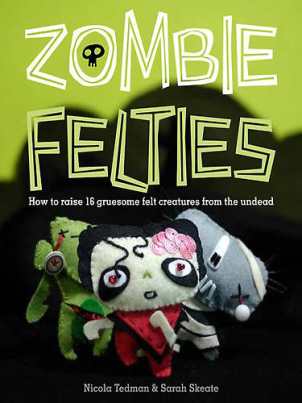
zombie-felties1Though it doesn’t happen very often, occasionally I am left speechless.

Generally this occurs when watching an episode of True Blood during which there is an abundance of vampire and werewolf nudity. However, sometimes it happens for other reasons as well.

Case in point.

Seeing the voodoo doll display on my desk along with the “I’m So Goth I Poop Bats” bumper sticker on my file cabinet, an insightful co-worker brought me the coolest “how to” book since that one that contained the instructions on how to bring a Golem to life.

Nicola Tedman, a special effects artist who worked on the Harry Potter films, has awaken her inner George A. Romero and focused her creative attention on the malleable, fuzzy softness of felt.

Zombie Felties: How to Raise 16 Gruesome Felt Creatures from the Undead is an oversized paperback which instructs the reader in the ultimate in anti-Martha Stewart craft making.

Inside, would be Zombie Masters will find remedial instructions for more than 15 zombie creatures, including a Romero-esque “Day of the Dead Zombie,” a “Dead Ducky” and my personal favorite the “Vampire Zombie.”

Read More Read More