Browsed by
Category: Blog Entry

My Sword is Bigger than Yours, or, When Size Really does Matter
My Sword is Bigger than Yours, or, When Size Really does Matter

v-next-book

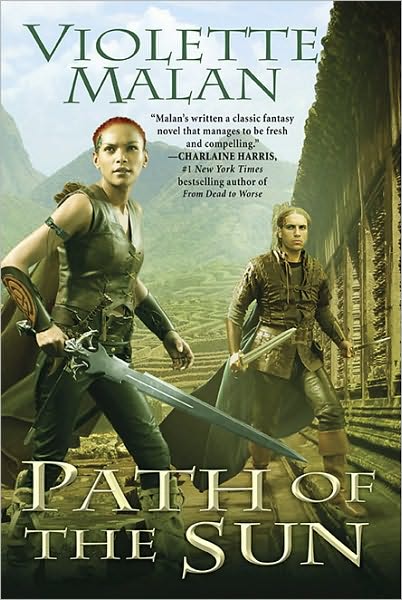
After meeting Violette Malan at ConFusion in Detroit a few weeks back, I wanted to find out a little more about her take on the genre near and dear to my heart, sword-and-sorcery. I asked her if she’d be interested in dropping by Black Gate to say a few words about how she approached her own work in the field, and here’s what she had to say:


When I found sword and sorcery in my teens, there weren’t a lot of strong female protagonists for me to relate to. Jirel of Joiry comes to mind, maybe Red Sonya – but they were already very old by the time I got to them. When I think now of the books and stories I read then, I’m hard pressed to come up with female characters, let alone female protagonists. There must have been some. You know, needing rescuing or marrying or something, but I didn’t find them memorable then, and I don’t really find them memorable now. Okay, I do remember the women that Fafhrd and the Grey Mouser loved, they were well-drawn, significant people. But we all know what happened to them, don’t we? They pretty much continue the tradition of female characters in western literature: if it’s a comedy they marry, if it’s a tragedy, they die. (Hint: for all their humorous elements, the F&GM stories aren’t comedies)

Flash forward a few years and I’m a writer of sword and sorcery, not just a reader. I’m a woman, living in a post-feminist western society, a person who’s written feminist literary criticism (okay, on 18th-century pastoral poetry, but it still counts). Now I get to actually create the kind of female characters I used to imagine when I was young. Protagonists, mind you, real, more-or-less human women. Not the good (or evil) fairies, queens, and goddesses that sociologists and feminist critics call examples of women as “other”.

How was I going to do that? Keeping in mind that – unlike the men – I didn’t have a lot of models I could use as a guide. And keeping in mind that I wanted to avoid either caricature, or cliché. (I think the phrase “no chain mail bras” will cover what I mean by that). I’m not going to talk about how a writer goes about forming any strong character – there are certain elements that apply no matter who or what the character might be. Instead, I’m going to address my own particular dilemma, how to create a strong, female, sword and sorcery protagonist.

Read More Read More

STURGES TOPS THE TOPPER WITH SHORTCUT MAN 2

STURGES TOPS THE TOPPER WITH SHORTCUT MAN 2

ap-book-review-shortcut-man-17944457jpg102452072The late Leo McCarey is remembered by most film buffs today for his imitation Capra-corn, The Bells of St. Mary’s and Going My Way starring everyone’s favorite likeable cad, Bing Crosby as the sort of priest you’d find in a parish where the nuns looked like Ingrid Bergman. Turn back the clock a few more decades and McCarey was the finest comedy director in Hollywood capturing the very best performances from Laurel & Hardy, an aging Harold Lloyd, and the Marx Brothers in their prime (when Zeppo was still part of the act). McCarey patented the chain reaction gag which tasked the comedy filmmaker with finding a way to consistently “top the topper.”

That was no mean feat. Once you get your biggest belly-laugh from the audience and then set out to find an even bigger laugh, you’re laying the groundwork for disappointment. Quite simply, no one can be that funny all the time. Yet McCarey managed it time and again and so did several other comedy directors who followed in his wake like Howard Hawks, a young Frank Capra (before sentimentality robbed him of his comic timing), Preston Sturges, and Billy Wilder. Very few others have managed to scale those same dizzying heights since Hollywood’s Golden Age and the lost art of the chain reaction gag is one of the measures by which one may easily separate modern and classic comedy. Comedy, in its purest form, allows us to break the pain barrier and laugh.

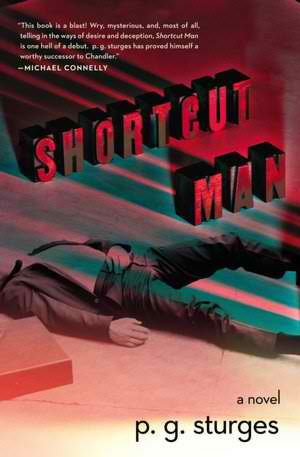
Such ruminations on the art of comedy are entirely appropriate when discussing P. G. Sturges, a new talent who arrived on the literary scene last year with The Shortcut Man. It was easily my favorite book of 2011. It had everything going for it: a hardboiled mystery mixed with high farce, a keen ear for dialogue, and an even sharper wit in laying bare personal and cultural failings in modern society. Any book that makes the reader think, consistently laugh, and still keeps them riveted to discover the next twist the story will take is exceptional.

Read More Read More

Goth Chick News: Another Priceless Tidbit from Ridley Scott

Goth Chick News: Another Priceless Tidbit from Ridley Scott

image0021This very nearly made me scream like a 14-year-old girl attending a Justin Bieber concert with Robert Pattinson.

Close, but not quite.

Apparently Ridley Scott is engaging in a little viral marketing for his upcoming Alien prequel, Prometheus; “viral” in that he’s trusting people like us to find this stuff and circulate it like the lunatic fan boys / girls we are.

Far be it from me to not live up to Mr. Scott’s expectations, so here it is.

TED is a nonprofit organization devoted to “Ideas Worth Spreading.” It started out (in 1984) as a conference bringing together people from three worlds: Technology, Entertainment, Design (“TED,” get it?).

Since then TED has grown in leaps and bounds. Along with two annual conferences, TED includes the award-winning “TEDTalks” video site, the Open Translation Project and TED Conversations.

Read More Read More

The Best in Fantasy Manga

The Best in Fantasy Manga

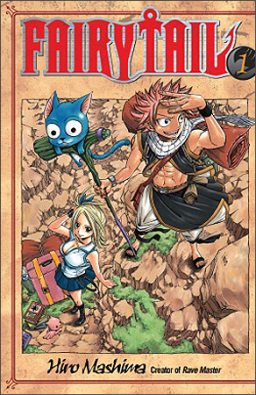
fairy-tail-1When I was invited to write a guest post, I immediately turned to manga. To my knowledge, Black Gate has never had a post dedicated to Japanese comics before, and I think that absence needs to be rectified.

The series I am about to recommend to you are as good, as dramatic, and as entertaining as any American comic book or even fantasy and science fiction novel.

What follows is a list of some of my personal favorites, as well as those that are must reads. At the end, I will list some of the series that I have not gotten to yet, but am looking forward to.

Fairy Tail by Hiro Mashima

Ongoing. Kodansha has released 17 volumes in translation with vol. 18 due in March.

Lucy Heartfilia, a celestial spirit wizard, and Natsu Dragneel, a fire dragon slayer, form the nucleus of Team Natsu. Stealing a book from a corrupt noble and crushing dark guilds are just some of the adventures that Team Natsu and their friends find themselves in as they ensure Fairy Tail’s reputation as the strongest and most infamous wizard guild in Fiore.

Though the series starts out with a heavy does of comedy, the series has steadily gotten darker and more serious with each succeeding story arc yet still maintains an upbeat feel. Indeed, the series really starts to pick up with the Galuna Island arc. The great thing about Fairy Tail is that Mashima does not neglect minor characters. They all have moments in the spotlight. I personally find the series fun and enthralling, and it is without question my favorite series.

Read More Read More

Art of the Genre: Review of the Inner Sea World Guide

Art of the Genre: Review of the Inner Sea World Guide

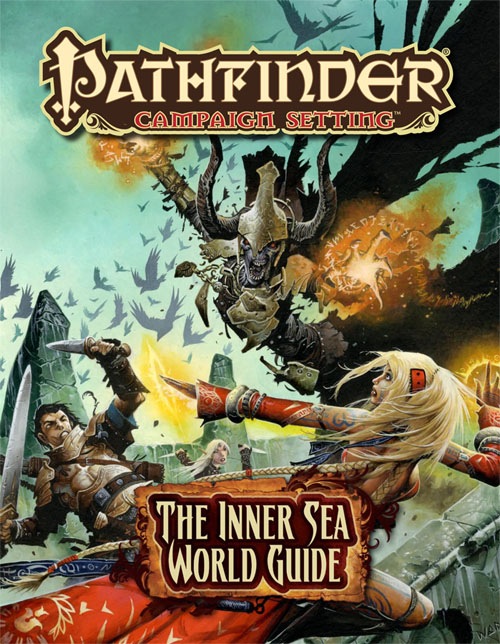
pzo9226_500My very first campaign setting, as probably the bulk of old time gamers would also claim, was The World of Greyhawk. I still have great nostalgia for that world, and the classic adventure modules set in it, but sometimes you just need to upgrade, you know? I mean, Greyhawk is over thirty years old, and has gone through a number of facelifts, but still it’s always nice to try on something new.

And speaking of new! How about Paizo’s Pathfinder Campaign Setting The Inner Sea World Guide. I mean the name alone is worth the price! I’m not sure when the first time I saw this book, but I know when I did I WANTED IT!

Pathfinder is already an outstanding supplemental system, with a massive amount of core books, adventure paths, and gazetteers, but if you’re looking for a new age setting or simply want to steal some quality ideas for your own world, this book is an incredible resource.

As I delved into the pages it was like opening a Pandora’s Box of fantasy grandeur. The book begins with a nice expansion of the races of The Inner Sea, and like Iron Kingdoms did some years back for their setting, Paizo defines twelve different human races before delivering a nice history on the usual suspects like elves, dwarves, and the like.

I was intrigued by this kind of detail, and as I flipped through the different races I couldn’t help by smile at those chosen and the great adventures that could be set in a country populated by these individuals.

Read More Read More

Edgar Rice Burroughs’s Mars, Part 5: The Chessmen of Mars

Edgar Rice Burroughs’s Mars, Part 5: The Chessmen of Mars

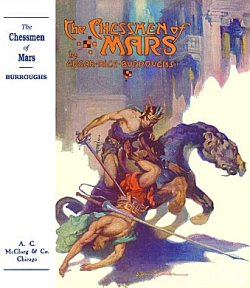
chessmen-of-mars-1st-edition1“The squares shall be contested to the death. Just are the laws of Manator! I have spoken.”
After Edgar Rice Burroughs pulled the Martian novels in a different direction with Thuvia, Maid of Mars, he retreated from Barsoom for a spell to concentrate on other projects. Eight years passed between the writing of Thuvia and the publication of the next adventure, The Chessmen of Mars, which switched to yet another hero and heroine to hurl into the unknown regions of Mars. In the process, Burroughs gave science fiction a new board game to play.

Our Saga: The adventures of earthman John Carter, his progeny, and sundry other natives and visitors, on the planet Mars, known to its inhabitants as Barsoom. A dry and slowly dying world, Barsoom contains four different human civilizations, one non-human one, a scattering of science among swashbuckling, and a plethora of religions, mystery cities, and strange beasts. The series spans 1912 to 1964 with nine novels, one volume of linked novellas, and two unrelated novellas.

Today’s Installment: The Chessmen of Mars (1922)

Previous Installments: A Princess of Mars (1912), The Gods of Mars (1913), The Warlord of Mars (1913-14), Thuvia, Maid of Mars (1916)

The Backstory

Thuvia, Maid of Mars was a success, and it made sense that when Burroughs returned to Mars he would repeat the same formula of third-person narration and a different hero and heroine pair in a one-off adventure. Although John Carter’s son Carthoris seemed a natural to continue as the hero, Burroughs chose to use a full-blood Martian as his lead for the first time. The decision to change protagonists once before made it easy to do it a second time, and with Carthoris already paired with Thuvia, picking a new character meant ERB could start over with a fresh love interest. (He rarely let his heroes switch heroines once they dedicated themselves. Tarzan could get away with it with La of Opar, but only because of amnesia.)

Read More Read More

Join the Heroes of the Feywild

Join the Heroes of the Feywild

heroesfeywildPlayer’s Option: Heroes of the Feywild (Amazon, B&N)

Dungeons & Dragons – Rodney Thompson, Claudio Pozas, Steve Townshend
Wizards of the Coast (160 pp, $29.95, Nov. 2011)

Fury of the Feywild Fortune Cards (Amazon)
Dungeons and Dragons
Wizards of the Coast ($3.99, Nov. 2011)

Reviewed by Andrew Zimmerman Jones

In roleplaying games, I’ve always been a fan of taking full advantage of each character’s unique traits. The statistics are a reflection of these unique traits, of course, but they aren’t the most important element. The differences between Dwarves and Elves goes far beyond just their Dexterity and Constitution bonuses, reflecting deep cultural differences that are far more interesting.

As such,I love supplements that help to differentiate even more between different types of characters. The Dungeons & Dragons Player’s Option book Heroes of the Feywild is superb at doing that for Feywild characters, providing both storytelling details about these engaging character types as well as new mechanics designed to support stories that feature the Feywild. If you want to enter into this world of raw magical power, this is definitely a must-have supplement.

To supplement the book, Wizards of the Coast also released an Fortune Cards expansion, Fury of the Feywild, which allows you to invoke feywild-linked events into your Dungeon & Dragons game in a more random fashion. You can download the rules for using Fortune Cards from Wizards directly.

Read More Read More

Blogging Alex Raymond’s Flash Gordon, Part Twenty-Two – “Marvela”

Blogging Alex Raymond’s Flash Gordon, Part Twenty-Two – “Marvela”

marvelaraymond_flash“Marvela” was the twenty-second installment of Alex Raymond’s Flash Gordon Sunday comic strip serial for King Features Syndicate. Originally published between August 20, 1944 and February 4, 1945, “Marvela” was the first of the Sunday strips completely illustrated by Austin Briggs. Don Moore scripted from a story he developed with the series’ creator, Alex Raymond. This was the final storyline to have any involvement from Raymond. The story picks up following the conclusion of the epic-length Tropica story arc with Flash and Dale traversing Mongo in the triphibian rocket car given to them by Queen Desira as a reward for helping restore her to the throne of Tropica.

“Marvela” marks a strange departure for the strip. Austin Briggs’ artwork, though never a match for Alex Raymond, at least is an improvement on his finishes for Raymond’s rushed pencils that marred much of the second half of the Tropica stories. The title refers to the kingdom that Flash and Dale visit when they see a rocket crash in the forest and a beautiful woman thrown from the cockpit. A giant scorpion appears and moves in for the kill. Flash dives down from the triphibian rocket car to distract the scorpion and he and Dale team up to destroy it. Oddly, Briggs never depicts the rocket falling from the sky nor does he show its wreckage. Its existence is only referred to in Moore’s script. This should be conclusive proof, if any were needed, that Alex Raymond never layed out any of the early panels for the strip.

Read More Read More

Goth Chick News: King Shines On

Goth Chick News: King Shines On

image001Telling you that The Shining ranks in my top five favorite horror movies of all time isn’t news here at Black Gate. Over the years I’ve found all sorts of ways to weasel it into my posts, even going so far as to cyber-stalk Danny Lloyd, the reclusive adult who played the emotionally damaged little kid with the “shine” all over him.

The Shining is my stormy, Sunday afternoon go-to movie, and the first one into the Blu-ray player as soon as the snowfall breaks the 12 inch mark here in Chicago.

No matter that I know the dialog by heart, it scares the crap out of me anyway. Because let’s be honest; those two creepy little girls will get you every time.

But as much as I love the adrenaline rush brought on by the film, ironically I’ve always been a little lukewarm on the book.

I say “ironically” because it is a rare thing indeed when a movie manages to simply not massacre the text upon which it is based — not to mention equal it or surpass it.

The Shining book is absolutely interesting in that it provides all the backstory about why the Overlook Hotel is such an attractive vacation spot for evil spirits, and why Jack Torence is such a fractured human being.

However, what makes the book less of a fav for me is that exact same backstory.

Read More Read More

Finding the Right Cover Artist for your eBook

Finding the Right Cover Artist for your eBook

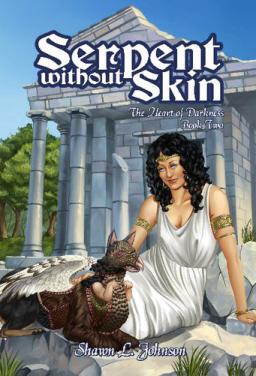
serpent-without-skin2When I resolved to publish the two novels in my Heart of Darkness series as eBooks, I figured I was all set. The books had already been edited and re-edited; I had the future plotlines mapped out in my head. That was everything, right?

Of course not. My wife — aka “Queen of Internet Research” — cautioned me, “Everything I’ve read says you need a great cover that really catches the eye.”

I hadn’t thought that far ahead. I’d always dreamed of being picked up by a major publishing house that had its own artists.

I mean, I like fantasy art as much as anyone, but I’m good with words, not pictures. I had no idea how to locate a good cover artist.

So I asked a friend of mine who is an artist to do it. He begged off, citing his current, non-artistic workload. Nor did any other personal connections pan out.

Ahead of me yet again, my wife told me about several options she’d read about on the internet. The most interesting was a contest where artists compete for the prize of being your cover artist. You are presented with several custom options and only pay if you accept one.

An intriguing concept, but I wanted to know more about my prospective artists. So my friend recommended deviantart.com. There, my wife and I posted a job description and waited, though not for long.

Read More Read More