Browsed by
Category: Blog Entry

Apex Magazine #35

Apex Magazine #35

apexmag0412_mediumThis month’s Apex Magazine is a special international themed issue, featuring ”Love is a Parasite Meme” by Lavie Tidhar  (who is interviewed by Stephanie Jacob) and  ”The Second Card of the Major Arcana” by Thoraiya Dyer; the classic reprint is “Alternate Girl’s Expatriate Life”  by Rochita Loenen-Ruuize.
Raul Cruz provides the cover art. Nonfiction by Charles Tan and editor Lynne M. Thomas round out the issue.

While each issue is available free on-line from the magazine’s website, it can also be downloaded to your e-reader from there for $2.99.  Individual issues are also available at  Amazon and Weightless. A version for the Nook will also be available in the near future.  Twelve issue (one year) subscription can be ordered at Apex and Weightless for $19.95Kindle subscriptions are available for $1.99 a month.


Blogging Sax Rohmer’s The Yellow Claw – Part One

Blogging Sax Rohmer’s The Yellow Claw – Part One

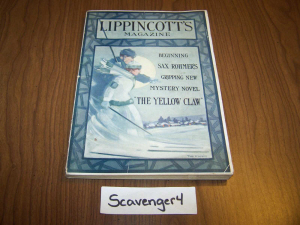
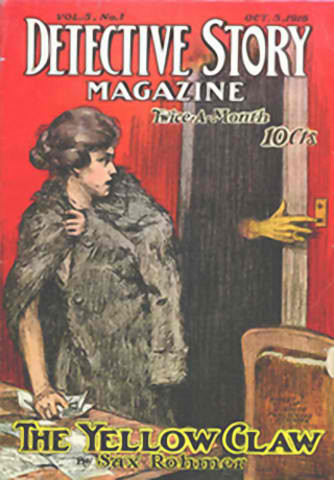
lippincott1detective-storySax Rohmer’s The Yellow Claw was originally serialized in five installments in Lippincott’s from February through June 1915. The serial was subsequently published in book form later that same year by Methuen Press in the UK and McBride & Nast in the US. The novel chooses to divide the story into four sections which is how we shall examine the title over the next four weeks.

Rohmer’s first Yellow Peril thriller outside the Fu Manchu series is chiefly remembered today for having introduced the character of his dapper French detective, Gaston Max of the Surete. Max went on to feature in three other novels [The Golden Scorpion (1918), The Day the World Ended (1929), and Seven Sins (1943)] as well as the BBC radio series, Myself and Gaston Max adapted from a series of short stories about an entirely different Rohmer character, The Crime Magnet.

Gaston Max was highly influenced by Edgar Allan Poe’s Auguste Dupin, the series detective who did much to direct the development of the mystery genre and was a primary source of inspiration for both Sir Arthur Conan Doyle’s Sherlock Holmes and Agatha Christie’s Hercule Poirot. Max was not Rohmer’s first attempt at fashioning his own French detective after Dupin’s example. His very first novel, The Sins of Severac Bablon (1912) featured Gaston Max’s prototype, Victor Lemage. The interesting feature is that while elements of Yellow Peril thrillers will surface in the book, Rohmer was trying hard to write a more conventional and realistic detective story in a direct break from the thrillers that made his name.

Read More Read More

In Defense of Elves

In Defense of Elves

hornsofruin1I’m in the middle of another book, this one my fourth, and the first in a series of four. But writers are always in the middle of a book, always writing the next book, always revising the current one. And, worst of all, always reviewing and revising and dwelling endlessly on the books of the past.

One of the great things about the Arts is that you create specific works that are pretty much a time capsule of who you were and what you were capable of doing at one discrete point in your life. Each book is a little piece of you that you leave behind in the time stream, and every time you open it you get to re-live and remember what it was like to write that book. It’s a little bit like having a conversation with a younger self.

I don’t mean to sound pretentious when I say things like that. I think too much about what it means to be a writer, how we go about coming up with worlds and gods and believable characters, and then translate those ideas into words in such a way that a reader can experience them as well. Let’s be honest, words are probably the crudest, clumsiest, most difficult to wield of all the creative arts. We depend so much on the imagination of the reader. A writer doesn’t even get to read the book to the writer, and instead has to depend on the reader’s ability to pace the sentences correctly, read the dialogue with the right tonality… everything. It’s troublesome, when you really think about it. This is why I encourage you to go to readings when you get a chance, if only to hear the words in the writer’s voice.

Anyway. One of the books I’ve written is The Horns of Ruin, which was published by the fine folks at Pyr Books in 2010. I’ve been thinking about it a lot recently because what I was trying to do when I started that book is similar to what I’m trying to do with the current work. But at some point I changed my plan and went in a different direction.

Read More Read More

Goth Chick News: Welcome to the Hotel Transylvania

Goth Chick News: Welcome to the Hotel Transylvania

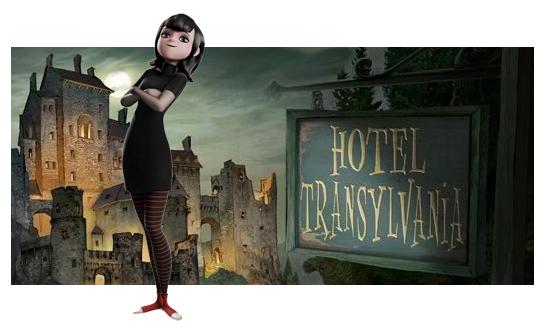
ht-bannerNothing sends me straight to my happy place faster than a cartoon; unless it’s a cartoon about monsters.

This probably started before I could walk with the Saturday-morning Bugs Bunny episodes; specifically Hair-Raising Hare featuring the first appearance of the sneaker-wearing creature “Gossamer.” As an adult I was still so enamored with Gossamer that I very nearly had him tattooed on my…

Well thankfully I decided against it.

But maybe its comic books or Captain Crunch cereal or anything related to Star Wars which does the same thing for you. You know you held onto those Dark Lord of Sith footie PJ’s and don’t try to say it was for the collectable value either.

Nowadays, what I love most about cartoons (or animated features as we now call them) is their multiple layers of humor. Just try watching those Warner Brothers shorts today and see what I mean. There was a whole different level of funny which was aimed at our parents, thus flying straight over our heads.

And happily this tradition has carried forward to features like The Incredibles and Despicable Me. I own both and even though I’ve watched them dozens of times, I still kill myself laughing over something new I hadn’t noticed before.

Read More Read More

Art of the Genre: Top 10 Literary Sci-Fi/Fantasy Covers of the 1970s

Art of the Genre: Top 10 Literary Sci-Fi/Fantasy Covers of the 1970s

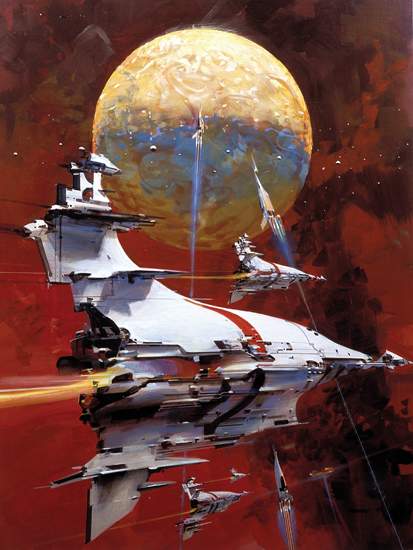
John Berkey WILL appear on this list... but where and when?

I was born in 1971, which makes me old, but not too old, at least in my mind. Although I was indeed a living creature on this planet during the bulk of the 1970s I didn’t really have much conscious thought that was dedicated to anything resembling fiction.

Sure, I saw Star Wars at the local cinema, I had the action figures, but that was about as close to anything literary as I got, the bulk of my time sucked up with Hot Wheels and green-plastic army men. However, while I was learning to walk, potty on a toilet, ride a bike, and crushing on my first girlfriend, the forces of American fantasy art were going into overdrive around me.

Truly, the 1970s was a creative bloom in fantasy and science fiction art, and although I do enjoy both the 60s and even the 50s, I think it is best I start with the decade where this genre moved from the minds of a chosen few to the big time of the greater American consciousness.

As I grew along up, my appreciation for art in general started to move me into the realm of fantasy books and their unreal covers. That’s not to say that 1970s art played directly into this progression, as I was really a child of the 1980s, but the greater knowledge I gained of the industry as a whole, the more I appreciated the groundbreaking art from the decade of my birth.

So, today, having spent nearly twenty years studying the fantasy art industry, and ten of that working directly in it, I’ve grown to love the literary art of the 1970s and wanted to share with you my thoughts concerning some of the very best it had to offer.

Read More Read More

Sawyer’s Triggers Fires on All Cylinders

Sawyer’s Triggers Fires on All Cylinders

triggers

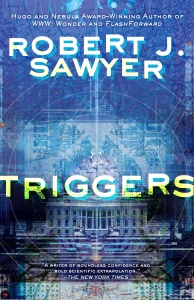
Triggers (Amazon, B&N)
Robert J. Sawyer
Ace Hardcover (352 pages, $25.95, April 2012)

Hugo- and Nebula-award-winning science fiction author Robert J. Sawyer returns with a new hard science fiction novel which pulls together elements of a gripping political thriller with cutting edge psychological insights to create a story that works on many levels. I had the pleasure of getting an advance look at Triggers over the last few months as it was serialized within the pages (digital pages, in my case) of Analog magazine. Triggers has the pacing of an episode of 24 and the philosophical sensibilities of an Isaac Asimov novel, so any readers who were introduced to Sawyer through his television series FlashForward (Amazon, B&N) will find it particularly interesting.

The Plot (High-Level Spoilers)

The novel begins in an America gripped by fear, victim of a series of domestic terrorism attacks attacks, administered with devastating explosives by an al Qaeda splinter group. During a speech about these attacks, the President is shot on the steps of Lincoln Memorial. On the brink of death, the President is rushed to a nearby hospital for life-saving emergency surgery.

Elsewhere in the hospital, an experimental procedure attempts to cure an Iraqi veteran of his PTSD.

In the middle of these two procedures, the city is struck by another devastating attack … one that leads to bizarre and unexpected side effects. A number of people within the hospital have become mentally linked, now associated in a chain where each person can access the memories of another person in the chain.

Complications continue to multiply as the President realizes that the terrorist attacks seem to be an inside job and that the key to solving them may lie in his very own memories. Memories that he is currently unable to access.

And, more importantly, memories which some unknown person now has the ability to access … along with all of his knowledge about America’s upcoming response to the terrorist attacks.

Read More Read More

Art of the Genre: The Pillaging of Kickstarter? 2: Stats & Video

Art of the Genre: The Pillaging of Kickstarter? 2: Stats & Video

Although about a post-apocalypse, Wasteland 2 wants to see Kickstarter prosper.

It’s been a very interesting two weeks since I posted up a little article on Saturday in my Kickstarter spot here on Black Gate. Usually, all my Kickstarter posts are met with a HUGE lack of readership or interest, most posting no more than two hundred reads, so I decided it wouldn’t be horribly impactful to post an article I titled The Pillaging of Kickstarter?

When I posted it at 12:01 AM on a Saturday morning, I had no idea that when I’d wake up the next day it would already be at over seven hundred reads. The article created a perfect firestorm of venom and vitriol spat in my general direction from every single soul who decided to comment on it, and let me assure you there were more than a couple.

My premise was that companies shouldn’t be on a grass roots movement crowd-funding platform like Kickstarter because it hurt smaller projects. That argument was flatly burned at the stake by all comers, but I was intrigued by the fact that no matter how villainous I seemed for saying what I did, there was no one with actual numbers to back their theory any more than I could back mine.

By Thursday that week my article had over two-thousand views, and some of my initial arguments had been refuted by inXile’s participation in a couple of things, first they were actually backing project with pledges on the platform, and second inXile CEO Brian Fargo had initiated a call for a program called Kicking it Forward in which 5% of total sales income from products produced on Kickstarter would be returned to the platform in the form of pledging.

Read More Read More

Interzone #239

Interzone #239

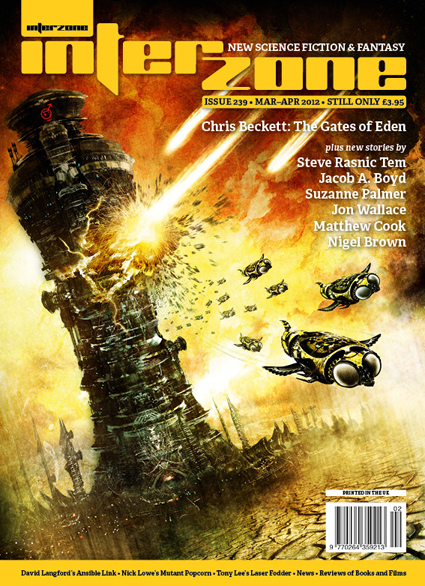
443_largeThe March-April issue of Interzone features new stories by Chris Beckett (”The Gates of Eden”), Steve rasnic Tem (”Twember”), Jon Wallace (”Lips and Teeth”), Suzanne Palmer (Tangerine, Nectarine, Clementine, Apocolypse”), Matthew Cook (“Railriders”) and Nigel Brown (“One-Way Ticket”); cover artwork by Ben BaldwinJacob Boyd (“Bound in Place”); “Ansible Link” genre news and miscellanea by David Langford; “Mutant Popcorn” film reviews by Nick Lowe; “Laser Fodder” DVD/Blu-Ray reviews by Tony Lee; book reviews by Jim Steel and other contributors.
Interzone alternates monthly publication with sister dark horror focused Black Static, published by the fine folks at TTA Press.

Wrath of the Titans Makes Me Want to Start a Hoax That It’s a Re-make

Wrath of the Titans Makes Me Want to Start a Hoax That It’s a Re-make

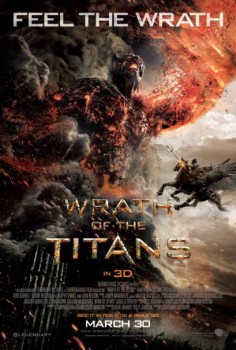
wrath_of_the_titans_9Wrath of the Titans (2012)
Directed by Jonathan Liebesman. Starring Sam Worthington, Rosamund Pike, Bill Nighy, Edgar Ramirez, Toby Kebbell, Danny Huston, Ralph Fiennes, Liam Neeson.

Well, that was trivial.

A sequel nobody demanded from a re-make nobody cared about. There’s no John Carter of Mars “never gonna see a sequel” bitterness here at all. Nope.

But there is some Ray Harryhausen gloating. While watching Wrath of the Titans, I constantly thought of reverse-engineering the movie to create the Ray Harryhausen-Charles H. Schneer original from which it was re-made. I came up with a pretty entertaining film; not as good as Jason and the Argonauts or The Golden Voyage of Sinbad, but right on the level of Mysterious Island, although lacking a Bernard Herrmann score. The scene of Perseus fighting the Minotaur in the labyrinth is one of Harryhausen’s most suspenseful an atmospheric stop-motion creations. In the re-make, the scene is sloppily tossed into the action without any tension, and then fought through without a moment of genuine excitement.

Yes, I’m criticizing this movie by comparing it to a movie that doesn’t exist. But Wrath of the Titans made me do it! It begged me to imagine this better movie from the mid-1980s, one that right now all of us would be geeking-out over on its Blu-ray tie-in release. In fact, I’m going to start an Internet hoax right here: Warner Bros.: Release Ray Harryhausen’s Original Wrath of the Titans (1985) or I Shall Release the Kraken!

Help out, spread the false word. Next year, I want people genuinely confused about the existence of an earlier movie called Wrath of the Titans. It’s almost April Fool’s day, right?

Wrath of the Titans feels exactly like what the Clash of the Titans re-make felt like when I watched it for the second time on DVD: a lifeless spectacle. I gave the re-make a decent review on Black Gate back in the day, but any critic knows that his or her first impressions do not necessarily remain constant. I cannot now, in good conscience, recommend the 2010 Clash of the Titans as even a decent time-waster. It’s a mass of digital nothing that flashed from memory the moment it was over. It is awful.

So Wrath of the Titans is no better or worse than its predecessor — it just reaches the point of minimum returns faster. As in, before the end credits roll.

Read More Read More

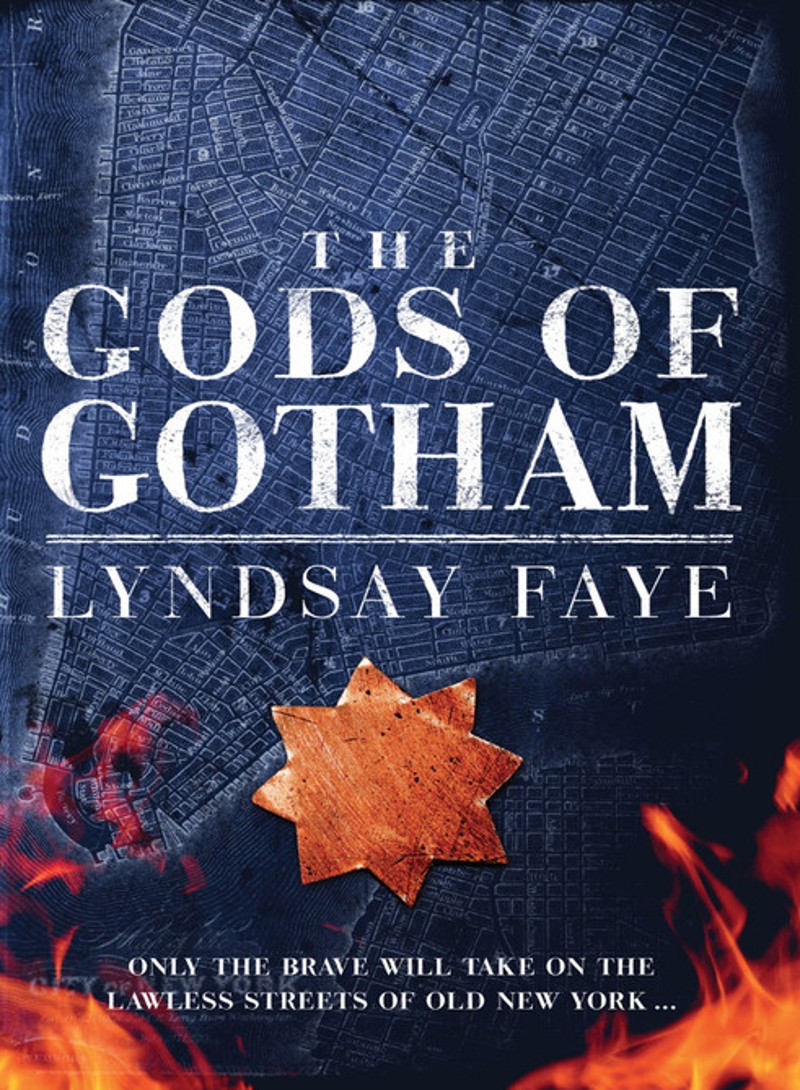
Lyndsay Faye’s The Gods of Gotham is a Modern Classic

Lyndsay Faye’s The Gods of Gotham is a Modern Classic

the_gods_of_gotham-1the-gods-of-gotham-lyndsay-fayeLyndsay Faye made quite a splash a couple years ago with her excellent Sherlock Holmes novel, Dust and Shadow. It was an impressive debut for a first-time novelist not only for taking on the world’s most famous sleuth but in choosing to have him investigate the most notorious criminal case of Victorian London. Holmes had, of course, already tackled Jack the Ripper in A Study in Terror which came off as an exceptionally good Holmes film and novelization (by Ellery Queen, no less) in the mid-sixties. What could this ambitious young woman bring to the Ripper case that Alan Moore or Nicholas Meyer had not already covered in From Hell and Time After Time, respectively? Quite a lot, it turned out. Ms. Faye delivered a cracking good mystery and an excellent piece of historical fiction in one turn. The question was how to follow her success.

Another Holmes story for an anthology that was published hot on the heels of her first book was taken as proof of her intent to join the ranks of the multitude of successors continuing the exploits of Sir Arthur Conan Doyle’s immortal consulting detective. In a sense, Ms. Faye has done just that with her newly-published and wholly original sophomore effort, The Gods of Gotham. Her new series hero, Timothy Wilde, is a character Conan Doyle would have been proud to call his own and is not without his parallels to the famous resident of London’s Baker Street.

Read More Read More