The Wily Dalilah: Arabian Nights Feminist
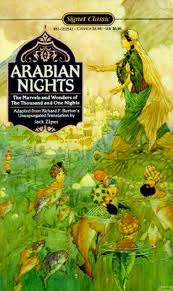
In a work as varied as The Arabian Nights there are naturally some portions more popular than others, probably because some are more easily adapted into standalone tales of adventure. I think we in the West are more familiar with the Nights as a concept than a whole, and many of us have only read or watched adaptions of the most famous of the tales.
Don’t presume that means that the best of the stories have all been filmed and that there is no point reading the rest. There are plenty of excellent, lesser known yarns within, and surely part of the fun of reading the nights is watching the puzzle box interrelation of stories within stories within stories. Admittedly, there are some portions that I don’t like as well and don’t revisit, as with any short story anthology, and many people feel the same, although you’re likely to get a slightly different list of favorites from whomever you speak with.
Today I want to draw attention to one of my favorite sections, “The Wily Dalilah and Her Daughter Zaynab.” If you’ve ever read my musings, you might expect this to be a tale of swashbuckling adventure set in distant locales, swimming with magic rings and djinn and evil wizards. “The Wily Dalilah,” though, is set only in Baghdad, and there is no magic to speak of within the entire story. There are no daring princes with swords, or mysteries, only a clever old woman running a series of con games. Over the course of the narrative, Dalilah, with occasional aid from Zaynab, foments so much trouble in Baghdad that she draws down the attention of the caliph himself.




 This post is part of an ongoing series about fantasy and the literary movement called Romanticism; specifically, English Romanticism in the late eighteenth and early nineteenth centuries. The series began with
  You know the prologue. Contracting an illness (possibly scarlet fever or meningitis) at the age of nineteen months, Helen Adams Keller survived, but was left both deaf and blind. Keller’s parents would eventually contact Anne Sullivan, herself blind, to tutor their daughter (who, at the age of six, still had not grasped the concept of words representing things). By pressing her hand into the girl’s palm, Sullivan was able to teach the girl to read sign language through touch. After that breakthrough, Helen Keller went on to write twelve books, meet thirteen U.S. Presidents, help found the American Civil Liberties Union, and introduce the Akita breed of dog to the United States.