Browsed by
Author: John ONeill

Howard Waldrop’s “The Ugly Chickens”

Howard Waldrop’s “The Ugly Chickens”

universe-10I’ve been reading a lot of short fiction recently. It started as I was putting away a collection of Worlds of IF magazines and dawdled over the April 1970 issue, with Ron Goulart’s tale of casual wife-swapping, “Swap,” which I talked about here. The same thing happened with Octavia E. Butler’s “Bloodchild” (in the June 1984 issue of Isaac Asimov’s Science Fiction Magazine), and then George R.R. Martin’s “Nightflyers” (Analog, April 1980). And my wife wonders why it takes me two hours to put away a dozen magazines.

It happened again today, this time with Howard Waldrop’s “The Ugly Chickens,” which also originally appeared in 1980, in the tenth volume of Terry Carr’s long-running Universe anthology series. I read it in Donald A. Wollheim’s The 1981 Annual World’s Best SF, where it had this introduction:

Science Fiction is subject to many definitions and there are some that are so specific that they might exclude this unusual story. But if science fiction deals with the probable that is just beyond the newspapers or with things that might have happened — even though they did not shake the world — then this is truly science fiction.

“The Ugly Chickens” won the Nebula Award for best novelette, and the World Fantasy Award for Short Fiction. There are times when I look around at my collection of science fiction and fantasy, and wonder if I’ve wasted my time gathering such a concentration of work in relatively few genres. Then I read something like Howard Waldrop’s “The Ugly Chickens.” If even a fraction of the unread books in my collection have the charm and wonder of this story, then I’m certain I’ll never grow tired of it.

Read More Read More

New Treasures: Best New Werewolf Tales, edited by Carolina Smart

New Treasures: Best New Werewolf Tales, edited by Carolina Smart

best-new-werewolf-tales1It’s Thursday, so I must be Goth Chick. Sadly, I am not. Last night Goth Chick received reports of a possible sighting of the Jersey Devil in Skokie, Illinois, and she immediately leaped in the Gothmobile to investigate. At the moment, she’s diligently exploring the back alleys of the Chicago suburbs with an EMF detector and a Piña colada.

Frankly it all sounds dubious to me, but maybe that’s because I’m left holding the bag for the Thursday blog entry. “Uphold my fine journalistic standards — I will countenance nothing less,” said her last text. Had to look up “countenance,” which didn’t bode well.

Luckily, Toronto-based Books of the Dead Press came to my rescue with a well-timed announcement this week, promoting six new releases.

Founded in 2009, Books of the Dead Press is one of the most active small presses around. They’ve already released eight books this year; some of their recent titles include Berserk by Tim Lebbon; Husk by Matt Hults; Gary Brandner’s The Howling Trilogy, Pain Cages by Paul Kane, Badass Zombie Road Trip by Tonia Brown, and the Zombie Kong anthology, edited by James Roy Daley.

But the title that really grabbed my attention was Best New Werewolf Tales, Volume 1, edited by Carolina Smart, which was released in paperback and Kindle format in May. Following on the heels of their popular anthologies Best New Zombie Tales and Best New Vampire Tales, this one contains “more than 100,000 words of ferocious, slavering, hairy horror” from Jonathan Maberry, Michael Laimo, John Everson, James Newman, David Niall Wilson, and many others — 20 short stories altogether.

The fiction appears to be all new (not reprints). The cover art is by Carl Graves. You can find the complete Table of Contents at the Books of the Dead website here.

“Ferocious, slavering, hairy horror.” That’s gotta be better than whatever Goth Chick finds in Skokie, no matter how good that EMF detector is. I tell you, good things come to he who waits. And who patiently checks his e-mail.

Best New Werewolf Tales is available for $9.99 in paperback and $3.49 in Kindle format. You can purchase both at their online store.

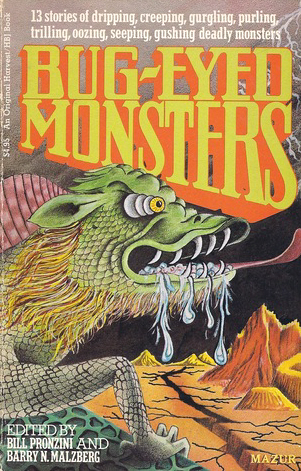
Vintage Treasures: Bug-Eyed Monsters, edited by Bill Pronzini and Barry N. Malzberg

Vintage Treasures: Bug-Eyed Monsters, edited by Bill Pronzini and Barry N. Malzberg

bug-eyed-monsters2Last week I posted a brief article on Damon Knight’s landmark SF anthology, A Science Fiction Argosy (and I mean that in the literal sense — it’s so large that for years I used it as a visual landmark when scanning my bookshelves.) The first response in the Comments Section was from the esteemed John C. Hocking, who wrote:

Some years back I read the anthology Bug-Eyed Monsters, edited by Bill Pronzini and Barry Malzberg, which leads off with Knight’s story “Stranger Station.”

This story knocked me out of my chair.

It is not a clever punch-line kind of tale, it’s a bravura piece of serious space operatic sf with strong characters, a vivid setting, genuinely alien horror, and a plot that manages to make the outcome of a single character’s dire situation a crux of cosmic importance without pushing the whole tale into wide-eyed melodrama.

The other stories in the collection were worth reading, but Knight’s tale put them deep in the shade.

So naturally I had to dig up my copy of Bug-Eyed Monsters, a 1980 Harcourt Brace Jovanovich trade paperback, to see what all the fuss was about. First thing I noticed was the Ruby Mazur cover. Mazur, who created over 3,000 album covers, was one of the most famous rock ‘n’ roll cover artists of the 70s and 80s. His work here is serviceable but not particularly attractive, with a rather drooly BEM lording it all over a pulpy alien landscape.

But we’re here to talk about “Stranger Station,” not 70s cover art, and Mr. Hocking is right that Damon Knight’s story, which first appeared in 1956 in F&SF, is a fine piece. The editors give it pride of place as first in the anthology, calling it “a virtuoso performance — arguably, one of the two finest BEM stories ever written (the other being, of course, H.G. Wells’s The War of the Worlds.)”

Read More Read More

July/August Fantasy & Science Fiction Magazine now on Sale

July/August Fantasy & Science Fiction Magazine now on Sale

fantasy-and-science-ficiton-july-aug-2012Nice creepy cover on the new issue of Fantasy & Science Fiction. This one is by Ed Valigursky; click for a bigger version. Great line of writers this issue too, including Kate Wilhelm, Eleanor Arnason, Jeffrey Ford, Matthew Hughes, Rachel Pollack, Albert E. Cowdrey, and many others. Check out the TOC:

NOVELLAS

  • “The Fullness Of Time” – Kate Wilhelm

NOVELETS

  • “Wearaway and Flambeau” – Matthew Hughes
  • “The Afflicted” – Matthew Johnson
  • “Jack Shade in the Forest of Souls” – Rachel Pollack

SHORT STORIES

  • “Hartmut’s World” – Albert E. Cowdrey
  • “The Woman Who Fooled Death Five Times” – Eleanor Arnason
  • “A Natural History of Autumn” – Jeffrey Ford
  • “Wizard” – Michaele Jordan
  • “Real Faces” – Ken Liu

The tireless Lois Tilton has already reviewed the issue in detail at Locus Online, calling this one “A superior issue… most notably a fine novella by Kate Wilhelm and a short anthropological tale by Eleanor Arneson.” Here’s what she says about Matthew Hughes’ “Wearaway and Flambeau,” a far-future tale of Raffalon the thief:

This time, Raffalon has been nabbed in the act of breaking into the well-warded stronghold of the wizard Hurdevant the Stringent. The wizard employs an experimental punitive spell, which, fortunately for the thief, goes awry in a manner that offers unexpected possibilities. Entertaining stuff. The editorial blurb claims that this one is set in the author’s far-future universe, but it seems like a typical fantasy world of the sort with wizards and thieves.

The cover price is $7.50, for a thick 258 pages. Additional free content at the F&SF website includes book and film reviews by Charles de Lint, Michelle West, and Lucius Shepard; a Science column, “Quicksand and Ketchup,” by Pat Murphy and Paul Doherty; and the “Curiosities” column by the talented Bud Webster. We last covered F&SF here with the May/June issue.

Samurai 7: Swords and Sorcery with Killer Robots

Samurai 7: Swords and Sorcery with Killer Robots

samurai-7It was my daughter’s 13th birthday yesterday. One of the things she wanted was the 2004 anime series Samurai 7, which her brother Tim gave her in a handsome Blu-Ray package.

As the parents of most young girls will tell you, it’s not enough to get them a few presents and a hug for their birthday. What they really want is attention. And what Taylor really wanted was for Dad to watch Samurai 7 with her.

Which I did. All 3.6 hours of Disk One, a full nine episodes. Let’s face it — the days when my teenage daughter will want to hang out with me are coming to an end; better seize them while I can.

I’m glad I made the effort to spend time with her. For lots of good reasons, not least of which was that Samurai 7 turned out to be a terrific piece of animated cinema. A lot more enjoyable than those two hours I spent playing dolls when she turned six, let me tell you.

I knew the basic premise before parking my butt on the couch. Like Yul Brynner’s classic Western The Magnificent Seven, Samurai 7 is directly inspired by Akira Kurosawa’s 1954 film Seven Samurai, one of the most influential films ever made.

A small group of peasants whose town is ruthlessly pillaged by bandits every year journey to the city to hire seven masterless samurai to defend their village. Desperate and poor, all they can offer these samurai is rice — and not very much of it.

Seven Samurai is set in sixteenth-century feudal Japan; Samurai 7 translates the classic story to a post-apocalyptic world of towering, decrepit cities and a blasted landscape dotted with the twisted debris of a recent war.

Read More Read More

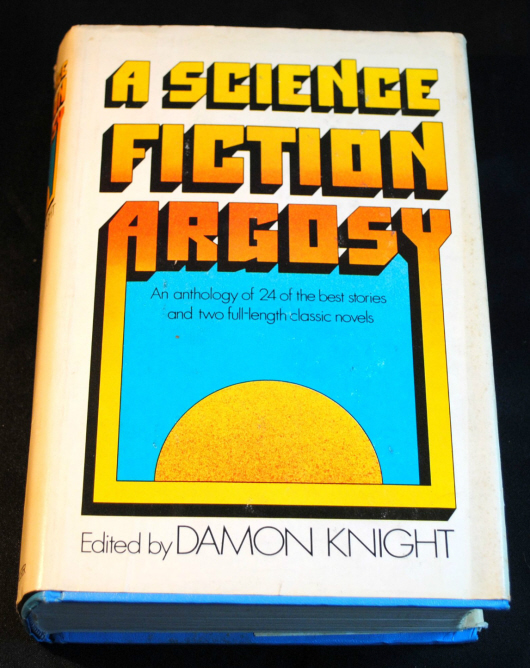
Vintage Treasures: A Science Fiction Argosy, edited by Damon Knight

Vintage Treasures: A Science Fiction Argosy, edited by Damon Knight

a-science-fiction-argosy2Damon Knight’s massive anthology A Science Fiction Argosy was published in 1972, when I was eight years old. It’s over 800 pages, packed with 24 novellas and short stories plus two complete novels, Theodore Sturgeon’s More Than Human and The Demolished Man by Alfred Bester. It’s one of those big, heavy books I’d often glance at on my bookshelf, thinking “I should really read that. As soon as I finish this game of Solitaire.”

I know Damon Knight mostly as an editor — of the highly acclaimed Orbit series, and dozens of other SF anthologies — but he was also a novelist and short story writer. Late in his career he wrote some exceedingly weird SF novels. Check out the article I published at SF Site in 1997, Jim Seidman’s review of his last novel Humpty Dumpty: An Oval, which centers on a lingerie salesman whose skull is fractured by a stray bullet, and who abruptly finds himself dodging both deadly meteorite storms and the society of dentists that secretly rules the world. Glad Jim read it, as I’m sure he made more sense out of it than I would have.

Damon Knight was also a highly respected critic, famous for his dislike of popular pulp writer A. E. van Vogt (“A pygmy who has learned to operate an overgrown typewriter”), for founding the Science Fiction and Fantasy Writers of America, and co-founding both the Milford Writer’s Workshop and the Clarion Writers Workshop. He was a busy guy.

I finally started reading A Science Fiction Argosy this morning (after blowing nearly four decades of dust off it). And you know what? It’s pretty good. I was particularly charmed by Knight’s introduction, which can be nicely encapsulated with its first and last sentences:

Some few years ago, when I was only teen-aged science fiction addict in Hood River, Oregon, I prowled the stacks of the local library… like a pornographer looking for pornography, I ferreted out science fiction… but I never got enough…

This is the kind of big meaty selection I wish someone had given me when I was a teen-aged science fiction addict in Hood River, Oregon.

That may be the most honest intro I’ve ever read, and it explains a good deal about what Knight was trying to accomplish with A Science Fiction Argosy — and indeed, perhaps, his entire life as a critic and highly vocal advocate for science fiction. The first story, John Collier’s “Green Thoughts,” is from 1931, but the anthology quickly leaps forward (skipping nearly the entire pulp era) to 1949 for the second, Isaac Asimov’s talky SF puzzler, “The Red Queen’s Race.” Henry Kuttner and C.L. Moore’s “The Cure” is even better, a dark and twisted fantasy of a New York lawyer trying to understand an oddly recurring hallucination of suffocation.

That puts me barely 50 pages in. I’m tempted to stop here and write a review, but Knight the critic would not be impressed. So I’ll reserve final judgment until I turn a lot more pages. In the meantime, consider this un-critical word of advice: find your own copy, and don’t wait as long as I did to crack it open.

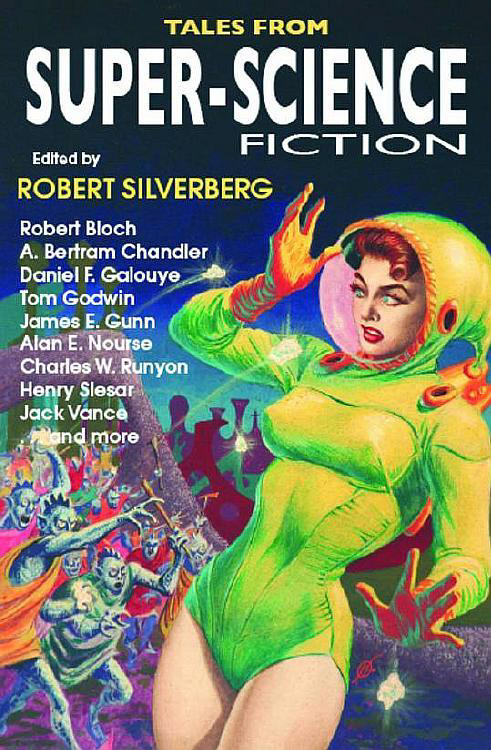
New Treasures: Tales From Super-Science Fiction, edited by Robert Silverberg

New Treasures: Tales From Super-Science Fiction, edited by Robert Silverberg

tales-from-super-science-fiction2You really have to admire the team at Haffner Press. These guys must work night and day. Hot on the heels of their last release just two months ago — the gorgeous Kuttner collection Thunder in the Void — they’ve now published Tales From Super-Science Fiction, a thick anthology of fourteen stories from the legendary 50s SF magazine Super-Science Fiction. I’m not sure how they do it.

As usual the team at Haffner is firing on all cylinders, and both the marketing team and the production staff deserve kudos for a top-notch production. The Art Director and Book Designer have hit it out of the park, and —

What’s that? There is no “team” at Haffner Press? It’s just one guy, Stephen Haffner?

Ha. Like I’m going to believe that. Just take a look at their schedule of upcoming titles. There’s nearly a dozen. Maybe Stephen is the front man, but nothing can convince me he doesn’t have two dozen gnomes in a sweatshop in his basement. There’s no other explanation.

However he does it, I hope he keeps it up. Tales From Super-Science Fiction contains fiction by A. Bertram Chandler, Robert Bloch, Jack Vance, Robert Moore Williams, Daniel L. Galouye, Alan E. Nourse, Tom Godwin, Robert Silverberg, and others. Here’s the book description:

Super-Science Fiction was launched during the sf boom of the mid-1950s. Paying a princely rate of 2 cents a word the magazine attracted fiction by Isaac Asimov, Robert Bloch, Harlan Ellison. James Gunn, Jack Vance, and Donald Westlake, and featured cover art by Frank Kelly Freas and Ed Emshwiller. Running for 18 bi-monthly issues (Dec ‘55 to Oct ‘59), the magazine eventually devolved into a publication capitalizing on the then-current craze of “monster” stories. Editor Silverberg traces the genesis of Super-Science Fiction from its beginnings as an outlet for numerous colonization/expedition stories to its conclusion with such stories as “Creatures of the Green Slime,” “Beasts of Nightmare Horror” and “Vampires from Outer Space.”

Tales From Super-Science Fiction is 400 pages, with a cover price of $32. It is illustrated by Ed Emshwiller and Frank Kelly Freas, with cover art by Freas. You can find the complete Table of Contents at the Haffner website.

See the complete list of recent New Treasures here.

Reimagining Star Wars as West Wars

Reimagining Star Wars as West Wars

west-wars-vaderI usually ignore the endless stream of Star Wars fan creativity here on the blog — Lego remakes, the Silent Star Wars, and numerous others. Black Gate is all about shining a light on neglected fantasy… if you think Star Wars is neglected, it’s because you’re blind and deaf and you live on Easter Island.

But every once in a while a simple idea comes along that reduces me to a 12-year old Star Wars fanboy again. That’s what happened yesterday when I discovered Sillof.com, the brainchild of Indianapolis, IN, sculptor Sillof, who specializes in making custom action figures and also makes props for films.

Sillof has created a line of action figures called West Wars, featuring a brilliantly realized cast: Luke S. Walker, a young man living on the outer borderlands with his poor aunt and uncle, Leah Orango, daughter of one of the most prominent ranch families in the territory, “Old” Bennet Kennelly, one-time sheriff who was driven into hiding when his former deputy turned on him, and the villainous Sheriff Akan “Death” Vardas, enforcer for the corrupt robber barons and railroad tycoons.

The entire cast is instantly recognizable, even though they’re all in period garb. Sillof has done the same with other periods, giving names and faces to the cast of Samurai Wars, World Wars, Noir Wars, Serial Wards, and others.

Besides making me daydream of someday watching a version of Star Wars set in a western town — sort of like watching MacBeth set during the US Civil War, or Romeo & Juliet in 1950s Brooklyn, both of which I have done — Sillof’s creations remind us just how universal the themes of Star Wars are. And in fact, just how fluid story is… how easy it can be to move the props of narrative to a different stage to make it fresh spin.

Not to mention that they vindicate a decades-long fascination with action figures. Thanks, Sillof!  You the man.

Vintage Treasures: George R.R. Martin’s “Nightflyers”

Vintage Treasures: George R.R. Martin’s “Nightflyers”

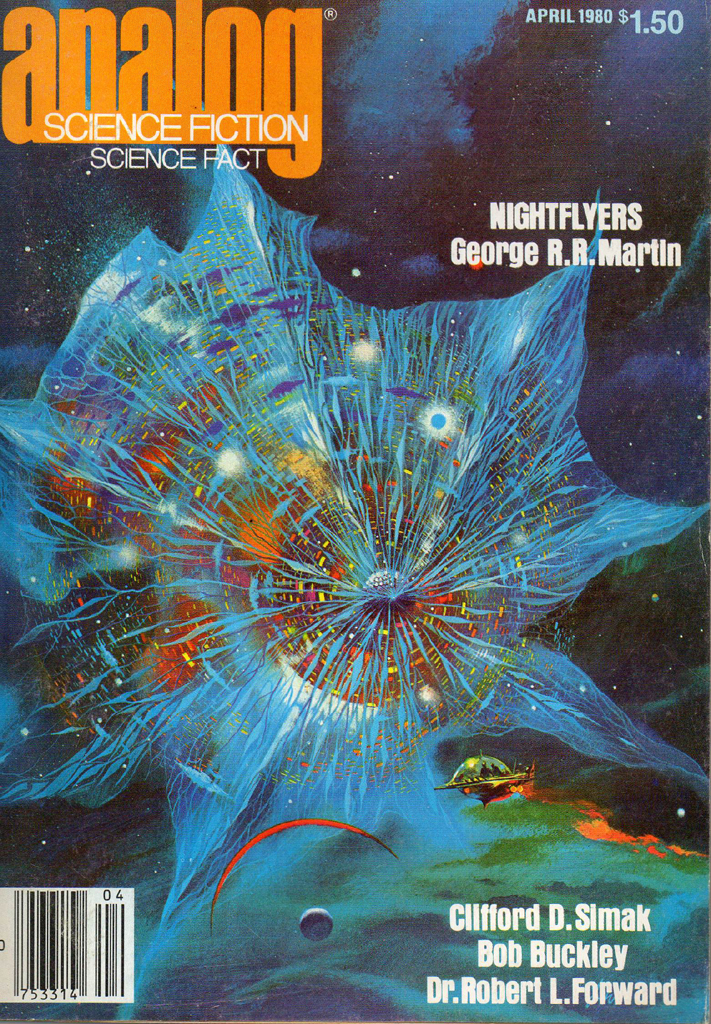
analog-april-1980-smallOver the weekend I put away a collection of 80s magazines I purchased a few months ago. In the process I discovered the April 1980 issue of Analog, which I read as a junior in high school in Ottawa, Canada.

There’s a lot to like about this issue, from the gorgeous cover by Paul Lehr — perhaps my favorite SF artist — to a famous short story by one of my all-time favorite SF writers: “Grotto of the Dancing Deer,” by Clifford D. Simak, which won both the 1980 Nebula Award and 1981 Hugo Award for Best Short Story. Even the ads reflect those things I personally found most exciting and fresh about SF and fantasy at the time: a full page ad from TSR for D&D, “The Ultimate in Adventure Games;” an ad for six microgames from Metagaming (the company that introduced me to role playing games), including the classic Ogre; and a subscription form for Ares, the short-lived SF gaming magazine from SPI.

This issue is an intriguing cultural artifact for other reasons. There’s an editorial from Stanley Schmidt in response to the recent kidnapping of 50 Americans at the US embassy in Iran, both a fascinating snapshot of a critical moment in American history, and a typical science fiction response:

What the Iranian crisis really demonstrates, at least as dramatically as any incident so far, is that if we want real freedom, we must produce our own energy… Technologies which can do this are possible, and we should not willingly settle for less. Readers of this magazine are well acquainted with the role space can play, but many people are not — and we need to get the action under way now.

If you read Analog in the 20th Century, you got used to this. Exploring space was pretty much the answer to everything — the energy crisis, the hole in the ozone, foreign policy crises, and crappy network television programming — and the magazine’s self-congratulatory tone clearly told its readership (including 15-year-old readers in Ottawa) that they were smarter and more informed than everyone else, especially on science and technology, topics far more important than cars, sports, and other things kids our age obsessed about. Analog told its readers they were destined for success. The future was ours.

But the real reason this issue is remembered is its cover story, George R.R. Martin’s novella of horror in deep space, the chilling classic “Nightflyers.”

Read More Read More

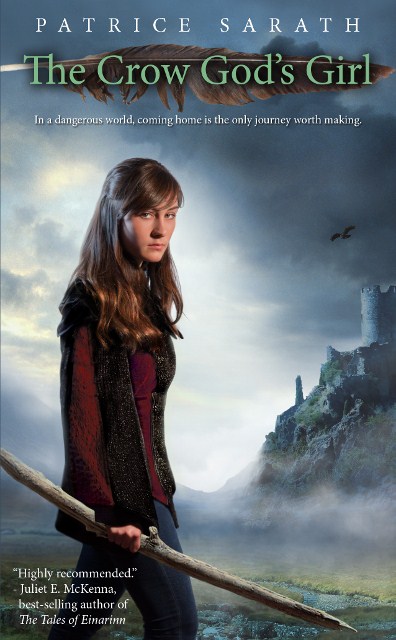
New Treasures: Patrice Sarath’s The Crow God’s Girl

New Treasures: Patrice Sarath’s The Crow God’s Girl

the-crow-gods-girl-patrice-sarathPatrice Sarath has had an enviable career. Her contribution in Black Gate 4, “A Prayer for Captain LaHire,” the tale of three knights and followers of Joan of Arc who discover the horror a fourth disciple has unleashed, was one of the most acclaimed stories from our early years and was reprinted in Year’s Best Fantasy 3 (2003). She edited the anthology Tales From The Secret City in 2007.

She turned to novels in 2008 with Gordath Wood, a book she describes as “hard to categorize:”

It’s fantasy but with only a touch of magic to it. It has romance, but is not a romance (a very different beast). It has a murder-kidnap mystery in it. Basically it has all of the elements of books I like to read. And although everybody has different tastes, I am betting that more than a few of you also like your books the same way I do — shaken and stirred. So if you like fantasy-mystery-romance novels, this one’s for you.

Gordath Wood was well reviewed and spawned a sequel, Red Gold Bridge, in 2009. In 2011 she published The Unexpected Miss Bennet, a Pride & Prejudice sequel which follows middle sister Mary Bennet, the most misunderstood of the Bennet sisters.

Now she’s turned to digital books with a second sequel to Gordath WoodThe Crow God’s Girl. When Lord Terrick’s youngest son is kidnapped, teenage Kate Mosland teams with a mysterious young girl named Ossen to execute a daring rescue… an action with unexpected consequences. As the kingdom stands on the brink of war and Terrick demands Kate submit to a new role, Kate finds that another daring and unexpected action may be the only way to find her true home.

The Crow God’s Girl is 326 pages and was published June 6, 2012. It is available via Amazon Kindle for $3.99.