Browsed by
Author: John ONeill

Vintage Treasures: Gaslight Tales of Terror, edited by R. Chetwynd-Hayes
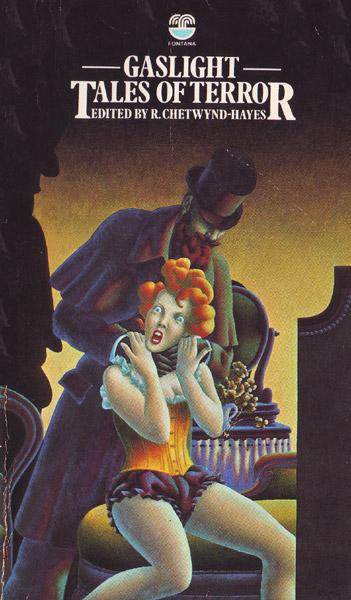
Vintage Treasures: Gaslight Tales of Terror, edited by R. Chetwynd-Hayes

Gaslight Tales of Terror-smallI don’t know much about British ghost story writer R. Chetwynd-Hayes. According to his entry at the Internet Speculative Fiction Database, he produced ten novels and two dozen short story collections between 1959 and 2001, the year he died. That’s a heck of a lot of ghost stories.

I did know he was a prolific and important anthologist. He took over The Fontana Book of Great Ghost Stories from editor Robert Aickman with number nine in 1973, bringing the series to 20 volumes before it ended in 1984, and he edited six volumes of the Armada Monster Book between 1975 and 1981. He also produced five standalone horror anthologies with Fontana, including Cornish Tales of Terror (1970), Scottish Tales of Terror (1972), Welsh Tales of Terror (1973), and Tales of Terror from Outer Space (1975).

The last in the series was Gaslight Tales of Terror (1976), a marvelous mix of original and classic spooky tales. Here’s R., from his introduction:

Here are fourteen Gaslight Tales of Terror, including one or two oil lamps and a few guttering candles. With one exception all the stories have either a Victorian or Edwardian background… But although — if newspaper reports are to be believed — ghosts and other horrors have not been exorcised by the advent of space travel and colour television, one feels they were more at home during the reign of Queen Victoria. And I do mean at home: in pea-souper fogs, on gloomy streets where the lamp-lighter with his long pole trudged wearily from post to post, and a potential Jack the Ripper lurked in dark alleyways.

Eight tales are original to this volume, including contributions from J. Sheridan Le Fanu, Roger Malisson, Dorothy K. Haynes, Rosemary Timperley, and a vampire tale from Chetwynd-Hayes himself.
Read More Read More

New Treasures: The Vampire Archives, edited by Otto Penzler

New Treasures: The Vampire Archives, edited by Otto Penzler

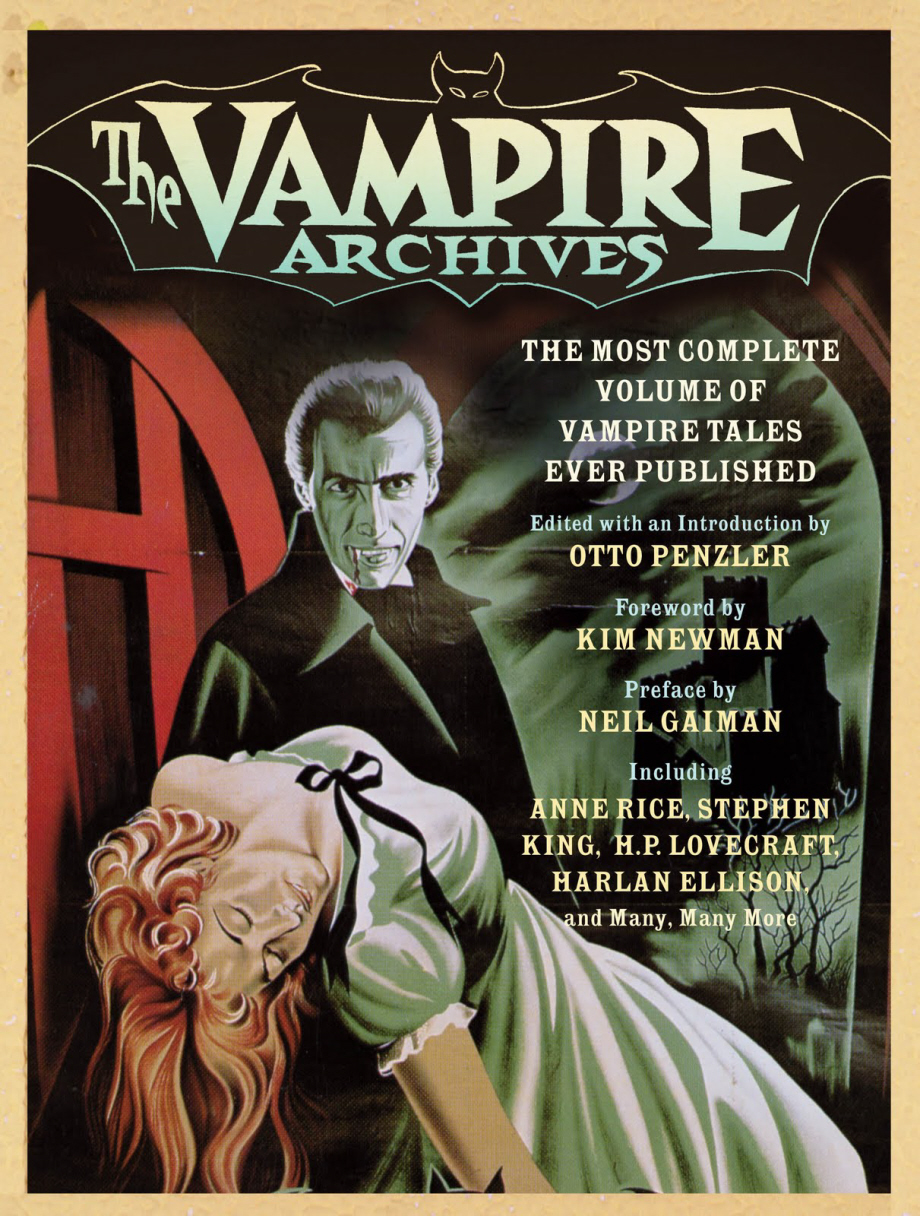
The Vampire Archive-smallLast week I wrote a brief piece on Otto Penzler’s marvelous The Big Book of Adventure Stories, and I’ve been having so much fun with it that I decided to look at some of his other door-stopper genre anthologies. So here we are this week with The Vampire Archives, one of the best collections of vampire stories I’ve ever encountered.

What makes it so great? It’s over 1,000 pages of the finest vampire fiction ever written, old and new, in a beautiful and inexpensive package. This is the only volume you need to bring yourself up to speed on vampire lit of the 18th, 19th, 20th and 21st centuries — no small claim.

It includes the classics you’d expect, like John Keats’ 1820 poem “La Belle Dame sans Merci,” Guy de Maupassant’s “The Horla,” and “The Girl with the Hungry Eyes” by Fritz Leiber — as well as many that you might not, like Ambrose Bierce’s 1891 tale “The Death of Halpin Frayser,” an excerpt from Lord Byron’s poem “The Giaour,” “Ligeia” by Edgar Allan Poe, “The Lovely Lady” by D. H. Lawrence, and even a Sherlock Holmes tale, “The Adventure of the Sussex Vampire” by Arthur Conan Doyle.

There’s a generous selection of fiction from the pulps, including “Stragella” by Hugh B. Cave, “Revelations in Black” by Carl Jacobi, “When It Was Moonlight” by Manly Wade Wellman, and Clark Ashton Smith’s Averoigne tale “The End of the Story.”

Read More Read More

Vintage Treasures: Shardik by Richard Adams

Vintage Treasures: Shardik by Richard Adams

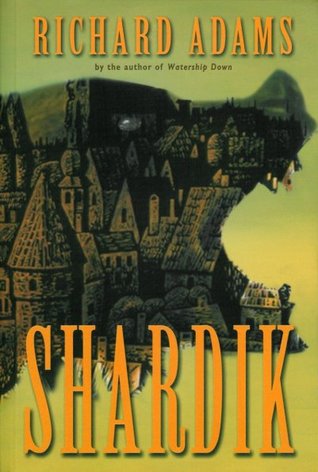
Shardik-smallI’m frequently asked what my favorite fantasy novel is. I don’t have a standard answer — some days it’s The Lord of the Rings, some days Bridge of Birds. If I can get away with it, I sometime say Lord of Light, although that’s secretly science fiction (shhh).

But as the years go by, more and frequently I find myself saying Watership Down, by Richard Adams.

Watership Down is a brilliant book — wholly original, uniquely English in both setting and viewpoint, and possessed of the most exciting and satisfying climax I’ve ever read (go Bigwig, you magnificent Owsla, you.) But it’s far from Adam’s only fantasy novel — or even his only worldwide fantasy bestseller. He also wrote The Plague Dogs, the tale of two dogs on the run from a secretive testing facility in Britain; Traveller, a retelling of the American Civil War through the eyes of Robert E. Lee’s favorite horse; the massive Maia, the story of a sex slave in a fantasy empire; and his short story collection Tales from Watership Down.

And in 1974, only two years after Watership Down, he produced perhaps his most ambitious novel, the epic fantasy Shardik, which The Wall Street Journal said “Grips with suspense, haunts with mystery… not to be read once but to be reread as loved books are.”

Shardik struck a chord with readers after it appeared. Fantasy fans expected another animal fantasy, but perhaps weren’t expecting the depth of world-building and political intrigue in Adams’ Beklan Empire, or his powerful antagonist, the giant god-bear Shardik.

Read More Read More

New Treasures: Bone Dance by Emma Bull

New Treasures: Bone Dance by Emma Bull

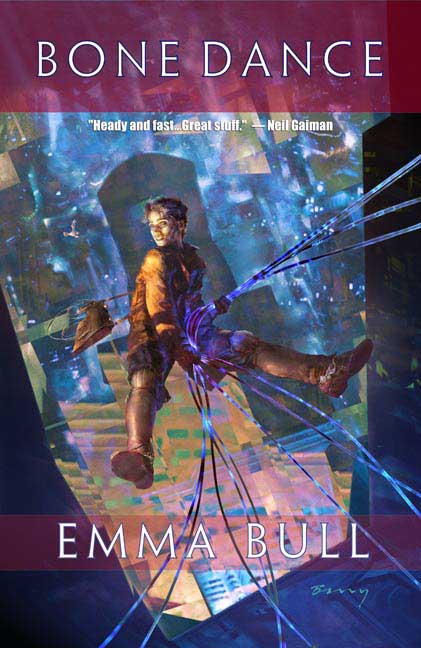
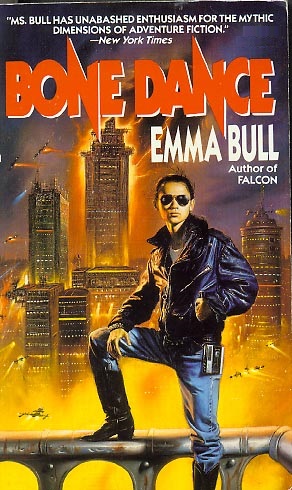
Bone Dance Emma Bull-smallI’m not all that familiar with the fantasy of the 90s. That’s the decade I graduated, got a job, got married, had three kids… and my leisure reading time fell to zero. Things got better after the year 2000 as life settled back into a routine, but when I look back at the major publishing events of that decade, things are still kinda fuzzy.

Fortunately, I’m not the only person working at Black Gate. In fact, I’m surrounded by annoying young people who first discovered fantasy in the 90s, and devoured everything on the shelves. I can’t walk to the water cooler without overhearing them go on and on about the books that first turned them into fantasy fans. And the more I listen, the more I realize that they’re talking about Emma Bull.

Emma Bull is not a prolific writer. Her first novel War for the Oaks made a huge splash in 1987; it was followed by Falcon (1989), Bone Dance (1991), Finder (1994), The Princess and the Lord of Night (1994), Freedom and Necessity (1997, co-written with Steven Brust) and Territory (2007). I finally decided it was time to find out how someone can win over an entire generation with half a dozen fantasy novels, and figured I’d start with Bone Dance.

Sparrow’s my name. Trader. Deal-maker. Hustler, some call me. I work the Night Fair circuit, buying and selling pre-nuke videos from the world before. I know how to get a high price, especially on Big Bang collectibles. But the hottest ticket of all is information on the Horsemen — the mind-control weapons that tilted the balance in the war between the Americas. That’s the prize I’m after.

But it seems I’m having trouble controlling my own mind. The Horsemen are coming.

Bone Dance was nominated for a ridiculous number of awards — the Hugo, Nebula, World Fantasy, Locus, and even the Philip K. Dick Award. It was originally published in paperback by Ace in May, 1991, with a typical 80s art by Jean Pierre Targete, who looked like he was trying to paint Corey Hart on the cover. It was reprinted in a handsome trade paperback edition by Tor/Orb Books on July 7, 2009, and this cover has much more of a YA feel — and a new subtitle: “Fantasy for Technophiles.” Bone Dance is 317 pages, priced at $15.99 in trade paperback, or $7.99 for the digital edition. I bought a discounted trade edition at Amazon for just $6.40 — copies are still available if you act fast.

C.S.E. Cooney’s “Martyr’s Gem” Acquired for Rich Horton’s The Year’s Best Science Fiction & Fantasy 2014

C.S.E. Cooney’s “Martyr’s Gem” Acquired for Rich Horton’s The Year’s Best Science Fiction & Fantasy 2014

The Year's Best Science Fiction & Fantasy 2014We were very pleased and proud to hear reports this morning that editor Rich Horton has acquired C.S.E. Cooney’s novella “Martyr’s Gem” for his annual collection, The Year’s Best Science Fiction & Fantasy 2014.

Yay!! Drinks are on us!1

“Martyr’s Gem” was originally published in Ann Leckie’s online magazine GigaNotoSaurus in May of last year. Giganotosaurus publishes one longish fantasy or science fiction story every month, including the Nebula nominees “All the Flavors” by Ken Liu, and “The Migratory Pattern of Dancers” by Katherine Sparrow. If you can’t wait for the book, you can read the complete “Martyr’s Gem” here.

There’s a marvelous animated excerpt narrated by Ms. Cooney, “The Epic of Shursta Sharkbait,” here. Sara Norja at Such Wanderings pretty much summed up our feelings when she said:

It’s a gorgeously written story with characters that jumped off the screen and will linger in my mind for a good while, I suspect. The island culture she’s created is fascinating and vibrant. Sharks and gemstones! Bantering, loving sibling relationships! A society where men and women are pretty equal! An interesting oral storytelling culture and stories-within-stories! I love pretty much everything about this novella. Go forth and be immersed!

It’s fairly unusual for a 19,000-word novella to make it into a Year’s Best volume, so this is something to celebrate. Rich Horton’s volumes are our favorite Year’s Best anthologies out there; the 2014 edition is due in May. We covered the 2013 edition here.

We published C.S.E. Cooney’s novella “Godmother Lizard,” which Tangent Online called “a delightful fantasy… [it] entranced me from the beginning,” and the sequel “Life on the Sun” — which Tangent called “bold and powerful… this one captured a piece of my soul. Brilliant.”


1. Must be of legal drinking age. Must realize we’re joking. Offer not valid outside the continental U.S.A. Or anywhere that serves alcohol.

Vintage Treasures: The Witches of Karres by James H. Schmitz

Vintage Treasures: The Witches of Karres by James H. Schmitz

The Witches of Karres-smallSo I tried to hit all the genre classics in my early days as an SF and fantasy reader, and I think I did a pretty fair job . Sure, I have a few gaps here and there, but overall I think I managed to read the ones that looked interesting.

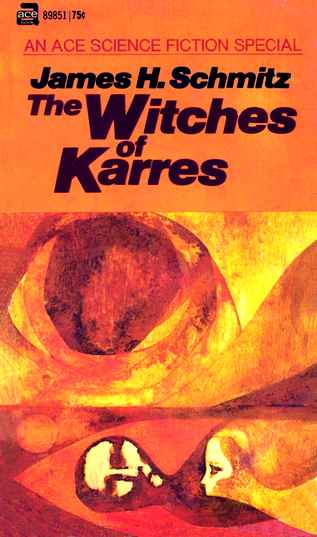
With a few notable exceptions. I didn’t discover James H. Schmitz until relatively late, and I wasn’t able to lay hands on his most famous novel, Hugo nominee The Witches of Karres, until years after I heard about it. Considering that it’s been re-issued six times since its original 1966 publication, by Ace, Gollancz, Baen, and the Science Fiction Book Club, that’s either really bad luck or I’m not nearly as accomplished a collector as I like to think. I have a copy now, and I look forward to rectifying the situation.

Over the years I’ve read multiple brief synopses of the novel, but my favorite remains P. Schuyler Miller’s Analog review:

In the far future, Mankind has scattered among the stars, bred into peculiar forms and developed peculiar powers. Captain Pausert of Nikkeldepain makes the serious mistake of rescuing three little Witches of Karres from their overwrought owner. There follows espionage, piracy, assorted forms of mayhem, and a freewheeling galactic war that nobody knew was in progress. You will, in the process, encounter such things as Worm Weather, klatha hooks, and a vatch to end all vatches… not to mention grik dogs and Nartheby Sprites and Sheem Robots.

Read More Read More

Margaret St. Clair, Andrew Offutt, and Appendix N: Advanced Readings in D&D

Margaret St. Clair, Andrew Offutt, and Appendix N: Advanced Readings in D&D

The Green Queen Margaret St Clair-smallI think I’ve read — and written — more about Gygax’s Appendix N in the last year than I have in the past three decades.

I’m not sure why there’s been such a recent surge of interest in a relatively short addendum to a 1979 gaming volume, to be honest, but I credit James Maliszewski. He’s examined Appendix N more diligently than any other fan writer, with several intriguing articles on his popular gaming blog Grognardia over the years.

Those include “My Appendix N” (from May 8, 2009), in which he answered the question “What fiction has influenced your campaigns, play styles, and writings?”; “Appendix N 2.0” (June 28, 2010), which reviewed the more extensive list of recommended books Gygax compiled thirteen years after the publication of the DMG, for his 1992 fantasy RPG Mythus Magick; and “Appendix N, 1981 Edition” (June 15, 2011), examining the fantasy authors “whose works are relevant to D&D,” as cited by the authors of What is Dungeons & Dragons?

Perhaps most fascinating, one of James’ earliest articles on the subject was “Addendum to Appendix N,” (November 25, 2008), in which he published Gygax’s answer to the question “How would Appendix N change if you’d written it in 2007 rather than 1979?”:

The fact is that I wouldn’t change the list much, other than to add a couple of novels such as Lanier’s second Hiero yarn, Piers Anthony’s Split Infinity series, and the Disc World books.

I would never add other media forms to a reading list. If someone is interested in comic books and/or graphic novels, they’re on their own.

I think it’s probably safe to say that James has been the king of Appendix N scholarship for the past five years. (Read the complete text of Gygax’s original Appendix N here).

Read More Read More

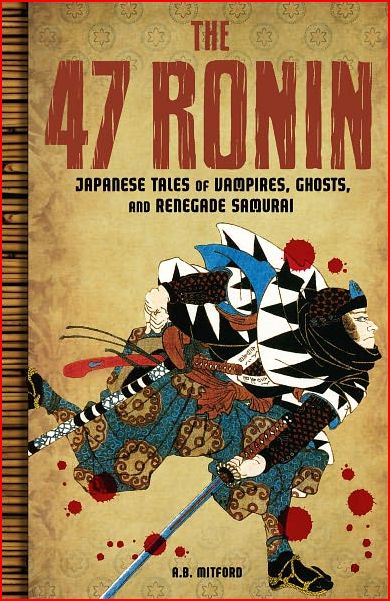
Revisiting A.B. Mitford’s The 47 Ronin: Japanese Tales of Vampires, Ghosts, and Renegade Samurai

Revisiting A.B. Mitford’s The 47 Ronin: Japanese Tales of Vampires, Ghosts, and Renegade Samurai

The 47 Ronin-smallTwo weeks ago I reviewed the film 47 Ronin, which Universal Pictures labeled a flop only a day after its U.S. release.

At that point the picture had earned about $85 million worldwide. That take has now increased to $116 million (according to BoxOfficeMojo), still well shy of its $175 million budget. Whether or not Universal’s premature announcement doomed the film, it’s now clear they weren’t wrong about its ultimate fate.

While browsing the remainder tables at Barnes & Noble yesterday, I stumbled on a curious title: The 47 Ronin: Japanese Tales of Vampires, Ghosts, and Renegade Samurai, by A.B. Mitford. I assumed it was a guerrilla tie-in; a cheap reprint timed to capitalize on the release of the movie. Except it was published nearly two years ago, in 2012, and there’s nothing cheap at all about the beautiful design, with striking endpapers and gorgeous color art on nearly every page.

I was right about at least one thing though: it is a reprint. It was originally published as Tales of Old Japan in 1871, one of the very first tomes to bring tales of Japanese monsters to Western shores.

Algernon Bertram Mitford was a British diplomat who later became Baron Redesdale. He developed a keen interest in Japanese folk tales while serving as attaché to the British delegation in Japan from 1866 – 1870 where, among other things, he witnessed the dissolution of the last feudal Japanese military government — the Tokugawa shogunate, ruled by the shoguns of the Tokugawa clans at Edo Castle — and the founding of a modern nation-state under Emperor Meiji.

Mitford was writing at a time when Japan was beginning to open to the West for the first time, less than 20 years after American Commodore Matthew Perry infamously sailed into Tokyo Bay with modern steam ships and explosive shell guns, gave the Japanese two white flags, and told them to hoist the flags when they wanted him to cease shelling the city and surrender. Perry forced the opening of Japan with the Convention of Kanagawa, and Mitford, writing a decade later, is a textbook case of white-guy-stupid, especially in how he’s perpetually surprised that the Japanese don’t greet Westerners with open arms and a bottle of warm saki.

Read More Read More

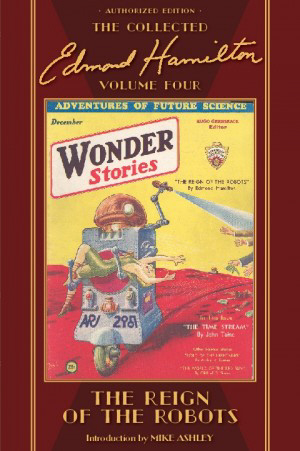
Gifts From the Godfather of Space Opera: The Collected Edmond Hamilton, Volume Four

Gifts From the Godfather of Space Opera: The Collected Edmond Hamilton, Volume Four

The Collected Edmond Hamilton Volume Four-smallCancel all my appointments! My copy of The Reign of the Robots, The Collected Edmond Hamilton, Volume Four arrived today.

Edmond Hamilton is my favorite pulp writer, and has been ever since I encountered his work in Isaac Asimov’s seminal anthology Before the Golden Age. I talked about my early affection for Hamilton — and my frustration at being unable to find some of his most acclaimed early space opera — in my Vintage Treasures piece on The Best of Edmond Hamilton last fall.

At the time I wrote:

While some of Hamilton’s shorter fiction was reprinted over the years, both Cities in the Air and The Universe Wreckers, and much of the longer work which made him famous, was available only in the early pulps in which they first appeared.

Stephen Haffner finally rectified this in 2011 with his The Collected Edmond Hamilton volumes, which gathered at last all of Hamilton’s early pulp work in archival quality hardcovers (thanks Stephen! I owe you one).

When I wrote that, only three volumes of The Collected Edmond Hamilton were available, covering Hamilton’s work from his very first story “The Monster-God of Mamurth” (from Weird Tales, Aug 1926, gathered in The Metal Giants and Others), through “World Atavism” (from Amazing Stories, Aug 1930, collected in The Universe Wreckers.)

Read More Read More

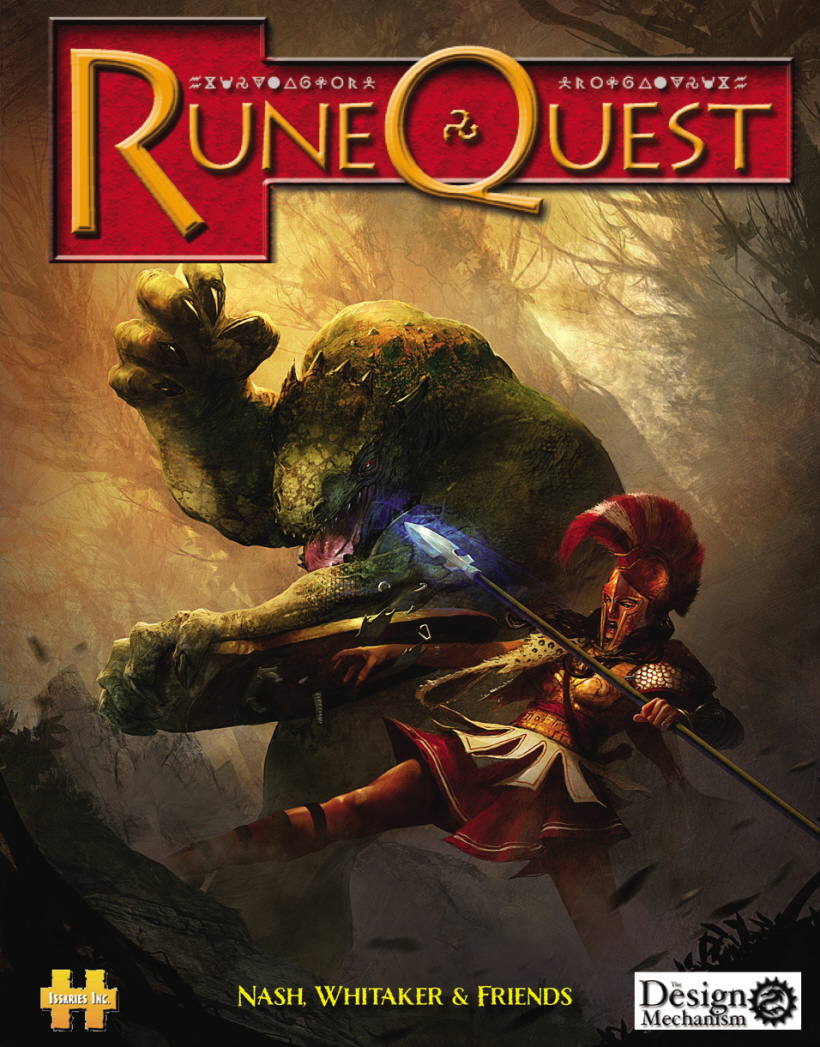
New Treasures: RuneQuest 6 by Pete Nash and Lawrence Whitaker

New Treasures: RuneQuest 6 by Pete Nash and Lawrence Whitaker

Runequest Sixth Edition-smallIt takes a lot to get me to try a new role playing system. I’m fairly happy with the ones I already play — first edition Advanced Dungeons and Dragons, Call of Cthulhu, and Steve Jackson’s Melee and Wizards games — and I barely have time to devote to those at it is.

I’m not sure what it was that originally drew me to try RuneQuest. I think it might have been the promise of a wholly different flavor of fantasy. AD&D was medieval villages, magic users, and Gygax’s Against the Giants. RuneQuest was talking animals, bronze age warriors from strange ancient cultures, and Paul Jacquey’s enigmatic Duck Tower (“What? A tower of ducks? That’s so weird. What’s with all the ducks in armor? Seriously? Mike, come check this out.”)

So I dragged my brother Mike to a RuneQuest game on the campus at Carleton University in Ottawa, where we soon found ourselves in the thick of a fast-action melee. In our first exposure to critical hit tables, Mike’s grizzled dwarf fighter fumbled an epic axe hit at the height of the battle, and managed to slice off his own leg. To this day, I can’t mention the word “RuneQuest” without Mike growling, “Yeah. Best system in the world.”

Needless to say, Mike didn’t play much after that. But I kept up with the various incarnations. A big part of my fascination was the result of Chaosium’s support efforts, especially the amazing Pavis and Big Rubble boxed sets. I still consider them some of the finest gaming products ever created, and have been much impressed with the recent reprint editions from Moon Design Publications.

Read More Read More