Browsed by
Author: John ONeill

Doc Savage, The Shadow and The Avenger, Together Again: The Vril Agenda by Derrick Ferguson and Josh Reynolds

Doc Savage, The Shadow and The Avenger, Together Again: The Vril Agenda by Derrick Ferguson and Josh Reynolds

The Vril Agenda-smallOne of the first things I did when I landed at the Windy City Pulp and Paper show on Friday was make a beeline for the Airship 27 booth.

Time is finite and the Windy City Dealer’s room is vast, and to make sure you get the treasures you really want, it helps to be a little determined. The treasures I really wanted this year included B.C. Bell’s 1930’s pulp vigilante novel, Tales of the Bagman, which I wrote about enthusiastically in my report on last year’s show, and Jim Beard’s supernatural detective collection, Sgt. Janus, Spirit-Breaker — both of which are published by Airship 27Plus, I wanted to make sure I had plenty of time to look over their whole table, since it’s always piled high with a tantalizing array of new titles.

As proprietor Ron Fortier happily sold me those two volumes, I casually mentioned that I’d first heard of Sgt. Janus via Josh Reynolds’s splendid Nightmare Men column, published at the fabulous Black Gate website… which, coincidentally, I happened to run, did I mention? Without missing a beat, Ron pointed out one of the many titles on his table, saying, “Josh is a terrific guy. That’s his latest book, a new pulp adventure, right there.”

I was suitably astounded. Here I was, trying to impress Ron by name-dropping Josh Reynolds, and he was able to produce a novel I didn’t even know existed! I know when I’ve been one-upped. Besides, I’ve known Josh as a terrific writer for years, so it was a thrill to discover he’d written a pulp adventure novel.

The Vril Agenda was co-written by Derrick Ferguson, author of Dillon and the Voice of Odin. Derrick does a terrific job of relating how the book came about on his blog and I think I’ll turn it over to him:

It got into my melon of a head a particular obsession to have Dillon be trained in various disciplines by the great pulp champions of the past. Since Dillon is a spiritual son of those heroes, I always thought it would be a gas for him to seek out some of these men and women to learn what they know…  Of course I knew I couldn’t use The Big Three by name. I’m talking about Doc Savage, The Shadow and The Avenger. But I could allude to them…


Read More Read More

The Top 20 Black Gate Fiction Posts in March

The Top 20 Black Gate Fiction Posts in March

Steven H SilverSteven H Silver’s tale of the strange astral adventures of Hoggar the Cremator, “The Cremator’s Tale,” surged to the top of our fiction charts in March.

Second on the list was Jason E. Thummel’s fast-paced story of a skilled swordsman caught up in a web of treachery in a decadent city, “The Duelist.”

Joe Bonadonna’s sword & sorcery tale, “The Moonstones of Sor Lunarum,” a perennial favorite, claimed the #3 spot.

Martha Wells’s complete novel, the Nebula-nominee The Death of the Necromancer, came in fourth, and Michael Shea’s novelette of Lovecraftian horror, “Tsathoggua,” rounded out the Top Five.

Also making the list were exciting stories by C.S.E. Cooney, Peter Cakebread, Janet Morris and Chris Morris, E.E. Knight, Aaron Bradford Starr, Mark Rigney, John C. Hocking, Jon Sprunk, Harry Connolly, Tara Cardinal and Alex Bledsoe, John R. Fultz, Dave Gross, Jamie McEwan, Mike Allen, and Ryan Harvey.

If you haven’t sampled the free adventure fantasy stories offered through our Black Gate Online Fiction line, you’re missing out. Here are the Top Twenty most-read stories in March.

  1. The Cremator’s Tale” by Steven H Silver
  2. The Duelist,” by Jason E. Thummel
  3. The Moonstones of Sor Lunarum,” by Joe Bonadonna
  4. The Death of the Necromancer, a complete novel by Martha Wells
  5. Tsathoggua,” by Michael Shea
  6. Godmother Lizard” by C.S.E. Cooney
  7. An excerpt from The Alchemists Revenge by Peter Cakebread
  8. An excerpt from The Sacred Band by Janet Morris and Chris Morris
  9. The Terror in the Vale,” by E.E. Knight
  10. The Sealord’s Successor,” by Aaron Bradford Starr
  11. Read More Read More

Total Pulp Victory: A Triumphant Return from Windy City Pulp & Paper

Total Pulp Victory: A Triumphant Return from Windy City Pulp & Paper

Super Science Stories Canada December 1942-small Super Science Stories Canada February 1945-small Super Science Stories Canada August 1945-small

Doug Ellis’s Windy City Pulp and Paperback Convention has wrapped up for another year (see my report from last year here). I got to see many old friends, meet some new ones, and also connect in person with a few for the first time — including Barbara Barrett, who traveled many hundreds of miles to make it to Chicago. Barbara has been blogging for Black Gate for many years and her early article “Robert E. Howard: The Sword Collector and His Poetry” is one of the most popular pieces we’ve ever published… but we’ve never met in person, and it was an absolute delight to finally join her for dinner — and give her a big hug.

In between all the meetings, reunions, and forging of new friendships, I also picked up a treasure or two. I’ll be reporting on some of the most interesting here over the next few weeks (the most common comment I heard as I put away my purchases was, “Something new for you to blog about!”), but I can’t resist telling you about one now.

Read More Read More

Vintage Treasures: Charles de Lint’s Wolf Moon, and a Tale of Roving Booksellers

Vintage Treasures: Charles de Lint’s Wolf Moon, and a Tale of Roving Booksellers

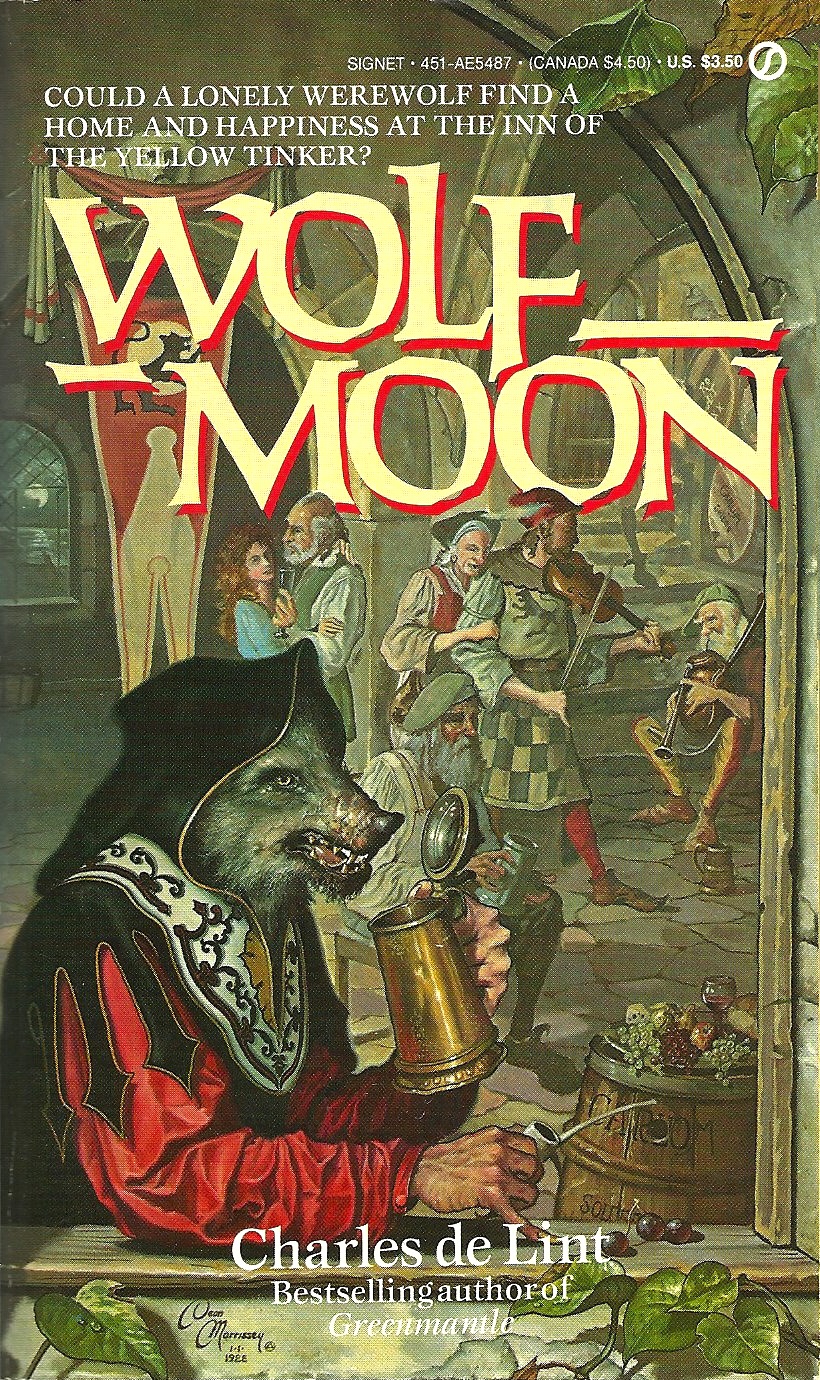
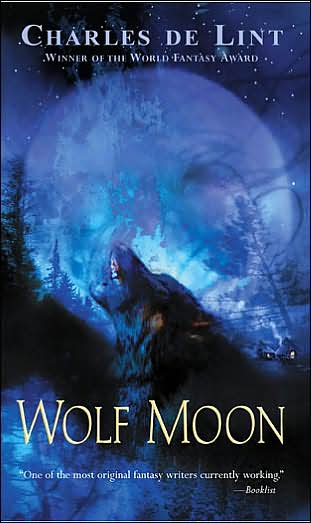
Wolf Moon Charles de Lint-smallIt pays to know excellent booksellers.

On Tuesday, Rich Warren, co-owner of Starfarer’s Despatch, posted a pic of Charles de Lint’s 1988 Signet paperback Wolf Moon on Facebook and later this brief review:

What a blast. Just finished this one this morning. A tale sympathetic to the Werewolf, and told from his point of view. I know there are De Lint fans who enjoy his urban fantasy (Newford) more but the great writing is still present in these older fantasies.

My comment was concise, but completely heartfelt: “I need this book! Rich, sell me one!”

I meant it, too. Wolf Moon was reprinted in 2004, with a generic urban fantasy cover, but the 1988 paperback original, which boasts a fabulous cover by Dean Morrissey, showing a werewolf relaxing in The Inn of the Yellow Tinker, is much harder to come by.

Three days later, I returned from my business trip to Las Vegas. I drove straight from the airport to the Westin hotel in Lombard, Illinois, and arrived shortly before the Dealer’s Room closed at Windy City Pulp and Paper, one of my favorite local cons (the write-up I did on last year’s is here). I wasn’t in the room five minutes before I heard a friendly voice calling my name: Arin Komins, Rich’s wife and the other half of the splendid enterprise that is Starfarer’s Despatch.

“We have a book for you,” Arin said. We found Rich and, sure enough, he pulled a beautiful, unread copy of Wolf Moon out of his backpack.

Read More Read More

1939 Retro Hugo Award Nominees Announced

1939 Retro Hugo Award Nominees Announced

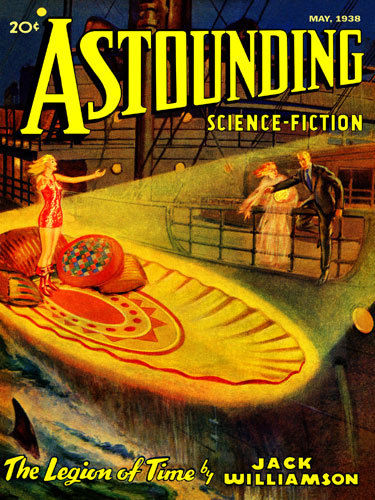
Astounding Science Fiction May 1938-smallThe Hugos have become science fiction’s more recognizable award, ever since they were first presented in 1953 at the 11th World Science Fiction Convention in Philadelphia. In the decades since though, there’s been plenty of speculation in fan circles about classic SF published before 1953.

“Oh, Jack Vance’s The Dying Earth would have win the Hugo Award hands down back in 1951.”
“Are you kidding? The Lion, the Witch and the Wardrobe was published that same year — it would have been the easy victor.”
“You’re both crazy. The most popular SF release in 1951  was E.E. “Doc” Smith’s First Lensman, no question.”
“Wait a minute — what about Asimov’s Pebble in the Sky? It came out that same year!”

If there’s one thing fans like to do more than argue, it’s to prove they’re right. So in 1996, the First Retro Hugo Awards were given out, for SF first published in 1946. Retro Hugos have only been awarded twice since: in 2001 (for 1951) and in 2004 (for 1954). And for the record, the winner of the Retro Hugo Award for Best Novel in 1951 was Robert A. Heinlein’s Farmer in the Sky.

Loncon 3 has announced that it will present Retro Hugos this year, for work first published 75 years ago. Here’s part of the introduction to the award from the Loncon 3 Hugo Award Administrator:

1939 was an auspicious year among science fiction enthusiasts. On  2 July roughly 200 of them got together in New York City to hold the World  Science Fiction Convention… As host of the 2014 Worldcon, Loncon 3 will be hosting the Hugo Awards for the best work in 2013. As Loncon 3 marks  the 75th anniversary of that first convention in 1939, we will also be hosting  a Retrospective Hugo Award process for the best work of 1938.

Read More Read More

New Treasures: Nebula Awards One and Two From Stealth Press

New Treasures: Nebula Awards One and Two From Stealth Press

Nebula Award Stories One, from Stealth Press (2001)
Nebula Awards One, from Stealth Press (2001)

Okay, I’m stretching things a bit by calling these New Treasures, as they were printed over a decade ago. But I just bought pristine copies, still in the shrinkwrap, and I’m pretending they’re actually new. Work with me a little.

I have no idea who Stealth Press is. But they’re clearly a small press that specializes in deluxe hardcover editions and they do great work. Truth to tell, I just stumbled across these books on eBay, offered in a lot for a great price, and I wanted them immediately.

You don’t need hardcover reprints of these, my brain said. See, right over there, you have the paperback editions. But look at the great Frank R. Paul covers, I said to my brain. And plus, if I order these, I could write New Treasures posts about them! Well, I suppose that makes sense, my brain agreed. My brain. What a sucker.

It is nice to have handsome permanent editions of these books. But the real benefit is that they remind me just how incredible these early Nebula Award anthologies really were. Until these deluxe versions arrived, Nebula Awards One and Two were just two more slim paperbacks crammed in a dusty bookshelf alongside over 30 of their cousins. Now, they’re very real treasures, stacked by my bedside to be read at the first opportunity.

Nebula Awards One collects the very first Nebula Award-winning stories (and several runners-up) from 1966, as selected and edited by SFWA founder Damon Knight.  It contains two complete novellas , the Nebula Award winner “The Saliva Tree” by Brian W. Aldiss and runner-up “He Who Shapes” by Roger Zelazny, and shorter work from Harlan Ellison, James H. Schmitz, Larry Niven, Gordon R. Dickson, and J. G. Ballard, and even a second Zelazny story.

It contains some of the most famous short science fiction and fantasy of the 20th Century, by many of its most gifted practitioners, plus a thoughtful intro from Knight. If you could only preserve one genre anthology for future generations, I think a strong case could be made for this one.

Here’s the complete Table of Contents.

Read More Read More

The 2014 David Gemmell Award Nominees

The 2014 David Gemmell Award Nominees

The Daylight War-smallThe nominations for the David Gemmell Legend Award for Best Fantasy Novel of 2013 have been announced by the DGLA. May we have the envelope please!

The Legend Award for Best Fantasy Novel

  • The Daylight War, Peter V Brett (Del Rey)
  • Emperor of Thorns, Mark Lawrence (Harper Collins)
  • The Republic of Thieves, Scott Lynch (Gollancz)
  • A Memory of Light, Brandon Sanderson & Robert Jordan (Tor)
  • War Master’s Gate, Adrian Tchaikovsky (Tor)

The David Gemmell Legend Award is a fan-voted award administered by the DGLA. The Legend Award for Best Fantasy Novel was first granted in 2009 to Andrzej Sapkowski’s Blood of Elves; in 2010, the winner was Graham McNeill’s Empire: The Legend of Sigmar; and in 2011, it was Brandon Sanderson’s The Way of Kings. In 2012, the winner was The Wise Man’s Fear by Patrick Rothfuss and last year, The Blinding Knife by Brent Weeks took home the top prize.

The Gemmell Award is not the only award administered by the DGLA; every year it gives out two others: The Morningstar Award for Best Fantasy Newcomer and The Ravenheart Award for Best Fantasy Cover Art. So much excitement packed into one ceremony! The nominees for those awards follow.

Read More Read More

Vintage Treasures: Dervish Daughter by Sheri S. Tepper

Vintage Treasures: Dervish Daughter by Sheri S. Tepper

Dervish Daughter-smallI need to read more Sheri S. Tepper.

I tend to think of her primarily as a science fiction writer, probably because I first encountered her with her groundbreaking The Gate to Women’s Country (1988) and the major SF novel that followed, Grass (1989), a Hugo and Locus Awards nominee. But she wrote a great deal of highly acclaimed fantasy in the 80s and 90s, and it’s high time I acquainted myself with it.

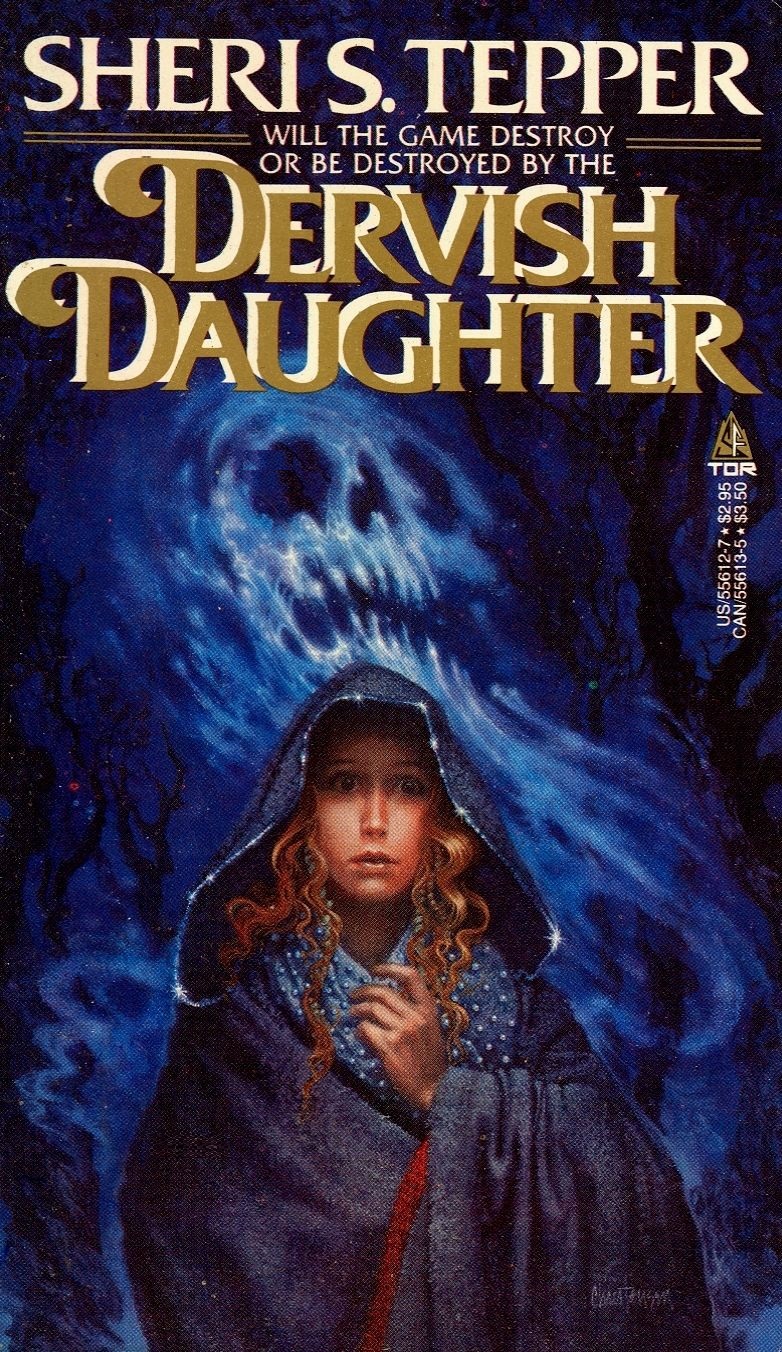
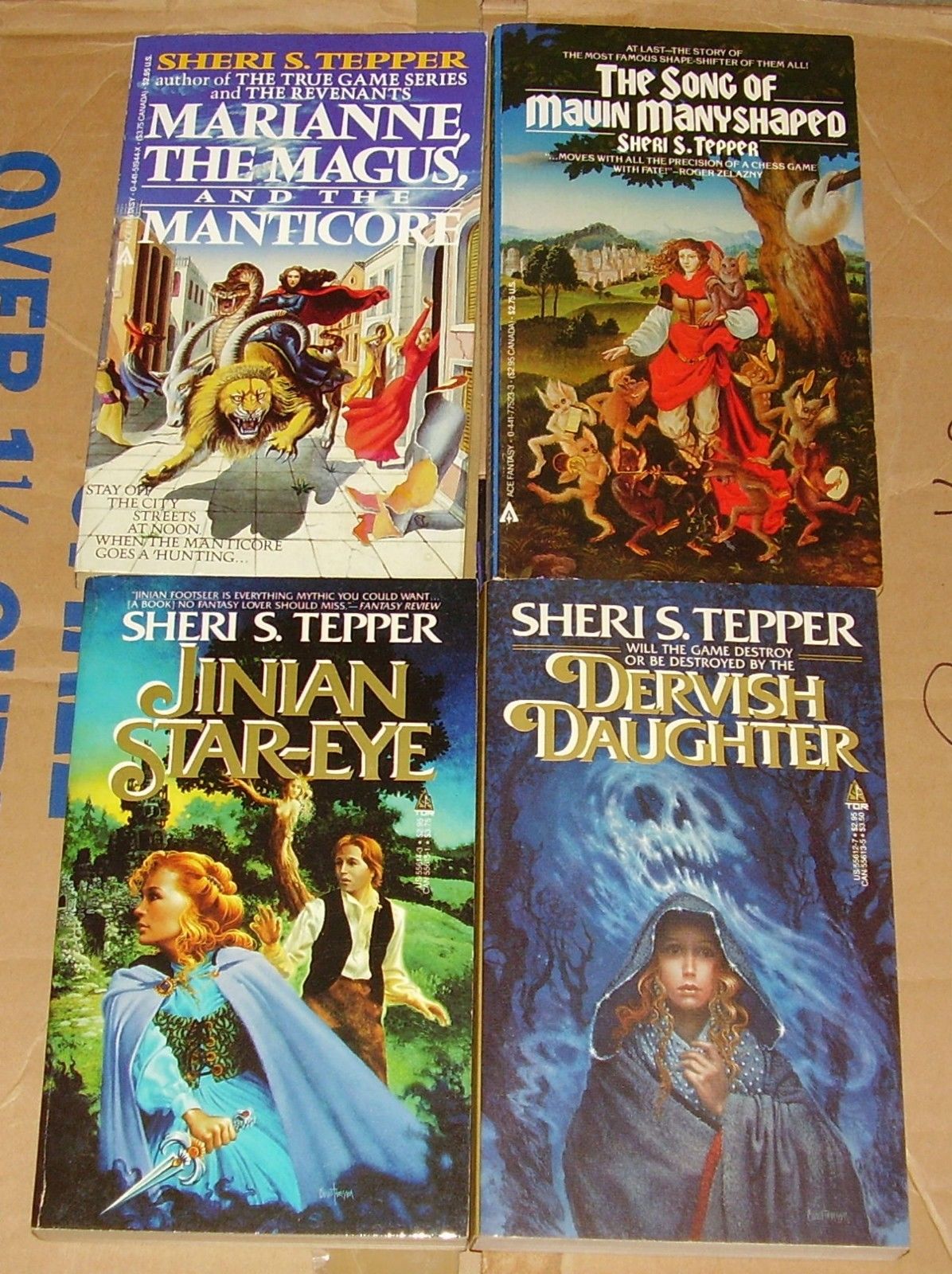
A few weeks back, I purchased a set of four Tepper fantasy novels on eBay, all originally published in 1985-86 (and they look great, too — just look). Last night, I grabbed one to bring with me on a business trip. I chose Dervish Daughter because it had a floating ghost skull on the cover and this criterion has rarely steered me wrong in the past.

So now I’m sitting on the 24th floor of Caesar’s Palace in Las Vegas, with what I just discovered is the second volume in the Jinian trilogy, itself the third series in a trilogy of trilogies called The True Game. Not that the Tor paperback bothered to tell me this. In fact, Tor doesn’t tell me much about the book at all. There’s not much of a plot description on the back, just this kooky poem.

Egg in the hollow — Hatching to follow
Lovers come calling — Bitter tears falling
Bright the sun burning — Night will come turning
New powers arise in the Land… Players beware!

I’m guessing free verse on the back of paperbacks was a short-lived marketing trend in the mid-80s. Anyway, I’m a little frustrated — as I imagine casual paperback buyers in 1986 were frustrated, when they discovered this is the second (eighth?) novel in a series. Over the last few decades, Tor has gotten better at letting buyers know books are part of a series. (They aren’t big on marketing through poetry anymore, either.)

Read More Read More

Tales From Windy City Pulp and Paper

Tales From Windy City Pulp and Paper

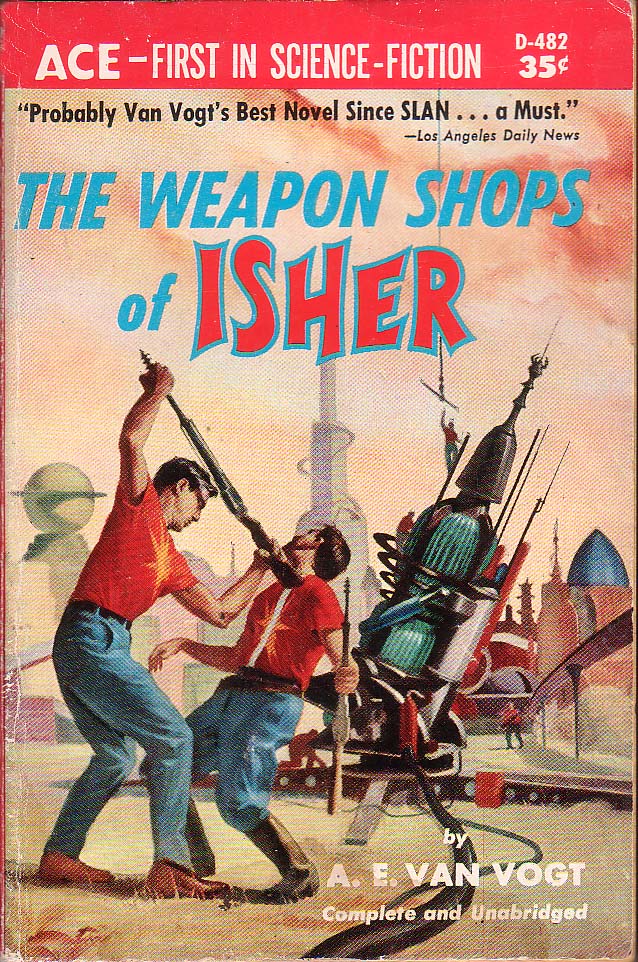
The Weapon Shops of IsherThis coming weekend, Friday April 25th through Sunday April 27th, is Doug Ellis’s magnificent celebration of all things pulp, the Windy City Pulp and Paperback Convention here in Chicago, in nearby Lombard, Illinois.

Windy City is one of my favorite local cons. I’ve written about it before, and in fact I’ve been attending the show for around 10 years. 2012 was perhaps the most successful show in some years, considering I returned with a fabulous assortment of mint-condition fantasy and science fiction paperbacks from the collection of Martin H. Greenberg. See the article and photos from that show in my 2012 post, “Thank You, Martin H. Greenberg (and Doug Ellis).”

The show has been growing steadily over the years. Doug and his cohorts have added a film program, an Art Show, panels, an auction, readings, and more programming, but the real draw continues to be the massive Dealer’s Room, a wall-to-wall market crammed with pulps, paperbacks, rare DVDs, posters, artwork, comics, and much more.

I jotted down a few notes last year, and promised myself I’d write them up before the 2014 convention, to let folks who may be on the fence about attending (or those sad and lonely souls who, like me, just enjoy reading far-off convention reports), know what they’re missing.

In 2013, the list of Dealers was the longest I’ve ever seen, boasting some 80 vendors. They had to add more space, and it took even longer to walk the floor. Doug reported that he sold more tables than at any previous convention, and in record time.

If there’s a drawback to the show, it’s that the Dealer’s room closes at 5:00 pm. That made it impossible for me to make it there after work on Friday. My weekly D&D game with my kids kept me tied up until after 3:00 pm Saturday, which meant that by the time I made the show on Saturday, I had less than half an hour to walk the floor before it closed.

I put the time to good use. After a few years, you tend to find a few favorite sellers and I searched them out immediately.

Read More Read More

Vintage Treasures: The Shores of Space by Richard Matheson

Vintage Treasures: The Shores of Space by Richard Matheson

The Shores of Space-smallI’ve told you about a few really excellent single author collections recently, including Eric Frank Russell’s Men, Martians, and Machines, Michael Shea’s Polyphemus, and H.P. Lovecraft’s The Dunwich Horror and Others. As long as I’m on a roll, I figure I should continue in the same vein. So this week, I want to talk about Richard Matheson’s 1957 collection The Shores of Space.

Matheson is rightly revered by both SF and horror fans as a genius, especially at short length. He passed away in June, at the age of 87, and was productive right up to the end — with new novels (Other Kingdoms, 2011, and Generations, 2012), collections (Bakteria and Other Improbable Tales, 2011), and even a new movie (Real Steel, staring Hugh Jackman, based on his short story “Steel” from the May 1956 issue of The Magazine of Fantasy and Science Fiction.) That’s damned impressive… the closer I get to 55, the harder I find it just to summon the energy to change channels.

The Shores of Space was Matheson’s second collection (after his groundbreaking Born of Man and Woman, 1954) and it proved very successful, with half a dozen reprintings and new editions over the next 20 years. The last one was in 1979, with an intriguing (and rather purple) cover by Murray Tinkelman. But overall, I prefer the 1969 Bantam paperback (shown at right), with a defiant spaceman standing on a harsh alien landscape, ready to shake his fist at the first person who suggests he put pants on. You show ’em, naked spaceman.

Here’s the back cover copy (it helps if you imagine Rod Serling reading it in a slow, urgent monotone).

A Shattering Journey into the Supernatural

Thirteen extraordinary stories that explore the slippery edge of madness — and beyond — into a chilling nightmare of bizarre and unexplainable occurrences… into a world where unspeakable horror becomes normal — where murky darkness from space works on the minds of men — in a time when creatures of dreadful, unearthy powers can control human beings… and humans create beings beyond their control. Weird fantasy and eerie imagination inspire stories of unforgettable force and unpredictable conclusions!

There’s some pretty good stuff in The Shores of Space. It includes, among many other fine tales, the short story “Steel” that was the basis for Real Steel.

Read More Read More