Browsed by
Author: Bob Byrne

The Public Life of Sherlock Holmes: A Musical Fairy Tale – Mt. Vernon and Fairway
The Public Life of Sherlock Holmes: A Musical Fairy Tale – Mt. Vernon and Fairway

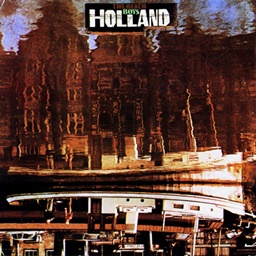
MtVernon_HollandI’m fortunate in that my boss here at Black Gate lets me wander afield from Sherlock Holmes and mystery-related topics. Now, I think I’ve managed to nominally stay within the milieu of Black Gate,  though my Humphrey Bogart – George Raft post might have stretched things a bit (I’ve got a reasonable argument ready!). So, for example, I haven’t written anything (yet…) about my hero, Hall of Famer Jackie Robinson. Today I’m going to stretch the rubber band a ways.

I think that Brian Wilson, the musical force behind the Beach Boys, is a genius. Before you could find almost any unreleased song on Youtube, I was avidly collecting bootleg albums, then CDs. I probably have a bigger SMiLE collection than anybody else you know.

It’s a rare week that I don’t listen to at least one Beach Boys song. And if you’re my Facebook friend, you’ve almost certainly learned something about their music from my posts (like this one about the Lei’d in Hawaii album). Today, I’m going to bring the Beach Boys to Black Gate: assuming it actually gets posted.

It’s well documented that Brian increasingly withdrew from the band (and for the most part, life…) after the SMiLE album was aborted in 1967. His participation level varied on succeeding albums (Smiley Smile, Wild Honey, 20/20, Sunflower, Surf’s Up and Carl and the Passions: So Tough), but it’s indisputable that he wasn’t running the Beach Boys anymore and his brother Carl was largely filling his shoes.

In the summer of 1972, the entire band, with family and friends, relocated to the Netherlands, recording in a studio that had been sent over from California and rebuilt (yes, the Beach Boys did those kinds of odd things back then). Brian co-wrote only two of the nine songs on the album, and they were late additions to boot.

But Brian’s contribution to the Holland album loomed large – in a way. The record included a bonus EP (any of you youngsters who don’t know what an EP is, go look it up).  You can click here to listen to what we’re going to be talking about.

Read More Read More

The Shannara Chronicles Will Be Back (Though Amber will Not…)

The Shannara Chronicles Will Be Back (Though Amber will Not…)

Shannara_titleBack in January, I wrote about the then-in progress Shannara Chronicles miniseries on MTV. I was less than overwhelmed. Even though Terry Brooks was involved, and while it did some things nicely, it most certainly was not the Shannara project some of us have been waiting decades for. Granted, it was decent enough that I stuck through all ten episodes.

While the main storyline got closure in the final episode, others (which had nothing to do with The Elfstones of Shannara, the book the series was based on) were left wide open.

I missed this, but back in April, MTV signed on for a second season, though I haven’t come across any kind of timeline.

“This dream team delivered a beautiful, ground breaking show with compelling stories and character journeys which brought in new viewers. I can’t wait to see what season 2 brings,” said Mina Lefevre, Executive Vice President and Head of Scripted Development at MTV.

The show did extremely well in digital format, with over 16 million streams and becoming the most downloaded single-season show ever for MTV. Since it was aimed at the teens and twenties crowd, that’s a good sign.

I liked it enough that I will watch season two, where I’m sure we’ll get more pretty people and lots of the angst, which is the hallmark of the target age group.

Terry Brooks has said that the story is leaning towards The Wishsong of Shannara (which followed Elfstones), with some of Sword of Shannara mixed in.

Read More Read More

The Public Life of Sherlock Holmes: Arsenic and Old Lace

The Public Life of Sherlock Holmes: Arsenic and Old Lace

In Brooklyn during World War II, a pair of black widows were luring men to their deaths. They preyed upon older, lonely men without family or close friends. With a “Room for rent” sign hanging in the front window of their idyllic-looking home, they fed arsenic-laced wine to their victims. A male relative who lived with them buried the bodies in the basement, with no one the wiser. The women were in fact little old ladies: think Aunt Bee as a serial killer.

But a nephew came over and found a body in window seat – the thirteenth victim. He slowly realized that his two loveable old aunts were killers. Then, his brother, a murderer on the lam from the police, showed up with his lackey in tow. It’s a hardboiled, true crime story that curiously, is largely forgotten today.

Just kidding! It’s actually Arsenic and Old Lace, a smash stage play that became a popular movie starring Cary Grant, Raymond Massey and Peter Lorre. The play ran on Broadway for 1,444 performances and is still in wide use today.

Read More Read More

The Public Life of Sherlock Holmes: Western Noir – Hell on Wheels

The Public Life of Sherlock Holmes: Western Noir – Hell on Wheels

Back in November of 2011, AMC debuted a gritty new western, Hell on Wheels. Anson Mount played Cullen Bohannon, a former Confederate soldier out for revenge against the Union soldiers who had killed his wife and son and burned his farm. His pursuit takes him to the camp of the Union Pacific Railroad, which is headed across the central plains under the leadership of Thomas Durrant (Colm Meany: O’Brien of Star Trek: The Next Generation fame).

While the series starts out as a revenge tale, Bohannon abandons that quest after he kills the wrong man and instead focuses on helping build the Transcontinental Railroad. The series becomes the story of the various employees and camp followers who move along as the laying of track progresses: the mobile community is ‘Hell on wheels.’

I’m writing about this series, which wrapped up weekend before last, because it is a Western Noir: And a darn good one. I had never seen Mount in anything before, but I’m telling you, he was made for this part. He’s the protagonist, but he’s not a white-hatted cowboy. Roy Rogers need not apply. He develops his own code of honor as the series progresses, but he’s a ‘get it done guy’ who rises from swinging a pick to the most important person in the Transcontinental’s story. And as he demonstrates many times, he isn’t afraid to use a gun.

Read More Read More

The Public Life of Sherlock Holmes: A Century of John D. MacDonald

The Public Life of Sherlock Holmes: A Century of John D. MacDonald

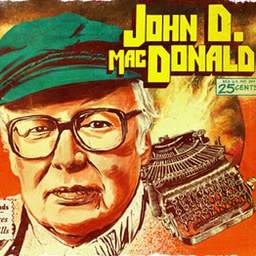
MacDonald_WSJIt’s no surprise, given the title of this column, that I’ve written more Sherlock Holmes-related posts than about any other topic. What is surprising to me, given that I know myself fairly well, is that I’ve only done one post about John D. MacDonald. You can read some stuff I’ve written about him over on my own blog, Almost Holmes, here and here and here. But perhaps because I haven’t been able to delve deeply enough into re-reading and analysis, I’ve not come back to him at Black Gate. Until today.

Yesterday marked the one hundredth anniversary of John MacD’s birth. When MacDonald died in December of 1986 of heart-related problems, he was one of the most influential and popular authors in America. Thirty years later, while he is still respected and cited by many writers, including John Jakes, Randy Wayne White and others, he’s somewhat forgotten. Which is both sad, and something that I would like to ponder on for a future post as well.

A quote from Stephen King:

“John D. MacDonald has written a novel called The End of the Night which I would argue is one of the greatest American novels of the twentieth century. It ranks with Death of a Salesman, it ranks with An American Tragedy,”

A quote from me, Bob Byrne (I admit, I don’t quite have the cachet of that King fellow):

“John D. MacDonald is one of the greatest writers of the twentieth century: In any genre. He was a skillful storyteller and a first-rate social commentator.”

Read More Read More

The Public Life of Sherlock Holmes: Mycroft’s Job

The Public Life of Sherlock Holmes: Mycroft’s Job

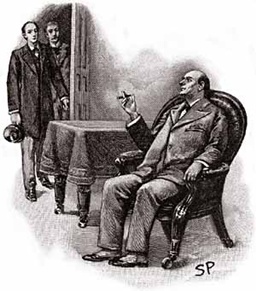
Mycroft_SP1One of the things I enjoy about being a Sherlockian (no, I don’t mean a fan of the BBC television show) is the way ‘one thing leads into another’ and you can explore all kinds of avenues and lanes, wandering here and there, encountering interesting stuff. That was a long sentence!

I was fortunate enough to be included in the upcoming MX Book of New Sherlock Holmes Stories – Part V. In the early part of my story, The Case of the Ruby Necklace (yes, I know, captivating title), I had cause to include a passage from A Study in Scarlet:

“Well, I have a trade of my own. I suppose I am the only one in the world. I’m a consulting detective, if you can understand what that is. Here in London we have lots of Government detectives and lots of private ones. When these fellows are at fault, they come to me, and I manage to put them on the right scent. They lay all the evidence before me, and I am generally able, by the help of my knowledge of the history of crime, to set them straight. There is a strong family resemblance about misdeeds, and if you can have all the details of a thousand at your finger ends, it is odd if you can’t unravel the thousand and first.”

“And these other people?” I asked, regarding the many strangers that visited our rooms for private sessions with Holmes. I had wondered if he were not some kind of fortuneteller and too embarrassed to tell me so.

“They are mostly sent on by private enquiry agencies. They are all people who are in trouble about something, and want a little enlightening. I listen to their story, they listen to my comments, and then I pocket my fee.”

“But do you mean to say,” I said, “that without leaving your room you can unravel some knot which other men can make nothing of, although they have seen every detail for themselves?”

“Quite so. I have a kind of intuition that way. Now and again a case turns up which is a little more complex. Then I have to bustle about and see things with my own eyes. You see I have a lot of special knowledge, which I apply to the problem, and which facilitates matters wonderfully. Observation with me is second nature.”


Read More Read More

Of Necromancers and Frog Gods: Part Two (The Public Life of Sherlock Holmes)

Of Necromancers and Frog Gods: Part Two (The Public Life of Sherlock Holmes)

FROG GOD GAMES

Last November, I did a post on the history of Necromancer Games. I wrapped up with, “And there, our saga of Necromancer Games draws to a close. But our story has most certainly not come to an end.” That’s because Slumbering Tsar would rise from the ashes and a new RPG company would be built on its foundations. Welcome to Part Two: Of Necromancers & Frog Gods.

Waking the Tsar

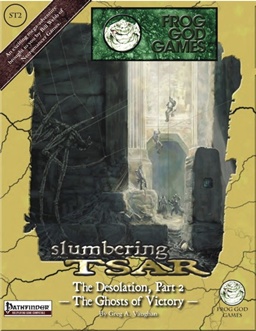
FGG_DesolationShortly after Necromancer hung it up, co-founder Bill Webb established Frog God Games just to publish Greg Vaughan’s The Slumbering Tsar as a fourteen-part subscription saga, to be issued as one massive book at the end of the project.

Starting at 7th level, Tsar is divided into three books. If you want to start from 1st level, I suggest using The Wizard’s Amulet and/or The Crucible of Freya, then part of Tomb of Abysthor as a 1st through 6th level lead-in. The Lost City of Barakus is another excellent option, though not as thematically linked. Though it wouldn’t take much to give the villainous Devron a tie-in to Tsar.

Book one, The Desolation, is three installments (parts) dealing with a small settlement in the barren plains. It totals about 125 pages and gives the party a staging area for adventuring towards Tsar. Think of a Necromancer version of The Village of Hommlet – but way nastier. The story of The Army of Light at the very end of part one is worth it alone for me.

Part two includes the Ashen Waste: with such highlights as The Tomb of the Sleeping Knight (not a lot of sleeping going on here) and the burial mound of the barbarian warriors led by Tark. The Chaos Rift, featuring The Sepulcher of the Last Justicar, is even more deadly.

Part Three gets the party to the walls of Tsar, though it might well perish in The Boiling Land or The Dead Fields first. And a sticky situation waits outside the walls…

Read More Read More

The Public Life of Sherlock Holmes: Don’t Panic!

The Public Life of Sherlock Holmes: Don’t Panic!

BG_AdamsDontPAnicTo those who ascribe to Dirk Gently’s belief in the fundamental interconnectedness of everything (the working premise that made him the holistic detective that he was), you might be able to tie together today’s rambling post. If you do, feel free to explain it to me. My Sherlockian approach failed miserably in the attempt. I got to the point where, once I had eliminated the impossible, whatever remained, however improbable, must be the truth. Except what remained was still impossible.

(I wrote about the Gently books here and the television miniseries here. Go ahead and read them. You know you want to.)

And since I’m talking about a mega-successful series, that has sold/rated well in almost every medium short of Mime, you don’t get a Spoiler Alert. If you’re not familiar with Adams’ works, I don’t know why you’re reading this post anyways. Go read/watch/play/listen to some incarnation of this stuff.

Dirk Gently’s Holistic Detective Agency is my favorite Douglas Adams book (many folks would like me to explain how that could be!). But I first came to Adams’ just like everybody else: through The Hitchhiker’s Guide to the Galaxy. Note I use the unhyphenated spelling.

I wouldn’t tackle that controversy without downing at least two Pan Galactic Gargleblasters first. And since I would lose consciousness two swallows into the first one, we can put that issue to bed right now. And I don’t mean on one of the follopping mattresses from the swamps of Sqornshellous Zeta, either. There.

Now we can move along. Though if you want to delve deeper into the issue on your own, see Don’t Panic: The Official Hitchhiker’s Guide to the Galaxy Companion by Neil Gaiman – pages 50-51.

Read More Read More

The Public Life of Sherlock Holmes: Lt. Columbo

The Public Life of Sherlock Holmes: Lt. Columbo

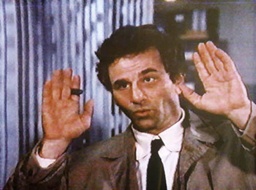
Columbo_HandsUpThe mystery field is full of great detectives and private eyes, both amateur and professional, created by authors. Hercule Poirot, Nero Wolfe, Father Brown, Inspector Morse, Sam Spade, Philip Marlowe, Mike Hammer, The Continental Op: and of course, Sherlock Holmes. The list goes on and on.

There have also been quite a few detectives created for television. McCloud, Matt Houston, Magnum PI and Jim Rockford to name a few. The germaphobic Adrian Monk was immensely popular. But perhaps the supreme television detective is Inspector Columbo.

A prototype Columbo, if you will (heck – even if you won’t), appeared in Enough Rope: a 1960 episode of The Chevy Mystery Hour, played by Bert Freed. It was then turned into a play, Prescription Murder, starring Thomas Mitchell, who died of cancer during its run.

Next, the play evolved into a two-hour television movie. The under-appreciated Lee J. Cobb was approached but unavailable and Bing Crosby turned down the part (imagine that). Though he was considered too young at the time, Peter Falk was given the part and the movie aired in 1968.

The network ordered another TV movie to see if a series was feasible. Ransom For a Dead Man did well and Columbo became part of a rotating series of shows, including Dennis Weaver’s McCloud and McMillan and Wife, with Rock Hudson.

Read More Read More

The Public Life of Sherlock Holmes: Stephen Mangan’s Dirk Gently

The Public Life of Sherlock Holmes: Stephen Mangan’s Dirk Gently

Gently_TVbothLast week, I was writing my post for today. It was about the Houdini and Doyle miniseries, in which Stephen Mangan plays Arthur Conan Doyle, who was, of course, the creator of Sherlock Holmes. But, the principle of Zen Writing Navigation took me elsewhere.

There is a school of thought that says you should use a map when you are lost. Dirk Gently’s strategy is to find someone who looks like they know where they are going and follow them. He rarely ends up where he was intending to go, but often ends up somewhere that he needed to be. Back in 2010, Mangan played Gently in a pilot episode that was followed by three more episodes in 2012.

I followed Magnan and ended up writing this post, not one on Houdini and Doyle. And through this, once again proving the fundamental interconnectedness of everything.

Just as Sherlock Holmes was the world’s first (and greatest) private consulting detective, Gently was the world’s first, greatest and only holistic detective, created by the late Douglas Adams. I wrote about Gently here at Black Gate and if you haven’t read Adams’ two novels about him, you’re missing out on some terrific humor.

You might be familiar with the phrase, “Almost, but not quite, entirely unlike tea.” If you’re not, as soon as you finish reading this post, you need to read The Hitchhiker’s Guide to the Galaxy. Not watch the movie (which is better than people give it credit for), but read the book. Fortunately, this miniseries is closer to Gently than that phrase implies.

Read More Read More