Medea
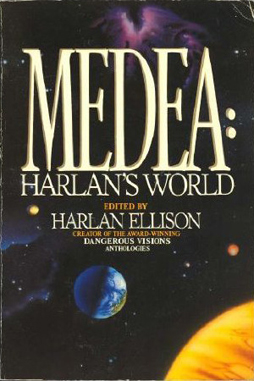 Lately in this space I seem to be writing a lot, one way or another, about worldbuilding. As it happens, I also read a book not long ago which both imagines a detailed science-fictional world and determinedly lifts the curtain on the group act of creation that generated the world. The book is Medea: Harlan’s World, and there are some interesting things to take away from it — not just ideas about worldbuilding, either.
Medea is in the lineage of shared-world books, though Ellison, who has expressed disdain for shared worlds, would likely dispute that; at any rate, it was originally conceived in 1975, but not published as a whole until 1985, so was imagined before Thieves’ World or Wild Cards or Liavek, before the articulation of the ‘shared world’ as a specific kind of endeavour. Perhaps ironically, Medea would spawn a kind of conceptual sequel, Murasaki, edited by Robert Silverberg, one of the participants in the Medea collaboration. Medea‘s an anthology of stories by different writers, all set on what is notionally the same science-fictional planet. Many of the individual stories were highly praised. Ellison’s “With Virgil Oddum at the East Pole” was selected for inclusion in The 1986 Annual World’s Best SF; Larry Niven’s “Flare Time” placed ninth in that year’s Locus poll for best novella; Frederik Pohl’s “Swanilda’s Song” placed fourth in the novelette category; Poul Anderson’s “Hunter’s Moon” won the Hugo Award for Best Novelette. Whether they work well together is in the eye of the beholder.
It doesn’t much read like the typical shared-world anthology. Ellison’s quite specific about that in his introduction, where he describes an editorial process that gladly welcomed individual takes on the basic concepts of the fictional world, even encouraging contradictions between stories: “Not only do I admit to the contradictions in these yarns, I champion them!” It probably does help give the book an idiosyncrasy unlike many shared worlds; the problem, I found, was that the individual stories were of varying quality (as one would expect of an anthology), none were really excellent, and they didn’t seem collectively to create a real unity out of the book. Then again, I also thought Medea as a whole was well worth reading for the extensive look at the creative process behind the making of the fictional world, and indeed for the look it gives us at a specifically science-fictional kind of creativity.