Galaxy Science Fiction, July 1953: A Retro-Review
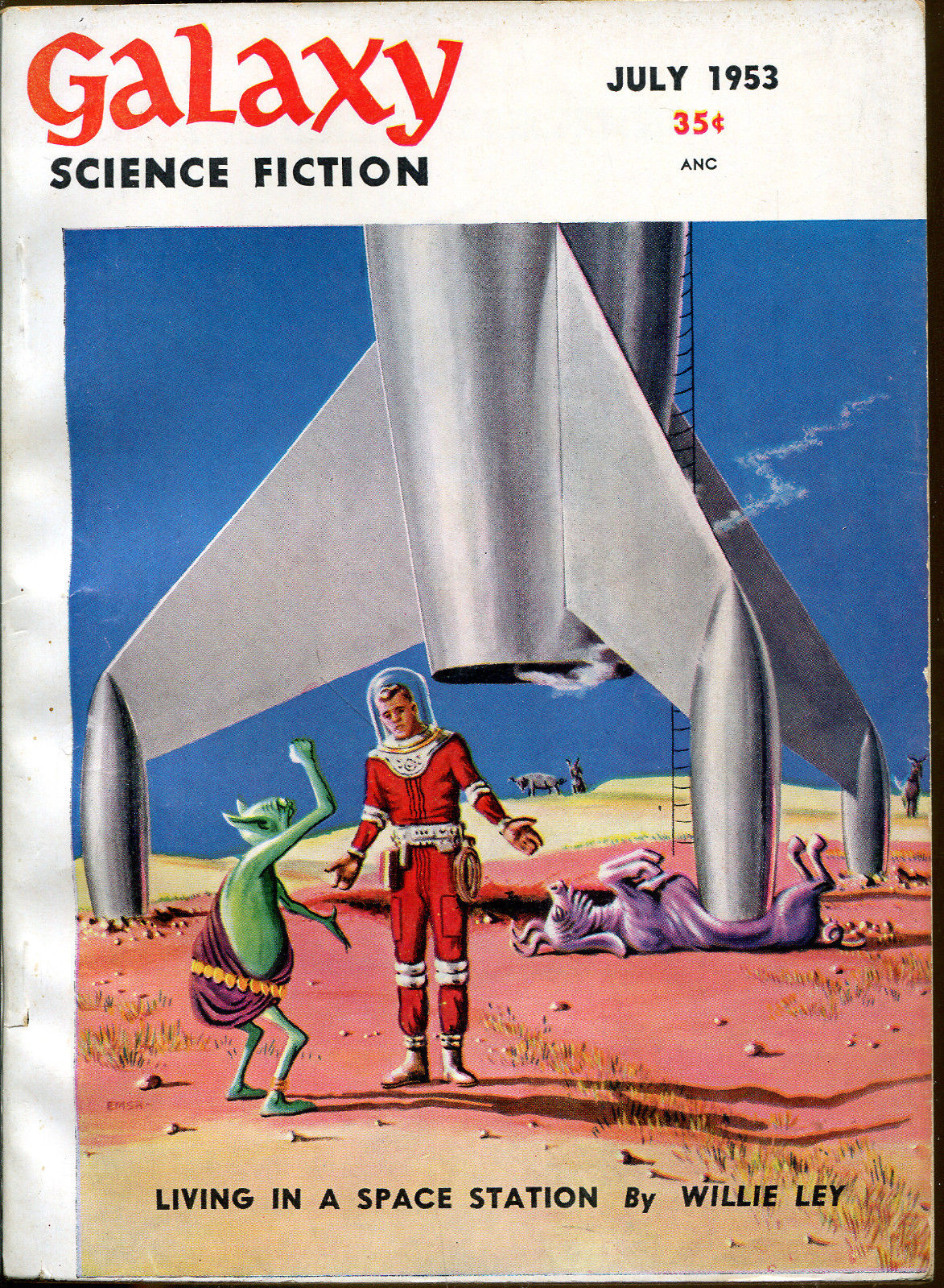 The July, 1953 issue of Galaxy Science Fiction is bereft of a serialized novel, so a curious reader could jump into it without feeling a need to commit to something larger. I suggested the same thing for the June, 1953 issue as well, so here are two issues to choose between. Or read them both.
“Kindergarten” by Clifford D. Simak — Peter lives in the country, having moved out of the city after being diagnosed with cancer. He lives a simple life until he discovers a strange machine on his property. When he touches it, it dispenses a remarkable piece of jade.
Other people discover the machine soon enough, and with each touch, it dispenses an item specific to the person. As word spreads, the police become involved, followed by the military. The machine, though clearly alien, isn’t too disturbing until it begins laying a foundation for something much larger.
Simak’s story works really well. I think he did a good job with Peter’s character — showing his pain with cancer. And I like that the source of his pain or why he lived in the country didn’t come out immediately. I expected after reading it that nothing else in the issue would top this story, but I later found something else that edged it out as my favorite.
“Caretaker” by James H. Schmitz — An exploring party visits the planet, Cresgyth. A man named Hulman crashed on it over twenty years ago — the lone survivor of his crew. He was saved by other humans — the only humans known to exist beyond Earth. Those humans, however, are threatened by other humanoid creatures that Hulman calls snakes. The humans won’t fight back, and Hulman believes the humans will become extinct unless something is done about the snakes.


 Impossible to predict some things. Notably: you can’t know how you’ll react to a work of art until you’ve experienced it. Looking at the movies Fantasia offered on Sunday night, July 24, I thought I’d try If Cats Disappeared from the World (Sekai kara neko ga kietanara), which promised a tale about a terminally ill man who makes a surreal Faustian bargain. After that, I decided I should watch Superpowerless, as it was a genre piece about an aging superhero who’d lost his powers. In truth, I had my doubts about both movies; Cats looked it might suffer from excess of romanticism and forced whimsy, while Superpowerless seemed like some kind of mumblecore satire treading ground comics had worked over decades past. In the event, I was wrong to doubt. If Cats Disappeared from the World would be likely the best movie I saw at Fantasia, and probably my favourite. Superpowerless, meanwhile, turned out to be the festival’s most pleasant surprise, the film which most greatly exceeded all my expectations.




 I’d marked four screenings on the Fantasia schedule to attend on Sunday, July 24. The first two were both at the small De Sève Theatre: a presentation of the 1983 Shaw Brothers film Holy Flame of the Martial World (Wu lin sheng huo jin), followed by a short film showcase. The showcase, Fragments of Asia 2016, promised half-a-dozen pieces from across Asia, both animated and live-action. Afterward I’d have time for food, and then two more movies would follow. Before all that, though, came one of the films I’d immediately highlighted when I first saw what was playing at this year’s Fantasia.