Fantasia 2019, Day 8, Part 2: Jesus Shows You the Way to the Highway
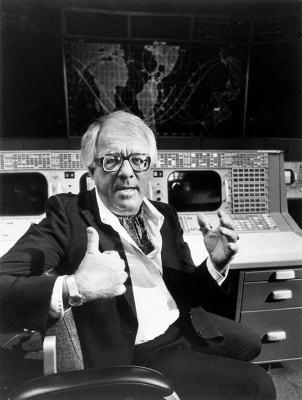
 Before my second film of July 18, a surreal science-fiction movie from the director of Crumbs, I had time to catch a panel discussion. Returning Life to the Departed: Adventures in Genre Cinema Restoration was moderated by Heather Buckley, producer of films and of DVD supplements, who introduced David Gregory of Severin Films (also director of Blood and Flesh: The Reel Life and Ghastly Death of Al Adamson, which Buckley produced), Joe Rubin of Vinegar Syndrome, and, by Skype, James White of Arrow Films. All those companies preserve, restore, and reissue vintage genre, exploitation, and cult movies.
I’m not going to go through the entire panel because it was filmed, and you can find it on Fantasia’s Facebook page. I do want to note a few highlights. Buckley asked the panel at one point how their restoration process evolved and how they did what they did, and Gregory made the point that there was no one way to restore a film as it had to depend on what materials of the original are available. Sometimes those materials might be so bad that the film might look like it wasn’t worth putting out (he cited The House on Straw Hill), but the flip side is that those materials will only get worse until the film is lost (for Straw Hill he talked about cobbling together a version from two prints and a mold- and water-damaged negative). The ideal was to work from the original camera negative or something that had been protected in a lab. Rubin agreed, but noted for exploitation films the negative often doesn’t exist. Every project will have its own issues and shortcomings and things the restorer will have never had to deal with before. He talked about how low-budget movies did not usually get to have a timer sit with the cinematographer or director when the first prints were made to make sure the film looked right. Gregory noted that often the director or cinematographer will often say that a restored film is the best that film has ever looked.
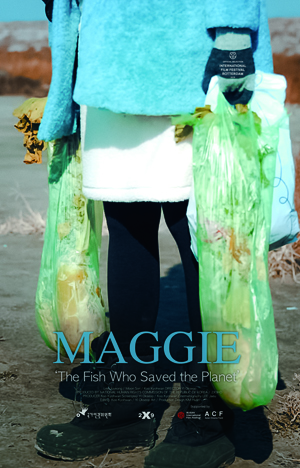 July 17 for me was a day of rest and running errands; then for my first film at Fantasia on July 18 I went to the De Sève Theatre to watch Maggie (메기). Directed by Yi Ok-seop from a film she wrote with star Koo Kyo-hwan, it’s the story of Yeo Yoon-young (Lee Ju-young), and her boyfriend Sung-won (Koo). Yoon-young’s a nurse at Love of Maria Hospital in Seoul. One day, an X-ray surfaces showing a man and a woman having sex in the X-ray room. The next day almost nobody comes in to work; the X-ray room’s a popular site for assignations, and everyone thinks they’re one of the figures in the X-ray. Yoon-young’s the only one who dares show her face, along with Doctor Lee (Moon So-ri). They end up forming an unlikely partnership as Maggie helps Lee learn to trust other people. Meanwhile, Sung-won finds work filling in sinkholes opening up in Korea, following an earthquake predicted by a catfish named Maggie — who also turns out to play an important role within the film.

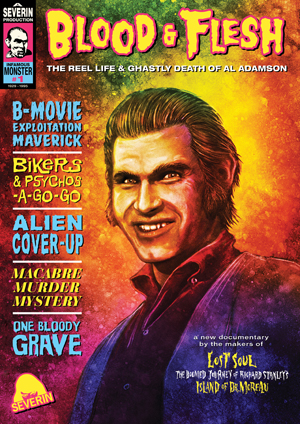 I expected my last film of July 16 would be a documentary called Blood & Flesh – The Reel Life and Ghastly Death of Al Adamson. You may not have heard of Adamson. I hadn’t. He was an exploitation filmmaker in the 1960s and 70s, responsible for titles like Satan’s Sadists, The Naughty Stewardesses, and Dracula Vs. Frankenstein, as well as not one but two separate films titled Psycho a Go-Go (Technically, one was Psycho à Go-Go; note accent). Introducing the documentary, Fantasia co-Director Mitch Davis described Adamson as more of a hustler than a filmmaker, then called up director David Gregory to briefly explain the film’s genesis. Gregory said it began as a special feature for a Blu-ray release, but the more he investigated Adamson, the more he realised the material was worth digging into more deeply. Thus, it’s now a feature, covering Adamson’s life, the films he made, and his awful death.
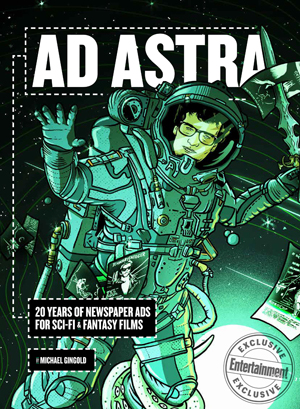 On July 16 I started my day at Fantasia with a book launch. Michael Gingold’s book Ad Astra is coming out this fall, but attendees of his multimedia presentation had the chance to buy it earlier. It’s a follow-up to 2018’s Ad Nauseam: Newsprint Nightmares From the 1980s and its sequel to come in September, Ad Nauseam II: Newsprint Nightmares From the 1990s and 2000s. Those books were collections of classic newspaper ads for horror movies, while Ad Astra is subtitled 20 Years of Newspaper Ads for Sci-Fi & Fantasy Films.