The Return of the Sorcerer: Falling under Clark Ashton Smith’s potent spell for the first time
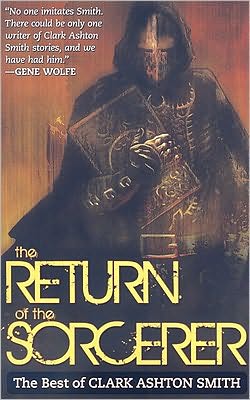 Confession: I am a fan of pulp fantasy who has, until recently, read very little Clark Ashton Smith. Yes, the man who comprises one of the equilateral sides of the immortal Weird Tales triangle has largely eluded me, save for a few scattered tales and poems I’ve encountered in sundry anthologies and websites.
This past week that all I changed when I cracked the cover of The Return of the Sorcerer: The Best of Clark Ashton Smith (2009, Prime Books). As I read the introduction by legendary fantasy author Gene Wolfe I knew I was in for something special: Not only was Wolfe singing Clarke’s praises (“No one imitates Smith: There could be only one writer of Clark Ashton Smith stories, and we have had him”), but he ended with this declaration:
“Earlier I wrote that Smith had come—and gone. That he had been ours only briefly, and now was ours no longer. That is so for me and for many others. If you have yet to read him, it is not so for you. For you solely he is about to live again, whispering of the road between the atoms and the path into far stars.”
The stories that followed did just that. Smith came alive for me, and I find myself a changed man. I have trekked on distant planets, seen alien beings beyond my conception, and peered wide-eyed over the shoulders of reckless sorcerers reading from musty tomes of lore that should not be opened. I have witnessed wonders and horrors beyond the knowledge of mankind. It was a wonderful experience. Though they comprise only a small part of his body of work, the stories of The Return of the Sorcerer reveal Smith as a man of staggering imagination, considerable poetic skill, and surprising literary depth.
 “You’re gonna need a bigger boat.”
 “Clowns, without a doubt.”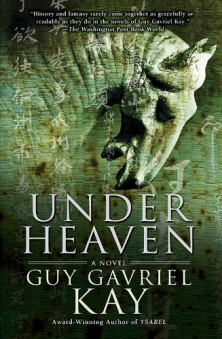
 Over at
 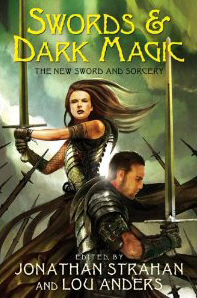 It isn’t often we see a new Sword & Sorcery anthology, especially one from a major publisher.
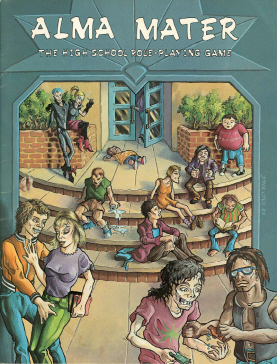
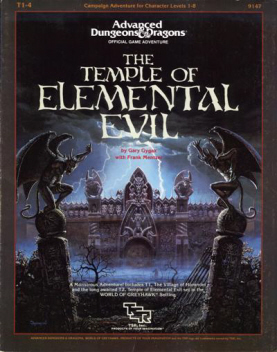 Role-playing games have always interested me because, at heart, they’re about stories. They’re ways to tell stories that you don’t know in advance, ways to bring people together to create something unpredictable but still structured in a narrative form. Now, that said, the question is: how do you go about doing that? If you’re writing a module, an adventure, that referees are going to pick up off a store shelf (or download from a web site), what do you give them to help create that story with their players?
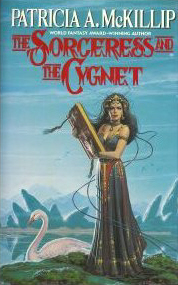 Corleu is an oddity, a white-haired youth in a black-haired tribe of wanderers. His family has a talent for foresight, but all he has is a knack for stories. And then one year the tribe goes south for the winter and finds itself in a marsh where time seems to stand still, where the flowers are perfect but the skies are invisible behind the mists — and no one knows how long they’ve been there. No one but Corleu notices anything wrong.
 While
While 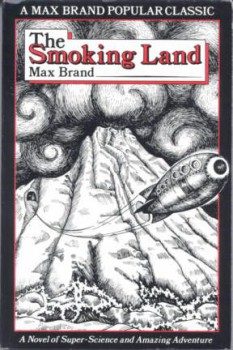 The Smoking Land