In the Grip of “The Northern Thing:” My Top 10 Northern Inspired Stories
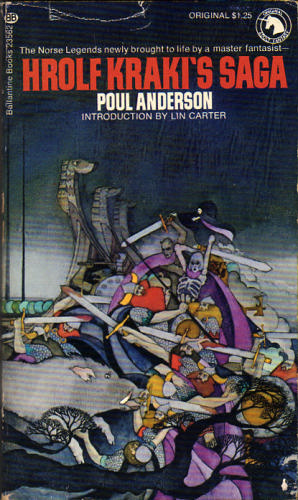 Let us die in the doing of deeds for his sake;
let fright itself run afraid from our shouts;
let weapons measure the warrior’s worth.
Though life is lost, one thing will outlive us:
memory sinks not beneath the mould.
Till the Weird of the World stands unforgotten,
high under heaven, the hero’s name.
–from Hrolf Kraki’s Saga, Poul Anderson
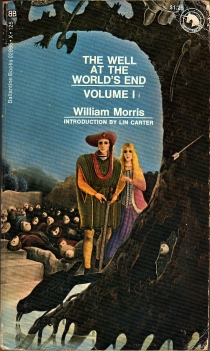
If I had to choose a favorite sub-genre of fantasy literature it would be those writings showing the clear influence of ancient Northern mythology. Fantasy critic Lin Carter once described a group of writers including the likes of J.R.R. Tolkien, Poul Anderson, and William Morris as being possessed by “The Northern Thing”; I too am firmly in that Icelandic grip of iron. There’s just something about tales of pagan heroes possessed of grim northern courage, set against a backdrop of bleak fjords and smoldering mountain peaks and gray lowering skies, that make me want to hop on the nearest dragon-headed longship and go a-viking.
Following in no particular order are my top 10 favorite northern stories. These are stories inspired by northern myth (the Prose and Poetic Eddas), legend (the Icelandic Sagas), or history (the Danish invasions of England), and sometimes all three at once.
1. The Broken Sword, Poul Anderson. Arguably the greatest fantasy novel without the name J.R.R. Tolkien on its cover, The Broken Sword combines Norse mythology, inexorable tragic fate, faerie races vs. encroaching humanity, and Christianity vs. Paganism in a bloodthirsty, unforgettable saga.
2. Hrolf Kraki’s Saga, Poul Anderson. Anderson makes his second appearance on this list, the only author to do so. Hrolf Kraki’s Saga is a terrific, too little known novel that moves with the speed of lightning (just 260 pages) and hits with the impact of Thor’s hammer. It’s also a retelling of the life and times of an actual Danish king of the same name, and is rendered even more powerful and mythic with its tragic Arthurian overtones.
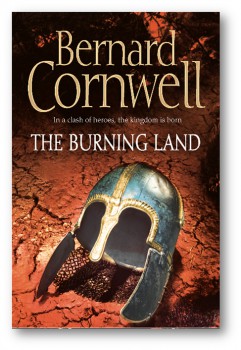 3. The Saxon Stories, Bernard Cornwell. Uhtred of Bebbanburg is a Saxon youth captured and raised among the Danes, who then proceeds to spend the next several books in this yet-unfinished series fighting alternately for both sides in war-torn 9th century England. The Saxon Stories features Cornwell, a brilliant historical fiction writer, at his near-best (though I still prefer his Warlord Trilogy) with Viking raids, shield walls, axes, dark ages combat, hall-burnings, and general mayhem galore. Great stuff.
 No deals . . . I want to drive the truck.
 Steve is a very normal man, perhaps even a bit boring. He works at an English shipping company, handling inventories and looking forward to a career in politics once he climbs the business ladder as far as it will take him. One day, for no particular reason, a sudden fit of discontent sends him down to the docks looking for something different, perhaps a restaurant he hasn’t visited. In an alley, he sees a man being attacked . . .
 Early on in this film we see Bruce Willis with hair and looking young, and not Die-Hard bashed up, and we wonder absently if this time he’ll actually finish the film as scar-free as he began it. The Willis we begin with is quickly established as a ‘surrogate,’ the robot avatar of the real Willis character, Tom Greer, and it doesn’t take long for both Greer and his surrogate to get bashed up in familiar form.
 On the whole, I’m not opposed to traveling with boys. Generally speaking they are amusing companions particularly when refusing to ask directions, thereby winding you through mildly interesting places while attempting to locate the desired destination sans MapQuest. Along the route, in an effort to distract their hapless passengers from all the pointless meandering, they can generally be counted on for lively and revealing conversation about former girlfriends, prior arrests and entirely icky things done in frat houses; all of which become prime blackmail fodder for later use.
 Who was the first person to write high fantasy?