David Lindsay, A Voyage to Arcturus, and Necessary Strangeness
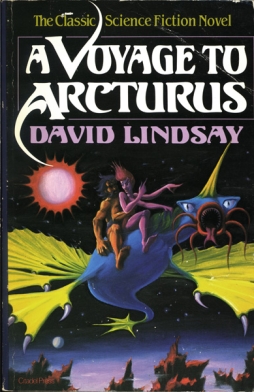 Writing about Romanticism has gotten me started thinking about forms, and conventions, and how we read a story. To some extent I’ve come to feel that contemporary ways of reacting to narrative are more classical than romantic; they’re more to do with structure and form than with trusting the individual genius. It seems to me that many readers, and critics, have become used to looking for certain things in a story, and have come to think of stories that function in a different manner as necessarily defective rather than distinct. And I feel this is a pity, since if we can’t accept the strange works of genius that succeed in defiance of everything we think we know about storytelling, then our experience of story becomes diminished.
Take, for example, David Lindsay’s novel A Voyage to Arcturus.
Lindsay’s first book, published in 1920, the book begins with two men preparing for a séance, the medium and his host; neither man appears after the opening pages. Instead we follow two other men who come to the séance, Maskull and Nightspore, who afterward are invited by an acquaintance of Nightspore’s, Krag, on a journey to a planet in the system of Arcturus. Maskull, who now swiftly becomes the main character, is dubious; still, he agrees to the trip, seeking some kind of adventure he can’t quite seem to articulate. Maskull spends much of the trip asleep, finally awaking on his own on the Arcturan planet of Tormance. From there, we follow him as he heads northward, learning about the planet and the mysterious forces that seem to be struggling for mastery upon it.
To describe the book in such a way, though, is not to give any real sense of its contents. It challenges all traditional sense of character and indeed story. Maskull’s given no real history or coherent drives. He decides to do things on the spur of the moment, then changes those decisions on a whim. His body alters repeatedly on Tormance, sprouting a third arm and new sense organs; he takes it with aplomb. The people he meets on Tormance are equally difficult to understand, developing loves and hates almost at random. And yet there is a sense of a kind of logic at work; a dream-logic, where emotions rise and fade for no obvious reason.
 The November issue of Clarkesworld is currently
 I still haven’t quite come to grips with The Hobbit in 3D. I’ve got a few 3D films under my belt—Avatar, Captain America, Green Lantern, and Jaws 3—and to be honest, the added dimension hasn’t done much for me. Avatar made the most of it with its rich images of Pandora; the other films felt like they were trying to capitalize on a fad (hey, look, there’s a shield coming at me!) in order to take in a few extra bucks at the gate.
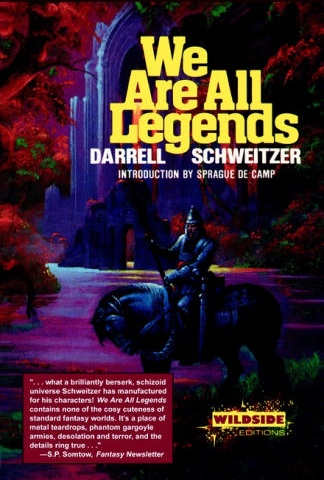 Swords Against Darkness.