Blogging Sax Rohmer’s The Bride of Fu Manchu, Part Two
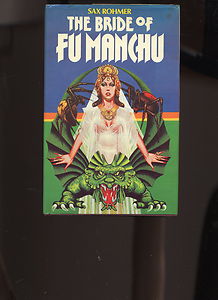
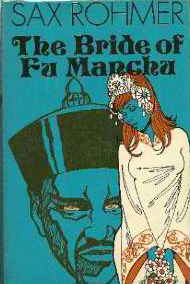 Sax Rohmer’s The Bride of Fu Manchu was originally serialized in Collier’s from May 6 to July 8, 1933 under the variant title, Fu Manchu’s Bride. It was published in book form later that year by Cassell in the UK and Doubleday in the US. The US edition retained the original magazine title until the 1960s, when the UK book title was adopted for the paperback edition published by Pyramid Books.
After Alan Sterling recovers consciousness, Sir Denis insists he dine out that evening in Monte Carlo to take his mind off the terrible situation with Dr. Petrie. Complying with his wishes, Alan drives to Monaco and spends some time at a casino trying to apply Petrie’s (really Rohmer’s) complicated system to break the bank, to no avail. While dining that night, he is startled to spy Fleurette at another table dining with a Russian nobleman and Mahdi Bey.
Observing them in public, Sterling convinces himself that Fleurette must be Mahdi Bey’s mistress. This devastates him as he has idealized her as his virginal dream girl since first glimpsing her on the beach at Ste. Claire. Sterling’s reverie is broken when he spies the Chinese agents of Dr. Fu Manchu in the restaurant. He then hears the mysterious sonic trumpet sound once more. He doesn’t understand the connection, but he is now certain that Mahdi Bey is somehow mixed up in the dangerous business and Fleurette with him.




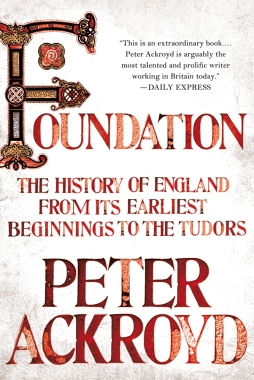 I’ve been reading Peter Ackroyd’s writing for almost twenty years now, and I’m frankly beginning to fall behind. It’s hard to keep up with the man: he’s produced poetry, fiction, biographies, creative nonfiction, and, most recently, narrative history. One of his nonfiction books, Albion, was subtitled ‘the English Imagination,’ and was an essay or set of essays investigating exactly that; in fact, much of Ackroyd’s work can be seen as an investigation of, or a struggle with, the nature of English literary, historical, and imaginative traditions — especially as manifested in the history of London. And so his current project (or one of them) is an ambitious six-book history of England. Two have been published so far; as I say, I’m behind, and have only just completed the first, Foundation, examining the past of England from prehistory to the end of the Wars of the Roses.