How to Write Magical Words
I’m a fan of books aimed at writers, and I’m always delighted to find another good one.
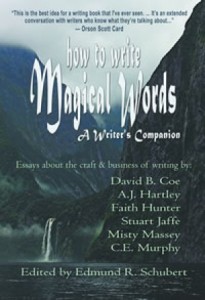 How to Write Magical Words: A Writer’s Companion debuted in January 2011. Unlike most “how to write” books that I’ve ever seen, Magical Words is presented in bite-size chunks. The authors take turns writing about various topics, presenting short essays with information, advice, and helpful anecdotes, then get out of the way for the next essay. None of which are more than four or five pages long. It’s an ideal approach for someone working in this busy modern world, or for someone under deadline, or with kids, or who wants to read a little something before sitting down to write for the day, and editor Edmund Schubert is to be commended for the structure.
The book is broadly divided into seven categories, like “Characters, Dialogue, & Point of View” or “Self-Editing,” into which each of the short essays is placed. Perhaps because the material originated on the web site magicalwords.net there’s an approachable, conversational quality to the advice — indeed, the contributing writers often react and expand upon the advice in the concluding remarks to each essay. As I read my way through the book I found myself looking more and more forward to seeing what the other writers would add, and what alternative perspective they might be able to offer. It was a lot like listening to a group of helpful professional writers as they trade tips among themselves — one has the sense that they are not so much talking at you as talking in a group in which you yourself would be welcome to drop in and ask for a few tips.
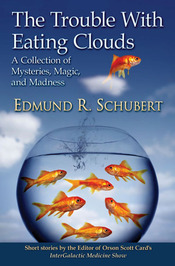 While there are certainly tips inside for all levels of writers, I think it will probably be of most use to aspiring writers or those who are just getting their career going (and this does seem to be the intent of the magicalwords.net site). I was impressed enough with the book’s structure that I’ve decided to look further into the work of Mr. Schubert. I’ve had the pleasure of talking with him at a convention or two over the years, and I’ve read a few stories during his tenure as Editor of Orson Scott Card’s Intergalactic Medicine Show, but this is my first extended exposure to what he’s capable of, and it’s made me curious about his recently released book of short stories, The Trouble with Eating Clouds. Anyone who can offer advice on writing this polished clearly knows something about writing, so I’ll be taking a look at his work soon, along with that of the other writers in the volume, David B. Coe, A.J. Hartley, Faith Hunter, Stuart Jaffe, Misty Massey, and C.E. Murphy.
Moreover, I think I’ll definitely be dropping by magicalwords.net in the near future. They seem like a friendly bunch, and I’d like to join the conversation. Maybe I’ll “see” you there.