Browsed by
Category: Vintage Treasures

Vintage Treasures: Four for Tomorrow by Roger Zelazny

Vintage Treasures: Four for Tomorrow by Roger Zelazny

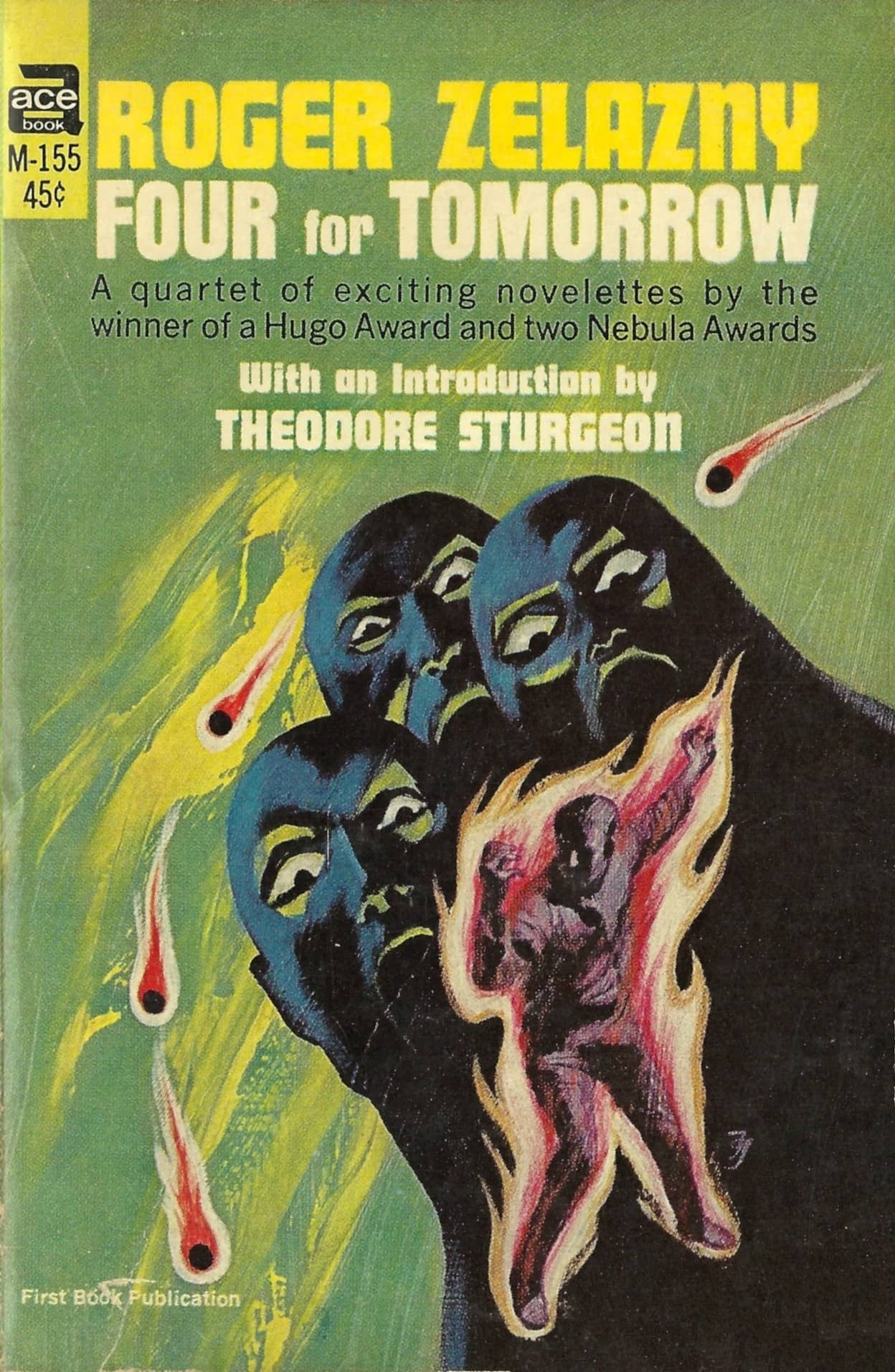
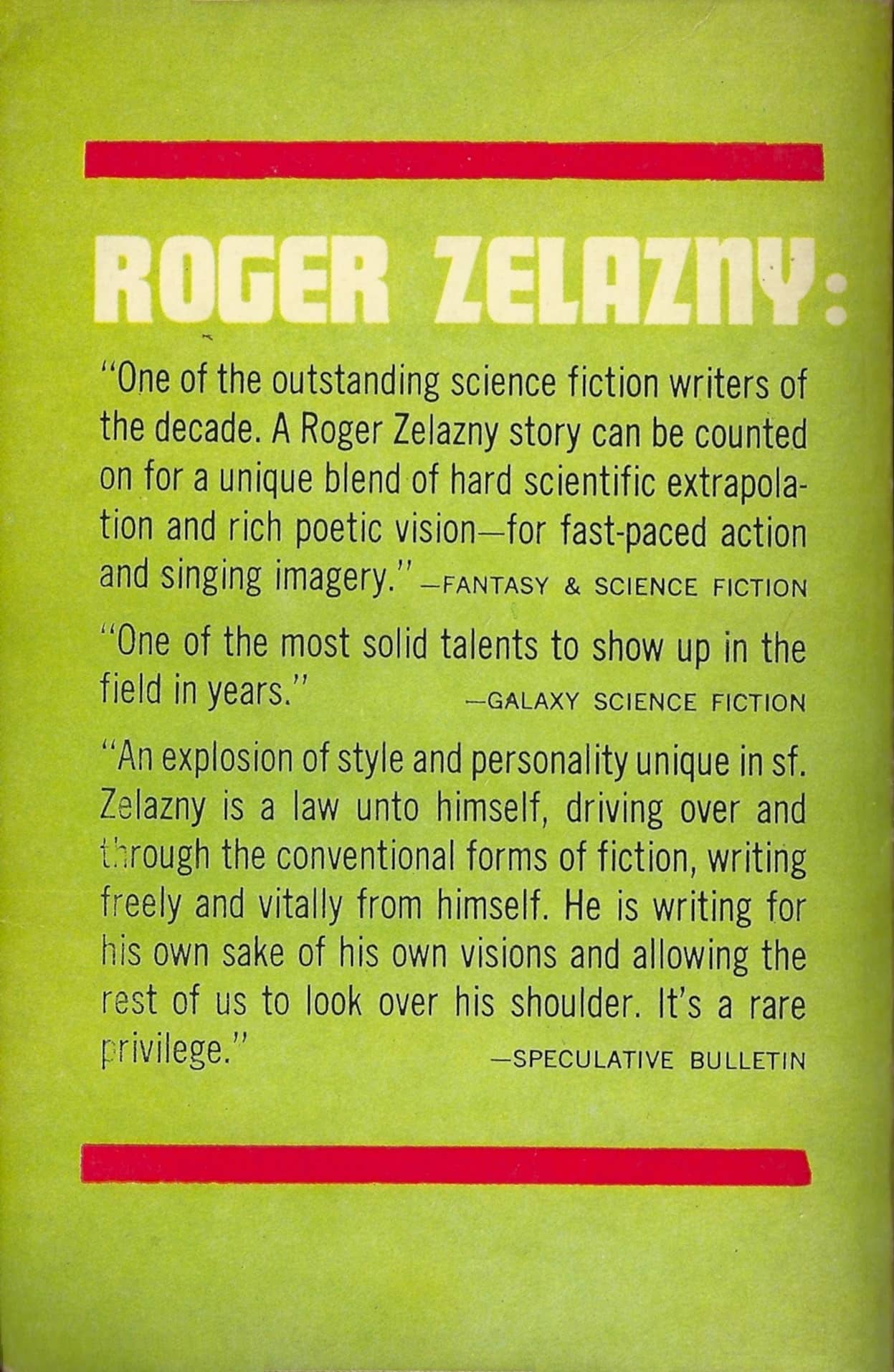
Four for Tomorrow-small Four for Tomorrow-back-small

If you’ll allow me to wax nostalgic for a moment (I know, I know…. when do I do anything else?), I’d like to spend a moment fondly remembering an era when relatively unknown writers could make a huge splash with a mass market paperback collection.

Roger Zelazny’s first collection Four for Tomorrow was published as a paperback original in March 1967 by Ace Books, with a rather uninspired (and very green) cover by Jack Gaughan. Now, Zelazny wasn’t exactly an unknown writer in 1967 — the year before he’d published his first novel ..And Call Me Conrad, which tied with Frank Herbert’s Dune for the Hugo Award for Best Novel, and his second, The Dream Master, an expansion of his Nebula Award-winning novella “He Who Shapes.” In fact, it was a busy time for Zelazny — his novelette “The Doors of His Face, the Lamps of His Mouth” won the 1966 Nebula Award, and his groundbreaking Lord of Light, one of the finest SF novels ever written, won the 1968 Hugo Award.

It was Zelazny’s time. And it’s certainly no surprise that his slender 45-cent collection Four for Tomorrow, which collected four of his best-known longer works from his fledgling career, was a huge success. It was reprinted more than half a dozen times over the next 25 years, and is still fondly remembered.

Read More Read More

Baum’s Giant Robot

Baum’s Giant Robot

Baum The Magical Monarch of Mo, and His People color illus

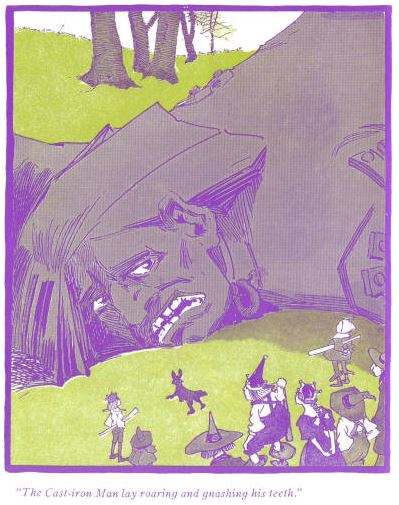
L. Frank Baum is a seminal figure in the history of robots, and not for the reason that might leap to mind. By my standards The Tin Woodman (whose subtle real name is Nick Chopper, if you bother to read on to the second Oz book, The Marvelous Land of Oz (1904)) isn’t a robot. He retains his original brain and personality, which makes him a cyborg. So is Fyter the Tin Soldier and Chopfyt, who can both be found into the hallucinogenic The Tin Woodman of Oz. (Fyter is a second tin man, and Chopfyt is made of the leftover human parts of the two of them. You think the Flying Monkeys give kids nightmares!) I’m sure some academic has done a lengthy examination of retention of identity in Oz stories, given all the transformations Baum puts his characters through.

Read More Read More

Birthday Reviews: Bruce Coville’s “The Passing of the Pack”

Birthday Reviews: Bruce Coville’s “The Passing of the Pack”

Cover by Gary Lippincott

Bruce Coville was born on May 16, 1950.

Best known as a YA author, Coville won the Golden Duck Award in 1992 for his novel My Teacher Glows in the Dark, won it again in 2000 for I Was a 6th Grade Alien, and in 2006 won a Golden Duck for an audio production of Robert Heinlein’s novel Rolling Stones. His novels have twice been nominated for Mythopoeic Awards and in 2000, he received a Skylark Award from NESFA. He received the Empire State Award for Excellence in Literature for Young People from the New York Library Association in 2012.

“The Passing of the Pack” was originally written for the young adult anthology Werewolves: A Collection of Original Stories, edited by Jane Yolen and Martin H. Greenberg in 1988. Coville included the story in his collection Oddly Enough in 1994 and when that volume and its successor were collected in the omnibus Odds Are Good: An Oddly Enough and Odder Than Ever Omnibus, the story saw print again. In 2011, Coville issued the story as an e-book.

Throughout most of history, wolves have been seen as an enemy. They threaten the livestock on small villages and, when particularly hungry can also threaten humans. Bruce Coville channels that fear of wolves in the opening of “The Passing of the Pack,” which describes a wolf attack on a sixteen year old boy and then flashes back to the first time wolves attacked his village when he was five years old.

The story looks at the character’s life as a fatherless boy in a small village, specifically how he was treated almost as an outsider by the rest of the villagers. When he came to the defense of a girl he had befriended, the accusation of witchcraft against her was applied to him as well. By this time, Coville has shown an affinity for him by the wolves and his rescue by the animals is not really a surprise.

Read More Read More

The Roots of Grimdark:The Black Company by Glen Cook

The Roots of Grimdark:The Black Company by Glen Cook

No one will sing songs in our memory. We are the last of the Free Companies of Khatovar. Our traditions and memories live only in these Annals. We are our only mourners.

It is the Company against the world. Thus it has been and ever will be.

from The Black Company

oie_1471611MVbvsrErYou never know, when you pick up a book, the impact it will have on your life. In 1984, my friend Carl tossed me a copy of The Black Company (1984), a book I’d end up rereading half a dozen times over the next thirty-five years. It turned out to be the first book in what eventually grew into a ten book series (eleven actually, as the first new Black Company book in eighteen years, Port of Shadows, is to be published in September) and one of my favorite works of epic fantasy. Several of Cook’s other books are better written, better plotted, and more cohesive than The Black Company, but none of them has left as indelible a mark on me as this one.

The setup of the novel is this: a mercenary company unknowingly signs on to the service of Sauron’s wife the Lady, a great and powerful sorceress. Her empire has risen up in rebellion against her and her minions, the Nazgul Taken. Assassinations, intrigue between world-shaking sorcerers, and massive battles unfurl in a world notable mostly for its corruption, constant deceit, and an assumption that nothing ever really goes right. Never an especially good bunch of guys, by the book’s end, several important members of the company have grasped the awfulness of their employer and have started to have second thoughts about remaining in her pay. That may not sound original in 2018, but back in 1984, villains as protagonists was mind-blowing.

The novel is presented as a volume from the annals of the Black Company, a notorious band of sell-swords, as written by the company’s annalist and surgeon, Croaker. Not a senior officer, but not a grunt either, he serves as the perfect narrator of the book’s calamitous and epic events. He’s rarely in on the plotting out of the Company’s next missions, but he’s usually in a position to participate in the more important aspects of them.

There’s a sizable epic fantasy-sized cast in The Black Company, but by focusing so intently on a single character, Croaker, the story’s told on a very human scale. Croaker’s primary concerns, as a member of the company and as its doctor, are for the lives of his brothers-in-arms, more than for the concerns of empire. Through him we get a feel for the most prominent of the company’s soldiers and wizards. We see huge events from the perspective of someone effected by them but without any significant control over them. This is not a book about the destinies of kings and princes or heroes and wizards, but men who carry spears, grumble about bad rations, and worry about paying off their debts from losing at cards.

Read More Read More

Birthday Reviews: Dave Wolverton’s “We Blazed”

Birthday Reviews: Dave Wolverton’s “We Blazed”

Cover by Michael Sabanosh

Dave Wolverton was born on May 15, 1957. He also writes using the pseudonym David Farland.

Wolverton won the Grand Prize from the Writers of the Future in 1987 to start off his career with his story “On My Way to Paradise,” which he expanded to book length. The novel version received a special citation from the Philip K. Dick Awards. His novelette “After a Lean Winter” was nominated for the Nebula Award in 1997. After his wins and nominations, Wolverton served as a judge for both the Philip K. Dick Award and the Writers and Illustrators of the Future. His historical novel In the Company of Angels received the Whitney Award and he won the International Book Award for Best Young Adult Novel for Nightingale.

“We Blazed” was written for the anthology Peter S. Beagle’s Immortal Unicorn, edited by Beagle with Janet Berliner, and Martin H. Greenberg. It was reprinted in the June 2011 issue of Leading Edge, whole number 61, edited by Chris Baxter. Later that year Wolverton re-issued the story as an e-book under his David Farland pseudonym.

Wolverton’s “We Blazed” is a wonder of misdirection. Seemingly the story of an immortal man on a quest to find his equally immortal lover, Wolverton provides some wonderful twists. No reason is given for Alexander Dane’s longevity, nor that of Kaitlyn, whom he is trying to find, but he walks through an Earth impossibly in the future, almost completely amnesiac except knowing that he is looking for Kaitlyn.

Read More Read More

With a (Black) Gat: George Harmon Coxe

With a (Black) Gat: George Harmon Coxe

Coxe_MurderPicture(Gat — Prohibition Era term for a gun. Shortened version of Gatling Gun)

Working from Otto Penzler’s massive The Black Lizard Big Book of Pulps, we’re going to be exploring some pulp era writers and stories from the twenties through the forties. There will also be many references to its companion book, The Black Lizard Big Book of Black Mask Stories. I really received my education in the hardboiled genre from the Black Lizard/Vintage line. I discovered Chester Himes, Steve Fisher, Paul Cain, Thompson and more.

With first, the advent of small press imprints, then the explosion of digital publishing, pulp-era fiction has undergone a renaissance. Authors from Frederick Nebel to Raoul Whitfield; from Carroll John Daly to Paul Cain (that’s 27 letters – we went all the way back around the alphabet – get it?) are accessible again. Out of print and difficult-to-find stories and novels have made their way back to avid readers.

Strangely, George Harmon Coxe, one of the Black Mask boys, has been elusive in this pulp rebirth. He had a half-dozen recurring characters and wrote over sixty novels and his stories were also adapted for movies, television and radio. But it’s tough to find even a handful of his works these days, though a few novels have found their way to ebook format.

From 1935 to 1973, Coxe wrote twenty-three novels featuring Kent Murdock. Murdock, a Boston-area crime photographer, is really an evolved (make it, more refined and mature) version of an earlier Coxe creation, (Jack) Flashgun Casey. It’s a Casey story that’s in The Big Book and our focus today.

The photographer appeared two dozen times in Black Mask from 1934 through 1943. And there were six novels (one of which was previously serialized in Black Mask). But Casey fell by the wayside for the ‘cleaned up version’ that was Murdock. The Casey story, “Murder Mixup” was included in Joseph ‘Cap’ Shaw’s legendary Hard Boiled Omnibus — though it was one of three stories dropped when the paperback from Pocket Books came out.

Read More Read More

Vintage Treasures: The House of Many Worlds by Sam Merwin, Jr.

Vintage Treasures: The House of Many Worlds by Sam Merwin, Jr.

The House of Many Worlds-small The House of Many Worlds-back-small

Sam Merwin Jr. was one of the most influential SF editors of the pulp era. He took over the reins at Thrilling Wonder Stories and Startling Stories in Winter 1945 from Oscar J. Friend, and immediately adopted a more mature attitude, attracting more adult readers and better writers. At first he assumed Friend’s editorial pseudonym, Sergeant Saturn, but eventually he simply went by the title Editor. By 1950 he was also editing Fantastic Story Quarterly and Wonder Stories Annual, making him one of the most important names in the field. His letter columns were avidly followed by fans of all ages, and he’s widely credited with steering his SF magazines out of the kid’s section and towards an adult readership.

Merwin quit editing in 1951 to become a freelance writer, and found some success with mysteries, and writing stories for DC’s Strange Adventures and Mystery in Space in 1952-1953. He briefly edited Fantastic Universe in 1953, and was an associate editor at Galaxy around the same time.

But Merwin is remembered today chiefly for two linked time travel novels, The House of Many Worlds and Three Faces of Time. They were published in a paperback omnibus edition by Ace in 1983, with a cover by comic artist Frank Brunner (above).

Read More Read More

Birthday Reviews: Elizabeth Engstrom’s “Seasoned Enthusiast”

Birthday Reviews: Elizabeth Engstrom’s “Seasoned Enthusiast”

Cover by Allen Koszowski

Elizabeth Engstrom was born on May 11, 1951. She occasionally writes using the name Liz Cratty as well.

Engstrom’s collection Nightmare Flower was nominated for the Bram Stoker Award and she co-edited the anthology Imagination Fully Dilated with Alan M. Clark, which earned them an International Horror Guild Award nomination.

“Seasoned Enthusiast” first appeared 1990 in Pulphouse: The Hardback Magazine: Horror, the seventh issue, edited by Kristine Kathryn Rusch. Engstrom later reprinted the story in her 1992 collection Nightmare Flower.

The short work “Seasoned Enthusiast” tells two parallel tales, one about a dancer performing in front of an audience, the other the story of a divorced woman who is considering her own self-worth in light of her husband’s new life.

The more interesting story looks at Lillian, whose life has fallen apart after her divorce and she’s living in squalor while her husband and his new wife start their life together in an upscale house, a symbol of the success which eluded the couple while they were married. Unable to separate her life from his, and seeing herself as a failure because she lost him, Lillian drives over to her ex-husband’s house without a firm plan in mind, feeding her obsession with him without any plan of action.

In the other story, a crowd gathers around to watch a woman dance in an apparently primitive setting. As the dance sequences are interwoven with Lillian’s story, it becomes clear that things aren’t quite as they seem. There is an element of danger in the woman’s dance and she has suffered for her craft as she has perfected it.

Read More Read More

The Ties That Bind: Mike McQuay’s The Nexus

The Ties That Bind: Mike McQuay’s The Nexus

The Nexus Mike McQuay-smallThe Nexus, by Mike McQuay
Spectra Special Edition (Bantam Books, 474 pages, $4.50 in paperback, May 1989)
Cover by Bob Hickson

Amy Kyle, an Autistic girl on the threshold of puberty, has divine powers. She can cure the sick, heal the lame, mend broken bones and make horrible scars disappear. She also has incredible powers of teleportation and telekinesis, and can manipulate reality in such ways as making a horde of food appear out of thin air, the way Christ is said to have done with the loaves and fishes. Thus, the comparisons to Christ and discussions about the nature of God and divinity are at the core of this story. Amy’s mother, Tawny, is a booze-addled, chain-smoking, sometime prostitute and train wreck of a human being who can channel her daughter’s powers. This she does in old-fashioned “revival” type meetings, charging people a modest sum to be healed and cured of their physical limitations and ailments.

Denny Stiller is a nearly washed-up newsman for WCN, a Dallas, Texas cable news network, who lives and breathes for “the story.” He is a self-professed seeker of the Truth who lives a life avoiding most relationships and commitments. Part hero, part rogue, his whole adult life has been devoted to being the ultimate newshound, the ultimate reporter. Frank Hargrave is a Vietnam veteran with a badly scarred and damaged leg. A one-time storm chaser who can barely hang onto his sanity; he’s one of the walking wounded who drinks too much in an effort to numb himself from the nightmares, the cruelty, and the violence of the world. An overly sensitive soul, he leads a troubled life filled with pain and terrible nightmares, but none of this intrudes on his talent for “capturing the moment” on film. The head honchos at WCN would have dumped him long ago, if not for Denny’s support and belief in his friend.

But Denny himself, once the top reporter at WCN, was demoted to covering less-urgent news because of a scathing interview he once conducted with the President of the United States of America. Now he’s trying to redeem himself and work his way back to being king of the news hill.

Molly Hartwell is a producer at WCN, and is also in love with Denny. She stands by him, backs him all the way, and risks her own career in order to help him rise to the top of the heap again. But Denny often mistreats her, uses her, and her love for him is not always reciprocated, not in the way she wants. Their relationship is further complicated when she finds out that she’s pregnant with Denny’s child, something he neither wants nor cares about; although she asks and expects nothing from him in return, he tells her that he is willing to help her out in any way he can.

Read More Read More

Birthday Reviews: John Scalzi’s “Utere Nihil Non Extra Quiritationem Suis”

Birthday Reviews: John Scalzi’s “Utere Nihil Non Extra Quiritationem Suis”

Cover by Edward Miller

John Scalzi was born on May 10, 1969.

John Scalzi won the John W. Campbell Award for Best New Writer in 2006. He won the Hugo Award for Best Fan Writer in 2008, breaking David Langford’s nineteen year winning streak. He won a second Hugo in 2009 for Best Related Work for Your Hate Mail Will Be Graded: A Decade of Whatever, 1998-2008. In 2013, he won a fiction Hugo Award for his novel Redshirts: A Novel with Three Codas. His novel The Collapsing Empire is currently a Hugo Finalist. Redshirts earned Scalzi his second Geffen Award, which he previously won for the novel Old Man’s War. His novel The Android’s Dream received the Kurd Lasswitz Preis and the Seiun Award. Scalzi served two terms as the President of the Science Fiction and Fantasy Writers of America.

Scalzi wrote “Utere Nihil Non Extra Quiritationem Suis” for an audio anthology he edited, METAtropolis, produced for Audible Frontiers in 2008. The following year, the anthology was published in print form for the first time by Subterranean Press. Brilliance Audio issued the original audio anthology on CD and as an mp3 in 2009. In 2010, Tor reprinted the anthology and in the same year, it was translated into German. The story has not appeared outside its original anthology, whether in audio or printed form.

Benjamin Washington is living in the fully self-sustaining city of New St. Louis. Despite, or perhaps because of, a high-powered mother, Benjy is something of a slacker, putting off tackling his required aptitude test until the last possible moment. His poor scores, and lack of time to retake before the deadline of this twentieth birthday, coupled with his mother’s refusal to expend her political capital on nepotism, mean that he must take a job as a pig farmer working with genetically modified swine.

Suffering through life as a pig farmer, Benjy’s realizes how much he has screwed up, especially when he sees the girl he cares about together with a boy who is constantly needling him. Even as Benjy deals with the repercussions of his laziness, his learning experiences are presented in a manner that is designed to get a laugh, although Scalzi uses those same lessons to great effect later in the story.

Read More Read More