Browsed by
Category: Vintage Treasures

Dungeon Wishes

Dungeon Wishes

sears1982I first read a Dungeons & Dragons rulebook in late 1979, nearly six years after the world’s first roleplaying game had been released. Over the course of those years, a great deal had happened, both to D&D and to the wider hobby it spawned. While I hadn’t personally experienced all that had happened, my friends and I were beneficiaries of it all.

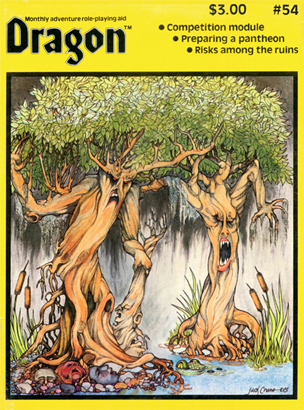
Looking back on the late 1970s from the vantage point of 2013, just days before the release of yet another big budget fantasy film, it’s sometimes hard to remember that fantasy – at least the peculiar kind of fantasy that D&D represents – was once a rather unusual taste. It certainly wasn’t yet the mainstream genre of entertainment it would become over the course of my lifetime, thanks in no small part to the success of Dungeons & Dragons. A few months before I discovered the game, Gary Gygax, in an editorial published in issue #26 (June 1979) of Dragon magazine, noted that, initially, he had assumed D&D would appeal only to a very small segment of the population. He writes:

The target audience to which we thought D&D would appeal was principally the same as that of historical wargames in general and military miniatures in particular. D&D was hurriedly compiled, assuming that readers would be familiar with medieval and ancient history, wargaming, military miniatures, etc. It was aimed at males.

He then goes on to say that, “Within a few months it became apparent to us that our basic assumptions might be a bit off target. In another year it became abundantly clear to us that we were so far off as to be laughable.” His larger point was that, because the game’s popularity had spread beyond college-age and older men with an interest in military history, the game itself would have to change to be more accessible to other potential players.

My 10 year-old self was one of those other potential players.

Read More Read More

Colin Wilson, June 26, 1931 – December 5, 2013

Colin Wilson, June 26, 1931 – December 5, 2013

The Space VampiresBill Crider is reporting that Colin Wilson, the British author of over 110 books — including Ritual in the Dark (1960), The Mind Parasites (1967), The Space Vampires (1976), Science Fiction as Existentialism (1980), and the Spider World novels — passed away late last week.

Wilson debuted in 1956 with a bestselling work of non-fiction, The Outsider, when he was only 24 years old. Written mostly in the Reading Room of the British Museum, while he was living in a sleeping bag on Hampstead Heath, the book examined the psyche of the Outsider by looking at the lives of artists and writers including Ernest Hemingway, Franz Kafka, Jean-Paul Sartre, Friedrich Nietzsche, Vincent van Gogh, T. E. Lawrence, and others. (See “Now they will realise that I am a genius,” The Observer‘s entertaining piece on his autobiography, for more details)

Wilson was immediately celebrated as one of Britain’s leading intellectuals — a reputation “that sank as fast as it had rocketed” (as he later observed) after the publication of his second book, Religion and the Rebel (1957), which Time magazine reviewed under the headline “Scrambled Egghead.” By the 60s and early 70s, Wilson had left academic subjects behind to focus on the Occult, in books like The Occult: A History (1971), Aleister Crowley: The Nature of the Beast (1987), and biographies of other spiritualists. Wilson became an active member of the Ghost Club and began to seriously explore topics such as telepathy, life after death, and the existence of spirits in his later writing.

Wilson’s fiction includes several noted Cthulhu Mythos pieces. The hero of The Return of the Lloigor (1974) discovers the Voynich Manuscript is actually a medieval translation of the Necronomicon; and in the preface to his 1967 novel The Mind Parasites, Wilson wonders “what would have happened if Lovecraft had possessed a private income – enough, say, to allow him to spend his winters in Italy and his summers in Greece or Switzerland?… what he did produce would have been highly polished, without the pulp magazine cliches that disfigure so much of his work.”

In 1985, Poltergeist director Tobe Hooper filmed Wilson’s The Space Vampires as Lifeforce. Wilson hated the film version (so did a lot of people), but it’s cheesy fun, as Leonard Maltin happily reported in his review for Entertainment Tonight.

Colin Wilson was a tireless writer; his last two books, Super Consciousness and Existential Criticism: Selected Book Reviews, appeared in 2009. He suffered a stroke in June of last year, losing the ability to speak. He died on December 5th in Cornwall, at the age of 82.

Vintage Treasures: The Unknown, edited by D.R. Bensen

Vintage Treasures: The Unknown, edited by D.R. Bensen

The Unknown edited by D R Bensen-smallIn all of our recent discussions of pulps, we have sorely neglected one of the greatest pulp fantasy magazines of all time: John W. Campbell’s magnificent Unknown. It wasn’t deliberate; we’ve just been focusing on Amazing Stories, Galaxy, and the pulp roots of Dungeons and Dragons of late.

So to do a little catch-up, I thought I’d talk about a splendid anthology I’ve been reading this weekend: The Unknown, a collection of ten short stories and one novelette from the pages of Unknown. If you’ll allow me, I’d like to quote from the Wikipedia entry on Unknown, since I think it does a fine job of summarizing the genesis and impact of Campbell’s great experiment in fantasy:

Unknown (also known as Unknown Worlds) was an American pulp fantasy fiction magazine, published from 1939 to 1943 by Street & Smith, and edited by John W. Campbell. Unknown was a companion to Street & Smith’s science fiction pulp, Astounding Science Fiction, which was also edited by Campbell at the time; many authors and illustrators contributed to both magazines. The leading fantasy magazine in the 1930s was Weird Tales, which focused on shock and horror. Campbell wanted to publish a fantasy magazine with more finesse and humor than Weird Tales, and put his plans into action when Eric Frank Russell sent him the manuscript of his novel Sinister Barrier, about aliens who own the human race… The magazine is generally regarded as the finest fantasy fiction magazine ever published, despite the fact that it was not commercially successful, and in the opinion of science fiction historian Mike Ashley it was responsible for the creation of the modern fantasy publishing genre.

The Unknown contains an excellent survey of Unknown magazine, with entertaining editorial comments and fiction contributions from Henry Kuttner, Nelson S. Bond, Theodore Sturgeon, L. Sprague de Camp, H. L. Gold, Manly Wade Wellman, Fredric Brown, and Anthony Boucher — plus a Fafhrd and the Gray Mouser tale from Fritz Leiber, and more.

It also reprints interior art from the magazine by the great Edd Cartier (see a sample here), who painted the covers for many Unknown issues. I wish more paperbacks from the era did this, as I found the artwork delightful.

Read More Read More

Vintage Bits: BattleTech: The Crescent Hawk’s Inception

Vintage Bits: BattleTech: The Crescent Hawk’s Inception

Battletech The Crescent Hawk's Inception-smallInfocom is one of the most revered names in computer gaming history. In fact, for serious collectors of PC games, there’s probably no other company that commands the respect of (or is as collectible as) Infocom.

Their heyday was the early 80s, when they released the most famous text adventure ever written, Zork (1980), alongside other classics like Enchanter (1983), Steve Meretzky’s Planetfall (1983), Brian Moriarty’s Wishbringer (1985), and Dave Lebling’s fabulously creepy Lovecraftian scarefest The Lurking Horror (1987).

But my favorite Infocom game came late in their history — indeed, after the company very nearly collapsed following the failure of their ambitious DOS database, Cornerstone, in 1986. By that time, over half of the employees had been laid off and the remnants of the company sold to Activision in a fire sale. For the first time in their history, Infocom turned to outside developers to help fill their production schedule.

It was a desperate move. Infocom had a nearly flawless reputation in the gaming industry, even as late as 1988, and expecting an untested development shop to deliver product that would meet the public’s exceedingly high expectations for an Infocom title was an exceptionally risky bet.

Fortunately, the outside developer they chose was Westwood Studios, who would later go on to develop some of the most successful games of the 90s, including Dungeons & Dragons: Eye of the Beholder (1990), Command & Conquer (1995), Blade Runner (1997) — and who virtually created the real-time strategy (RTS) genre with their groundbreaking Dune II (1992). Their first game for Infocom, and the one that really put them on the map, was one of the best titles Infocom ever released: BattleTech: The Crescent Hawk’s Inception (1988).

Read More Read More

The Whole Northern Thing: Hrolf Kraki’s Saga by Poul Anderson

The Whole Northern Thing: Hrolf Kraki’s Saga by Poul Anderson

oie_Ballantine Edition

Doom: Old English dom “law, judgment, condemnation,” from Proto-Germanic *domaz (cf. Old Saxon and Old Frisian dom, Old Norse domr

For a crime committed by King Frodhi the Peace-Good against the giantesses Fenja and Menja, a great doom is laid on the royal family of Denmark, the Skjöldungs.

How that doom works its murderous effects on the Skjöldungs is the core of Hrolf Kraki’s Saga (1973), Poul Anderson’s gripping retelling of the sagas (read the original here) of the ancient Danish king, Hrolf. The book brings together the extant stories of the Skjöldungs (which, almost as an aside, include the tale of Beowulf) and welds them into a coherent novel of great potency.

According to legend, Hrolf was the greatest king of Denmark and the most outstanding member of the semi-divine Skjöldung family. With his canny intelligence, he thwarted most of his kingdom’s enemies and built up its wealth. His great nobility drew the North’s mightiest warriors to his court.

Whether real or mythical, Hrolf and his reign are remembered in Denmark as fondly as Arthur’s in Britain. And like Arthur, all Hrolf’s great works were destroyed and chaos ruled in his wake.

From a people whose myths foretold the annihilation of the gods themselves in the end times of Ragnarok, the bleakness that runs through so many of their stories isn’t surprising. Perhaps it’s traceable to the violence of the Great Migratory period when the Germanic people spread out from their ancient homelands in Scandinavia and northern Germany and came into conflict with the Roman Empire and Celtic tribes in Gaul and Britain. Maybe it was just the cold and diminished winter sunlight in Norway and Sweden that bred their melancholy. Whatever the causes, doom in its modern sense runs through almost every chapter of Hrolf Kraki’s Saga.

Read More Read More

Christmas in the Dungeon

Christmas in the Dungeon

dungeongame1975Whenever Christmas looms, my thoughts turn not to decorations, carols, and presents; but to dungeons. Actually, that’s not entirely true. My thoughts do turn to presents – or, rather, a single, very specific present, albeit one received not by myself, but by a good friend of mine in 1979.

Among my childhood friends, it was traditional that, during the Christmas break from school, we’d all take turns visiting one another’s homes to marvel at our respective holiday hauls. Together, we’d then play with whatever we deemed the most interesting presents. In the dying days of the 1970s, that typically meant Star Wars action figures (or perhaps Micronauts) and so it was that year. I believe that was the year that I received the much-coveted Imperial Troop Transport vehicle and so became the envy of my friends. But, cool as it was to be able to push a button on the Troop Transport and hear sound effects from my favorite movie, that wasn’t the Christmas gift that most interested me.

That honor fell instead to a strange little board game my friend Mike received. I say “strange,” because the “board” wasn’t really a board at all, but rather a folded up piece of thick paper that didn’t lay very flat on the table unless you held down the corners with books or other heavy objects. This board depicted a bunch of colored boxes connected by meandering yellow spaces, with a few larger spaces here and there. These larger spaces were all given rather evocative names like “King’s Library” and “Queen’s Treasure Room” and “Torture Chamber.” Flimsy though it might have been, the board nevertheless caught our attentions – and fired our imaginations.

The game, of course, was David R. Megarry’s Dungeon!, which was first published in 1975 by TSR Hobbies.

Read More Read More

A Fond Look Back at Bluejay Books

A Fond Look Back at Bluejay Books

Alien Cargo Theodore Sturgeon-smallThe most popular article on the Black Gate website in July was our report on the departure of James Frenkel from Tor Books.

News articles like that are usually good for some decent traffic. It seems everyone had something to say about Frenkel stepping down from his post at the most powerful genre publisher in America and all that attention generated a lot of clicks.

Most conversations, however, dwelled on the circumstances of his departure, and overlooked his many accomplishments. During his years at Tor, Frenkel sure was busy. He acquired and edited some of their most important books, including volumes from Frederik Pohl, Dan Simmons, Jack Williamson, Timothy Zahn, Greg Bear, Andre Norton, Vernor Vinge, and many others.

But even before he joined Tor, Frenkel made major contributions to American SF and fantasy, particularly as publisher at Bluejay Books in the mid-80s. It’s Bluejay, and the beautiful books they produced before going out of business, that I want to talk about today.

Bluejay was active just as I was really discovering American fantasy and SF in the early 80s, haunting bookshops in downtown Ottawa. They were pioneers in the trade paperback market, hired excellent cover artists — including Rowena Morrill, Tom Kidd, Barclay Shaw, John Pierard, Jill Bauman, and others — and published many of the top writers in the field, such as Theodore Sturgeon, Philip K. Dick, Harlan Ellison, Vernor Vinge, and many more.

That was a powerful combination, and it meant that Bluejay was an imprint with enormous prestige — at least in my mind. I kept an eye out for their books on the shelves and always gave them special attention.

That prestige extended to all their titles, not just the authors I recognized (part of the magic of having a strong and easily recognizable visual brand). It also extended to the new authors they discovered and championed.

Read More Read More

Vintage Treasures: Shattered Glass by Elaine Bergstrom

Vintage Treasures: Shattered Glass by Elaine Bergstrom

Shattered Glass Elaine Bergstrom-smallFor a long time, I credited the rise of the paranormal fantasy genre pretty much single-handedly to Buffy the Vampire Slayer. While I knew it was a little simplistic, it seemed obvious that the roots of the modern fascination with dating vampire, ghouls, werewolves, etc. arose from the long-running romance between the leads of Buffy and Angel, perhaps the two most successful horror TV shows of the our generation.

Of course, as I explore the modern history of dark fantasy, I find more and more evidence that paranormal romance was alive and well long before Joss Whedon penned his first screenplay. Chelsea Quinn Yarbro’s first vampire romance, Hôtel Transylvania, featuring Count Saint-Germain, was published in 1978, for example. (And the series is still going strong — with volume 26, Night Pilgrims, just released in August.)

Yarbro was hardly the only pioneer in the genre, however. Elaine Bergstrom was working as a copywriter when she wrote her widely acclaimed first novel, Shattered Glass (1989), one of the first vampire romances. It featured a family of vampiric immortals and received a Stoker nomination. She followed up with five additional novels of the Austra family: Blood Alone (1990), Blood Rites (1991), Daughter of the Night (1992), Nocturne (2003), and Beyond Sundown (2011). Here’s the back cover copy for the book that kicked it all off:

Modern technology has rendered the vampires’ night hunt obsolete. But some vampires continue to kill. By choice.

Stephen Austra is a prominent artist, renowned for his wondrous restorations of stained glass in cathedrals and churches. He is also a vampire. But he respects ordinary human lives, and would never hurt a soul. Or so his lover, Helen Wells, desperately wants to believe…

Chilling, erotic and provocative, this sensational new novel by Elaine Bergstrom will lure you into a world where immortal evil meets undying passion. And where a series of appalling murders leads a beautiful young woman into the depths of suspicion… and to new heights of terror.

Bergstrom has also written two Ravenloft novels: Tapestry of Dark Souls (1993) and Baroness of Blood (1995). Shattered Glass was published in July 1989 by Jove Books. It is 372 pages, originally priced at 3.95 in paperback. It is currently available in digital format for $3.99.

Vintage Treasures: The Coming of the Rats by George H. Smith

Vintage Treasures: The Coming of the Rats by George H. Smith

The Coming of the Rats-smallA lot of post-apocalyptic novels and films appeared in the 50s and 60s. World War II was still a recent memory, and the threat of the H-Bomb was very real, even if most folks didn’t understand exactly what the “H” stood for. Publishers and filmmakers played on the very real terrors people faced every day. Fear of another war. Fear of atomic radiation.

And, going by the cover of George H. Smith’s The Coming of the Rats, the deep-seated fear that rats would attack our women and strip their clothes off.

Now, I’m not sure how our parents and grandparent dealt with these crippling fears, but from what I understand their coping mechanism involved a lot of cheap paperbacks, and multiple Saturday matinees (which seems like a stable strategy, when you think about it).

This is how that generation learned the facts about atomic radiation. And how the logical result would be mutants, and lots of ’em. Giant mutant ants. Mutant town-eating blobs. And horrible, women-chewing mutant rats.

Which brings us to The Coming of the Rats, and its hallowed place in the post-apocalyptic fiction canon.

Author George H. Smith (not to be confused with George O. Smith, author of Venus Equilateral and Troubled Star, or the George H. Smith who wrote Swamp Lust, Swamp Bred, and other swamp love classics) had a checkered career as a paperback writer in the 60s. His first publication was a short story in Startling Stories in 1953, and he sold a number of stories to SF magazines throughout the fifties before graduating to novels. He’s mostly remembered today for a line of soft-core erotica written under various pseudonyms.

His first attempt at more serious SF was The Coming of the Rats. But nobody told the cover artist, who cheerfully went the soft-core route, depicting a toga-party victim unsuccessfully fending off high-jumping rats.

Of course, the best covers intrigue readers and make them ask questions, and this cover made me ask questions. Chiefly, “Why are you wearing a dish towel?”

Read More Read More

A Hero in the Service of Organized Crime: A Review of Jhereg by Steven Brust

A Hero in the Service of Organized Crime: A Review of Jhereg by Steven Brust

oie_250265755JIVFDZI’m always excited to find a new author, especially one with a long back catalogue for me to plunge into. With 26 novels to his name, Steven Brust is one of those finds.

When I first started blogging about swords & sorcery I spent some time looking around for newer books and series (newer for me meaning anything written after 1984). Again and again, people suggested Steven Brust’s Dragaeran Empire series. Without reading too much about it I learned the main protagonist, Vlad Taltos, had a little pet dragon. Right away my brain flashed some kind of warning and, fearing the books might be too cute by half, I rejected them.

Well, a few weeks ago Bill Ward wrote very highly of the adventures of Vlad Taltos. I figured why not? For a penny (plus $3.99 shipping) I ordered The Book of Jhereg (1999), an omnibus containing the series’ first three books: Jhereg, Yendi, and Teckla. Though still apprehensive of the little dragon, I started on Jhereg (1983) and blew through it in two days. Well I’m feeling a little foolish now for not having overcome my dracophobia much sooner.

The Dragaerans are nearly immortal, seven foot tall beings with slightly pointed ears and more finely featured than humans. Their society is divided into seventeen houses, each with its own traits and skills. Humans are a small and disfavored minority. The human Vlad Taltos is an assassin in House Jhereg, the Dragaeran equivalent of the mafia.

Read More Read More