Browsed by
Category: Vintage Treasures

The Public Life of Sherlock Holmes: Holmes – Creation to Death and Back

The Public Life of Sherlock Holmes: Holmes – Creation to Death and Back

Ormond1In 1882, Arthur Conan Doyle (not yet “Sir”) opened up his own shop as a doctor in Southsea (England). Business was slow and his most notable triumph was marrying the sister of a patient who died of meningitis.

With some spare time on his hands, Doyle wrote fiction. Somewhere around 1886, he came to the conclusion that he could write detective stories better than the ones he was reading. He would create, “a scientific detective, who solved cases on his own merits and not through the folly of the criminal.”

Putting the pen to the paper, he completed A Study in Scarlet (working title, The Tangled Skein) that year. Originally starring Sherrinford Holmes and Ormond Sacker, the names had settled into the now familiar Sherlock Holmes and John Watson.

Doyle’s stories of Holmes owe a debt to Edgar Allen Poe that has been discussed by far better minds than mine. The now mostly forgotten Emile Gaboriau was also acknowledged by Doyle as an influence.

Mystery maven and Doyle biographer John Dickinson Carr stated that Holmes was clearly based on Doyle himself, which seems overly flattering.

Read More Read More

Vintage Treasures: Universe 13 edited by Terry Carr

Vintage Treasures: Universe 13 edited by Terry Carr

Universe 13 Terry Carr-smallLast Sunday, I was busy complaining about the apparent death of the original SF and fantasy paperback anthology series (as one does), when it occurred to me that I should probably read a few of the books I was talking about.

Nothing like waxing nostalgic and working up a good frothy indignation at the death of a vital part of American culture to remind you that your memories on the subject are actually kinda vague and unspecific. It’s a crime that Universe is no longer being published! It was a source of some of the most brilliant SF of the 70s! I think. Wait, which one was Universe again?

So I decided to start by reading Universe 13. Partly because Terry Carr really was a terrific editor and he knew how to put together a splendid anthology. But mostly because I found a copy in easy reach in a stack of vintage paperbacks and I didn’t have to get up out of my big green chair.

I’ve talked about Universe before, especially about Carr’s insight into the field. One of the most famous quotes about science fiction comes from his introduction to Universe 3, which I printed in 2012 and I’d like to reprint here:

When aficionados of this field get together, that’s a standard topic of discussion. When was science fiction’s golden age? Some say the early forties, when John W. Campbell and a host of new writers like Heinlein, Sturgeon and van Vogt were transforming the entire field; others point to the early fifties, to [editors] H.L. Gold and Anthony Boucher and to such writers as Damon Knight, Alfred Bester and Ray Bradbury. Some will lay claims for the late sixties, when the new wave passed and names like Ballard, Disch and Aldiss came forward. There are still people around, too, who’ll tell you about 1929 and David H. Keller, E.E. Smith and Ray Cummings.

The clue in most cases is when the person talking first began to read science fiction. When it was all new, all of it was exciting. Years ago a friend of mine, Pete Graham, tersely answered the question “When was the golden age of science fiction?” by saying “Twelve.” He didn’t have to explain further; we knew what he meant.

Read More Read More

The Novels of Michael Shea: A Quest for Simbilis

The Novels of Michael Shea: A Quest for Simbilis

A Quest for Simbilis-smallThe stories that surround Michael Shea’s first novel, A Quest for Simbilis, have the stuff of legend.

In the early 70s, Michael found a copy of Jack Vance’s Dying Earth novel The Eyes of the Overworld in the lobby of a hotel in Juneau, Alaska. The book stayed with him for four years, through a brief first marriage and extensive travels, hitch-hiking through France and Spain, until he sat down to write an homage to Vance and a sequel to his novel. It was published in paperback by DAW Books in 1974 and was a finalist for the British Fantasy Award.

There are dangers to playing in someone else’s playground, and some at the time saw Michael as a dabbler, not really serious about writing. But nothing could have been further from the truth, as his wife Lynn noted in the announcement of his death at Michael Shea’s website on March 7th.

Michael published his first novel, A Quest for Simbilis, in 1974, and for all the years that I knew him, he wrote almost every day. Novels, short stories, and, his first love, poetry poured out of him up through the very last day of his life. Some thought of Michael as reclusive, when in fact he was just old-fashioned, a writer’s writer. Once a piece was perfect, he wanted to set it aside, forget it, and begin the next project. Even so, we, his family, feel that, along with our memories, his written works are what we still have of him.

Michael’s family have now turned his website into a forum where his friends and fans can “share their experiences, both literary and personal, as well as find access to new releases and formats of his work.” Visit the site here.

Jack Vance graciously declined to share the advance offered by DAW Books for A Quest for Simbilis, but allowed the book to be released as an authorized sequel to his Dying Earth novels. Eventually, Vance took the series in a different direction when he published a third book, Cugel’s Saga, in 1983.

Read More Read More

New Treasures: The Dark Eidolon and Other Fantasies by Clark Ashton Smith

New Treasures: The Dark Eidolon and Other Fantasies by Clark Ashton Smith

The Dark Eidolon and Other FantasiesAt long last, Clark Ashton Smith gets a little respect.

The highly regarded Penguin Classics line — which scholars and teachers love to rely on when drawing up things like course reading lists — has been slow to embrace pulp writers, and especially pulp fantasy writers. But in the last decade or so they’ve been correcting that oversight, starting with Lovecraft (The Call of Cthulhu and Other Weird Stories, Oct. 1999, The Thing on the Doorstep and Other Weird Stories, Oct. 2001, and more.) They’ve done a little better with other fantasy writers, including Lord Dunsany (In the Land of Time: And Other Fantasy Tales, February 2004), Arthur Machen, Shirley Jackson, M. R. James, and others.

Much of this has been the result of the efforts of editor S.T. Joshi, who now brings Penguin Classics their very first pulp sword & sorcery collection, gathering together the best work of the great Clark Ashton Smith.

Called “unexcelled by any other writer, dead or living” by H.P. Lovecraft, Clark Ashton Smith, a prolific poet, amateur philosopher, bizarre sculptor, and unmatched storyteller, simply wrote like no one else. Now, The Dark Eidolon and Other Fantasies, the much-awaited collection of poetry and prose from Clark Ashton Smith, introduces him into the Classics as a cosmic master artist who saw horror and wonder in all things, and in whose pen note a single sentence was safe.

This collection of his very best tales and poems, selected and introduced by supernatural literature scholar S.T. Joshi, allows readers to encounter Smith’s visionary brand of fantastical, phtantasmagorical worlds, each one filled with invention, terror, and a superlative sense of metaphysical wonder. The volume’s title story — a revenge tale that ends with macrocosmic stallions returning to trample a house they had formerly spared — is set in Smith’s Zothique story circle, in which the last inhabited continent on Earth watches humanity at the end-time regress to a pre-modern state.

The Dark Eidolon and Other Fantasies was published by Penguin Books on March 25. It is 370 pages — including 32 pages of Explanatory Notes on the stories by Joshi — and priced at $16 in trade paperback and $9.99 for the digital edition.

Read More Read More

Blogging Sax Rohmer’s The Island of Fu Manchu, Part Four

Blogging Sax Rohmer’s The Island of Fu Manchu, Part Four

island titanisland zebraSax Rohmer’s Fu Manchu and the Panama Canal was first serialized in Liberty Magazine from November 16, 1940 to February 1, 1941. It was published in book form as The Island of Fu Manchu by Doubleday in the US and Cassell in the UK in 1941. The book serves as a direct follow-up to Rohmer’s 1939 bestseller, The Drums of Fu Manchu, and is again narrated by Fleet Street journalist, Bart Kerrigan.

The final quarter of the novel sees Rohmer really deliver the goods with Kerrigan and Sir Denis Nayland Smith successfully infiltrating the Haitian voodoo ceremony of Queen Mamaloi. While similar scenes had occurred in the past at various clandestine gatherings of the Si-Fan, the sequence most closely resembles the gathering of the followers of El Mahdi in 1932’s The Mask of Fu Manchu. Rohmer’s mastery of the art of suspense writing makes the reader believe the heroes are in genuine danger. While this is no small feat, considering the number of times Rohmer had penned similar scenes in the past, part of the success here is down to the climactic revelation of the voodoo Queen Mamaloi.

Read More Read More

Goth Chick News: Something Wicked Is Coming Back This Way…

Goth Chick News: Something Wicked Is Coming Back This Way…

Something Wicked this way comes poster-smallOkay, at this point it’s pretty clear that Hollywood is out to remake every story that ever freaked us out as kids.

Last month, we heard Cary Fukunaga (True Detective) is finally set to direct an IT remake after five years in development hell. That was OK, since it’s not like clowns were ever going to be funny and harmless again anyway.

But this week, we learn that Disney is taking another run at their 1983 film version of Something Wicked This Way Comes and once again I heave that sigh which basically says ‘there they go f’ing up another classic.’

Not that the movie version of Something Wicked is entirely a “classic” that did well the first time around – because it didn’t.

Bradbury actually scripted the original film, but he and the director Jack Clayton had a difference of opinion over the tone of the movie. Clayton wanted something more “family-friendly” and Disney had a revised draft produced without Bradbury; but the first cuts of the film tested poorly. Additional effects and a new score were added and Bradbury was brought back in to write new material.

But it was too little too late. Bradbury always claimed much of his intentions for the movie were destroyed and Disney barely broke even.

Read More Read More

The Fantasy Novels of Lucius Shepard: The Golden

The Fantasy Novels of Lucius Shepard: The Golden

The Golden Lucius Shepard-smallLucius Shepard was known chiefly as a science fiction writer, and for good reason. His most popular books, including Green Eyes and Life During Wartime, were science fiction and so was much of his most acclaimed short fiction.

But to disregard his fantasy contributions would be a major oversight. Shepard died earlier this month and to commemorate his profound contributions to the genre, we will survey his fantasy books, beginning with his third novel, 1993’s The Golden, a tantalizing mix of mystery and horror subtitled A Sensual Novel of Vampires and Blood Lust.

In the mid nineteenth century, vampires gather at Castle Banat, one of their most sprawling and ancient warrens. Their five-hundred-year breeding project has produced the Golden, a mortal of perfect blood, and they’ve come to drink from her in a ceremony that will incidentally make her one of the Family. When the girl is found murdered, the clan’s shadowy patriarch calls on the detective Michel Beheim to solve the crime. But Michel has been a vampire for only a short while, and though he was a talented investigator among mortals, he is ill-prepared for the task. Soon he is fighting to survive the bizarre terrors of the labyrinthine castle and the schemes of vampires who guard a secret that may forever alter the world of the undead.

The Golden won the Locus Award for Best Horror Novel in 1994.

The Golden was published in a limited edition hardcover by Mark V. Ziesing books in April 1993 and in a mass market paperback by Bantam Books in August 1993. It was 291 pages in paperback, priced at $4.99. It is currently out of print, but a digital version is available for $6.99.

John W. Campbell on Tolkien, Conan, and Sword & Sorcery

John W. Campbell on Tolkien, Conan, and Sword & Sorcery

The August 1968 issue of Analog Science Fiction, with Sword & Sorcery creeping up on Science Fiction
The August 1968 issue of Analog Science Fiction, showing Sword & Sorcery creeping up on Science Fiction

Gordon van Gelder, the editor of The Magazine of Fantasy and Science Fiction, has posted a fascinating excerpt from The John W. Campbell Letters, Volume 1. The excerpt is from a September 7, 1967 letter to Analog author and Hugo Award winning writer Gordon R. Dickson, author of Dorsai! and Soldier, Ask Not, and it captures the frustrations of the top SF editor in the country as he senses his audience being lured away by the growing popularity of J.R.R. Tolkien.

The swords-and-sorcery and Tolkien have displaced science fiction almost completely. Why? Well, partly — but I think a small part — is the current leaning to escape-from-reality, LSD etc. to the undisciplined world of my opinion is as good as any other, and don’t tell me there’s a Universe’s Opinion I’ve got to accept, willy nilly.

But the larger item, I suspect, is *human beings want heroes.* Real heroes. Not common-men-who-proved-under-stress-they-could-struggle-through. The swords-and-sorcery yarns are all based on superhuman heroes — and it’s clearly obvious the readers love ’em.

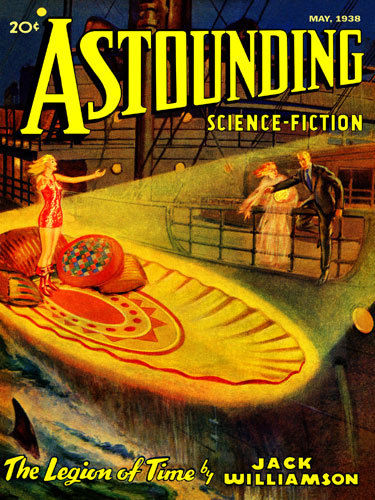
Now in as much as it’s the readers who pay for the magazines, it damn well behooves us to give ’em what they want — and they obviously want super-heroes on the Conan order. They want for Frank Herbert’s Dune, with his super-hero. They used to go with all-out enthusiasm for Jack Williamson’s really-not-very-good “Legion” stories.

Now if the fans want — and they evidently do! — swords-and-sorcery type yarns, then we had damn well better give ’em the type of thing they want, or get out of the way for someone who will.

Campbell never published much fantasy in Analog, but he did champion adventure-oriented science fantasy in the late 60s, like Anne McCaffrey’s Dragonriders of Pern stories (the first of which, the Hugo Award-winning “Weyr Search,” appeared in Analog in October 1967). It would be interesting to take a closer look to see if there was any noticeable editorial shift in this period.

Read the complete excerpt in Gordon’s Facebook post.

I Invoke the Voidal! Oblivion Hand by Adrian Cole

I Invoke the Voidal! Oblivion Hand by Adrian Cole

oie_24224952K95LzfUEStripped of all his memories for some great transgression against the Dark Gods, the mysterious one called the Voidal, or Fatecaster, endlessly traverses the dimensions of the omniverse. Always he brings vengeance via his Oblivion Hand, an additional punishment of the Dark Gods. And furthermore, any who aid or befriend him are made to suffer.

Oblivion Hand (Wildside Press 2001) is a fix-up of eight early stories by Adrian Cole about his dark wanderer, the Voidal. Cole’s amnesiac protagonist was introduced in a chapbook titled “The Coming of the Voidal” (in this book reworked and retitled “Well Met in Hell.”) Five more tales appeared in a variety of small magazines and anthologies between 1977 and 1980, including Fantasy Crossroads and the Gerald Page-edited Heroic Fantasy. Two more, “The Lair of the Spydron” and “Urge and Demiurge,” were scheduled to be in Phantasy Digest and Weird Adventures respectively, but both magazines shut down before the stories could be published. They appear for the first time in Oblivion Hand.

In a review I did of the first two stories, “Well Met in Hell” and “The Lair of the Spydron,” I was harsh and almost disdainful. Still, there was something about them that I remember liking. Reading Lin Carter’s Kellory the Warlock last week (and whoever thought a writer most people agree was generally mediocre could attract so many comments a quarter of a century after his death?), elements of it reminded me of Cole’s book. Both authors were intent on creating a setting that wasn’t just another watered down mimeograph of Middle-earth; they wanted something stranger. Carter succeeded, but Cole did immeasurably better.

Cole’s omniverse is an endless collection of interesting settings: universe-sized dimensions; monster-infested pocket worlds; a realm filled not with planets but islands that float in space. Countless arrays of gods rule over these various worlds. Terrible beings like the Spydron create and work their will on hidden places they carve out for themselves. Powerful sorcerers raise themselves up above the gods in other worlds.

Read More Read More

The Public Life of Sherlock Holmes: The Case of the Short-Lived Holmes

The Public Life of Sherlock Holmes: The Case of the Short-Lived Holmes

HouseofCardsNetflix’s House of Cards redefined what can be achieved by a web series. Everything about it, from casting to story to visuals, screams “quality.” The fact that it was intended to run for only a single season yet has already been renewed for a third testifies to the success that the show has had. It’s tough to maintain viewership when there’s almost nobody to root for, but they’ve done it.

But I wonder how many people realize that it is a remake of a 1990 British miniseries (apparently lust for power transcends decades. And centuries…)? Ian Richardson plays the Kevin Spacey role. Francis Urquhart has a disarming smile that makes him seem more warm than Spacey’s Frank Underwood. Don’t be fooled!

HouseofCardsRichardsonThe original House of Cards has a few Holmes ties. Female lead Susannah Harker appeared opposite Charlton Heston in the TV version of Crucifer of Blood, a modified version of The Sign of the Four.

She was also the client in Jeremy Brett’s version of The Adventure of the Dying Detective. Also, Colin Jeavons was Brett’s Inspector Lestrade. But it is Richardson’s brief tenure as Sherlock Holmes that we will look at now.

Read More Read More