Browsed by
Category: Vintage Treasures

Galaxy, September 1972: A Retro Review

Galaxy, September 1972: A Retro Review

Galaxy September 1972-smallI don’t usually look at magazines quite this recent in these reviews… though now that I think about this, this issue appeared well over 40 years ago! It’s a fairly significant issue in context, though coming from a period in Galaxy’s history usually disparaged.

This period was the editorship of Ejler Jakobsson, which extended from 1969 to 1974. He succeeded Frederik Pohl, and preceded Jim Baen, two extremely important figures in SF editing. Indeed, the only other editor of Galaxy before Pohl was H. L. Gold, yet another absolutely central SF editor. So Jakobsson was bound to have a hard time being compared to that crowd. A number of writers complained that Jakobsson was an editorial meddler (ironically, the same complaint was often made of Gold).

I confess I have never thought much of Jakobsson’s reign myself. I began reading Galaxy in October 1974, shortly after Baen took over. And I loved Baen’s Galaxy. The few issues of Jakobsson’s I’ve seen before this one have been rather dull.

I often have read words to the effect that he knew little or nothing about SF, but that’s not quite true. He was Finnish and emigrated to the US in 1926, aged 15. In the ’40s, he worked on the magazines Astonishing Stories and Super Science Stories, and indeed edited the latter for a couple of years starting in 1949. But he had been out of the field since that time – so perhaps it was more accurate to say he knew little about then contemporary SF.

He did have a couple of important assistants: Judy-Lynn Benjamin was Managing Editor and Lester Del Rey was Features Editor. (Del Rey and Benjamin married later, of course, and co-founded the Del Rey Books imprint.)

Read More Read More

Meet You In The Bar

Meet You In The Bar

talesLast week I introduced the topic of the bar story and I saw from the comments that I struck a popular chord.

As I mentioned, the bar story is an example of a framing device, a literary tool which enables a writer to link a series of stories, in this case by having them told by people who have gathered together in a bar. The question of whether the “club story” qualified as a “bar story” came up, and on thinking it over, I realized that it did. For purposes of tale-telling – to say nothing of drinking – one’s club is essentially the same as one’s local.

This week, I’d like to talk in a little more depth about the anthologies edited by George H. Scithers and Darrell Schweitzer, Tales From The Spaceport Bar (1987) and Another Round at the Spaceport Bar (1989).

As they tell us in the preface to Tales,  the editors were inspired to collect these stories by what they call “that magnificent old cliché with chairs” the spaceport bar – as depicted in the scene from Star Wars (Episode IV, for those of you who weren’t around at the time). The preface also gives us a more detailed history of the sub-genre of “bar story” than I gave you last week.

I think we can all agree, however, that the important contents here are the 22 stories, not the preface. Many, if not most, of the stories are examples of framework “bar stories”, like Larry Niven’s “The Green Marauder” from his Draco’s Tavern series, “Elephas Frumenti” from the Gavagan’s Bar series of L. Sprague de Camp and Fletcher Pratt, “Strategy at the Billiards Club” from Lord Dunsany’s Joseph Jorkin series, or Spider Robinson’s “The Centipede’s Dilemna” from Callahan’s Bar.

Read More Read More

Hardboiled Pulp: More Than Just a Man’s World

Hardboiled Pulp: More Than Just a Man’s World

nogoodfromacorpsecorpse 2The world of hardboiled pulp is certainly male-dominated, but there have been female authors who have given the masters of the sub-genre a run for their money. Leigh Brackett is certainly the best known female hardboiled writer, if only for her screenplay adaptation of Raymond Chandler’s The Big Sleep (1945) for director Howard Hawks’s acclaimed film featuring Humphrey Bogart as Philip Marlowe. Brackett also adapted Chandler’s The Long Goodbye (1973) for director Robert Altman’s deconstruction of the genre with Elliott Gould as Marlowe. Less well-remembered is the hardboiled novel that won Brackett the chance to first adapt Chandler, No Good from a Corpse (1944).

From the outset, it is clear this is Chandler territory. Brackett’s tough guy private eye hero Ed Clive (named for Brackett’s husband and fellow pulp author, Edmond Hamilton) is very much in the Marlowe tradition and the Los Angeles setting only enhances the authentic feel. More than the trappings, it is the fact that Brackett writes convincingly as a man (particularly in her observations of women as objects of lust who are never to be entirely trusted) that is the most startling. One understands Howard Hawks’s surprise when he hired Brackett as a screenwriter on the strength of this book and found out she was a woman. Murder, blackmail, sultry singers, and beatings and shootings aplenty make No Good from a Corpse an unsung classic of pulp detective fiction.

Read More Read More

New Treasures: Voodoo Tales: The Ghost Stories of Henry S. Whitehead

New Treasures: Voodoo Tales: The Ghost Stories of Henry S. Whitehead

Voodoo Tales The Ghost Stories of Henry S. Whitehead-smallI continue to collect the Wordsworth Editions Tales of Mystery & The Supernatural, which I’ve found to be an inexpensive way to gather a diverse range of early horror writers on a single bookshelf.

My latest acquisition was Voodoo Tales: The Ghost Stories of Henry S. Whitehead, which I bought because it was huge (691 pages!), inexpensive ($3.90!), and ’cause it had voodoo in it (voodoo!). What can I tell you, it was a compelling combo.

I’ve never heard of Henry S. Whitehead, but apparently he was an early Weird Tales writer who had two Arhkam House collections. You’d think I’d be more on top of an author who had a pair of Arhkam House collections, but no. This genre keeps finding more ways to surprise me.

I’m guessing that Whitehead wrote mostly voodoo tales, but I won’t know for sure until I dig into the volume. Until then, I’m relying on the cover and the text on the back, and I’m definitely picking up a voodoo vibe.

“And behind him, like a misshapen black frog, bounded the Thing, its red tongue lolling out of its gash of a mouth, its diminutive blubbery lips drawn back in a murderous snarl…”

Let Henry S. Whitehead take you into the mysterious and macabre world of voodoo where beasts invade the mind of man and where lives of the living are racked by the spirits of the dead. In this collection of rare and out of print stories you will encounter the curses of the great Guinea-Snake, the Sheen, the weredog whose very touch means certain death, the curious tale of the ‘magicked’ mirror, and fiendish manikins who make life a living hell. Included in this festival of shivering fear is the remarkable narrative ‘Williamson’ which every editor who read the story shied away from publishing.

With deceptive simplicity and chilling realism, Whitehead’s Voodoo Tales are amongst the most frightening ever written.

Read More Read More

Jews With Swords: Gentlemen of the Road by Michael Chabon

Jews With Swords: Gentlemen of the Road by Michael Chabon

oie_19193039NDl2SGNtIn 2002, Michael Chabon edited a collection of retro-pulp stories titled McSweeney’s Mammoth Treasury of Thrilling Tales, filled with stories by both literary writers and genre writers. I found it underwhelming. What grabbed me, though, was Chabon’s cri de couer for a return to plot in fiction. And in so doing he wanted writers to be able to use whatever genres they wanted to tell whatever stories they wanted, without fear of being dismissed as no longer writing “literature.”

While he had by then written the superhero-themed novel Kavalier and Klay and the baseball and Norse Mythos mashup Summerland, he was known primarily as an author of literary fiction. From that point on, he threw himself deep into the waters of plot and genre. Since then, he’s written a Sherlock Holmes novella, The Final Solution, the Nebula- and Hugo-winning alternate history novel, The Yiddish Policeman’s Union, and the screenplay for John Carter.

In 2007, as part of his exploration of plot and genre, he wrote Gentlemen of the Road, an unabashed, fun-for-the-sake-of-fun swashbuckler. Hewing to its old roots, it was initially serialized in the New York Times Magazine. His working title and, as he writes, “in my heart the true” one, was Jews With Swords.

While he hoped to invoke memories of Jewish troopers at Antietam or Inkerman, or warriors like Bar Kochba and Judah Maccabee, most people found it too incongruous. But that incongruity, between Jews with swords and the modern steroptype of Jews as decidedly un-adventurous, was something Chabon wanted to explore. He notes that from their very begininning, when Abraham was told by God “lech lecha: Thou shalt leave home,” Jews have been wanderers and “by definition, find adventure.” In his own words, he “attempted to…find some shadowy kingdom where a self-respecting Jewish adventurer would not be caught dead without his sword or his battle-ax.”

Read More Read More

One of the Best Serials Ever Made: The Adventures of Captain Marvel, Chapter One: Curse of the Scorpion

One of the Best Serials Ever Made: The Adventures of Captain Marvel, Chapter One: Curse of the Scorpion

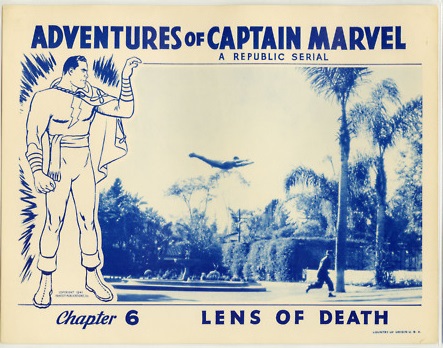
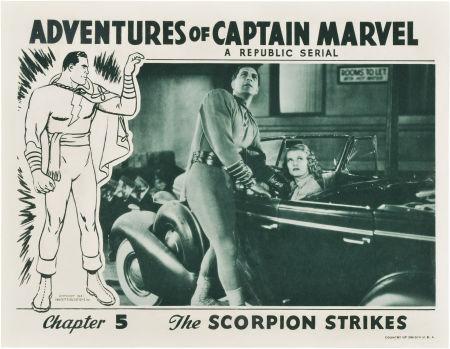
Adventures of Captain Marvel poster-smallPop quiz. Who was the first superhero to make it into film?

Yes — you in the back…what? Spawn?! Sit down! Okay… you there, in the Marvel Zombie tee-shirt… no, it was not Wolverine, though there may never be another superhero movie made without him. Yes, I see you… Superman? Good guess, but nope. Batman? Warmer, but still no.

The first superhero to make it into the movies was Captain Marvel (or as his four-color arch-nemesis, Dr. Thaddeus Bodog Sivana, contemptuously dubbed him, “That Big Red Cheese”), in the 1941 serial, The Adventures of Captain Marvel.

Captain Marvel and his alter ego, young radio reporter Billy Batson, made their first appearance in Fawcett’s Whiz Comics #2, in February of 1940. The character, the creation of writer Bill Parker and artist C.C. Beck, quickly became extremely popular, and for the remainder of the 1940’s, comics featuring him and the other members of the “Marvel Family” often outsold those featuring Superman.

National Periodical Publications (commonly known to comics fans as DC) tried to nip the rivalry in the bud by suing Captain Marvel out of existence in a legal wrangle that wouldn’t be decisively resolved until 1954. Well before that, though, Republic Pictures hopped on the bandwagon with The Adventures of Captain Marvel, a twelve-chapter serial that aficionados of the form regard as one of the best ever made.

The serial was directed by John English and William Whitney and written by the team of Ronald Davidson, Norman Hall, Arch Heath, Joseph Poland, and Sol Shor. They all keep the pot bubbling with action, peril, suspense, red herrings, and the crackling, popping energy that seems to be a unique feature of the best cliffhanger serials.

Read More Read More

Vintage Treasures: Two Decades of Interzone

Vintage Treasures: Two Decades of Interzone

Interzone 108-small Interzone 119-small Interzone 138-small

Interzone is the leading British science fiction magazine and has been for over 30 years. It was founded in 1982 and editor David Pringle remained at the helm for 193 issues, until he stepped down in 2004. Since then, it has been part of the TTA Press stable, with the capable Andy Cox as editor; their latest issue — Interzone 252, May–June 2014 — arrived earlier this month. In fact,the only thing not marvelous about Interzone is that it’s so hard to come by here in the US. Barnes & Noble imports issues every two months (although at the prohibitively high price tag of $11.95), but back issues are almost impossible to find. Even eBay isn’t much help.

Enter 2013 Windy City Pulp & Paper last month. I made some terrific purchases at the show, and I’ll be telling you about them over the next few weeks. But hands down, my best find of the weekend was a vast collection of fanzines and assorted 70s and 80s fantasy magazines in a $1 bin at the Adventure House booth — including 64 issues of Interzone, most of them unread. I ended up buying all of them… by far the largest collection of Interzone I’ve ever purchased. I bought about 30 recent issues from a UK seller a few years ago, but these were much older, and much less expensive: a beautiful assortment of issues between 75 and 191, with original fiction from Michael Bishop, Paul Di Filippo, Michael Moorcock, Tony Ballantyne, Paul Park, Thomas M. Disch, Eric Brown, Jon Courtenay Grimwood, Geoff Ryman, Tanith Lee, Ian Watson, Richard Calder, and many, many others.

Read More Read More

Vintage Treasures: Galactic Derelict by Andre Norton

Vintage Treasures: Galactic Derelict by Andre Norton

Galactic Derelict-smallI came too late to science fiction and fantasy to catch Andre Norton’s true heyday in the 50s and 60s, when she published over two dozen novels — including early classics like Star Man’s Son (1952), Star Rangers (1953), Star Gate (1958), The Time Traders (1958), The Beast Master (1959), Witch World (1963), Three Against the Witch World (1965), and Year of the Unicorn (1965).

True, she continued to publish books steadily throughout the 70s, 80s, and even the 90s — though by the last decade of her life (she died in 2005), she was writing almost solely in collaboration with other authors. But it was her early Ace paperbacks that really stirred my collector’s soul. Perhaps it was the splendid covers. Here’s the back cover copy from the 1961 Ace paperback Galactic Derelict — with one of those splendid covers — reprinting a review from Galaxy:

“All the classic elements are present in full measure in Galactic Derelict. It suffers not at all in being a sequel to Andre Norton’s excellent Time Traders.

“The U.S. Army’s race with the Russians through and against Time remains Norton’s background. Both search for abandoned wrecks of a race that had interstellar travel back in man’s infancy.

“Travis Fox, Apache, joins Ross Murdock and Dr. Gordon Ashe, time agents, in attempting the transfer, intact, of an alien ship through 20,000 years to present. Inadvertently, controls are activated and the group is launched on an involuntary galactic tour. Their efforts to return to Here and Now constitute a top-notch science-adventure yarn.” – Galaxy Magazine

Galactic Derelict is part of Norton’s Forerunner universe. The other books in the series include The Time Traders (1958), The Defiant Agents (1962), Key Out of Time (1963), and others.

Galactic Derelict was published in 1959 by the World Publishing Company and has been reprinted in eight different editions over the last half-century. It first appeared in paperback from Ace Books in 1961. It is 192 pages in paperback, priced at 35 cents. The cover is by Ed Emshwiller. If I have a few moments this weekend, I may assemble some of the other covers to display them here.

So We Were In This Bar . . .

So We Were In This Bar . . .

White HartThere’s a long tradition in western literature of the “framing device” – think Chaucer and The Canterbury Tales … or the Thousand Nights and a Night if we want something more obviously in our genre. Or Asimov and his Black Widower Mysteries.

My personal favourite among short story framing devices, however, is the bar story -– and I don’t mean the kind that starts, “We were in this bar…” Though, come to think of it, that’s how all my vacation stories start. Hmmm.

The device itself is fairly straightforward. The bar is a gathering place of disparate, but like-minded, people who exchange stories and anecdotes, usually involving people not present at the time. Sometimes the patrons of the bar take turns telling tales and sometimes, as with PG Wodehouse’s collections Meet Mr. Mulliner and Mr. Mulliner Speaks, one person in particular is the storyteller.

Undoubtedly because the storytellers are in a bar, the stories themselves can get a bit far-fetched, leading to such well-known formats as the Shaggy Dog Story and even the Tall Tale itself.

Which seems tailor-made for SF and Fantasy stories, don’t you think?

Read More Read More

Vintage Treasures: Marianne, The Magus, and the Manticore by Sheri S. Tepper

Vintage Treasures: Marianne, The Magus, and the Manticore by Sheri S. Tepper

Marianne The Magus and the Manticore-smallI’ve written a lot of Vintage Treasures articles (over 400 now, believe it or not.) Most of them feature collectible paperbacks and virtually all of them — even the old Ace Doubles from the 1950s — are inexpensive to acquire for the patient collector. It’s very, very rare that I discuss one that costs as much as a new paperback, for example.

Sheri S. Tepper’s Marianne, The Magus, and the Manticore is an exception. Used copies start at $10 – 15 on both Amazon and eBay and copies in good shape will run you closer to $40. It’s not particularly old — published in 1985 — and it’s not even all that rare. So why is it so expensive? Because it was published just before her groundbreaking novel The Gate to Women’s Country (1988) and the Hugo-nominated Grass (1989). In other words, before Tepper became a Big Name in the industry. The book was reprinted once, in 1988, but has now been out of print for nearly 30 years. Tepper has a great many fans, and the law of supply and demand dictates that the volumes in this trilogy are likely to be hot properties for some time.

Legacy Of Magic

Marianne was born to luxury in the tiny nation of Alphenlicht, nestled in the mountains between Turkey and Iraq. The her parents died, leaving control of their fortune to the older brother she fears. Struggling to make her way as a student in America, Alphenlicht seems as unreal as a fairy tale, her childhood there as distant as a dream…

… Until the Magus comes to claim her, and the Black Madame to destroy her, and the Manticore to hunt her down through the streets of another world. For there is magic in the land of Alphenlicht. Magic in Marianne’s blood, and magic in her soul…

Marianne, The Magus, and the Manticore was followed by two sequels in what’s now known as the Marianne series: Marianne, The Madame, and the Momentary Gods (1988), and Marianne, the Matchbox, and the Malachite Mouse (1989). A 592-page omnibus volume, The Marianne Trilogy, was offered briefly in paperback by Corgi in 1990 — it’s a great value, if you can find it.

Read More Read More