Browsed by
Category: Vintage Treasures

“The Distances Between Things”: Patricia A. McKillip’s The Changeling Sea

“The Distances Between Things”: Patricia A. McKillip’s The Changeling Sea

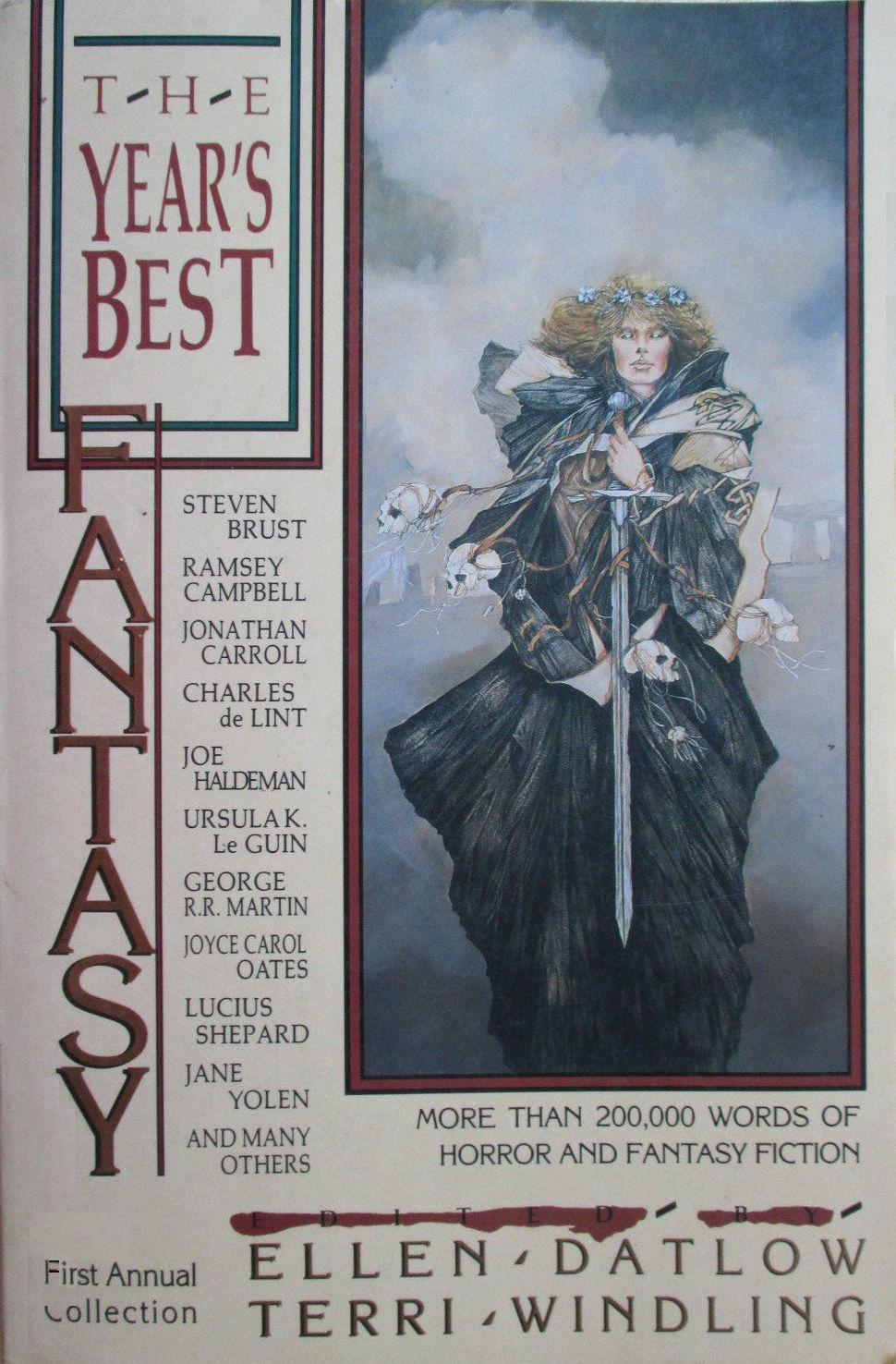
The Changeling SeaI’ve written a few times about my ongoing fascination with fantasy from the 1980s. That fascination led me to pick up a used copy of The Changeling Sea, a short 1988 novel by Patricia A. McKillip. McKillip isn’t specifically a 1980s writer — her first novel, The House on Parchment Street, was published in 1973, and she’s produced work steadily ever since; her last novel, The Bards of Bone Plain, came out in 2010 and a collection of short stories, Wonders of the Invisible World, was published in 2012. (You can find some reviews of her recent work at Black Gate: here Isabel Pelech looks at The Sorceress and the Cygnet, and here Thomas M. MacKay looks at Harrowing the Dragon). But having read some of her work from the 70s, specifically the Riddle-Master trilogy, I’d hoped to get a sense of how her work had developed through the 80s. And perhaps find the sort of unexpected angle on the fantastic some of the fantasy of that period provides.

And I did; I thought the book was excellent. It’s no surprise at all to see it was a finalist for the 1990 Mythopoeic Award. It’s precisely in the way it evokes the feel of a folktale, the feel of myth mixed with the matter of common life, that the book shines. It’s about love, and loss, and magic, and change. It has something of the feel of what now would be called young-adult fiction, with the specific kind of complexity that form can present: a young person encountering the adult world edge-on, struggling to understand what they’re finding, dealing with things that went wrong a generation ago, and trying to do no further wrong.

On a small island, one of seven making up a kingdom in a northern sea, a fifteen-year-old girl named Peri works at an inn. Her fisherman father has been taken by the sea a year ago, since which time her mother has drawn into herself. Finally, Peri can take it no more and casts a hex upon the sea. A prince becomes involved; and the magic takes a strange twist. A wandering wizard passes by. Things and people change, metamorphose magically and otherwise, and Peri must take a journey into the strange world under the ocean before the fate of land and sea will become clear.

Read More Read More

The Public Life of Sherlock Holmes: The Science Fictional Solar Pons

The Public Life of Sherlock Holmes: The Science Fictional Solar Pons

OffTrail_SnitchA few weeks ago, I wrote about the best of all Holmes pastiches, August Derleth’s Solar Pons. I mentioned that Pons had a more open-minded view towards the supernatural. This was certainly reflected in four stories that Derleth co-authored with noted science fiction writer Mack Reynolds.

Just last week, John O’Neill wrote a post about Anthony Boucher. As he mentioned, Boucher, along with J. Francis McComas, was the founder of the seminal Magazine of Fantasy & Science Fiction.

In January of 1953, they wrote to Derleth. Reynolds had submitted “The Adventure of the Snitch in Time,” a pastiche in which Sherlock Holmes receives a visitor from an alternate time-space continuum. The editors loved the idea, but, “Unhappily, Mack did not in any sense of the word recreate Holmes, Watson, or Baker Street! Outside of the plot idea, the story was, to be wholly frank, lousy!”

Also, to avoid trouble from those pesky Doyle brothers, none of the characters were named: wholly unsatisfactory.

So, the two editors wrote to Reynolds, suggesting that they have Derleth rework it into a Solar Pons story. Reynolds loved the idea, sending back, “I’d appreciate it if you’d give Augie Derleth first chance at it. It was after reading his Solar Pons stories that I got the idea for Snitch. Besides that, I’m an admirer of the old Seigneur of Sauk City and it would be a privilege to have a story appear under a collaborative by-line…”

Read More Read More

Vintage Treasures: The Compleat Werewolf, by Anthony Boucher

Vintage Treasures: The Compleat Werewolf, by Anthony Boucher

The Compleat Werewolf-smallI like classic werewolf tales, in much the same way I like old-fashioned vampire stories. Tales of spooky nights, full moons, and ancient family curses are both frightening and warmly familiar.

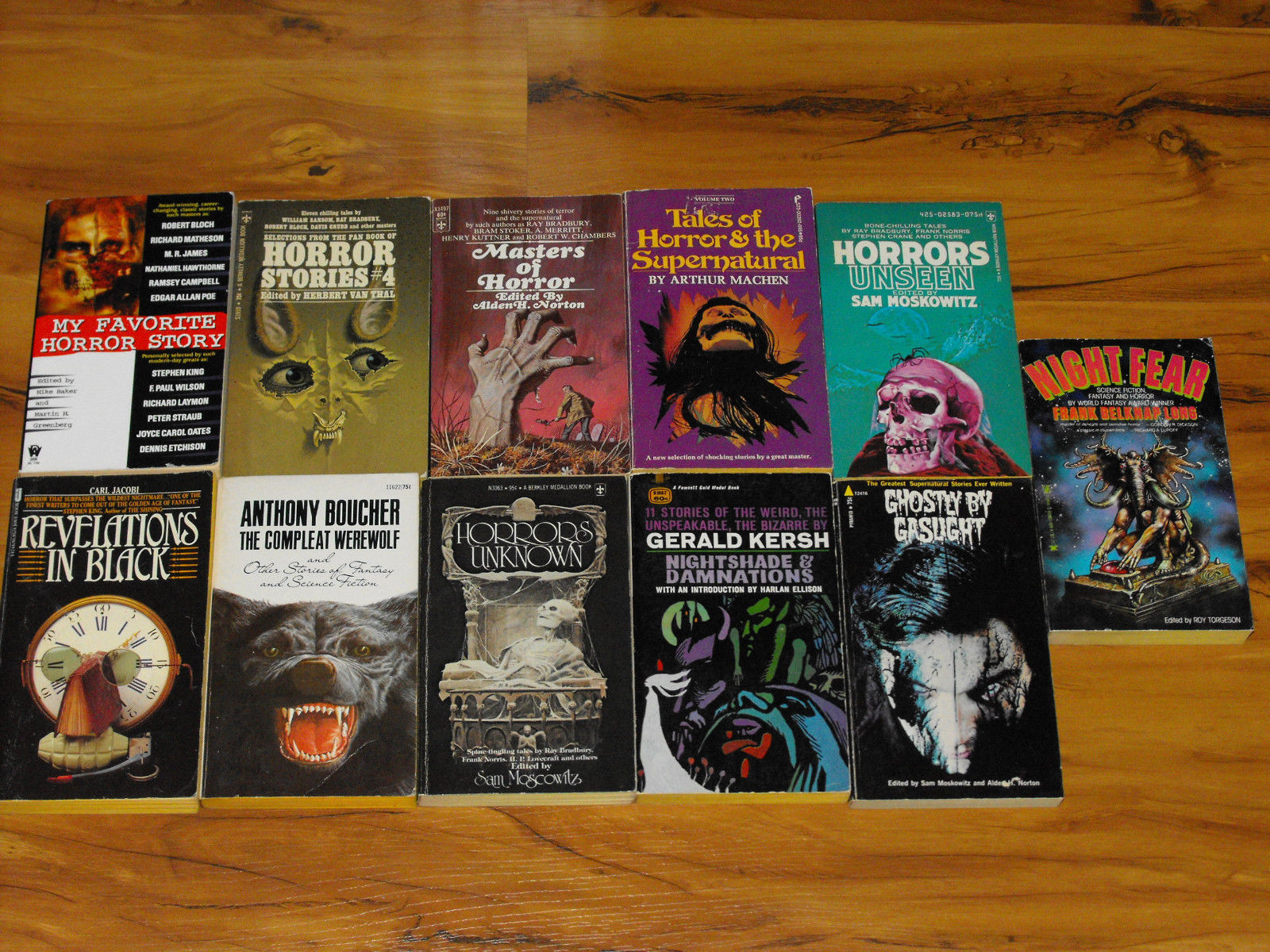
Along with J. Francis McComas, Anthony Boucher was the the founding editor of The Magazine of Fantasy & Science Fiction; he edited the magazine from 1949 to 1958, winning the Hugo Award twice for his efforts. He was equally acclaimed for his mystery novels, including Nine Times Nine (1940) and Rocket to the Morgue (1942), which featured thinly-disguised versions of Robert A. Heinlein, L. Ron Hubbard, Julius Schwartz, Henry Kuttner, Jack Williamson, Edmond Hamilton and John W. Campbell. He died in 1968. His 1969 collection The Compleat Werewolf is a delightful gathering of SF and fantasy tales originally published in the pulp magazines Unknown Worlds, Adventure, Astounding Science-Fiction, Weird Tales, and Thrilling Wonder Stories. Here’s the book description.

Anthony Boucher was long known as an important book critic and editor, master of languages and successful novelist. He was also a superb short story writer of science fiction and fantasy: inventive, prolific- and always entertaining.

The stories and novelettes in this titanic collection were chosen for the sheer virtuosity of their themes, moods, backgrounds; for their insights; for their laughter. They are wonderfully peopled by moth-eaten little demons, grim interplanetary predators, rebellious androids and dopplegangers; by humans with otherworld talents; and finally, not least, by one very special werewolf.

Read More Read More

Ghost Stories and Stranger Tales: Couching at the Door by D.K. Broster

Ghost Stories and Stranger Tales: Couching at the Door by D.K. Broster

Couching at the Door-smallThomas Parker’s article on Ghost Stories for Christmas yesterday inspired me to look through my own collection for Victorian era ghost stories. I was intrigued by his suggestion to revive the ghostly tradition of Christmas past, by reading classic ghost stories out loud to my kids around the fireplace on the cold evenings of December.

Of course, my children are all teenagers. Which means they’ll be checking their smartphones, playing games on the iPad, and generally rolling their eyes when I suggest a 100-year old family entertainment. They don’t even like to watch movies from the 1980s. Or technology of any kind released before 2010.

Well, that’s parenting. You need to endure a little eye-rolling before they come around. I think I’ll start with W.F. Harvey’s “The Clock,” from The Beast with Five Fingers, which John C. Hocking called “a masterful short piece… Truly one of the finest examples of what H.P. Lovecraft called ‘spectral fear’ ever put on the page.” Or maybe a ghost detective story from Mark Valentine’s The Black Veil & Other Tales of Supernatural Sleuths. Or a Sherlock Holmes pastiche from The Game’s Afoot.

Of course, all three of these books have one thing in common: They’re all part of Wordsworth’s Tales of Mystery & The Supernatural (or TOMAToS, for short). It’s the perfect line of books if you’re looking for great Victorian horror tales…. or great ghost stories, period.

I need a book that will keep them on their toes, an author who mixes supernatural mysteries with even stranger weird tales. And after looking through my Wordsworth collection, I think I have just the thing: D.K. Broster’s Couching at the Door.

Read More Read More

Gold, Frankincense, Myrrh… and Ectoplasm?! Ghost Stories for Christmas

Gold, Frankincense, Myrrh… and Ectoplasm?! Ghost Stories for Christmas

Victorian Ghost StoriesNow that we have passed the point of no return (also known as Thanksgiving), we have plunged irrevocably into the Christmas season, that time of the year which is richest in traditions, be they old or new, religious or secular, serious or lighthearted, shared with millions worldwide or kept hidden behind closed doors and reserved for the private humiliation of those we hold dearest.

Decorating a tree with lights and ornaments, kissing under the mistletoe, hanging stockings, singing carols — these widespread traditions are the instantly recognizable emblems of the season, while other rituals are restricted for a select circle. For one household the season’s signifier may be listening to Dad read the nativity story from the Gospel of Luke, for another group it may be gathering around the television to watch It’s a Wonderful Life, while for yet another family it may be nervously edging away as Uncle Carl begins his annual Yuletide disquisition on America’s inexorable slide into socialism.

Traditions come and traditions go, however. An observance that has largely faded from view is the once-widespread custom of reading ghost stories on Christmas Eve. As with many Christmas traditions, this one began in Victorian England. Of course long before the Victorians, Christmas was associated with the miraculous and the supernatural, but during those middle and later years of the nineteenth century, the season became explicitly linked with the overtly ghostly as well.

The Victorian era was the high-water mark of the traditional ghost story, which was a staple of the magazines and inexpensive books that vied for the attention of an expanding and prosperous middle class. These publications were hungry for content, and ghost stories helped fill that need. Some of the form’s greatest masters — Joseph Sheridan LeFanu, Amelia Edwards, Mary Braddon, Edith Nesbit, and M.R. James, among many others — wrote during this period.

However, it was Charles Dickens who was, more than any other person, responsible for the identification of one particular time of year — the Christmas season — with the explicitly ghostly. Dickens loved a good ghost story; he had, in the words of his friend and biographer, John Forster, “something of a hankering after them.”

Read More Read More

The Classic Games of Metagaming: Ogre

The Classic Games of Metagaming: Ogre

Ogre Metagaming-smallLast week, I wrote about discovering early Metagaming advertisements in copies of Analog and Asimov’s SF, as well as other science fiction magazines I read in the late 1970s. The ads — for tiny science fiction games I could carry around in my pocket — fired my imagination.

I was already gaming with my friends over lunch at school and the thought of playing games featuring giant robot tanks and wizard duels instead of another round of chess was too much to resist. I mailed off my check and waited impatiently for my treasures to arrive.

Now, ask most young folks how they felt when the magical item they ordered from the back of a comic or magazine finally came in the mail and you’ll hear some pretty sad stories. Those X-ray spectacles? A crushing disappointment. That family of sea monkeys? In reality, tiny frozen shrimp. And don’t even ask about the Polaris Nuclear Submarine.

But Metagaming microgames were not disappointments. Quite the opposite.

Microgame #1: Ogre was one of the first games I ordered from Metagaming. It was not the last. I still remember the first trial games I played with my brother Mike; the thrill of moving my Ogre cybertank relentlessly across the heavily cratered map board. Ogre was a wonderful game — brilliantly simple in design, easy to set up, and lightning fast to play.

It became, in fact, one of the most successful science fiction board games ever published, selling hundreds of thousands of copies. It went through numerous editions, and is still in print and available today — in both a no-frills reprint of the original 1977 edition and a limited edition deluxe version with multiple giant mapboards, more than 500 oversized full-color unit counters, and 3-D models, which will run you over $150 (if you can find a copy).

Read More Read More

The Public Life of Sherlock Holmes: Holmes for Christmas

The Public Life of Sherlock Holmes: Holmes for Christmas

HolmesXmas_HolidaysOf the sixty Sherlock Holmes tales penned by Sir Arthur Conan Doyle, only one is set during the holiday season. “The Adventure of the Blue Carbuncle” takes place two days after Christmas and involves a worn bowler hat and a goose worth more dead than alive.

That story doesn’t actually have a whole lot to do with Christmas; it just happens to occur shortly afterwards. However, there are a few books in my Holmes library that definitely qualify as Christmas adventures.

One of my favorite anthologies is 1996’s Holmes for the Holidays, which includes fourteen Christmas-themed adventures. Any Holmes anthology is likely to be a mixed bag. However, I consider this to be among the better of the multiple-author collections on my Holmes bookshelf.

Loren D. Estleman’s (author of Holmes pastiches featuring Dracula and Jekyll and Hyde) “The Adventure of the Three Ghosts” is a sequel to Dickens’s A Christmas Carol. Texan Bill Crider (give his Dan Rhodes mysteries a whirl) also continues the Scrooge story with “The Adventure of the Christmas Ghosts.”

William DeAndrea’s “The Adventure of the Christmas Tree” is a neat piece of Christmas-themed espionage. While Anne Perry’s “The Watch Night Bell” is one of my favorite Holmes holiday stories.

Read More Read More

Astounding Science Fiction, February and March 1953: A Retro-Review

Astounding Science Fiction, February and March 1953: A Retro-Review

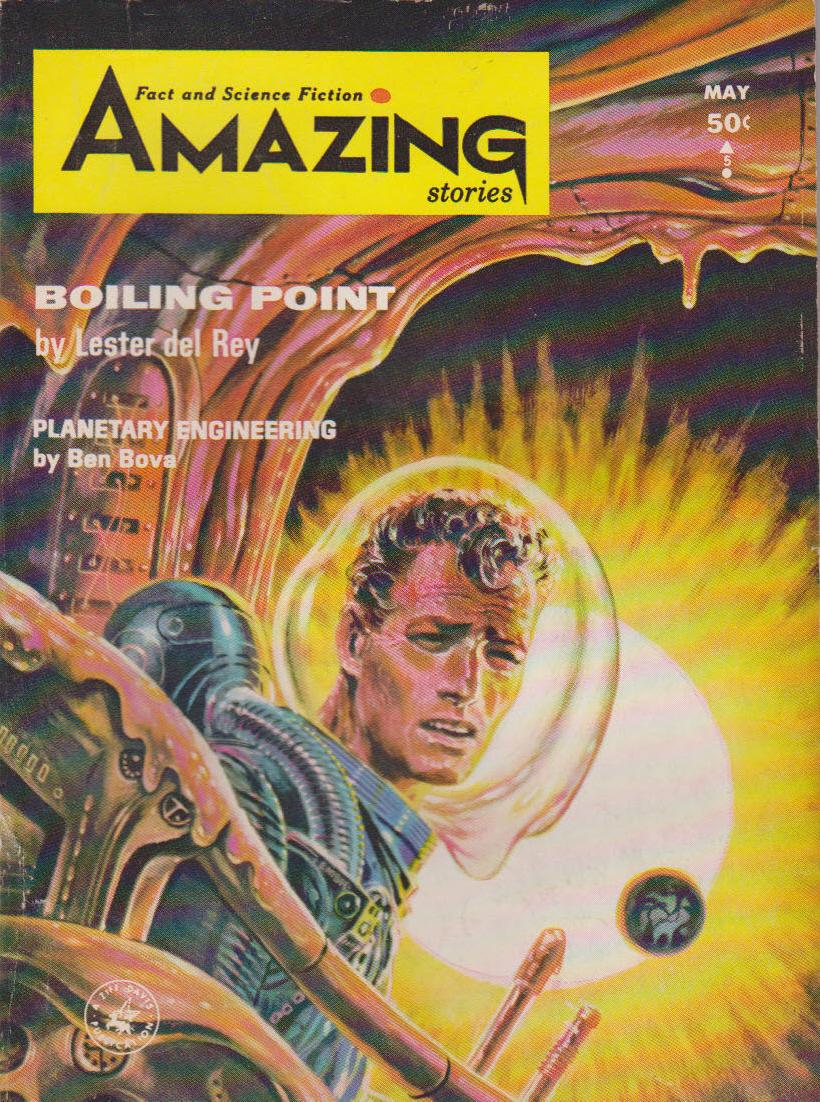
astounding science fiction February 1953-smallI thought it might be worthwhile to take a look at John Campbell’s Astounding, from the early ’50s, after its dominance of the market had been shaken by Galaxy and F&SF. So here are two 1953 issues.

I bought these two issues because the March issue has John Brunner’s first story for a major market, “Thou Good and Faithful.” I noticed that that issue also has the second part of a Piper serial that I hadn’t read, so I bought the February issue to get part 1.

Details, then. The February cover, for H. Beam Piper and John J. McGuire’s serial “Null-ABC,” is by H. R. Van Dongen, a pretty good one with a skull on a reddish background (flames and smoke, I think), and books and test tubes in the foreground.

The March cover, for “Thou Good and Faithful,” is less to my taste. It’s by G. Pawelka, an artist with whom I am unfamiliar, and it features a robot with a monkey-like creature on his shoulder, holding a globe of sorts — a very accurate depiction of a scene from the story, but not a picture I fancy much.

The features in each issue are the usual: Campbell’s editorial (“Redundance,” about information theory, in February; and “Unsane Behavior,” about war and the naivete of both those who think it works very well, and those who think stories of Atomic Doom will prevent it, in March); In Times to Come, The Analytical Laboratory, Brass Tacks, and P. Schuyler Miller’s review column.

Read More Read More

Vintage Treasures: Zacherley’s Midnight Snacks

Vintage Treasures: Zacherley’s Midnight Snacks

Zacherley's Midnight Snacks-smallI love Zacherly’s Midnight Snacks.

I love the whole goofy premise: a ghoul’s favorite midnight reading. A ghoul named Zacherley. Who comments on each story, with special “cheering notes.” You go, Zacherley.

Of course, it’s in the long-standing tradition of the Old Crypt Keeper, who introduced the horror tales in EC Comics, and Cain and Abel, hosts of DC Comics’ long-running House of Mystery and House of Secrets comics, just to name a few. The cheerful undead storyteller, who delights in a good creepy tale (not to mention the occasional moral fable or two.)

In keeping with the fiction that these stories were selected by a ghoul, the editor of Zacherly’s Midnight Snacks is uncredited. Someone must know who compiled this (and subsequent) volumes for Ballantine, but they’re not talking.

The book collects nine short stories and novelettes from the pulps (“precious old mouldering records”), including Thrilling Wonder, Unknown, Beyond Fantasy Fiction, and Fantastic Universe. Authors include Richard Matheson, Theodore Sturgeon, Wallace West, A. E. van Vogt, and Henry Kuttner. Here’s the blurb on the back of the book:

As choice a brew of ghouls, vampires, ghosts and creatures of EVEN MORE VARIED TALENTS as you could wish to meet, in stories garnered from precious old mouldering records, and with special cheering notes on each by ZACHERLEY.

This volume was released in March 1960. Zacherley managed one additional anthology, Zacherley’s Vulture Stew, released in August the same year, before (presumably) laying down for his eternal rest.

Read More Read More

Robert Silverberg on the Tragic Death of John Brunner

Robert Silverberg on the Tragic Death of John Brunner

The Great Steamboat Race John Brunner-smallSix months ago, I wrote about an unusual find I made online: The Great Steamboat Race, an enormous and ambitious historical novel written by none other than John Brunner. Brunner, of course, was a highly regarded SF and fantasy writer, beloved even today for Stand on Zanzibar, The Complete Traveller in Black, and many other novels. He died in 1995, at the World Science Fiction convention.

The Great Steamboat Race was an enigma. I’d never seen a copy before, never run across one in dozens of years of haunting bookstores. The copy I found online was very inexpensive — less than the $7.95 cover price for a brand new copy, for a book published over 30 years ago — so I bought it. I wrote it up as a Vintage Treasures curiosity, and then more or less forgot about it.

At least until this week, when I was browsing through a collection of Asimov’s SF magazines from the late 90s I recently acquired. Before I packed it away in the Cave of Wonders (i.e. the basement), I plucked one out of the box at random, and settled back in my big green chair to read it.

It was the March 1996 issue, with stories by Tony Daniel, Suzy McKee Charnas, Steven Utley, and the late John Brunner. I always take the time to read Robert Silverberg’s Reflections column, and I flipped to that first. The title was “Roger and John,” and it was a tribute to two recent deaths that had shaken the SF community: Roger Zelazny and John Brunner. Silverberg had been friends with both men for decades and said “Their deaths, for me, illustrate the difference between a tragedy and a damn shame. Let me try to explain.”

Silverberg portrays Zelazny’s death as a damn shame, saying “Roger was the happy man who led a happy life… By the time he was twenty-five he had begun what was to be a dazzling career in science fiction.” Zelazny’s career, Silverberg observes, had been filled with a series of triumphs, and his death by cancer at the age of 58 had robbed the field of future great work from a master.

Brunner, Silverberg observes, was a tragic figure. And central to the tragedy was the novel The Great Steamboat Race.

Read More Read More