Browsed by
Category: Vintage Treasures

Galaxy Science Fiction, February 1953: A Retro-Review

Galaxy Science Fiction, February 1953: A Retro-Review

Galaxy February 1953-smallGalaxy Science Fiction continued its momentum into the February, 1953 issue. Boldy asserting it only published original stories (no reprints), it drew the finest science fiction authors of the time.

“Four in One” by Damon Knight — George Meister and his team establish a base on an alien planet and begin to explore the surroundings. The four of them fall down a ridge and are consumed by a strange, slug-like organism. The only thing remaining of the humans are their brains, eyes, and spinal columns. Amazingly, they can each influence the organism as though it’s part of their own body, which is essentially the only body any of them have. Though George, as a scientist, wants to spend time analyzing the creature, the others are divided as to the next step to take. And they begin to take more aggressive actions, such as forming appendages that might be able to kill any opposing brains.

This is such a unique story that it’s a good read just for that reason alone. But the characters and tension also work well together. There’s a bit of a gross factor involved, I suppose, but I hope that doesn’t dissuade readers.

“Protective Mimicry” by Algis Budrys — Someone is counterfeiting galactic money, but the bills are perfect duplicates, down to the serial number. The treasury’s chief inspector sends a man named Baumholtzer to investigate where they turned up – a humid, heavily-forested planet named Deneb XI. Baumholtzer heads to the only city on the planet and finds a bar that knows how to make his drink. Unfortunately for Baumholtzer, the person behind the duplicate money knows he’s coming.

It’s a nice detective story with great descriptions. I wish it had been longer, but it moves at a good pace, so maybe expanding it wouldn’t be a great idea. I just liked the feel of the narration so much that I wanted to keep going.

Read More Read More

Hubert Rogers’ Astounding Covers — And His Fascinating Correspondence with Robert A. Heinlein and L. Sprague de Camp

Hubert Rogers’ Astounding Covers — And His Fascinating Correspondence with Robert A. Heinlein and L. Sprague de Camp

Astounding April 1941 Hubert Rogers-small

At IlluxCon this past October, one of our major purchases was a pulp painting by artist Hubert Rogers. Rogers was Astounding Science Fiction’s primary cover artist from late 1939 to early 1952, with a break from 1943 through 1946 due to World War II (which he spent in Canada painting war posters and other paintings related to the war). We’d made arrangements over the summer to buy it from a friend of ours, who had owned it for many years, and he drove it up to IlluxCon with him so we could complete the deal.

This one appeared on the cover for Astounding, April 1941, and illustrated “The Stolen Dormouse” by L. Sprague de Camp. Shortly after its publication, De Camp wrote to Rogers, asking if he could acquire the painting, which he did.

Read More Read More

Discovering Robert E. Howard: Howard Andrew Jones and Bill Ward Re-Read The Hour of the Dragon

Discovering Robert E. Howard: Howard Andrew Jones and Bill Ward Re-Read The Hour of the Dragon

The Hour of the Dragon Berkley fold out-smallHoward Andrew Jones and Bill Ward continue their re-read of The Bloody Crown of Conan by Robert E. Howard, the second of three omnibus volumes collecting the complete tales of Conan, with the full-fledged novel The Hour of the Dragon. It was originally published in five parts in Weird Tales, from December 1935 to April 1936.

Howard: Robert E. Howard was at the top of his game when he wrote it. For decades there was nothing with which to compare this novel on an apple to apple basis because it was so far ahead of what anyone else had done…

Bill: The novel… was the result of a solicitation from a British publisher for a full-length pulp adventure from REH… After an abortive stab at the planetary romance novel Almuric, left unfinished by REH and possibly later completed by his agent, Otis Aldebert Kline, REH turned again to the Cimmerian and his Hyborian landscapes. And it is to King Conan, whom we have not seen since “The Scarlet Citadel,” that REH returns to for his epic… King Conan is betrayed and captured by conspirators aided by a powerful wizard, and his throne usurped by an Aquilonian nobleman… the quick set-up of Conan’s betrayal and capture on the battlefield in “Citadel” becomes the far more memorable and exciting chapter in Dragon that sees Conan, about to lead his forces in battle, paralyzed by sorcery and his place on the field taken by another…

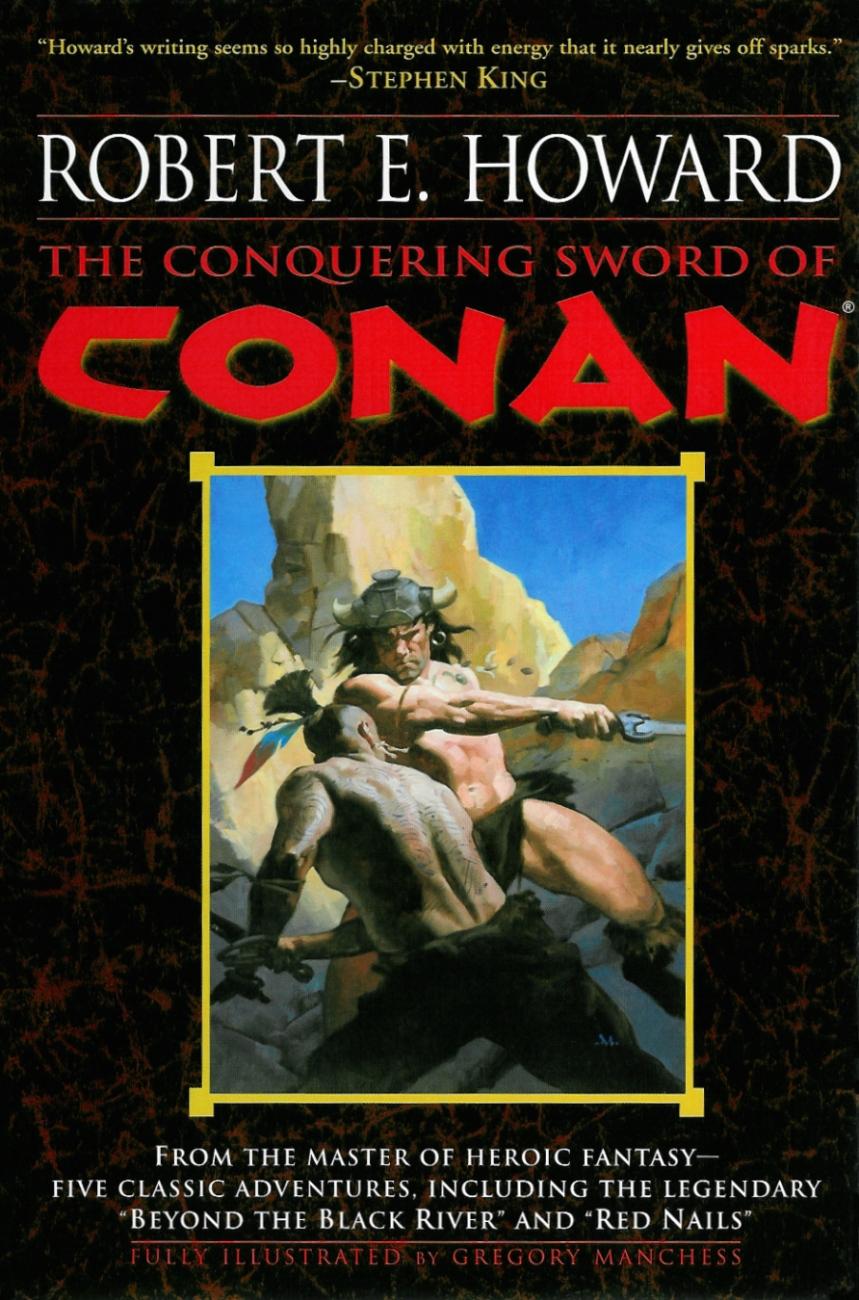
Next up, Bill and Howard dive into the third Rel Rey Conan collection, The Conquering Sword of Conan. Stay tuned.

Read More Read More

Vintage Treasures: Explorers and The Furthest Horizon, edited by Gardner Dozois

Vintage Treasures: Explorers and The Furthest Horizon, edited by Gardner Dozois

Explorers The Furthest Horizon

Last week I talked about two of my favorite anthologies by one of the most acclaimed editors in the field: The Good Old Stuff (1998) and The Good New Stuff (1999) (collected into one massive 982-page volume as The Good Stuff by the Science Fiction Book Club in 1999), both edited by Gardner Dozois. Those books collected some of the best adventure SF from the last century, alongside Dozois’ detailed and affectionate commentary on each author. The result was the equivalent of a Master’s level course in Adventure SF of the 20th Century, and its most proficient writers.

A year later, Dozois did the same thing with another pair of anthologies, this time focused on two similarly fascinating branches of science fiction: tales of deep space exploration, and tales of the far future. Like the first two volumes, they were both released in trade paperback from St. Martin’s/Griffin, and they are both excellent:

Explorers: SF Adventures to Far Horizons (495 pages, April 2000, $17.95)
The Furthest Horizon: SF Adventures to the Far Future (492 pages, May 2000, $17.95)

Both had covers by famous SF artist Chesley Bonestell. Like the first volumes, they include Dozois’ lengthy and highly informative intros to each story. These volumes perfectly compliment the first two, forming the basis for a solid library of modern science fiction.

Read More Read More

Vintage Treasures: The Etched City by K.J. Bishop

Vintage Treasures: The Etched City by K.J. Bishop

The Etched City-smallThe Etched City, the debut novel by Australian writer K. J. Bishop, was published in a small print run by Prime Books in 2003. It rapidly accumulated a lot of attention — not to mention stellar reviews — and was nominated for both the World Fantasy Award and the British Fantasy Award. Publishers Weekly said it combines “equal parts of Stephen King’s Dark Tower series and China Mille’s Perdido Street Station,” and James Sallis, in The Magazine of Fantasy & Science Fiction, called it:

An ambitious and casually brilliant debut, erudite, lavishly written… Though it borrows from both, this is neither heroic fantasy nor romance-fantasy chockfull of magic swords, witches, and wizards unaware. It’s fantasy as high literature, our world skewed to a hard right angle…

Here’s the book description:

Gwynn and Raule are rebels on the run, with little in common except being on the losing side of a hard-fought war. Gwynn is a gunslinger from the north, a loner, a survivor… a killer. Raule is a wandering surgeon, a healer who still believes in just — and lost — causes. Bound by a desire to escape the ghosts of the past, together they flee to the teeming city of Ashamoil, where Raule plies her trade among the desperate and destitute, and Gwynn becomes bodyguard and assassin for the household of a corrupt magnate. There, in the saving and taking of lives, they find themselves immersed in a world where art infects life, dream and waking fuse, and splendid and frightening miracles begin to bloom…

The Etched City was first published by Prime Books in 2003, and reprinted by Bantam Spectra in December 2004. It is 382 pages, priced at $14 in trade paperback. The cover is by Paul Youll. It is still in print, and there is also an $11.99 digital edition.

Vintage Treasures: The Good Stuff by Gardner Dozois

Vintage Treasures: The Good Stuff by Gardner Dozois

The Good Old Stuff-small The Good New Stuff-small

Gardner Dozois is one of the most accomplished and prolific editors in our field. He’s produced scores of anthologies, including 31 volumes of The Year’s Best Science Fiction, and won the Hugo Award for Best Professional Editor 15 times in 17 years from 1988 to 2004, as editor of Asimov’s Science Fiction.

In addition to championing countless new writers (as well as older and more neglected writers), he’s shown a lot of love for adventure SF and space opera over the years, which he calls “center-core SF.” In 1998 and 1999 he released two anthologies with the subtitle Adventure SF in the Grand Tradition, both with St. Martin’s/Griffin. They are probably my favorite of his numerous books:

The Good Old Stuff (434 pages, $17.95 in trade paperback, December 1998; cover by Ed Emshwiller)
The Good New Stuff (450 pages, $16.95 in trade paperback, February 1999; cover by Bob Eggleton)

The first volume collects fiction from 1948-1971, and the second from 1977-1998. Together they constitute the finest survey of adventure SF our field has seen.

Read More Read More

Prehistoric Fantasy from the Days Before the Earth had a Moon: Jane Gaskell’s Atlan Saga, Part I

Prehistoric Fantasy from the Days Before the Earth had a Moon: Jane Gaskell’s Atlan Saga, Part I

 The Quest for the Complete Series

SerpentPocket_Small
Pocket Books – art by Boris Vallejo
Serpent_Orbit_Small
Orbit / Futura – Artist Unknown

In my quest to revive interest in forgotten or overlooked fantasies, it would be remiss not to discuss Jane Gaskell, specifically her Atlan Saga. The fact that my past few posts about H Warner Munn also happen to reference Atlantis is purely coincidental, and I am by no means an expert on all things Atlantean.

I came upon Jane Gaskell’s Atlan Saga in the late 1980s. As a high school lad in South Africa with limited funds, the public and school libraries — as well as friends — were my main sources of fantasy material. While many folks I know seem to have been reading Heinlein and Tolkein by the time they were 10, I only started reading for pleasure as a pre-teen. Until then I actively despised it. That is not to say I didn’t enjoy a good story, just I was too lazy to read it myself.  My mother desperately tried to encourage me, but I recall thinking Enid Blyton (Secret Seven etc.) was really nyaff, and the Hardy Boys were too mainstream.

Fortunately I discovered Biggles by Captain WE Johns and my mind, at last, opened to the joys of reading. After moving through CS Forester’s Hornblower books and Alexander Kent’s Richard Bolitho series (both period sea adventure), I found myself looking for something different. I found it through friends who introduced me to Anne McCaffery’s Dragonflight and David Eddings’ Belgeriad books.

One of the factors hindering me at the time was that good material was relatively thin on the ground. I also had a juvenile dislike of second hand books, preferring to buy them new. Sure, the shops had a reasonable amount on their shelves, and there were a (very) few specialist shops with a plethora of gear to choose from, but most of it was out of my price range, or my sphere of travel. Fortunately the major chain store of the day, CNA (like a Borders I imagine) used to have an annual book sale just after Christmas where they moved loads of old warehouse stock. During one of these sales I encountered two slim volumes which, due to their awesome cover art, just had to be fantasy par excellence: The Dragon and The City, both by Jane Gaskell.

Read More Read More

New Treasures: Penguin Science Fiction Postcards: 100 Book Covers in One Box

New Treasures: Penguin Science Fiction Postcards: 100 Book Covers in One Box

Penguin Science Fiction 2

We’ve already established that I’m a sucker for a cool cover. I don’t have time to read a fraction of the books I buy, but I can look at great cover art all day long. Put an eye-catching cover on your book, and you’ve got my immediate attention.

Put a hundred cool covers on your book, and you can just shut up and take my money.

I think that’s the overall idea behind Penguin Science Fiction Postcards: 100 Book Covers in One Box. It’s sort of like a science fiction book with a great cover, but minus the book. And with 99 other covers. And with the added bonus that you’ll never lack for postcards again, when you need to drop a note to your uncle to remind him to return your copy of The Stars Like Dust. And did I mention the cool box?

Read More Read More

Robert E. Howard: Peering Behind the Veil of Life

Robert E. Howard: Peering Behind the Veil of Life

NOTE: The following article was first published on May 9, 2010. Thank you to John O’Neill for agreeing to reprint these early articles, so they are archived at Black Gate which has been my home for over 5 years and 250 articles now. Thank you to Deuce Richardson without whom I never would have found my way. Minor editorial changes have been made in some cases to the original text.

delrey-kullsubterranean-kull-limited“The Mirrors of Tuzun Thune” is Robert E. Howard at his most poetic.

His writing had taken a quantum leap forward in quality compared with his earlier Kull stories as he transitioned from working in familiar genres to blazing a trail none had attempted before him. More than his gift for well-turned phrases and evoking imagery so powerful, it literally sears itself in the reader’s mind; Howard reaches for a depth of character and achieves a work that is both psychologically and philosophically rewarding.

Sadly, as the author would later tell his friend, Clyde Smith he was disappointed in the result and resolved to never attempt anything so deep again.

The tale starts off with Kull, plagued with ennui and yearning for something more substantive than riches, power, and transient beauty. The brooding king rejects the company of loyal Brule, the Pict who won his respect and friendship in “The Shadow Kingdom,” but foolishly takes the advice of an alluring Eastern female.

Read More Read More

The Great Savage Sword Re-Read: Vol 3

The Great Savage Sword Re-Read: Vol 3

This series explores the Savage Sword of Conan collections from Dark Horse reprinting Marvel Comics’ premiere black-and-white fantasy mag from the 1970s. Click to read previous installments: Volume 1 / Volume 2

Vol3The third collected volume of Savage Sword of Conan includes issues #25 – 36 but begins with a short Barry Windsor-Smith piece that first ran in Savage Tales #2 a few years earlier. BWS adapts a Robert E. Howard poem called “Cimmeria” in a gorgeous 5-page feature. His black-and-white work is every bit as lush as his color work on the Conan the Barbarian comic (for which he is most well-known). The artists who did the black-and-white comic magazines of the 60s and 70s knew that drawing for a colorless publication demanded more from both pencilers and inkers. Especially inkers.

Savage Sword #25 was the last issue of 1977, hitting the stands while the original Star Wars movie mania was reaching its peak, and spiking sales of the Marvel Comics Star Wars title brought the company a new influx of capital. Roy Thomas had built an excellent Sword and Sorcery magazine during the turblent mid-70s, when publishers had to cut the number of pages in their comics and constantly raise their prices. This issue is another super job by Thomas, who faithfully adapts Howard’s “The Jewels of Gwahlur.” DC legend Dick Giordano steps in to illustrate this issue — seemingly from out of nowhere — and it’s obvious that Giordano is reaching for a Neal Adams-style Conan tale.

Adams had drawn a couple of landmark Conan tales by this time (in Savage Tales #4 and Savage Sword #14), and he left his unique imprint behind as usual — setting standards for other artists to follow. Giordano does a solid job on SS#25, but unless you’re an old-school fan of his work it comes off as Neal-Adams-Lite: a stiffer, less consistent version of the Neal Adams Conan from “Shadows in Zamboula.” Maybe if Giordano had stuck around he would have time to find his mojo on this book, but this feels like a filler issue. It has moments of greatness — certain panels and effects — but the consistency that marks John Buscema’s ongoing Savage Sword work is noticeably absent. The next issue solved this problem and started a new era of Conan greatness, thanks to the arrival of inker extraordinaire Tony DeZuniga.

Read More Read More