Browsed by
Category: Vintage Treasures

Space Colonies, Interstellar Fleets, and The Martian in the Attic: The Best of Frederik Pohl

Space Colonies, Interstellar Fleets, and The Martian in the Attic: The Best of Frederik Pohl

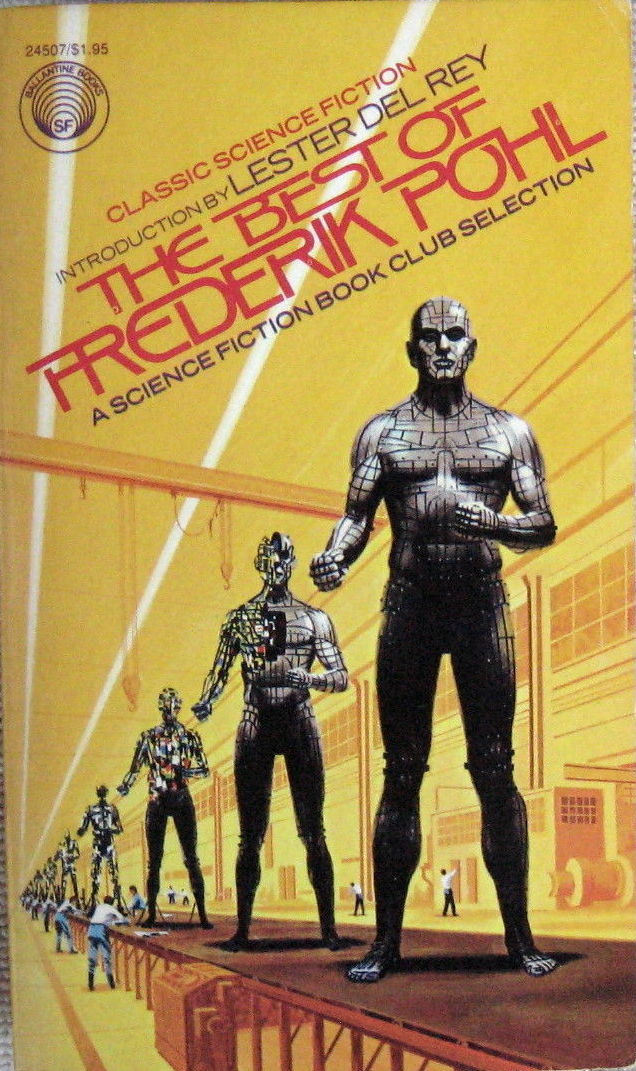
The Best of Frederik Pohl-smallIn my continuing posts of Del Rey’s Classic Science Fiction Series, we now come to the third volume in the series, The Best of Frederik Pohl (1975). The introduction was done by none other than the writer and editor Lester del Rey himself (1915-1993). As with The Best of Stanley Weinbaum and The Best of Fritz Leiber, the cover art for Pohl’s volume was done by Dean Ellis (1920-2009). And as with Leiber’s volume, the author himself, Frederik Pohl (1919-2013), gives an afterword as well commenting on several of the stories within.

To call Pohl a giant of science fiction is a cliched understatement. Pohl wrote and edited science fiction for over seventy years. He won numerous awards and was editor for many years of Galaxy and If magazines. His mark on science fiction is absolutely indelible.

But, I have to admit, I had actually never read any of Pohl’s stories before this volume. So I came to The Best of Frederik Pohl with fairly neutral eyes, though expecting to read some great classic science fiction. What did I find? Let me comment on a few the stories in this volume that really struck me and then I’ll give some final overall thoughts on Pohl’s work.

The story “Happy Birthday, Dear Jesus” was a fairly on-the-nose satire against Christmas commercialism — a pretty easy target. But, surprisingly, this satire was set within the context of a love story about a department store manager seeking to marry the daughter of a very conservative missionary. Not what I was expecting. What was even more surprising was that this turned out to be a very heart-stirring little romantic tale, very unexpected given the cynical bite of the story’s overall point.

Interestingly, in retrospect, the sci-fi elements of this story seem fairly tangential now. In fact, I don’t remember exactly what the sci-fi elements in this story were. And this wasn’t the only story like this. I often found myself trying to remember exactly what made Pohl’s stories examples of science fiction. I’ll return to this point.

Read More Read More

Vintage Treasures: The Best Science Fiction of JG Ballard

Vintage Treasures: The Best Science Fiction of JG Ballard

the-best-science-fiction-of-jg-ballard-small the-best-science-fiction-of-jg-ballard-back-small

On September 3rd of this year, I attended the 2016 Chicagoland Pulpfest. It’s a friendly gathering of Chicago area pulp fans and science fiction readers, held ever year at Doug Ellis’ house in Barrington Hills. I’d been hoping for an excuse to get out to Doug’s house for the last four years, ever since he invited me to dig through the massive — and I do mean massive — collection of paperbacks in his garage, originally belonging to famous editor Martin H. Greenberg.

Doug and Bob Weinberg had acquired the collection from Marty’s family shortly after his death, and Doug was looking for a buyer for the paperbacks. I wrote about my first encounter with Marty’s incredible collection (and acquiring a small portion of it) at the 2012 Windy City Pulp & Paper show. The sheer scale of the collection defeated me then, but I was spoiling for a re-match, and Doug’s invitation to dig into it during the party was just too tempting to resist.

Well, I tried to be social (honestly I did), but the lure of thousands of vintage paperbacks in the garage was just too strong. After a few hours I wandered away from the party and soon found myself elbow deep in boxes, happily sorting through an incredible selection of books — including some I’d been searching for for decades. Virtually all were in fabulous, like-new condition, and it wasn’t long before other book enthusiasts joined me.  Soon enough it seemed like the party had moved into the garage, as one after another most of the boxes were opened and we collectively cooed over the contents.

I walked away with nearly 300 paperbacks (which I bought from Doug for a criminally bargain price), including numerous treasures. Of course, I wasn’t the only one to make fabulous finds. I saw copies of The Best of Clifford Simak, a complete set of Wild Card volumes, and numerous vintage Lovecraft collections dug out of boxes and gleefully set aside by my fellow book prospectors. But for me the big regret of the evening, the one that got away, was The Best Science Fiction of JG Ballard, a 1977 Futura paperback that I didn’t even know existed until I saw it pulled out of a box in Doug’s garage.

Read More Read More

An Experiment in Gor: What Are John Norman’s Books About, Really? The Hidden Secret of the Counter-Earth Saga is an Over-Abundance of…

An Experiment in Gor: What Are John Norman’s Books About, Really? The Hidden Secret of the Counter-Earth Saga is an Over-Abundance of…

tarnsman_of_gor_vallejo_coverI’m positive that I read the first book in the [Counter-Earth Saga/Tarl Cabot Saga/Chronicles of Counter-Earth/Gorean Cycle/Gorean Saga/take your pick], sometime back in junior high. That would be Tarnsman of Gor, first published in 1966 by Ballantine, which recounts how Earth professor Tarl Cabot is mysteriously transported to our solar system’s hidden tenth planet orbiting the sun in a position exactly counter to Earth’s. There he encounters a Barsoomian-inspired sword-and-planet environment. He quickly adapts, becoming a Gorean swordsman and assimilating into the culture of his adopted planet.

If I read any of the sequels, I can’t recall — although I remember enjoying the first book, at least the first part of it recounting Talbot’s strange experiences (involving a mysterious package, I believe) and subsequent relocation to another world. As The Encyclopedia of Fantasy (1997), a huge tome sitting here on my bookshelf, notes, the first Gor books were passable Edgar Rice Burroughs pastiches, and that’s the impression I came away with too. As a boy, I was a huge fan of ERB’s John Carter of Mars stories and was looking for something else along those lines.

The Encyclopedia goes on to condemn later volumes in the series (which now total 34), noting that they “degenerate into extremely sexist, sadomasochistic pornography involving the ritual humiliation of women, and as a result have caused widespread offence.” DAW, which published the series from volumes 7 through 25, apparently dropped Norman for this reason (Naughty Norman!), and the subsequent 9 volumes are only available in e-book editions.

As a collector and purveyor of vintage sci-fi and fantasy paperbacks, I happen to have several Gor books sitting in a pile here beside my office desk. I will be posting them to eBay soon. I have, on occasion, picked one up and opened it at random to read a paragraph or two.

Read More Read More

Invaders of Pluto, and Brain Stealers of Mars: Rich Horton on The Ultimate Weapon and The Planeteers by John W. Campbell

Invaders of Pluto, and Brain Stealers of Mars: Rich Horton on The Ultimate Weapon and The Planeteers by John W. Campbell

the-ultimate-weapon-small the-planeteers-small

When I was twelve years old I read a book that changed my life. It was Before the Golden Age, a collection of Isaac Asimov’s favorite pulp tales from his own early teen years, and it inspired in me a love of the pulps that endures to this day.

One of the most captivating stories was John W. Campbell’s “The Brain Stealers of Mars,” from the December 1936 Thrilling Wonder Stories. The intrepid explorers Penton and Blake use an atomic-powered craft to visit Mars, where they find a sinister race of shapeshifters, eager to hitch a ride back to Earth. Sort of a prototype for “Who Goes There?”, the far more famous tale which Campbell published two years later in Astounding, “Brain Stealers” is more a science fiction puzzler than a true horror story, as our blaster-wielding heroes must find a way to outsmart an entire race of scheming telepathic shapeshifters with designs on conquest.

The Planeteers is a collection of five Penton & Blake tales published in Thrilling Wonder between 1936-38, following their adventures as they explore the solar system in their gleaming atomic spacecraft, discovering the double-minded aliens of Callisto, a benign race on Europa, and the super-intelligent energy eater out beyond Pluto. It appeared as half of an Ace Double in 1966, paired with The Ultimate Weapon, a standalone tale of the desperate race against time to create super-weapons on the Moon to thwart an alien invasion.

Rich Horton reviewed both books on his blog Strange at Ecbatan back in June. Here’s what he thought.

Read More Read More

Into the Mystic: The Mask of the Sorcerer by Darrell Schweitzer

Into the Mystic: The Mask of the Sorcerer by Darrell Schweitzer

oie_1852341b75ezo3oI read a lot of fantasy — most of it older works — and yet Darrell Schweitzer’s mesmerizing The Mask of the Sorcerer (1995) had escaped my attention until fairly recently. Around the time I reviewed another of Schweitzer’s books, Echoes of the Goddess (2013), John Fultz told me that if I was looking for something really wild, Mask was where to go, so I bought it. And for two years it sat there on the virtual TBR stack. When John (who described it as “Harry Potter in Hell” and wrote an appreciation of Schweitzer here at Black Gate ten years ago) and others recently recommended it as a work of S&S horror, I finally picked it up. I have read some extraordinary novels this year, several of which I will positively reread in the years to come. The Mask of the Sorcerer (MotS) is one of those.

MotS is about the education of sixteen-year-old sorcerer, Sekenre. In a land inspired by ancient Egypt, he learns that magic and sorcery are two very different things:

Sorcery is not magic. Do not confuse the two. Magic comes from the gods. The magician is merely the instrument. Magic passes through him like breath through a reed pipe. Magic can heal. It can satisfy. It is like a candle in the darkness. Sorcery, however, resides in the sorcerer. It is like a blazing sun.

Sorcerers draw on deep forces, often by evil means. When one sorcerer kills another, the killer absorbs his victim’s soul and knowledge. There’s a cumulative effect to this, so one victory can yield the spirits of dozens of previously defeated opponents.

Read More Read More

Vampires, Frozen Worlds, and Gambling With the Devil: The Best of Fritz Leiber

Vampires, Frozen Worlds, and Gambling With the Devil: The Best of Fritz Leiber

the-best-of-fritz-leiber-1974-small the-best-of-fritz-leiber-1974-back-small

In my last post I reviewed The Best of Stanley Weinbaum, the first volume in Del Rey’s Classic Science Fiction Series. In this one I’ll review the second in the series, The Best of Fritz Leiber (1974). The introduction was done by the excellent sci-fi/fantasy author Poul Anderson (1926-2001). The cover was by Dean Ellis (1920-2009), though a later 1979 printing (see below) has a cover by Michael Herring (1947-).

Fritz Leiber is probably best known for his Fafhrd and Grey Mouser sword and sorcery tales. At least, that was my introduction to him. He also produced some of the most well-loved horror tales of the twentieth century, such as “Smoke Ghost” and “The Girl with the Hungry Eyes.” I’ve read some of his science fiction in The Book of Fritz Leiber (Daw, 1974) and Fritz Leiber: Selected Stories (Night Shade Books, 2011), edited by Jonathan Strahan and Charles N. Brown. But it was interesting to read a book dedicated completely to Leiber’s science fiction (though there are one or two stories that I’m not sure fit this moniker).

Read More Read More

New Treasures: The Late Breakfasters and Other Strange Stories by Robert Aickman

New Treasures: The Late Breakfasters and Other Strange Stories by Robert Aickman

the-late-breakfasters-and-other-strange-stories-small the-late-breakfasters-and-other-strange-stories-back-small

Robert Aickman was one of the finest horror writers in our field. He received the World Fantasy Award in 1975, and the British Fantasy Award in 1981, the year he died.

Not familiar with Aickman? Great! There’s never been a better time to try him. The marvelous Valancourt Books has returned much of his work to print, including The Late Breakfasters and Other Strange Stories, an omnibus collection of his early work, released in hardcover and an affordable trade paperback format last week. It contains his debut novel The Late Breakfasters (1964), half a dozen short stories, and a new introduction by Philip Challinor.

I first discovered Valancourt by standing in front of their booth at the World Fantasy Convention a few years ago, and being absolutely astounded at how many terrific books they have in their back catalog. Here’s a few I’ve managed to highlight recently at Black Gate.

Read More Read More

Galaxy Science Fiction, July 1953: A Retro-Review

Galaxy Science Fiction, July 1953: A Retro-Review

galaxy-science-fiction-july-1953-smallThe July, 1953 issue of Galaxy Science Fiction is bereft of a serialized novel, so a curious reader could jump into it without feeling a need to commit to something larger. I suggested the same thing for the June, 1953 issue as well, so here are two issues to choose between. Or read them both.

“Kindergarten” by Clifford D. Simak — Peter lives in the country, having moved out of the city after being diagnosed with cancer. He lives a simple life until he discovers a strange machine on his property. When he touches it, it dispenses a remarkable piece of jade.

Other people discover the machine soon enough, and with each touch, it dispenses an item specific to the person. As word spreads, the police become involved, followed by the military. The machine, though clearly alien, isn’t too disturbing until it begins laying a foundation for something much larger.

Simak’s story works really well. I think he did a good job with Peter’s character — showing his pain with cancer. And I like that the source of his pain or why he lived in the country didn’t come out immediately. I expected after reading it that nothing else in the issue would top this story, but I later found something else that edged it out as my favorite.

“Caretaker” by James H. Schmitz — An exploring party visits the planet, Cresgyth. A man named Hulman crashed on it over twenty years ago — the lone survivor of his crew. He was saved by other humans — the only humans known to exist beyond Earth. Those humans, however, are threatened by other humanoid creatures that Hulman calls snakes. The humans won’t fight back, and Hulman believes the humans will become extinct unless something is done about the snakes.

Read More Read More

Fantastic, November and December 1963: A Retro-Review

Fantastic, November and December 1963: A Retro-Review

fantastic-november-1963-small fantastic-december-1963-small

I recently looked at a couple of issues of Fantastic with a Brak the Barbarian serial by John Jakes, and here’s another pair with a Brak serial. Indeed, this was Jakes’ first SF/Fantasy novel, and his second Brak story.

The editorials cover first, Freeman Dyson’s ideas about using gravity as an energy source (for transportation), and second, the notion of having astronauts use crayons in orbit. The covers are by Alex Schomburg (November) and Paul E. Wenzel (December), in neither case, perhaps oddly, illustrating Jakes’ novel. Interiors are by Lee Brown Coye, Virgil Finlay, and Peter Lutjens (each of them appeared in both issues). (I will note that I find Coye okay as a pure horror illustrator, which seems to have been his forte, but I thought his illustration for Jack Sharkey’s “The Aftertime” just terrible.)

There is a letter column in November (Fantastic’s lettercol, which only appeared occasionally at this time, was called According to You ...). The letters this time are by David T. Keil, Paula Crunk, and Dennis Lien. I’ve known Denny online for quite some time, first on Usenet and later via email, so that was interesting. Keil has praise for Keith Laumer and Brian Aldiss and Thomas Disch, some (generally positive) discussion of Fritz Leiber, and scorn for David R. Bunch. Paula Crunk is happy with Leiber and Laumer, but complains about some of the other dreadful stuff the magazine published. And Lien disputes a claim in an earlier letter that fantasy has gotten short shrift in Hugo nominations relative to SF. (He notes the several examples of fantasy that were nominated — 3 at least of the five short fiction nominees the previous year — and also notes that, after all, the Hugos are given at a “Science Fiction” convention.)

Read More Read More

Old Dark House Double Feature IV: Two Haunted Honeymoons

Old Dark House Double Feature IV: Two Haunted Honeymoons

haunted-honeymoon-lobby-poster

For this Old Dark House Double Feature I’ve chosen two films that are unrelated except for the fact that they share a title — Haunted Honeymoon. You might rightly make the argument that the earlier of these movies is more of a standard whodunit than an old dark house movie, but the coincidence was too good for me to pass up.

Haunted Honeymoon
Metro-Goldwyn-Mayer (1940)
Directed by Arthur B. Woods
Screenplay by Monckton Hoffe, Angus MacPhail, and Harold Goldman
Starring Robert Montgomery and Constance Cummings

Dorothy Sayers isn’t really a household name nowadays but she was a rather well-known mystery writer during the so-called Golden Age of mysteries, which lasted for a few decades, starting more or less in the Twenties. Busman’s Honeymoon, the source for this movie, first saw the light of day as a play, in 1936. A year later Sayers converted it to a novel and a few years after that it made its way to the big screen. Over on this side of Atlantic the movie was given the name Haunted Honeymoon, since few of us Yanks probably known what a busman’s holiday is (a holiday where you spend doing the same kind of thing that you usually do for your job, says Merriam-Webster).

Read More Read More