Browsed by
Category: Vintage Treasures

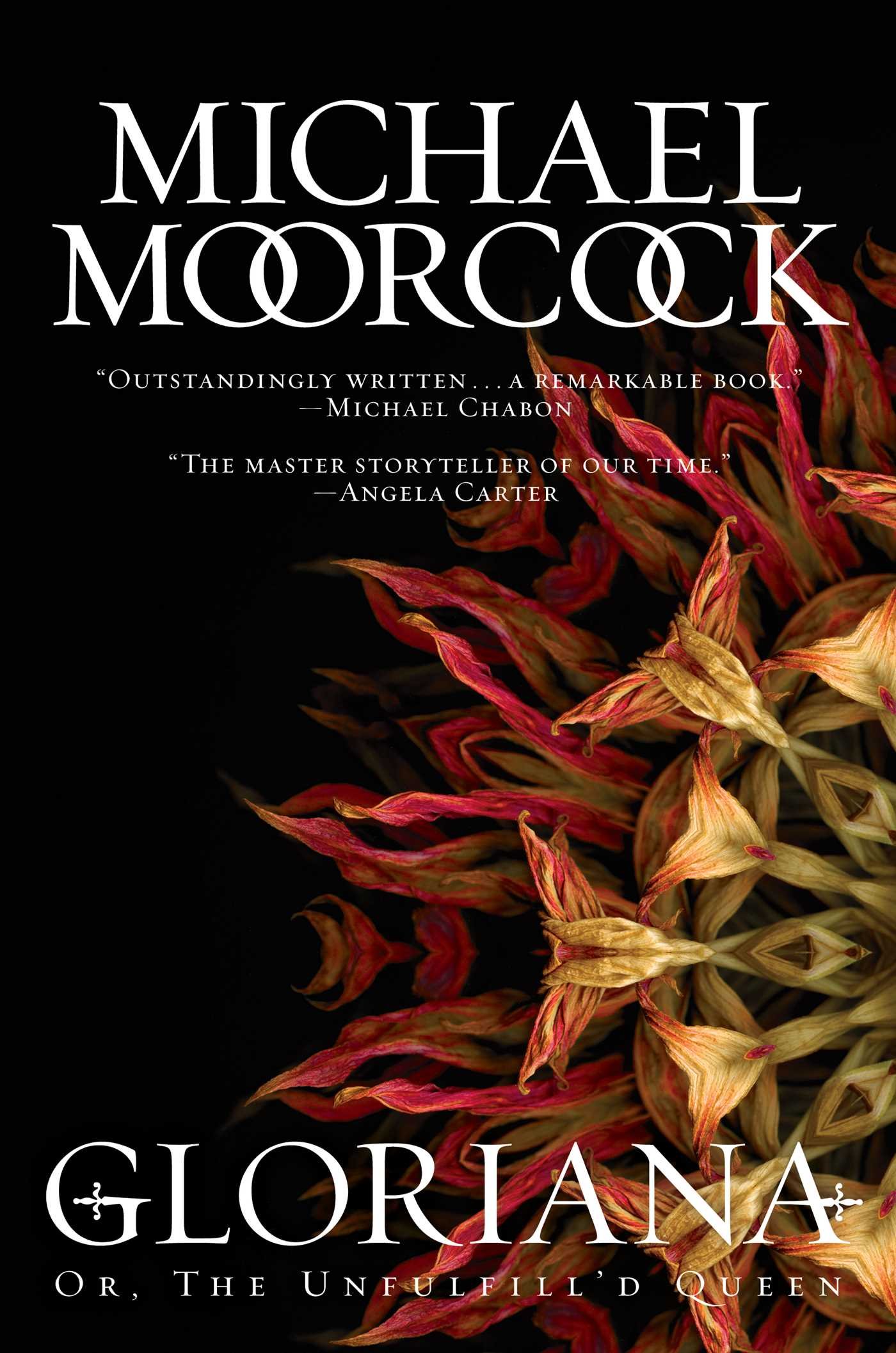
Future Treasures: Gloriana: Or, The Unfulfill’d Queen by Michael Moorcock

Future Treasures: Gloriana: Or, The Unfulfill’d Queen by Michael Moorcock

gloriana-or-the-unfulfilld-queen-smallMichael Moorcock is best known today for his ambitious Eternal Champion story arc, which includes the sword & sorcery classic Elric of Melnibone, the Hawkmoon novels, the Chronicles of Corum, the Von Bek novels… and man, a whole lot more. Seriously, if you want to dive in, there’s a whole lot of reading ahead of you. The Wikipedia page, which lists roughly a billion novels and short stories in the seres, will get you started.

But some of Moorcock’s most acclaimed fantasies were standalone works — including the World Fantasy Award and John W. Campbell Award winner Gloriana: Or, The Unfulfill’d Queen, which first appeared nearly 40 years ago. The tale of a beautiful but sexually frustrated queen who finds herself drawn into deadly court intrigue, Gloriana has been reprinted over a dozen times, and at the end of the month Saga Press returns it to print again in a handsome new hardcover description. Here’s the description.

In this “spellbinding” (The Sunday Times) award-winning fantasy, the vast empire of Albion is ruled by the beautiful and forlorn queen, Gloriana who must battle against a nefarious scoundrel, Captain Quire, and a court soured by debauchery with her wits.

First published in 1978, Gloriana is the award-winning story set in the alternate English kingdom of Albion that reimagines Queen Elizabeth’s reign.

Bawdy, cruel, and brilliant, Gloriana has been awarded the World Fantasy Award and the John W. Campbell Memorial Award for Best Science Fiction, and is often cited as one of the great works of speculative fiction and fantasy along the lines of J.G. Ballard, Thomas Pynchon, and Philip K. Dick.

Gloriana has previously been published in the US by Avon Books, Questar, Warner Aspect, and the Science Fiction Book Club, and in the UK by Fontana, Gollancz Fantasy Masterworks, Gateway/Orion, and others. I’ve collected half a dozen examples below, with a gorgeous sampling of cover art — including the 1986 Flamingo edition, one of the rare examples of full frontal nudity I’ve ever seen on a mass market fantasy cover.

Read More Read More

Star Pirates and Cyborg Games: Rich Horton on The Star Virus by Barrington J. Bayley and Mask of Chaos by John Jakes

Star Pirates and Cyborg Games: Rich Horton on The Star Virus by Barrington J. Bayley and Mask of Chaos by John Jakes

the-star-virus-small mask-of-chaos-small

The famous Ace Double series is highly collectible in its early D-series, which included classic work by Isaac Asimov, Andre Norton, Philip K. Dick, H. Beam Piper, Eric Frank Russell, A.E. van Vogt, Poul Anderson, Robert E. Howard, Leigh Brackett, Clifford D. Simak, and many others.

Later series, however, published fewer big names (and had a reduced art budget), and aren’t nearly as in demand. But there are still a few curiosities in the bunch — and more than a few good reads, as Rich Horton notes in his ongoing series of Ace Double reviews at his website, Strange at Ecbatan.

Here he is on The Star Virus by Barrington J. Bayley, published as half of Ace Double #78400 in 1970 — the tale of a star pirate, a mysterious alien artifact, and a daring theft that leads to a galaxy-spanning pursuit.

Read More Read More

Into the Maelstrom: Berserker: Shadow of the Wolf by Chris Carlsen

Into the Maelstrom: Berserker: Shadow of the Wolf by Chris Carlsen

oie_2231022c1px60owRobert Holdstock is best known for his Ryhope Wood series that started with the 1981 novella “Mythago Wood,” later expanded into the 1985 World Fantasy Award-winning novel of the same name. He would go on to write another six books in the series before his untimely death in 2009. I have only read the novel Mythago Wood, but recommend it highly. It is a fascinating excursion into England’s myths, Jungian archetypes, and damaged familial bonds.

Many readers of the Ryhope books, a series lauded for its psychological depth and poetic style, don’t know that Holdstock wrote at least fifteen earlier novels under various pen names. As Richard Kirk, he contributed to the bloody Raven series (the first of which I reviewed here). His Night Hunter horror series, written as Robert Faulcon, ran to six books. Today, I’m going to look at Shadow of the Wolf (1977), the first of the Berserker trilogy of swords & sorcery novels set in historical Europe, and written under the name Chris Carlsen.

Harald Swiftaxe is a young Norse warrior raiding Ireland for the first time. Despite participating with nearly as much fury and relish as the rest of the warband he belongs to, he lets a monk live out of an odd sense of mercy he doesn’t understand. When he doesn’t rape a woman and kill her child, one of his companions nicknames him “the Innocent.”

Harald is a bit of an innocent, at least as innocent as a red-handed brigand can be. He may be a Viking at heart, primed and ready to kill and pillage, but he also longs to return to his father’s comfortable steading and Elena, the girl he plans to marry.

After leaving Ireland’s shores, Harald heads first for Elena’s town. Instead of a place of warm welcomes, he finds it destroyed and its people slaughtered. While he doesn’t discover his beloved’s body, when attacked by a wounded Berserker he does learn who annihilated the town. Even wounded near to death, Harald’s assailant almost proves too tough for him, but the young Viking survives and kills the raider.

Read More Read More

Oz’s Bag of Holding: Stephen King Edition featuring A Brief Guide, Fear Itself (with an essay by Fritz Leiber!), and Danse Macabre

Oz’s Bag of Holding: Stephen King Edition featuring A Brief Guide, Fear Itself (with an essay by Fritz Leiber!), and Danse Macabre

danse-macabre-originalI have here a bag of holding. I am going to pull some things out of it now…

First up is:

A Brief Guide to Stephen King: Contemporary Master of Suspense and Horror by Paul Simpson (2014)

Funny how I came across this one. I was perusing the bookshelves in The Dollar Tree — all those overstocks and remaindered copies now relegated to the fate of being sold for a dollar.

Every once in a while I make a “find,” but on this occasion, it was looking like there was good reason none of these books had sold for their original double-digit cover prices. The thought actually went through my head, “Too bad you never come across a book by Stephen King in here.” A moment later, King’s name caught my eye! Turns out it was a book not by but about King. Still, it was too much of a sign to ignore, so I bought it.

A Brief Guide is as advertised: a brief, workmanlike bibliography of all King’s work through 2014, with synopses of each. Opens with a short bio. Not a must for shelves of diehard King fans, but I actually found I had plowed through the whole book in two sittings — so it succeeded in its professed purpose as a succinct overview of the author’s career. Every King book, film and TV adaptation, and comic book is covered (indeed, even tie-ins like video games are included). While the synopses are quite short, the author livens it up a bit by including tidbits here and there relating a work to events in King’s own life at the time or King’s opinion or the reaction of critics.

Read More Read More

Amazing Stories, May and June 1965: A Retro-Review

Amazing Stories, May and June 1965: A Retro-Review

amazing-stories-may-1965-small amazing-stories-june-1965-small-2

Here we come to the very last two issues of Amazing edited by Cele Lalli.

The editorials, as ever by Norman Lobsenz, consider the difficulty of accurate and precise time measurements, and a very brief discussion of David Bunch, the writer readers of Amazing and Fantastic loved to hate. Lobsenz quotes Bunch (“I’m not in this business… to entertain. I’m here to make the reader think… chastise him for the terrible… world we allow… The reader I want is the one who wants the anguish… All space must look askance at us.”)

This last Lalli issue was the last issue Bunch would appear in (not surprisingly) for over three years — he didn’t return to Amazing until late 1968, under editor Barry N. Malzberg — and the only one for which he had the cover story. (One suspects the June cover was partly Lalli and Lobsenz saying, “Heck, we don’t care anymore, we’re going to promote what WE like!”) The covers are each by Gray Morrow. There are only two interior illustrations, both in May, by Morrow and by Virgil Finlay.

The letter column is gone, again perhaps in view of the upcoming sale of the magazines. Robert Silverberg conducts the book review column, The Spectroscope, sharply and indeed acerbically, to good effect. In May he reviews an Avalon Books reprint of George Allen England’s Darkness and Dawn, a somewhat famous piece of proto-SF. Silverberg calls it “a cruel resurrection,” and indeed it does seem awful (and shockingly racist) as described. He also covers Walter Cole’s Checklist of Science Fiction Anthologies (with much praise) and The Worlds of Robert F. Young (“I am not fond of the writing of Robert F. Young” – given that Young was a Goldsmith/Lalli regular, this is a perhaps brave statement – and a sensible one!)

Read More Read More

Future Treasures: Jack Ketchum’s Off Season: 35th Anniversary Edition From Dark Regions Press

Future Treasures: Jack Ketchum’s Off Season: 35th Anniversary Edition From Dark Regions Press

off-season-35th-anniversary-edition-small

Jack Ketchum’s debut novel Off Season created something of a sensation when it first appeared as a Ballantine paperback in 1980. Partially based on the legend of the Scottish cannibal clan led by Sawney Bean (which also inspired Wes Craven’s The Hills Have Eyes), the novel was heavily critiqued for its over-the-top violence, and Ballantine eventually withdrew it from circulation. Now, to celebrate the book’s 35th anniversary, Dark Regions Press is returning the book to print in a special unexpurgated edition, with a new short story and afterword by the author, and a gorgeous wraparound cover by David Stoupakis.

The Ultimate Edition of Jack Ketchum’s Debut Novel That Shocked the Horror Scene in 1980

Jack Ketchum’s debut novel Off Season made a huge impact on the horror scene with its initial publication in 1980. It became so controversial that the original publisher withdrew their support of the novel. Now award-winning specialty publisher Dark Regions Press is bringing Ketchum’s debut novel back in its best form yet.

The 35th anniversary edition of Off Season includes the author’s originally intended version of the novel (unexpurgated), a new short story based in the Off Season universe, a new afterword from the author, the novelette “Winter Child,” five full page interior illustrations by Tomislav Tikulin and stunning full color wraparound dust jacket artwork by David Stoupakis.

Here’s the complete wraparound cover.

Read More Read More

Last Term: Honor’s Paradox by P.C. Hodgell

Last Term: Honor’s Paradox by P.C. Hodgell

oie_854428zsyhwbhz
Another tawdry Caldwell cover

Can you tell I really like P.C. Hodgell’s Kencyrath series? Not once have I followed up a review of an author’s book with a review of her next one. And in three weeks I’ll review the next one as well. In between there’ll be a short story roundup and then, provided the Canadian mail runs well, Chris Carlsen’s Shadow of the Wolf.

Last week, I wrote that Bound in Blood (2010) was essentially a story where just a bunch of stuff happens to Hodgell’s cat-clawed heroine, Jame. That’s pretty much the feel in Honor’s Paradox (2011) as well, but this time there’s more apparent purpose. The story is told in Hodgell’s usual mix of the funny, the tragic, and the sublime. One final time, the setting is the Kencyrath military school, the randon academy.

Again, the setup:

Thirty thousand years ago, Perimal Darkling began to devour the series of parallel universes called the Chain of Creation. To fight against it, the Three-Faced God forged three separate races into one: feline-like Arrin-Ken to serve as judges; heavily-muscled Kendar to serve as soldiers and craftsmen; fine-featured humanoid Highborn to rule them. For 27,000 years, the Kencyrath fought a losing battle, one universe after another falling to the darkness. Three thousand years ago, the High Lord Gerridon, fearful of death, betrayed his people to Perimal Darkling in exchange for immortality. Fleeing yet again, the Kencyrath landed on the world of Rathilien. Since then, they haven’t heard from their god and Perimal Darkling has seemed satisfied to lurk at the edges of their new home. Monotheists trapped on an alien world with many gods, the Kencyrath have had to struggle to make a life on Rathilien.

Now, the power of the Three-Faced God seems to be reappearing. The Kencyrath believe that only the Tyr-ridan, three Highborn reflecting the three aspects of their god — destroyer, preserver, and creator — will be able to defeat Perimal Darkling. Jame, raised in the heart of Perimal Darkling, is fated to be the Regonereth, That-Which-Destroys.

Read More Read More

A State of Suspension: Iain Banks’ The Bridge

A State of Suspension: Iain Banks’ The Bridge

the-bridge-iain-banks-small the-bridge-iain-banks-abacus-small the-bridge-iain-banks-uk

Iain Banks, the Scottish science fiction writer, established himself as a major presence in the genre with his Culture series, the first of which, Consider Phelebas, appeared in 1987. Set in a far future, post-scarcity universe teeming with human and alien societies, the Culture books are wide screen space operas with a decidedly sociological-political perspective. Banks wrote a new Culture book every few years until there were ten volumes. The final one, The Hydrogen Sonata, appeared in 2012, shortly before Banks died of cancer in 2013, at the age of 59.

In 1986, right before beginning the series that would dominate the rest of his career, Banks published something rather different: The Bridge, a book that stands high in the ranks of a significant sub-genre of fantasy, those stories that deal with pre or after life states, or that take place in the nebulous regions between life and death.

The Bridge begins as a nameless man (we eventually learn that he is an affluent Glasgow professional named Alex) has a moment of inattention while driving back from a weekend of nostalgic dissipation; as he gazes at the Forth Railway Bridge that crosses the Firth of Forth just west of Edinburgh, he fails to notice the shifting traffic patterns in front of him and crashes his car. He is trapped in the wreckage of his vehicle, praying that it doesn’t burst into flames before he can be rescued. Crushed and bleeding, he lapses into unconsciousness… and awakens, whole and uninjured, on the bridge.

Read More Read More

Vintage Treasures: The Best of John Brunner

Vintage Treasures: The Best of John Brunner

the-best-of-john-brunner-small the-best-of-john-brunner-back-small

In 1974 Lester Del Rey hit on the idea for a series of collections showcasing the best early SF writers in the field — especially those who had a publishing contract with his Del Rey imprint, naturally enough. The Classic Science Fiction line grew to roughly two dozen volumes, creating an essential library of early science fiction. It became one of the seminal SF series of my childhood, introducing me to such writers as C.L. Moore, Leigh Brackett, Edmond Hamilton, Fritz Leiber, Henry Kuttner, John W. Campbell, Philip K. Dick, Fredric Brown, Murray Leinster, Robert Bloch, Jack Williamson, and many others. James McGlothlin has been reviewing them at Black Gate. So far he’s covered The Best of Stanley Weinbaum and The Best of Frederik Pohl, two of the finest books in the set.

I always thought I had a complete collection, but just a few months ago I discovered there was a late entry — The Best of John Brunner, published fourteen years after the first volume in the series. How the heck did that manage to elude me for nearly 30 years? I scrambed to find one, and soon enough located a virtually new copy on eBay for just $4 — just five cents more than the 1988 cover price. It arrived a few weeks ago.

It has been a genuine treat. Brunner is one of science fiction’s finest 20th Century practitioners, and while I’m well familiar with his novels, I’ve discovered that I’m much less knowledgeable regarding his short fiction. In fact, while I haven’t finished reading it, I’m pretty sure I’ve never read any of these stories before.

Read More Read More

Another Term: Bound in Blood by P.C. Hodgell

Another Term: Bound in Blood by P.C. Hodgell

oie_13432gaur4x7bWith Bound in Blood (2010), P.C. Hodgell continues to blow me away with her talent for telling tales. It’s the fifth book in the Kencyrath series, and the second one about our heroine Jame’s time at military school, the randon academy at Tentir. It’s not the most compelling novel so far. In fact, it’s more of a collection of stuff that happens to Jame or stuff she does. That the book manages to hold a reader from cover to cover proves just how good Hodgell is.

First, the mandatory recap:

Thirty thousand years ago, Perimal Darkling began to devour the series of parallel universes called the Chain of Creation. To fight against it, the Three-Faced God forged three separate races into one: feline-like Arrin-Ken to serve as judges; heavily-muscled Kendar to serve as soldiers and craftsmen; fine-featured humanoid Highborn to rule them. For 27,000 years, the Kencyrath fought a losing battle; one universe after another falling to the darkness. Three thousand years ago, the High Lord Gerridon, fearful of death, betrayed his people to Perimal Darkling in exchange for immortality. Fleeing yet again, the Kencyrath landed on the world of Rathilien. Since then, they haven’t heard from their god, and Perimal Darkling has seemed satisfied to lurk at the edges of their new home. Monotheists trapped on an alien world with many gods, the Kencyrath have had to struggle to make a life on Rathilien.

Now, the power of the Three-Faced God seems to be reappearing. The Kencyrath believe that only the Tyr-ridan, three Highborn reflecting the three aspects of their god — destroyer, preserver, and creator — will be able to defeat Perimal Darkling. Jame, raised in the heart of Perimal Darkling, is fated to be the Regonereth, That-Which-Destroys.

Read More Read More