Browsed by
Category: Vintage Treasures

Announcing the Winners of The Watcher at the Door: The Early Kuttner, Volume Two!

Announcing the Winners of The Watcher at the Door: The Early Kuttner, Volume Two!

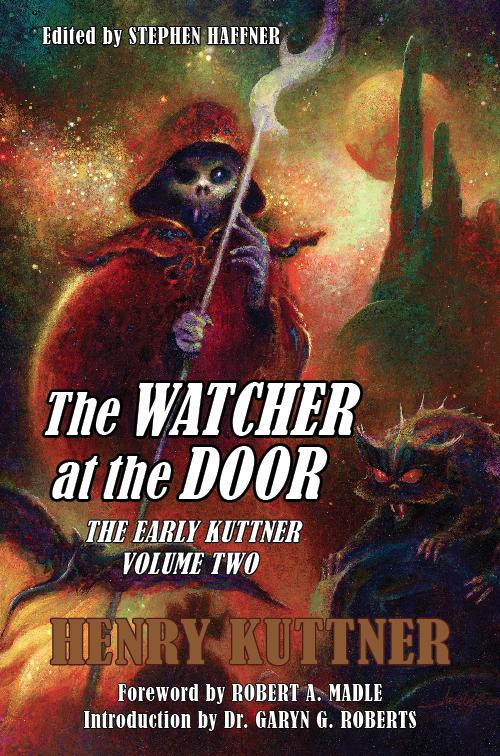
The Watcher at the Door-smallWe had a near-record number of entries in our latest contest. Not too surprising, as this time we’re giving away two copies of The Watcher at the Door: The Early Kuttner, Volume Two, the latest archival quality hardcover from Haffner Press.

This gorgeous book is a massive collection of 30 early weird fantasy tales by Henry Kuttner, and readers have been asking about if for months. We first gave you a sneak peek back in April 2015.

How did you enter? All you had to do submit the title of an imaginary weird fantasy story. The most compelling titles — as selected by a crack team of Black Gate judges — were entered into the drawing. We drew two names from that list, and the two winners will both receive a free copy of The Watcher at the Door, complements of Haffner Press and Black Gate magazine.

So let’s get right to it. The first job was to select the Top 25 entries from the numerous submissions we received over the past 9 days — no easy task, let me tell you. But after much agonizing debate (and two brief fist fights), here are the judges selections.

  1. Bob Cooper — Give Me Back My Heads!
  2. Chris Dodson — Wrath of the Mad King in the Golden Tower
  3. Kyle Crider — O, Slime That Yearneth and Singeth Out
  4. Amy Bisson — The Crystal Scimitar of Doom!
  5. George Kelley — Vampires of the Obsidian Void
  6. William White — The Lilt in Her Voice, the Grin on Her Face
  7. Read More Read More

For the Love of Monster Comics

For the Love of Monster Comics

where-monsters-dwell-lot-3-small

A few months back I spent almost $40 on eBay to acquire two dozen Monsters on the Prowl comics — late 60s and early 70s Marvel monster titles featuring the imaginative work of Stan Lee, Jack Kirby, Steve Ditko, and the entire Marvel bullpen at the height of their creative powers.

It was an impulse buy for sure — not the first I’ve done on eBay, and I strongly suspect it won’t be the last — and I half-expected I’d regret it almost immediately. Or at least, as soon at the package arrived. But the opposite happened. The moment I held those beautiful old artifacts in my hands, I did feel regret. But not the way I expected.

My immediate thought was, Why didn’t I bid on a lot more of these?

Read More Read More

Last of a Series… For Now: The Sea of Time by P.C. Hodgell

Last of a Series… For Now: The Sea of Time by P.C. Hodgell

oie_1362841tq9cvryr
Baen finally does right by Jame and Hodgell

Earlier this year I promised myself I would finally finish all the volumes in P.C. Hodgell’s Kencyrath series so far. I did that yesterday, with my completion of The Sea of Time (2014). I’m really enjoying the series and book 7 is a blast. Regular readers will be shocked to read my one complaint: it’s too short. Before I explain that, let me fill you in on the book and tell you all about its good points.

First, one more time, the setup:

Thirty thousand years ago, Perimal Darkling began to devour the series of parallel universes called the Chain of Creation. To fight against it, the Three-Faced God forged three separate races into one: feline-like Arrin-Ken to serve as judges; heavily-muscled Kendar to serve as soldiers and craftsmen; fine-featured humanoid Highborn to rule them. For 27,000 years, the Kencyrath fought a losing battle, one universe after another falling to the darkness. Three thousand years ago, the High Lord Gerridon, fearful of death, betrayed his people to Perimal Darkling in exchange for immortality. Fleeing yet again, the Kencyrath landed on the world of Rathilien. Since then, they haven’t heard from their god and Perimal Darkling has seemed satisfied to lurk at the edges of their new home. Monotheists trapped on an alien world with many gods, the Kencyrath have had to struggle to make a life on Rathilien.

Now, the power of the Three-Faced God seems to be reappearing. The Kencyrath believe that only the Tyr-ridan, three Highborn reflecting the three aspects of their god — destroyer, preserver, and creator — will be able to defeat Perimal Darkling. Jame, raised in the heart of Perimal Darkling, is fated to be the Regonereth: That-Which-Destroys.

At the end of the previous book, Honor’s Paradox, series heroine, Jame, had survived all the tests and trials thrown at her by the curriculum and her enemies at the Kencyrath military academy, and was promoted to second year cadet.  The Sea of Time opens with Jame arriving at the Southern Host. The Host is the main force of Kencyrath soldiers, hired out to the wealthy city of Kothifir.

Read More Read More

Amazing Stories, November 1961: A Retro-Review

Amazing Stories, November 1961: A Retro-Review

amazing-stories-november-1961-smallThis is an earlyish Cele Goldsmith issue. Unusually, it has only three stories.

The editorial is given over to a reprint of part of an interview with an Emeritus Professor of Mathematics from New York University, Richard Courant, that had been published in Challenge. Courant is presented as something of a skeptic about computers, though as presented his skepticism seems sensible enough. The only other feature is a pretty short book review column (it was cut, and the lettercol eliminated, to make room for the complete novel in one issue). The books reviewed were Level 7, by Mordecai Roshwald, a once famous post-apocalyptic novel, now little-known, which S. E. Cotts praises highly in terms that make it sound absolutely dreadful; and The Synthetic Man, by Theodore Sturgeon, a novel better known as The Dreaming Jewels, which Cotts also likes. The cover is by Alex Schomburg, and the interiors are by Virgil Finlay and Dan Adkins.

A word about S. E. Cotts, the book reviewer for Amazing throughout most of Cele Goldsmith’s tenure. I have long wondered who Cotts was, and also whether Cotts might have been a woman. In recent correspondence, Robert Silverberg, who succeeded Cotts as Amazing’s book reviewer (after a one column appearance by Lester Del Rey), said that he thought (but was not sure) that S. E. Cotts was actually Cele Goldsmith’s sister. I have never heard that before, and it’s pretty intriguing. (We might note that Floyd C. Gale, book reviewer for Galaxy in the 1950s, was editor H. L. Gold’s brother.)

The cover story is a novelet, “Meteor Strike!”, by Donald E. Westlake (12,500 words). Westlake, who was born in 1933 and died in 2008, was one of the great crime fiction writers of our time. I am particularly fond of his comic capers featuring the thief John Dortmunder. Others plump for his darker novels about a criminal named Parker, written as by Richard Stark. Early in his career, Westlake published a fair amount of Science Fiction, before bidding a bitter farewell to the field in a rant published in the great fanzine Xero. Westlake complained about SF’s conservatism, and particularly about John Campbell. Alas, I feel his argument — which had some merit — loses some force simply because, truth be told, Westlake was a pretty mediocre SF writer.

Read More Read More

Original Woodgrain Edition Dungeons and Dragons Box Set Sells For $22,100

Original Woodgrain Edition Dungeons and Dragons Box Set Sells For $22,100

woodgrain-first-edition-dungeons-and-dragons-box-small

A first printing of the original woodgrain box edition of Dungeons and Dragons, one of the rarest RPG collectibles, sold on eBay Friday for $22,100. The seller tells the story of how they acquired this ultra-rare piece of gaming history in the item description:

This set is in Very Fine condition with one small stain on the front label and very minor scuffing on the corners of the box. Note that the Reference Sheets are not stapled, but loose sheets folded together. This was the original condition.

It was acquired by the present owner in an interesting way.

In 1974 I worked in a project offering supplemental educational materials to four school districts in Northwestern Wisconsin. I met Bill, an elementary school librarian, who was very excited about working with his students using role playing games. He had a friend in Minneapolis whom he had met through their shared interest in war gaming. This friend, “Lance,” was involved with creating a new project, a fantasy-style wargame in a box that could be played by anyone.

My librarian friend was working with a sixth-grade class to create a book based on playing the game. Included in this set is a copy of the booklet that his students created using the game. Bill also used a 20-sided die that he had hand-colored to differentiate scoring. Adding to the charm of this set, the die is included, as is a hand-written note from Bill, the librarian, explaining the use of the die. He added that there was currently a shortage of these dice, but they were available in England. He was going to England for a vacation, and would be bringing some back with him.

I’m not sure this is a record price, but it must be pretty close. It’s definitely one of the most high-profile sales of a D&D collectible in recent memory. The seller, editorjan_1, has never previously sold on eBay, and has a zero feedback score, which makes this auction something of a risk for the buyer. See the complete listing on eBay here, and a more detailed breakdown of everything in the box at acaeum.com.

Edgar Rice Burroughs’s Pellucidar Saga: At the Earth’s Core

Edgar Rice Burroughs’s Pellucidar Saga: At the Earth’s Core

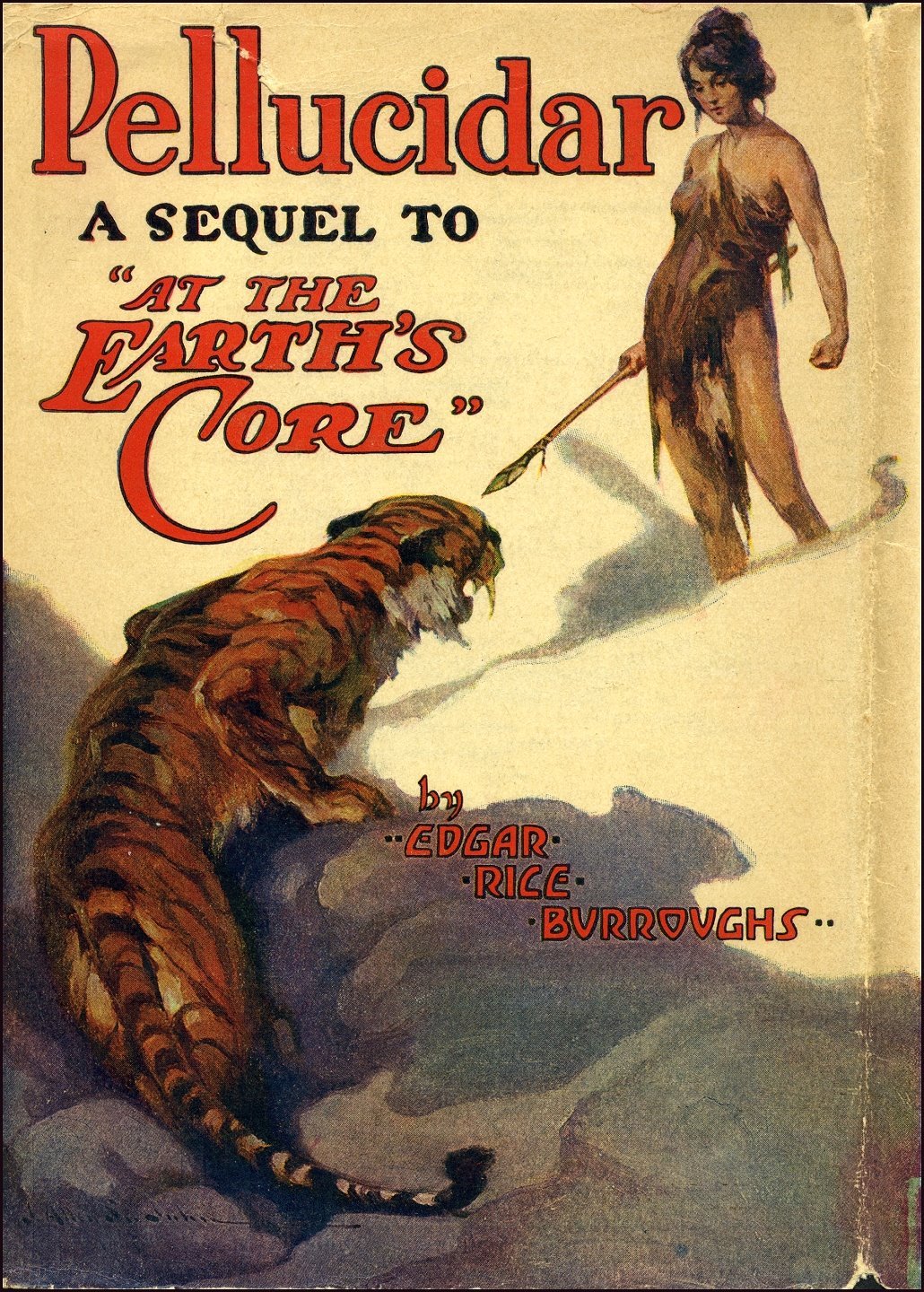
at-the-earths-core-first-edition-j-allen-st-johnOnce upon a time, I shouldered the enjoyable burden of analyzing all of Edgar Rice Burroughs’s Venus (Amtor) novels. Then, to celebrate the hundredth anniversary of the publication of A Princess of Mars, I took on the same task for the Mars (Barsoom) novels. It was inevitable that I would one day bring the same survey methods to the Pellucidar novels at the center of the earth. (Sorry, a Tarzan series just won’t happen. There are far too many Tarzan novels for the sanity of even the most hardcore ERB fan to take in concentrated doses.)

Our Saga: Beneath our feet lies a realm beyond the most vivid daydreams of the fantastic… Pellucidar. A subterranean world formed along the concave curve inside the earth’s crust, surrounding an eternally stationary sun that eliminates the concept of time. A land of savage humanoids, fierce beasts, and reptilian overlords, Pellucidar is the weird stage for adventurers from the topside layer — including a certain Lord Greystoke. The series consists of six novels, one which crosses over with the Tarzan series, plus a volume of linked novellas, published between 1914 and 1963.

Today’s Installment: At the Earth’s Core (1914)

The Backstory

Subterranean realms of the fantastic have a history reaching back to antiquity. But it was the nineteenth-century speculative theories of Captain John Cleves Symmes about the hollow earth that ignited a wave of fictional explorations of What Lies Within: “I declare the earth is hollow, and habitable within; containing a number of solid concentrick [sic] spheres.”

Read More Read More

Win a copy of The Watcher at the Door: The Early Kuttner, Volume Two, from Haffner Press!

Win a copy of The Watcher at the Door: The Early Kuttner, Volume Two, from Haffner Press!

The Watcher at the Door-smallContests! We love contests. It’s because we love to give you things, just like Santa Claus.

In this case, it’s something you really, really want: the latest archival quality hardcover from Haffner Press, The Watcher at the Door: The Early Kuttner, Volume Two, a massive collection of 30 early weird fantasy tales by Henry Kuttner. Here in the Black Gate offices we’ve been awaiting this gorgeous book for a long, long time. We first gave you a sneak peek back in April 2015.

The Watcher at the Door is the second volume in a three-volume “Early Kuttner” set collecting many of Kuttner’s earliest stories, most of which have never been reprinted. The first volume, Terror in the House, was released way back in 2010.

We have two copies of this beautiful hardcover to gave away. How do you win one? Now pay attention, this is the fun part. You must submit the title of an imaginary weird fantasy story. The most compelling titles — as selected by a crack team of Black Gate judges — will be entered into the drawing. We’ll draw two names from that list, and the two winners will receive a free copy of The Watcher at the Door, complements of Haffner Press and Black Gate magazine. Here are the titles of some of the stories in this book, to give you a little inspiration:

“We Are the Dead,” Weird Tales, Apr ’37
“The Curse of the Crocodile,” Strange Stories, Aug ’39
“Corpse Castle,” Thrilling Mystery, Nov ’39
“When New York Vanished,” Startling Stories, Mar ’40
“The Room of Souls,” Strange Stories, Jun ’40

How hard is that? One submission per person, please. Winners will be contacted by e-mail, so use a real e-mail address maybe. All submissions must be sent to john@blackgate.com, with the subject line The Watcher at the Door, or something obvious like that so I don’t randomly delete it.

Read More Read More

A Neglected Master: The Best of Henry Kuttner

A Neglected Master: The Best of Henry Kuttner

the-best-of-henry-kuttner-del-rey-small the-best-of-henry-kuttner-del-rey-back-small

In Henry Kuttner’s short story “The Voice of the Lobster,” a character who is trying to escape some enemies muses to himself that he wishes he were a Cerean. In a footnote Kuttner includes the following: “The inhabitants of Ceres were long supposed to be invisible. Lately it has been discovered that Ceres has no inhabitants.” (p. 135).

Such is the typical humor of The Best of Henry Kuttner (1975), the fourth installment in Del Rey’s Classic Science Fiction Series. The previous volumes in this series all had insightful afterwords by the featured author, but Kuttner’s book does not contain one. Primarily, I take it, because Henry Kuttner (1915-1958) had already been dead for over a decade and a half by the time of publication. A shame though, given how the previous author afterwords in this series shed much light upon the subtext of their stories.

The introduction for this volume was done by the late and legendary Ray Bradbury (1920-2012). As with the previous three volumes, the cover art was by the amazing Dean Ellis (1920-2009).

Read More Read More

The Public Life of Sherlock Holmes: Cool and Lam are Back!!!!

The Public Life of Sherlock Holmes: Cool and Lam are Back!!!!

coollam_heatErle Stanley Gardner is best known as the creator of Perry Mason. Mason, of course, was the famous lawyer portrayed almost three hundred times (!!!) by Raymond Burr, spanning three decades of television. But Gardner was a prolific pulpster who wrote far, far more than just Mason stories.

For example, his Ed Jenkins was one of the early hard boiled detectives appearing in Black Mask. And under the name of A.A. Fair, he wrote twenty-nine thoroughly entertaining novels about the mismatched PIs, Bertha Cool and Donald Lam. And that’s who we’re going to talk about today. Make sure you read to the end for some very cool news (No, don’t just jump ahead to there, please!).

Cool and Lam appeared in twenty-nine novels over thirty-one years, with the final tale coming out the same month Gardner passed away.

Bertha Cool, profane, massive, belligerent and bulldog, sat back of her desk, her diamonds flashing in the morning sunlight as she moved her hand over a pile of papers….

Bertha Cool said, “Now, don’t make any mistakes about Donald. He’s a go getter. God knows he hasn’t any brawn, but he has brains. He’s a half-pint runt and a good beating raises hell with him, but he knows his way around.

Donald can find her if anyone can. He isn’t as young as he looks. He got to be a lawyer, and they kicked him out when he showed a client hot to commit a perfectly legal murder. Donald thought he as explaining a technicality in the law, but the Bar Association didn’t like it. They said it as unethical. They also said it wouldn’t work…

‘Donald came to work for me, and the first case he had, damned if he didn’t show ‘em there was a loophole in the murder law through which a man could drive a horse and buggy. Now they’re trying to amend the law. That’s Donald for you!”

Read More Read More

Atlantis, Vikings, and the Hordes of Kublai Khan: Merlin’s Ring by H. Warner Munn: Part II

Atlantis, Vikings, and the Hordes of Kublai Khan: Merlin’s Ring by H. Warner Munn: Part II

terrortales-smallTime to come clean! When I published Part 1 of my review of Merlin’s Ring last year, it was not because the article was so massive that it had to be broken down into smaller parts. Rather, it’s because I was unable to finish the book promptly, and soon enough unforeseen circumstances left me deprived of my copy, wondering what happened to Gwalchmai and Corenice. John O’Neill suggested I proceed with what I had, and commit to completing the review later.

A replacement book was not an easy find. Mr Munn’s works are like hens teeth where I live. Honestly I have only ever, quite recently, come across one in a second hand book shop – alas it was The King of the World’s Edge, which is the book that caused me to seek out Merlin’s Ring in the first place!

Well, thanks to the internet and a service called Alibris, I finally received a replacement volume from Floridas. Not in as good a nick as my previous, pristine volume, but it is the first printing Ballantine version, which I suppose is something.

Part 1 of my review left off where Gwalchmai had joined forces with Joan of Arc, and became part of the army set to liberate Orleans. One has to appreciate the admiration for St Joan that Mr Munn must have had. His passion for the subject is strong, and the resultant detail a joy to read. My own knowledge of Joan of Arc has (until now) been somewhat sketchy. Pretty much the basics: when she lived, that she was burned as a heretic, and there have been a few recent movies about her.

While I can’t say whether Munn’s account is historically accurate, at least the recent movies have acquainted me with the subject of Joan of Arc. Munn’s Secondary characters are detailed and believable, with small quirks that can easily be believed. One example is Master Jean, the best marksman in France when it comes to the “hand cannon” (predecessor to a harquebus). The secret to his skill is cleverly woven into the plot, something rather mundane by today’s standards but so revolutionary, and risky, for a gunner in those days.

Read More Read More