Browsed by
Category: Vintage Treasures

A Detective With the Mind of a Criminal: The Casefiles of Mr. J G Reeder, by Edgar Wallace

A Detective With the Mind of a Criminal: The Casefiles of Mr. J G Reeder, by Edgar Wallace

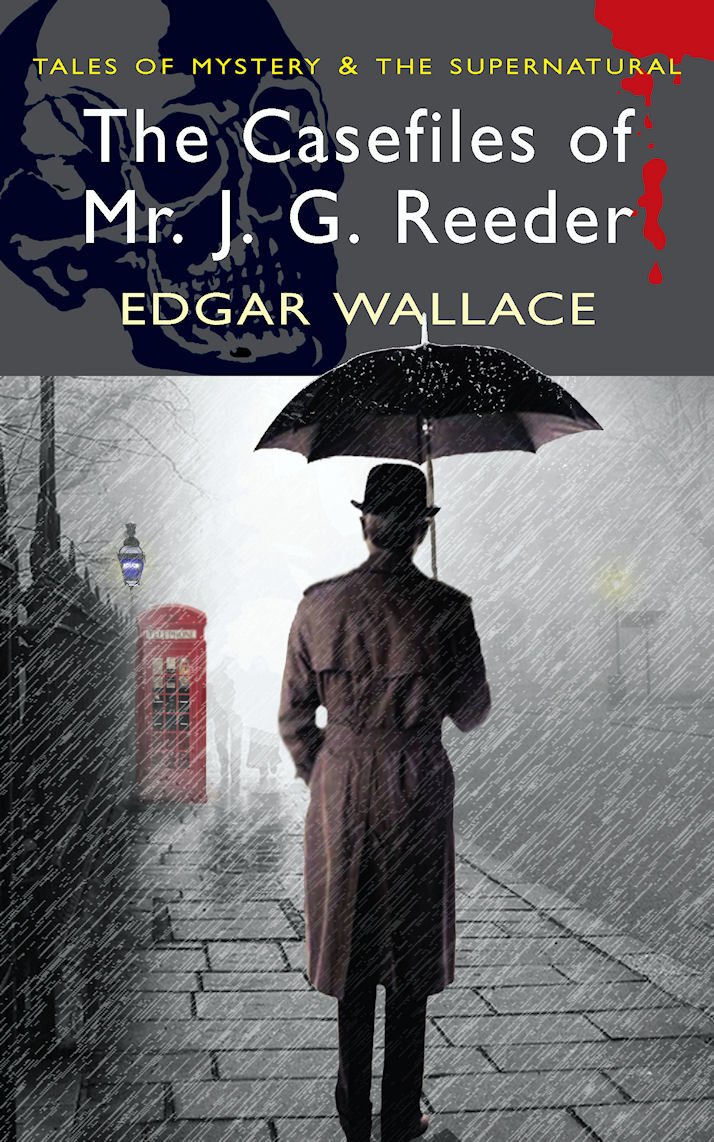
The Casefiles of Mr JG Reeder-smallWordsworth Editions published dozens of titles in their Tales of Mystery and the Supernatural imprint (or, as we like to call them, TOMAToS), featuring classic tales of detection, horror and ghostly doings from Robert E. Howard, Rudyard Kipling, Sheridan Le Fanu, William Hope Hodgson, W.F. Harvey, Edith Nesbit, Oliver Onions, E.F. Benson, and many others.

Wordsworth has revamped the entire series (see their website for the dramatic redesign), and they’re letting all the older titles gradually go out of print… which means it’s definitely time to snatch up those I still don’t have. Like The Casefiles of Mr. J G Reeder, an omnibus collection of three pulp-era books by popular British thriller writer Edgar Wallace.

How on earth did you piece together all this? he asked in wonder. Mr Reeder shook his head sadly. I have that perversion, he said. It is a terrible misfortune. I see evil in everything. I have the mind of a criminal.

Let us introduce you to the enigmatic J. G. Reeder, a timid, gentle middle-aged man who carries a furled up umbrella and wears an old-fashioned flat-topped bowler hat. He is one of the great unsung sleuths of mystery fiction, created by the prolific Edgar Wallace, the King of Thrillers. Despite his insignificant appearance, Reeder is a cold and ruthless detective who credits his success to his criminal mind which allows him to solve a series of complex and audacious crimes and outwit the most cunning of villainous masterminds.

This volume is a rich feast for crime fiction fans, containing the first three volumes in the Reeder canon: two novels, Room 13 and Terror Keep; and the classic collection of short stories, The Mind of J. G. Reeder.

Edgar Wallace was an enormously popular mystery and thriller writer of the 20s and 30s. More than 160 films have been based on his work, and The Edgar Wallace Mystery Magazine was a popular digest magazine in the mid-60s. But perhaps his most famous creation was the script for King Kong (1933); he died of complications of diabetes while working on revisions with director Merian C. Cooper.

Read More Read More

Edgar Rice Burroughs’s Pellucidar Saga: Pellucidar

Edgar Rice Burroughs’s Pellucidar Saga: Pellucidar

Pellucidar-1st-Edition-Cover-smallWelcome back to the concave world of Pellucidar and the second novel in Edgar Rice Burroughs’s series of adventures within the globe: the eponymous Pellucidar. ERB left readers in suspense about the fate of hero David Innes at the close of At the Earth’s Core, but only a year later delivered audiences from the tension and closed out a duology about the Imperial Conquest of the Pellucidar. (And we still have five more volumes to go after this.)

Our Saga: Beneath our feet lies a realm beyond the most vivid daydreams of the fantastic… Pellucidar. A subterranean world formed along the concave curve inside the earth’s crust, surrounding an eternally stationary sun that eliminates the concept of time. A land of savage humanoids, fierce beasts, and reptilian overlords, Pellucidar is the weird stage for adventurers from the topside layer — including a certain Lord Greystoke. The series consists of six novels, one which crosses over with the Tarzan series, plus a volume of linked novellas, published between 1914 and 1963.

Today’s Installment: Pellucidar (1915)

Previous Installments: At the Earth’s Core (1914)

The Backstory

During the mid-teens, Edgar Rice Burroughs frequently wrote with the aim of creating two-part novels. The books we know today as The Mad King, The Cave Girl, and The Eternal Lover are combinations of an original novel and its closely connected sequel. The Pellucidar series might have gone the same way. The sequel to At the Earth’s Core was written at this time and serves as an immediate follow-up that brings the story of its first novel to a conclusion. If Burroughs hadn’t returned to the setting fourteen years later and continued writing more about Pellucidar, it’s possible that At the Earth’s Core and Pellucidar would be considered a single novel today — probably simply titled At the Earth’s Core. (My title choice would be Conquest of the Earth’s Core.)

Read More Read More

Eaters of the Dead by Michael Crichton

Eaters of the Dead by Michael Crichton

oie_8192953ghlqmqv0-1In 921 AD, Aḥmad ibn Faḍlān ibn al-ʿAbbās ibn Rāšid ibn Ḥammād was sent from Baghdad as ambassador to the Volga Bulgars (who lived in the boundaries of modern Russia) to help establish Islamic law for the newly converted nation. The short journal he kept of his travels is famous for its descriptions of the Volga Vikings, in particular the death rites of one of their chietains.

In Eaters of the Dead (1976), the fourth novel published under his own name (he’d previously released ten under pseudonyms), Michael Crichton asked two important questions: What if ibn Fadlan, during his sojourn among the Vikings, met a certain hero named Buliwyf? And what if there was a historical basis for the legend of Beowulf? His answer is a fun mix of travelogue and bloody adventure tale. Years later, it went on to serve as the basis for the The 13th Warrior, starring Antonio Banderas.

The first three chapters of Eaters of the Dead are mostly lifted straight from ibn Fadlan’s manuscript. Instead of a trusted and willing diplomat, though, Crichton recasts ibn Fadlan as reluctant traveler, forced to join the mission as punishment for his dalliance with the wife of a merchant friendly with the Caliph.

The greatest change to ibn Fadlan’s story is, of course, his fateful meeting with Buliwyf. In Crichton’s story, the Geatish Viking is present at the funeral for the chieftain. Before he can reach the Bulgars, ibn Fadlan is forced to join Buliwyf and his band. King Rothgar’s realm has been attacked by an ancient horror and he has sent one of his sons to ask the great hero for aid. Terror has come out of the mist — something so evil that the name can’t be mentioned lest it be summoned up. Later, ibn Fadlan learns they are called the wendol.

At this the old man said that I was a foreigner, and he would consent to enlighten me, and he told me this: the name of “wendol,” or “windon,” is a very ancient name, as old as any of the peoples of the North country, and it means “the black mist.” To the Northmen, this means a mist that brings, under cover of night, black fiends who murder and kill and eat the flesh of human beings.* The fiends are hairy and loathsome to touch and smell; they are fierce and cunning; they speak no language of any man and yet converse among themselves; they come with the night fog, and disappear by day — to where, no man durst follow.

Read More Read More

A Doctor in a Torture State: Susan R. Matthews’ Under Jurisdiction Novels

A Doctor in a Torture State: Susan R. Matthews’ Under Jurisdiction Novels

Fleet Inquisitor-small fleet-renegade-small Blood Enemies Susan Matthews-small

Baen Books continues its fine tradition of attractive, inexpensive omnibus editions of top-notch science fiction. Most recently they’ve turned their attention to the Under Jurisdiction novels of Susan R. Matthews, the tales of a doctor of conscience who is a faithful servant of the Bench, where institutionalized torture is an instrument of State. This is a grim (and often controversial) series, as Lisa DuMond noted in her SF Site review of the first two novels:

Andrej Koscuisko wants nothing more than to be a doctor: a surgeon. His father wants him to carry on the family honour by enlisting with the Fleet in its glorious fight to basically control everything. Andrej manages to resist his father’s will for a time, finally giving in only with grudging obedience and quiet resistance. Because, in his position with Fleet, he will indeed be a ship’s chief medical officer — and, incidentally, Ship’s Inquisitor… How can a person dedicated to preserving life and obliterating suffering combine the two functions of the position?

With relish. Amid the blood and screams and seared flesh of the workroom, Andrej Koscuisko will meet his personal monster. A man of honour, compassion, and empathy will find a sexual passion such as he has never known in the agony of his helpless captives. Even as he uses his wits and the amazing skills he has developed to save the lives of others.

Facing this chilling dichotomy is the first step in a life that will tear away at his sanity and self-worth… Throughout the two books, the greatest miracles are pulled off by Matthews herself… More miraculous is the sleight of hand Matthews manages with the character of Andrej. Time and again he enters the workroom to become something we can’t even let ourselves dream about. He emerges, blood-stained and aroused, only to crash into self-loathing.

The opening novel, An Exchange of Hostages, was published by Avon Books in 1997 and nominated for both the Philip K. Dick Award and the John W. Campbell Award, and came in fourth in the poll for the Locus Award for Best First Novel.

Read More Read More

Generation Ships and Martian Rebels: Rich Horton on 200 Years to Christmas by J. T. McIntosh and Rebels of the Red Planet by Charles L. Fontenay

Generation Ships and Martian Rebels: Rich Horton on 200 Years to Christmas by J. T. McIntosh and Rebels of the Red Planet by Charles L. Fontenay

200-years-to-christmas-small rebels-of-the-red-planet-small

In its 26-year history (1952-1978) the Ace Double series published over 520 SF novels and collections, including original work by some of the greatest SF writers of the 20th Century, such as Philip K. Dick, Jack Vance, Poul Anderson, Robert Silverberg, Samuel R. Delany, Fritz Leiber, Clifford D. Simak, John Brunner, Brian Aldiss, and many others.

Of course, it also published writers who aren’t nearly as well remembered today, like Margaret St. Clair, Kenneth Bulmer, Robert Moore Williams, Charles de Vet, William F. Temple, Robert Lowndes, Jack Sharkey, Jerry Sohl, and others. As you probably suspect, not all of those books are winners, but there’s plenty of interesting stuff buried in the dusty nooks and crannies of the Ace library.

And Rich Horton is the guy to find it. He has an ongoing series of reviews of Ace Doubles at his website, Strange at Ecbatan. Recently he talked about a forgotten Ace Double from 1961 by two writers I’m unfamiliar with: the generation-ship tale 200 Years to Christmas by J. T. McIntosh, and a novel of forbidden genetic experiments and rebellion on Mars, Rebels of the Red Planet by Charles L. Fontenay.

Read More Read More

Galaxy Science Fiction, August 1953: A Retro-Review

Galaxy Science Fiction, August 1953: A Retro-Review

galaxy-science-fiction-august-1953-smallThe August 1953 issue of Galaxy Science Fiction has an intriguing cover titled “Dome Repairs on Mars” by Mel Hunter. But the cover is just the start of the fun…

“Mind Alone” by J. T. M’Intosh — Muriel Martin doesn’t know who she really is or that she came from the planet Murrane. She’d found out too much about the purpose of the war between Earth and Murrane, but instead of killing her, they wiped her memories and dropped her on Venus.

Though her past is erased, Muriel’s intelligence and curiosity remain. And given enough time, she’s formidable enough to discover those secrets again

This story was really good in a lot of ways. Except that I couldn’t quite buy the romantic tie-in. It seems to be a pattern in these older issues that if there’s a young woman and young man, they will inevitably have a romantic relationship, no matter how forced it might seem. There’s some degree of realism in that kind of premise, I suppose, but I’d also like to see characters who, for whatever reason, are fine with not dating anyone. And I think Muriel would have been a much stronger character if she was solely focused on her own agenda.

“We’re Civilized!” by Mark Clifton and Alex Apostolides — Humans arrive on Mars to claim it for their own. Captain Griswold, who tends to be of a conquering mindset, allows for the possibility of sentient life. If their scientist, Mr. Berkeley, can prove the existence of a civilization, Griswold is prepared to leave. After all, the last thing he wants is to become another villain in history. Well, maybe it’s not quite the last thing.

Read More Read More

The Library of America Publishes Elmore Leonard — Again

The Library of America Publishes Elmore Leonard — Again

Elmore Leonard Four Novels of the 1970s-small Elmore Leonard Four Novels of the 1980s-small elmore-leonard-four-later-novels

Back in January I dashed off a brief New Treasures article titled The Library of America Publishes Elmore Leonard, in which I highlighted the first two volumes of The Library of America’s omnibus editions of Leonard, Four Novels of the 1970s and Four Novels of he 1980s.

Despite the fact that Leonard never wrote a single SF or fantasy novel (and we’re very much a fantasy blog), it became one of the most popular New Treasures articles I’ve ever written — and in fact, it still outperforms half of the New Treasures articles I write every month. Elmore Leonard is a popular writer in any genre.

So I could hardly ignore the third and final volume in the set, Elmore Leonard: Four Later Novels. Like the others it contains four full novels (Get Shorty, Rum Punch, Out of Sight, and Tishomingo Blues, published between 1990-2002). Here’s the description, which does a find job of summarizing each of Leonard’s freewheeling plots in a single sentence.

Read More Read More

Adventures in Earth’s Prehistory: Jane Gaskell’s Atlan Saga, Part III

Adventures in Earth’s Prehistory: Jane Gaskell’s Atlan Saga, Part III

Paperback Library (Frank Frazetta)

Tandem edition
Tandem edition

Hodder & Stoughton (Denvil)

Paperback Library (second printing)

Book Three (or Two, depending on the publisher) of Jane Gaskell’s Atlan Saga bears the same title as the series: Atlan. The previous volume(s), reviewed here (The Dragon) and here (The Serpent), left off where our heroine Cija married the “Dragon” General Zerd. Having just received the throne of the fabled continent of Atlan in a bloodless conquest, Zerd was crowned emperor, effectively making Cija empress.

Atlan commences with a brief introduction by a deserter called Scar, recounting preceding events with his own first person narrative as he legs his way to the capital. Meeting up with a bird-riding officer in search of a disguise, they switch places. Now mounted, Scar (and the introduction) fast forward to the capital where we encounter the Empress Cija.

Being empress is not all it is cracked up to be. Cija is still very much a loner and even though she’s surrounded by courtiers and handmaidens, she is lonely. Zerd’s wandering eye soon has him distracted by other women, leaving Cija to her own devices. Unto this scene arrives her old lover Smahil, and a brief tryst follows.

This is probably the right time to reveal a spoiler I’ve avoided in my previous reviews: Smahil is Cija’s half-brother. This is something Cija did not know when they first became lovers, but by the time he arrives in the capital, she is well aware of their familial relationship, yet is so desperately lonely she still shares her bed with him.

Read More Read More

Vintage Treasures: Watership Down by Richard Adams

Vintage Treasures: Watership Down by Richard Adams

watershipdown“I announce,” read the Times of London’s review in 1972, “with trembling pleasure, the appearance of a great story.”

This is not the typical language of a contemporary book review, but then the book in question, Watership Down, was not a typical book. It was and is a fantasy with wide crossover appeal, a mythic adventure with rabbits as the principal characters. That’s right, rabbits: those long-eared good-for-nothings whom we humans largely dismiss as being dumber than a box of rabbit-sized rocks.

Having read and adored the book in my early teens, I determined it was time to share it with my twelve-year-old son, who still craves his daily dose of bedtime story. And why not? I’d get to read a tale I had not revisited for more than thirty-five years, and I’d get to gauge my son’s reactions every step of the way.

To say he was impressed would be an understatement. As we approached the closing chapters, he wanted extra, before-bed reading time, but in the same breath kept exclaiming how he didn’t want to finish. “Are there more books about Hazel and Bigwig?” he asked. “Are there?”

Spoilers follow. If by some terrible chance you, gentle reader, have not read Watership Down for yourself, then please, close this page. Go do something else. Purchase a copy of Watership Down, for example. You can always return here once you’ve read to “The End.”

Read More Read More

How Long Does it Take For Treasure to Become Vintage? The Fionavar Tapestry by Guy Gavriel Kay

How Long Does it Take For Treasure to Become Vintage? The Fionavar Tapestry by Guy Gavriel Kay

the-summer-tree-guy-gavriel-kay-canada-small the-wandering-fire-guy-gavriel-kay-canada-small the-darkest-road-guy-gavriel-kay-canada-small

There aren’t a lot of fantasy books that remind me of Christmas, but Guy Gavriel Kay’s Fionavar Tapestry, the trilogy that launched his fiction-writing career, is definitely one example.

I think it’s because the opening novel, The Summer Tree, was published by McClelland & Stewart in late October 1984, and by Christmas it seemed everyone I knew was talking about it. In 1984 I turned 20 years old, and started my last year of undergrad studies at the University of Ottawa. The bookstore I hung out in every Saturday was The House of Speculative Fiction, run by Pat Caven and Rodger Turner, and by December Pat — with whom I had long chats about books every week — was enthusiastically sharing the buzz about the book. “I’m told it starts slow,” she said, “but once they cross over into the fantasy world, it really picks up.”

There was a lot of attention paid to Guy Gavriel Kay’s first fantasy novel in Ottawa. He was something of a local celebrity. He was Christopher Tolkien’s co-editor on The Silmarillion, which was published to worldwide acclaim when Kay was just 23 years old. Although he lived in Toronto, where he returned to law school in 1975, and certainly didn’t hang out in any circles we knew (“He writes in a salon,” Pat told me, shaking her head), he was still Canadian. And in those days, a Canadian fantasy writer was a genuine novelty… especially a very good one, which it quickly became obvious Kay was.

Read More Read More