Browsed by
Category: Vintage Treasures

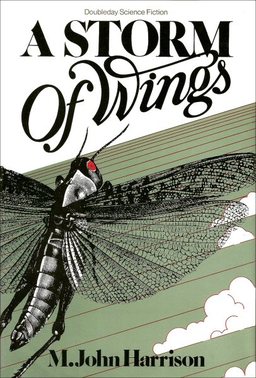
A Storm of Wings by M. John Harrison

A Storm of Wings by M. John Harrison

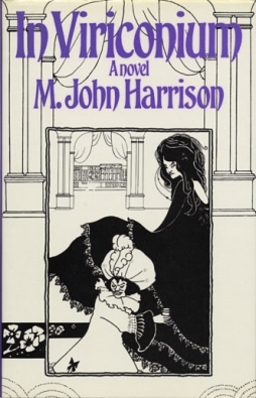
oie_701145jxuo14zKNine years, another novel, and ten short stories after the publication of The Pastel City (read last week’s piece on that here), M. John Harrison returned to the world of the city of Viriconium in A Storm of Wings (1980). Its title taken from a line in the previous book, A Storm of Wings largely recycles the plot of the that novel as well. Once again, alien forces are threatening the city of Virconium and only a ragtag band of heroes has a chance of staving off destruction. Other than setting and basic similarity of narratives, this second novel in the series exists on a whole different plane of storytelling, both in style and intent.

A new religion has risen up in and around the city of Viriconium, the Brotherhood of the Locust. Its origins are a mystery and its teachings appear to have arrived from beyond mortal thoughts.

Who knows exactly where it began, or how? For as much as a century (or as little as a decade: estimates vary) before it made its appearance on the streets, a small group or cabal somehwere in the city had propagated its fundamental tenet — that the appearance of “reality” is quite false, a counterfeit or artefact of the human senses.

This creed stands at the nucleus of A Storm of Wings, both the story on the page, and at what Harrison has to say about fiction. As the “world” of Viriconium comes under attack from a force that twists and alters its “reality,” we are, page by page, reminded any stability the “land” has comes from its creator and can be wiped away with a tap of the backspace key.

Read More Read More

Fantastic, June and July 1962: A Pair of Retro-Reviews

Fantastic, June and July 1962: A Pair of Retro-Reviews

Fantastic Stories of Imagination June 1962-small3 Fantastic Stories of Imagination July 1962-small2
Cover by George Barr Cover by Emsh

Another pair of Cele Goldsmith-edited issues of Fantastic, featuring a Poul Anderson serial. And an interesting letter on the subject of Mervyn Peake by Michael Moorcock.

The editorials, by Norman Lobsenz, consider a Russian project to increase silk production by selecting for male silkworms, and a theory that the physical constants may not be constant. The covers are by George Barr (quite good) and Ed Emshwiller (not his best). Interiors are by Leo Summers, Dan Adkins, Emshwiller, and George Schelling.

The letter column was quite irregular in Fantastic, but it’s present in the July issue, for something of a special occasion, perhaps. Michael Moorcock, then a very young writer (his first story, in collaboration with Barrington Bayley, appeared in New Worlds in 1959, and his first solo work in 1961 in Science Fantasy), had read comments about Mervyn Peake and his Gormenghast books in Fantastic earlier that year, and he wrote to mention that Peake (whom he knew well) was seriously ill and unlikely to write another Titus Groan book.

Read More Read More

Steven Brust’s Five Roger Zelazny Books that Changed His Life

Steven Brust’s Five Roger Zelazny Books that Changed His Life

Zelazny Lord of Light Creatures of Light and Darkness-small

Over at Tor.com, Steven Brust (The Incrementalists, the Vlad Taltos novels) talks about what may be my favorite fantasy novel, Roger Zelazny’s Lord of Light (1967).

You always get asked, “When did you know you wanted to be a writer?” And, of course, there’s no answer, or a thousand answers that are all equally valid. But I usually say, “In high school, when I read Zelazny’s Lord of Light.”

You see, until then, I had never known you could do that. I never knew you could make someone feel all those different things at the same time, with all of that intensity, just by how you used 26 characters and a few punctuation marks. What was it? Well, everything: Sam and Yama were the most compelling characters I’d come across; it was the first time I’d ever stopped reading to just admire a sentence; it gave me the feeling (which proved correct) that there were layers I wouldn’t get without a few rereadings; and, above all, it was when I became of what could be done with voice — how much could be done with just the way the author addressed the reader. I remember putting that book down and thinking, “If I could make someone feel like this, how cool would that be?” Then I started reading it again. And then I went and grabbed everything else of his I could find.

Steven uses this as a springboard to discuss Five Roger Zelazny Books that Changed My Life by Being Awesome, including the spiritual successor to Lord of Light, Creatures of Light and Darkness (1969), which includes the brilliant “Madrak’s Possibly Proper Death Litany, or the “agnostic’s prayer” as it has come to be called.” Read the entire article here.

A Shaper of Myths: The Best of Cordwainer Smith

A Shaper of Myths: The Best of Cordwainer Smith

The Best of Cordwainer Smith-small The Best of Cordwainer Smith-back-small

He and I stared at each other. Was this what culture was? Were we now men? Did freedom always include the freedom to mistrust, to fear, to hate?
— Cordwainer Smith, “Alpha Ralpha Boulevard,” p. 300

Such are the questions set in the context of Cordwainer Smith’s utopian, futuristic society where people are seeking to go back to being “human” again. But this is only one small time slice and representation of Smith’s massive mythos in The Best of Cordwainer Smith (1975). This volume was the fifth installment in Del Rey’s Classic Science Fiction Series, and the first to be edited by someone other than Lester Del Rey (1915–1993). John J. Pierce (1941–) edits this volume and provides a very fine introduction. Pierce is a science fiction critic and was once a very outspoken pundit against the 1960s New Wave in science fiction.

Whereas the cover art of the first four volumes was done by the late Dean Ellis (1920–2009), the cover for this book was by the late Darrell Sweet (1934–2011). Sweet’s artwork here is very reminiscent of Ellis’ work on the Classic Science Fiction Series. This is interesting, seeing how Sweet’s later artwork is very different from Ellis. (See this Black Gate memorial post to Sweet for later examples of his work.) It seems Sweet was attempting to keep with the aesthetic feel that Ellis had already established.

Read More Read More

The Pastel City by M. John Harrison

The Pastel City by M. John Harrison

The Pastel CityM. John Harrison, like Joan Vinge or J.G. Ballard, hails from my terra incognita of the universe of sci-fi/fantasy authors. Over the years I’ve read praises of his fiction but have never read a word of it. Searching my shelves for something to review this week, I saw a copy of the Bantam omnibus of his novels and stories of Viriconium, a city in the twilight days of Earth. I have no memory of how, when, or where it came into my possession, but there it was. So I figured it was about time to investigate its unknown literary landscapes.

Harrison came to my attention from a pair of essays he wrote on the creation of fantasy. The first, “What It Might Be Like to Live in Viriconium,” is an attack on the effort to codify and specifiy the nature of fantasy. It opens with this bold statement:

The great modern fantasies were written out of religious, philosophical and psychological landscapes. They were sermons. They were metaphors. They were rhetoric. They were books, which means that the one thing they actually weren’t was countries with people in them.

For him, any effort to delineate geographical boundaries and the like in a work of fantasy undermines what really lies at its heart. He describes his own tales like this:

“Viriconium” is a theory about the power-structures culture is designed to hide; an allegory of language, how it can only fail; the statement of a philosophical (not to say ethological) despair. At the same time it is an unashamed postmodern fiction of the heart, out of which all the values we yearn for most have been swept precisely so that we will try to put them back again (and, in that attempt, look at them afresh).

Read More Read More

Books and Craft: The Power of Point of View

Books and Craft: The Power of Point of View

Slow River Del Rey-small Slow River Del Rey-back-small

Today, I begin a new column here at Black Gate. I’ve been toying with the idea for “Books and Craft” for some time now. As an avid reader, a professional author, a writing mentor and instructor, and a lifelong student of craft, I have long been interested in what it is about certain books that capture our imaginations and elicit our passions. Why do we return again and again to certain stories? What qualities define “classic” novels and “must-read” new ones?

In this column, I hope to address those questions. I plan to look at a variety of fantasy novels, and science fiction as well, with an eye toward identifying an element of craft that contributes to their success. Sometimes the books will be familiar — those classics of the genre we know so well. Sometimes they’ll be more obscure titles — hidden gems that you might not know, but ought to. And sometimes they’ll be new works that demand our attention.

Let me be clear: I am not so presumptuous as to suggest that the specific craft element I identify is necessarily THE single factor in a given book’s success. Just because I might focus on, say, world building in Guy Gavriel Kay’s Tigana, that doesn’t mean his character work (or his prose, or his pacing) isn’t spectacular as well. My articles are intended to be illustrative and even instructive, but certainly not definitive. Whether as readers or as writers, we have something to learn from the work of successful artists. My hope is that these articles will help you see aspects of storytelling that you might not have noticed previously.

And so…

Read More Read More

Vintage and New Treasures: Oz’s Bag of Holding: John Sandford’s Prey Series; Stephen King’s Bill Hodges Trilogy

Vintage and New Treasures: Oz’s Bag of Holding: John Sandford’s Prey Series; Stephen King’s Bill Hodges Trilogy

rules of prey king-audio-small

I have here a bag of holding. I am now going to pull some things out of it…

This past fall, since I do a lot of commuting to work and had become too depressed to follow my daily routine of news radio, I began listening to books on CD.

I’ve now digested 5 books in John Sandford’s popular Prey series (following detective Lucas Davenport), read by Richard Ferrone, and the first two of Stephen King’s Bill Hodges trilogy (following retired detective Bill Hodges and his friends Jerome Robinson and Holly Gibney), read by Will Patton.

Sandford, a retired Minneapolis journalist, began writing the Prey books back in the ‘80s. The series now has 27 installments, with an additional 13 spin-off books! Looks like I’ll be spending time with Lucas Davenport in my minivan for a long time to come.

Having brought these out of the bag, I’d like to discuss two specific areas of appeal of a series like Prey. First is place. Second is chronological progression (following characters as they age). Then I have an afterthought about genre “classification.” I’ll also  address “audio” vs. “printed page.” And I’ll have a few things to say about King’s foray into hardboiled detective fiction along the way.

Read More Read More

Modular: Oz’s Bag of Holding: Breaking Out Basic D&D for the Next Generation

Modular: Oz’s Bag of Holding: Breaking Out Basic D&D for the Next Generation

D&D_Basic_Rules_1981I have here a bag of holding. I am going to pull some things out of it now…

Well, I’ve gone and done it. I’ve broken open the floodgates and moved my children on from Dungeon! The Board Game to the real deal.

This is fortuitous timing, as M Harold Page has launched a new series of posts (READ HERE) on Black Gate about introducing kids to tabletop role playing (which I have been reading with newly-relevant interest).

My daughter and son will soon be turning 8 and 6 respectively. Bringing the son in on things might have been a bit premature — he’s more apt to grab the miniatures and fight with them like action figures than to sit and patiently listen to a Dungeon Master try to paint a scenario in his mind’s eye.

To introduce these acolytes, I dug out my 1981 D&D Basic set (1981 edition). After decades of d20, revisiting this chestnut three decades later is kinda hilarious. D20 is so elegantly simple in concept: Hit a monster with AC 18? Roll a d20, add modifiers, and get an 18 or better. But with old-school D&D, no! You look at the monster’s AC and then have to consult a chart (I confess I’d forgotten what THAC0 even stood for). Cross-reference monster’s AC with character’s level to see what you have to roll. Basic? No, not really. Pretty damn cumbersome!

Read More Read More

Jack Kirby’s Fourth World: 45 Years Later

Jack Kirby’s Fourth World: 45 Years Later

Jack Kirby New Gods-small

I’ve been discussing comic books with a friend of mine who moved to Ottawa. Based on a stray comment of his, I committed to tracking down and reading Jack Kirby’s 4th World comics.

I obviously know about Darkseid and the New Gods, but from later works at DC, like the classic Great Darkness Saga in The Legion of Super-Heroes (check it out!).

And I’d read lots of 1960s Marvel Kirby as well as Machine Man and The Eternals at Marvel in the 1970s (I even blogged about The Eternals here).

Kirby was *huge* in the 1960s, having been a major creator of the current Marvel Universe. But by 1970, he was looking for a change and DC signed him to a 5-year exclusive deal.

Read More Read More

The Classic You Never Heard of: The 13½ Lives of Captain Bluebear

The Classic You Never Heard of: The 13½ Lives of Captain Bluebear

Bluebear Cover
Think “Hitchhiker’s Guide to the Galaxy does Adventure Time with a dash of Moomins”
Bluebear 2
Zamonia, a fantasy continent replete with baroque perils and wild adventure

The 13½ Lives of Captain Bluebear by Walter Moers is… nuts.

Think “Hitchhiker’s Guide to the Galaxy does Adventure Time with a dash of Moomins” and you would be on the way there.

It’s definitely a book for all ages. I read it in my 30s, before I became a dad. More than a decade later I’m reading it to my 9-year-old daughter.

It’s one of those rich works of the imagination that is somehow both compelling and a comfort read. Fairy story and fantasy adventure. Satire and parable. Tall tale and… met tall tale — there’s even a duel of lies!

It’s the autobiography of one Bluebear — a sentient blue bear (duh) and perhaps last of his kind. It recounts his wanderings in Zamonia, a fantasy continent replete with baroque perils and wild adventure — capital Atlantis (naturally) — that seems have a loose place and not entirely linear relationship to the history of our world.

Enlivening and illuminating his adventures are bonkers excerpts from Professor Abdullah Nightingale’s  “The Encyclopedia of Marvels, Life Forms and Other Phenomena of Zamonia and its Environs.”

The story kicks off with Bluebear’s first memory: floating in a walnut shell and then being rescued by Minipirates —

Read More Read More