Browsed by
Category: Pulp

Doug Draa on Weird Tales and Keeping the Brand Alive: The Paperback Years

Doug Draa on Weird Tales and Keeping the Brand Alive: The Paperback Years

Creeps by Night-smallLong before Doug Draa became an occasional blogger for Black Gate, I was a reader of his blog, Uncle Doug’s Bunker of Horror, which we’ve celebrated before. I especially enjoyed his habit of using any excuse whatsoever — and I do mean any excuse — to post luscious high-res images of countless beautiful old paperbacks. Reading Uncle Doug’s Bunker was like browsing a superb used bookstore (without any money).

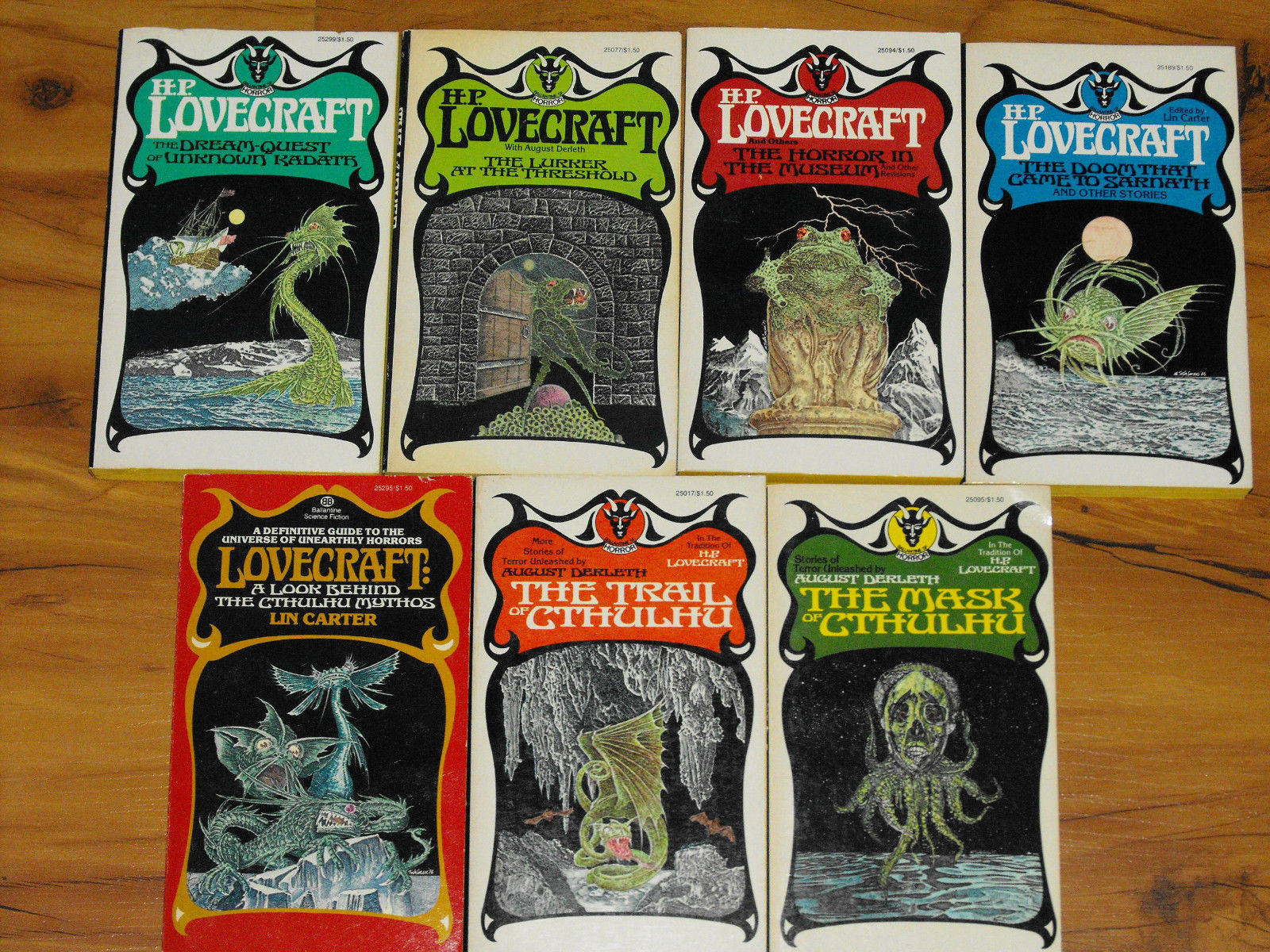
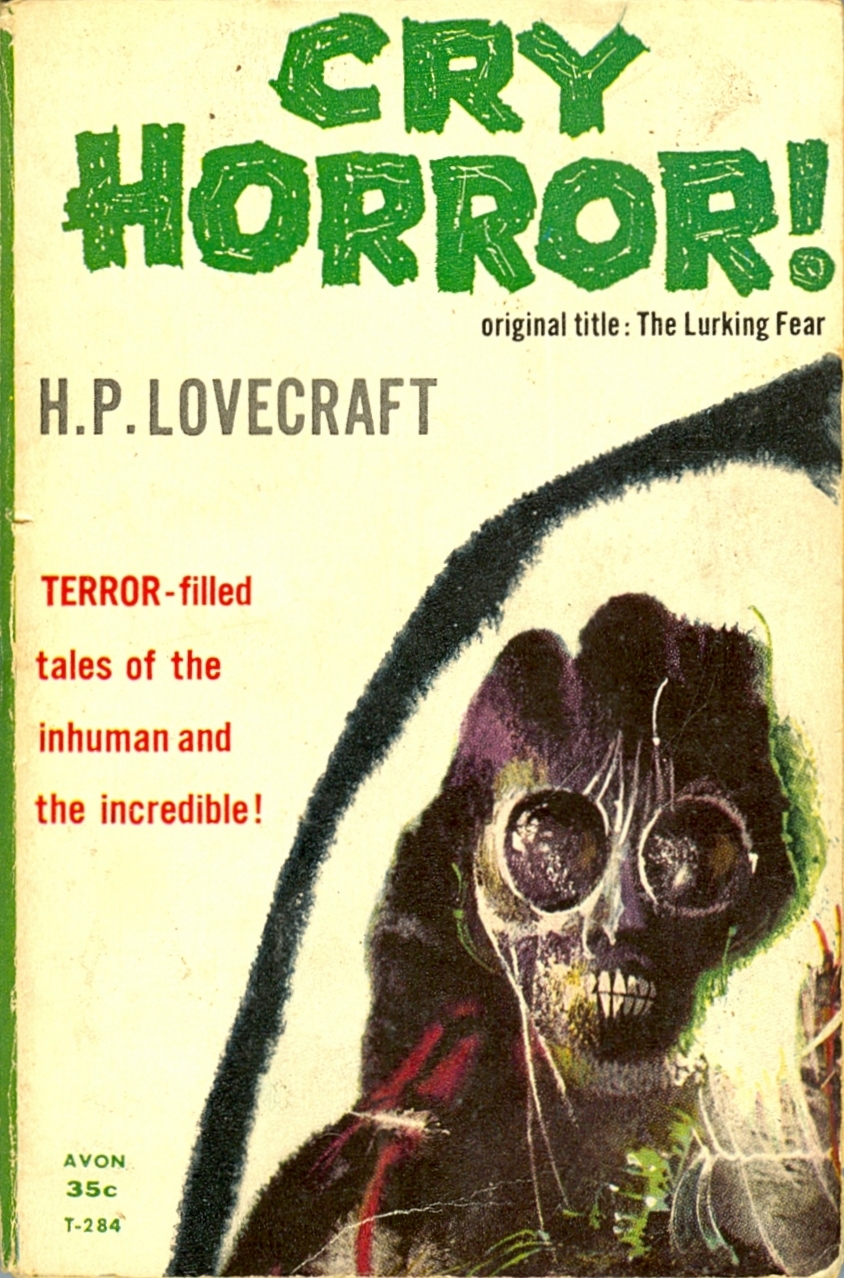
As Doug has become busier with other projects, including becoming an Online Editor for Weird Tales, he’s been less and less able to keep up his blog. So I was delighted to see that he’s now started to post at the Weird Tales site. His recent articles include “The 15 most entertaining Horror Films from the 1980s,” “Four Decades of the Lovecraftian Aesthetic in Paperback,” “Lin Carter’s Weird Tales” and more fun stuff like that (see a complete archive here.)

On May 25, Doug posted one of his best recent articles, continuing his series on 90 Years of Weird: Keeping the Brand Alive: The Paperback Years. Doug surveys three decades of paperback anthologies reprinting WT fiction, from the death of the pulp magazine in September 1954 through its rebirth in 1988, generously illustrated with nearly three-dozen high-res scans. Here’s a quick snippet:

Lin Carter has a special place among the ranks of Weird Tales preservationists and revivalists. During the late 1960s and early 70s he edited and reprinted many H. P. Lovecraft and Clark Ashton Smith collections as part of his Adult Fantasy Series published by Ballantine. Mr. Carter never failed to sing praises to Weird Tales from the roof tops in his numerous introductions to the collections in this series. At the beginning of the 1980s Mr. Carter even went as far as to revive Weird Tales in paperback format for four issues. This incarnation wasn’t a darling of the critics, but I found it to be enjoyable and true to the original vision of the magazine… Thank you Mr. Carter, I drink to your Shade!

See the complete article here.

Vintage Treasures: Weird Tales #290

Vintage Treasures: Weird Tales #290

Weird Tales 290-smallI’m still unpacking all the treasures I brought home from the 2014 Windy City Pulp & Paper show in April. Although, as my wife Alice points out, things would go a little faster if I didn’t fondle everything for 20 minutes.

I found the artifact at right buried in a box of magazines and fanzines from the 70s and 80s I acquired at the show. It’s the 290th issue of Weird Tales, covered dated Spring 1988 — the Sixty-Fifth Anniversary issue, a landmark, and one of my favorite issues of perhaps the most famous fantasy magazine of all time.

Issue 290 was the first issue of Weird Tales from Terminus Publishing, under editors George H. Scithers, John Gregory Betancourt, and Darrell Schweitzer. It’s special to me because the Terminus era was my favorite incarnation of Weird Tales.

I suppose some folks will find that odd. Certainly the early pulp era of the Grand Old Lady of fantasy was its most fertile and famous period — the late 20s to mid-thirties, when it routinely published groundbreaking work by Robert E, Howard, H.P. Lovecraft, Clark Ashton Smith, Edmond Hamilton, and many, many others. Those issue are highly prized by collectors and key copies in good condition from that era routinely command hundreds of dollars.

But the Terminus years, which began in my mid-20s, marked the resurgence of Weird Tales as a vibrant, important and thoroughly modern fantasy magazine, publishing short fiction by the top fantasy writers of the time. It was also the first time I was able to enjoy it as a contemporary publication, rather than a highly collectible relic of a distant era, and I appreciated that very much. I had a subscription, and looked forward to each issue eagerly.

Read More Read More

Blogging Sapper’s Bulldog Drummond, Part Two

Blogging Sapper’s Bulldog Drummond, Part Two

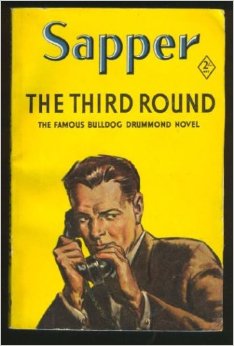
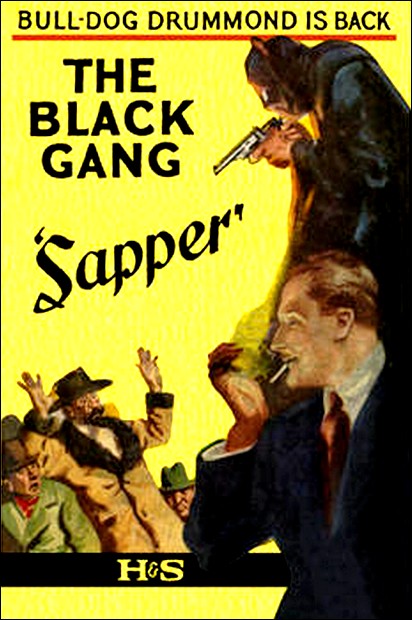
4b19b9961e944_71847n861809-superdicklib_3The strongest scenes in Bulldog Drummond (1920) are the ones that show off Sapper’s strengths as a humorist. While it has since become commonplace to see Bondian heroes tossing off quips while being menaced by an unfailingly polite villain, it hardly compares to the way Hugh Drummond handled himself in similar scenarios. Drummond regularly displays a self-deprecating humor when it comes to his features and his intellect, yet his ability to needle villains by refusing to treat them as a serious threat displays an intelligence and understanding of the criminal mind that provides a constant source of amusement to the reader.

Drummond may start off as an independently wealthy and very bored veteran of the First World War seeking adventure, but the character soon transforms into the head of a gang of vigilantes determined to right wrongs as they see fit. He and his gang view meting out justice without resorting to the law as their right as recently demobilized soldiers. The wartime ability to kill without fear of criminal punishment continues into their clandestine civilian activities, although they take the precaution of hiding behind masks and hoods to protect their identities when doing so.

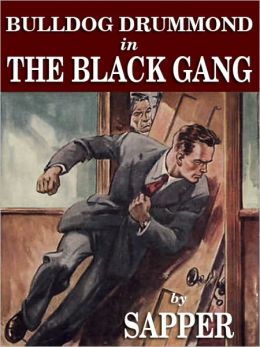
Drummond’s gang includes his fellow World War I veterans Algy Longworth, Peter Darrell, Ted Jerningham, Toby Sinclair, and Jerry Seymour, as well as New York police detective Jerome Green. Later dubbed The Black Gang, the vigilante squad was clearly inspired by Edgar Wallace’s bestselling Four Just Men series. The secret war they wage is aimed squarely against the forces of socialism and communism to an extent that was matched only by Harold Gray’s original version of Little Orphan Annie. The anti-foreign sentiments in the first book are rooted in the perceived threat of foreigners altering the course of England’s political identity and economic status.

Read More Read More

Blogging Sapper’s Bulldog Drummond, Part One

Blogging Sapper’s Bulldog Drummond, Part One

170px-Bulldog_Drummond_Poster2566515-bulldogdrummond2Bulldog Drummond is a peculiar case. The reputation of the original novels is more maligned than even Sax Rohmer’s Yellow Peril thrillers. To be sure, “Sapper” (the pseudonym of author H. C. McNeile) expressed views that stand out as offensive even among the common colonial prejudices of Edwardian England. The reason for this is easily understood. The author’s nationalistic fervor was predicated on the belief that the only good nation was Britain and every other nationality was inferior to varying degrees.

McNeile was a “True Blue” Brit in every way. A decorated veteran of the Great War, Sapper and his characters adore England and are intolerant of everyone else. Americans are castigated for their crudeness, the French are pompous, and Germans are a vile and irredeemable people. More bigoted views will follow, but that is the extent in the first quarter of the first book in the series.

Having covered the bad, what is it that makes the books still worth reading nearly a century later? Are they simply a document of more repressive times or do they offer value that makes one willing to overlook the reliance upon stereotypes and casual slurs? I would argue that anyone interested in the development of the thriller and pulp fiction should be exposed to at least the first four books in the long-running series. There is much that is light and entertaining in Sapper’s fiction, to the extent that they often read like drawing room comedies until thriller aspects interrupt the humor.

Read More Read More

John D. MacDonald: A Writer’s Writer

John D. MacDonald: A Writer’s Writer

MacDonald_Typewriter
That thing he’s using is called a ‘typewriter’

“With sufficient funds to cover four months’ living expenses, he set out and wrote at an incredible pace, providing eight hundred thousand words. Writing for a wide variety of magazines, he kept more than thirty stories in the mail constantly, not giving up on a story until it had been rejected by at least ten markets

In the process he accumulated almost a thousand rejection slips after five months of effort. During this period, MacDonald worked fourteen hours a day, seven days a week, literally learning his craft and gaining the experience of a decade as he went along, which was important for a man who made no serious attempt to write until he was thirty.”

– Martin H. Greenberg, in the introduction to Other Times, Other Worlds.

That is how John D. MacDonald, thirty years old, fresh out of the military in 1946 and with one published short story (which he actually sent to his wife in a letter: she submitted it to a magazine) learned the craft of fiction writing.

One of America’s finest writers (note: I didn’t qualify that with the word ‘fiction’) set himself upon a course that no sane person would have undertaken in that situation.

Read More Read More

Compiling The Big Book of Swashbuckling Adventure

Compiling The Big Book of Swashbuckling Adventure

The Big Book of Swashbuckling Adventure-smallGreetings, Black Gate readers! You may be familiar with my work as the game designer Lawrence Schick – possibly from role-playing material like the White Plume Mountain D&D scenario, video games such as Sword of the Samurai, or my recent work as Loremaster for The Elder Scrolls Online.

But I also write, edit, and translate historical fiction as Lawrence Ellsworth, and in that capacity I have a new title coming out from Pegasus Books, an anthology called The Big Book of Swashbuckling Adventure. Our friends at Black Gate asked me to write an article about compiling that anthology, and here it is.

I’ve been reading and collecting swashbuckling adventure fiction for many years – my whole life, really. A couple years ago, while in the middle of a long (and still uncompleted) translation project, it occurred to me that I probably knew enough about the subject to be able to compile a pretty interesting anthology. The more I thought about the idea, the better I liked it, so I sat down and starting making notes.

I decided the anthology had to meet four criteria. First, it would need to catch the attention of contemporary readers, which meant including recognizable, marquee names, of both characters and authors. Second, it would have to be attractive to mainstream publishers, which meant inexpensive to produce (works in the public domain), and couched in a familiar, saleable format – in this case, a “Big Book,” a fat collection of at least 200,000 words. Third, for variety I wanted a good mix of pirates, cavaliers, and outlaws – and they all had to be cracking good stories that would hold the attention of modern readers. Fourth, not just any stories would do – I wanted carefully hand-picked works that weren’t overly familiar and would re-introduce some of my favorite forgotten authors to the 21st century.

Read More Read More

Hardboiled Pulp: More Than Just a Man’s World

Hardboiled Pulp: More Than Just a Man’s World

nogoodfromacorpsecorpse 2The world of hardboiled pulp is certainly male-dominated, but there have been female authors who have given the masters of the sub-genre a run for their money. Leigh Brackett is certainly the best known female hardboiled writer, if only for her screenplay adaptation of Raymond Chandler’s The Big Sleep (1945) for director Howard Hawks’s acclaimed film featuring Humphrey Bogart as Philip Marlowe. Brackett also adapted Chandler’s The Long Goodbye (1973) for director Robert Altman’s deconstruction of the genre with Elliott Gould as Marlowe. Less well-remembered is the hardboiled novel that won Brackett the chance to first adapt Chandler, No Good from a Corpse (1944).

From the outset, it is clear this is Chandler territory. Brackett’s tough guy private eye hero Ed Clive (named for Brackett’s husband and fellow pulp author, Edmond Hamilton) is very much in the Marlowe tradition and the Los Angeles setting only enhances the authentic feel. More than the trappings, it is the fact that Brackett writes convincingly as a man (particularly in her observations of women as objects of lust who are never to be entirely trusted) that is the most startling. One understands Howard Hawks’s surprise when he hired Brackett as a screenwriter on the strength of this book and found out she was a woman. Murder, blackmail, sultry singers, and beatings and shootings aplenty make No Good from a Corpse an unsung classic of pulp detective fiction.

Read More Read More

New Treasures: Voodoo Tales: The Ghost Stories of Henry S. Whitehead

New Treasures: Voodoo Tales: The Ghost Stories of Henry S. Whitehead

Voodoo Tales The Ghost Stories of Henry S. Whitehead-smallI continue to collect the Wordsworth Editions Tales of Mystery & The Supernatural, which I’ve found to be an inexpensive way to gather a diverse range of early horror writers on a single bookshelf.

My latest acquisition was Voodoo Tales: The Ghost Stories of Henry S. Whitehead, which I bought because it was huge (691 pages!), inexpensive ($3.90!), and ’cause it had voodoo in it (voodoo!). What can I tell you, it was a compelling combo.

I’ve never heard of Henry S. Whitehead, but apparently he was an early Weird Tales writer who had two Arhkam House collections. You’d think I’d be more on top of an author who had a pair of Arhkam House collections, but no. This genre keeps finding more ways to surprise me.

I’m guessing that Whitehead wrote mostly voodoo tales, but I won’t know for sure until I dig into the volume. Until then, I’m relying on the cover and the text on the back, and I’m definitely picking up a voodoo vibe.

“And behind him, like a misshapen black frog, bounded the Thing, its red tongue lolling out of its gash of a mouth, its diminutive blubbery lips drawn back in a murderous snarl…”

Let Henry S. Whitehead take you into the mysterious and macabre world of voodoo where beasts invade the mind of man and where lives of the living are racked by the spirits of the dead. In this collection of rare and out of print stories you will encounter the curses of the great Guinea-Snake, the Sheen, the weredog whose very touch means certain death, the curious tale of the ‘magicked’ mirror, and fiendish manikins who make life a living hell. Included in this festival of shivering fear is the remarkable narrative ‘Williamson’ which every editor who read the story shied away from publishing.

With deceptive simplicity and chilling realism, Whitehead’s Voodoo Tales are amongst the most frightening ever written.

Read More Read More

Vintage Treasures: The Book of Skaith: The Adventures of Eric John Stark by Leigh Brackett

Vintage Treasures: The Book of Skaith: The Adventures of Eric John Stark by Leigh Brackett

Leigh Brackett The Book of Skaith-smallI joined the Science Fiction Book Club in the fall of 1975, when I was in my last year at St. Francis Junior High School in Halifax, Nova Scotia. Before I joined, I agonized over my introductory selection — three books for a just a dollar! — for days, reading and re-reading the tiny paragraphs in the brochure, and then waiting impatiently for my selections to arrive in the mail. My friend John MacMaster enrolled me and I’m pretty sure I’ll remember the contents of my enrollment package until the day I die: The Foundation Trilogy by Isaac Asimov, The Hugo Winners, Volumes One and Two, edited by Isaac Asimov, and Before the Golden Age, edited by (can you guess?) Isaac Asimov.

John had introduced me to science fiction earlier that year, loaning me Clifford D. Simak’s Shakespeare’s Planet and Piers Anthony’s Ox when I was home sick from school. I devoured them both and wanted more. John explained how the club worked and it sounded terrific. “They sometimes have these big collections, a bunch of novels gathered into one book,” he said. “They’re the best.”

John was right. The year after I joined, in 1976, the featured selection for the month was The Book of Skaith: The Adventures of Eric John Stark, an omnibus of three novels by Leigh Brackett, under a new cover by Don Maitz. It was a marvelous introduction to one of SF’s great pulp writers, in an attractive and affordable package offered exclusively through the Science Fiction Book Club.

That’s one of the great things about the SFBC: its exclusive omnibus editions, highly collectible as they are, are generally still available at excellent prices. In February of this year, nearly 40 years after it was published, I bought a copy of The Book of Skaith in excellent condition on eBay for just $2.99.

Read More Read More

Vintage Treasures: Fantastic Novels, July 1948

Vintage Treasures: Fantastic Novels, July 1948

Fantastic Novels July 1948-smallYesterday, I talked about finding a copy of the hardcover edition of Damon Knight’s Science Fiction of the 30’s on a sale table at Windy City Pulp and Paper for just $3.33. Items on the table were priced at 3 for $10, so before I could buy it, I had to find two additional items I could live with.

Didn’t turn out to be that hard. Right next to Knight’s dusty hardcover was a copy of the July 1948 Fantastic Novels magazine, with the gorgeous Lawrence cover at left. Admit it, that cover alone is worth $3.33. I snapped it up and didn’t even look inside.

I didn’t figure there was all that much to know about the contents, anyway. Fantastic Novels was famous for including a complete novel with each issue, which usually didn’t leave much room for filler. In addition to the cover story — Garrett P. Serviss’s 1911 novel The Second Deluge — this issue had only one additional story: Frank Lillie Pollock’s “Finis,” reprinted from the June 1906 issue of The Argosy magazine.

I imagine it had to be pretty cheap to produce a magazine containing only two reprints (assuming the editors paid anything for them at all). So what did the publishers of Fantastic Novels spend their money on? Beautiful art, that’s what. In addition to the cover by Lawrence, this issue had several full pages of art by Lawrence and the great Virgil Finlay. Click on the image at left to see the full-sized version. I have no idea what The Second Deluge is all about, but I want to frame this magazine and put it on my wall.

Alas, there were no other copies of Fantastic Novels to be found on the table — and no other hardcovers of interest. For my third item, I settled on an issue of The Original Science Fiction Stories from January 1956 that looked like it had just come off the printing press. It also has fiction by Randall Garrett and James Blish, so maybe it will turn out to be worth $3.33 too.  Either way, it’s fine by me; I got my ten bucks’ worth — and more — with the first two items.

Read More Read More