Fantasia 2018, Day 22, Part 3: Lifechanger
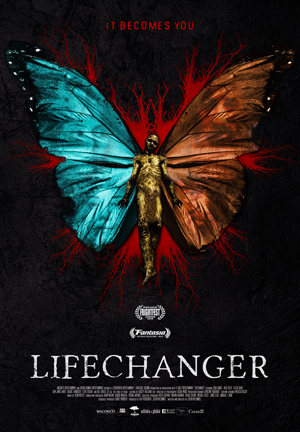 For my last movie of 2018 in the Fantasia screening room I selected a Canadian horror movie called Lifechanger. Written and directed by Justin McConnell, it follows an entity named Drew (narrated by Bill Oberst Jr), who, born human, at age 12 developed the ability and need to change bodies with other people (which Drew does repeatedly through the movie, tying the film together with voice-over ruminations; thus the “narrated by” in the previous parenthesis). The process kills the other person, and leaves Drew trapped in a swiftly decaying body. For decades, he’s had to keep changing bodies every few days, the inevitable rot slowed only slightly by doses of cocaine. Lately, though, he’s convinced himself he’s fallen in love with a woman named Julia. Drew wants to be close to her, but how can he do that given what he is?
That the question feels meaningful makes the movie a success. It’s odd as a story, with beats in unusual places. Drew never seems too curious about his own nature. Which makes sense; by the time we meet him, he’s resigned himself to the terms of his existence. Still, the movie occasionally feels convenient; his habit of living a few days as one of his victims, for example, feels as though it’d be unsustainable. The plotting here is not the strongest, I think, and I didn’t feel tension build in a traditional way. But it’s an interesting film nevertheless.
This is a small-scale movie, a kind of neighbourhood supernatural horror story set in a suburb of Toronto. It feels a little like the low-budget horror films that filled video store shelves in the 80s, but viewed from a different and somewhat more sophisticated angle. It’s a kind of revisionist horror movie, taking the genre and taking a new look at its framework and structure, keeping what makes those things work while using a different narrative approach. The aim here is not gore, though there is that, but explication of character through the use of horror. As such it succeeds; Drew feels like somebody who’s responding as a human being in an inhuman situation — and so has become inhuman himself, and now accepts the inhumanity as natural.
Drew’s a monster, then, so it’s not surprising that he doesn’t consider being honest with Julia about his nature. The movie manages a tricky balance here: Oberst’s dry narration and the sharp script keep Drew at least interesting, though he’s fundamentally unsympathetic on a number of levels. Drew’s got a certain amount of self-knowledge but views mass-murder as merely a necessity for his own survival; being that self-obsessed, he stalks Julia, in a number of different bodies, trying to find out where she lives and whatever information he can that will help him get close to her.
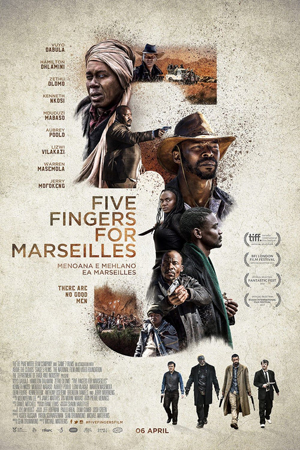 I went by the screening room early on August 2, the last day of the 2018 Fantasia International Film Festival. It was my final chance to see some of the things I’d missed at the festival, and if I watched three movies in the screening room before heading off to watch the two films I wanted to see that evening at the Hall Theatre, then I’d total 60 movies on the year. And I knew going in what the first film I wanted to see at the screening room was, a film that had gathered a goodly amount of buzz around the festival. On the first day of the festival I’d begun Fantasia 2018 with the revisionist Western
 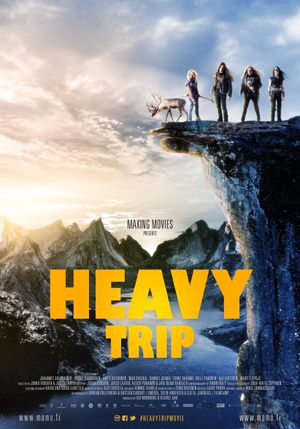 I had time for one more movie in the Fantasia screening room before I’d head over to the J.A. De Sève Theatre to watch a film called Madeline’s Madeline, an experimental film about a girl in a theatre group struggling to define herself. It’d be the last movie I’d see in the De Sève at this year’s festival, but before it started I opted to watch a Finnish comedy about death metal. (There’s a reason for that choice, involving the final film of the festival; more on that in a few posts.)
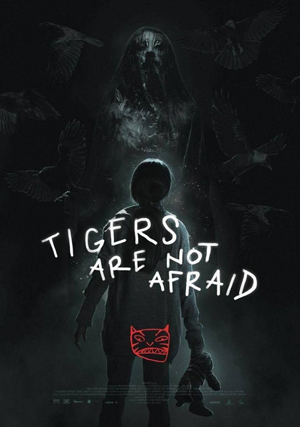 I was at the Fantasia screening room early on August 1 to watch a movie I’d missed when it played in a Fantasia theatre: Tigers Are Not Afraid (Vuelven), written and directed by Issa López. I’d heard a number of people around the festival rave about it, and I was intrigued. 10-year-old Estrella (Paola Lara) is a girl in a Mexican city ravaged by drug violence. When her mother goes missing, she falls in with a gang of four boys who live on the street. But their leader, a scarred child named Shine (Juan Ramón López), has stolen a cell phone containing a video incriminating an aspiring local politician (Tenoch Huerta) in brutal criminal activity. Now his cartel’s after them, and death is all around. So, perhaps, is magic; but magic is not always safe.
 On Tuesday, July 31, the first movie I planned to see alongside a general audience was a Hong Kong action movie called The Brink. After that, I’d pass by the screening room before heading home. There’d be only two more days of Fantasia after this one, and I wanted to catch up on things I’d missed in theatres. I was specifically curious about a Korean movie called The Outlaws, about a cop who’s working against the clock to catch a Chinese gang who’re trying to take over territory in a district of Seoul. Two promising action movies; I had reasonable hopes for the afternoon.
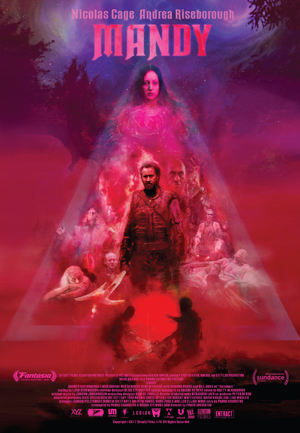 I was at the J.A. De Sève Theatre early on Tuesday, July 31, for a press screening of Mandy. It’s the second film by Panos Cosmatos (director of Beyond the Black Rainbow), who also wrote the script with Aaron Stewart-Ahn. The movie stars Nicolas Cage as Red Miller, a lumberjack who lives in a cottage in the deep woods of the Shadow Mountains with his wife Mandy (Andrea Riseborough), a metalhead artist, in the long-ago year of 1983. Mandy unwittingly catches the eye of a cult leader (Linus Roache), whose minions, the Children of the New Dawn, abduct her. Bad things happen. Miller is tortured. And, inevitably, he embarks on a quest for bloody revenge.
 The
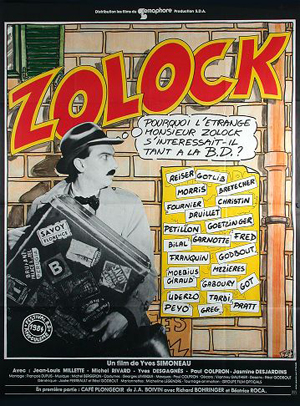
The  I had three films on my schedule for Monday, July 30. First, an animated science-fictional retelling of Cinderella for adults, called Cinderella the Cat. Then I’d hurry from the J.A. De Sève Theatre to the Centre Cinéma Impérial, where Fantasia was presenting a documentary from the early 80s about bandes dessinées: Pourquoi l’étrange Monsieur Zolock s’intéressait-il tant à la bande dessinée? Then I’d run back to the Hall Theatre for a presentation of Sion Sono’s Tokyo Vampire Hotel, a kinetic horror-action film with campy apocalyptic overtones. Even for Fantasia, it was going to be a strange day.