When I’m not writing for all you fine folks, I’m generally hanging out with my nine-year-old son, a budding engineer and scientist. If you have an intellectually curious child it’s best to feed their head, so we give him a steady diet of Lego Tech sets, electronics kits, and educational shows.
(Thank you, National Geographic, for getting my kid to actually ask to see documentaries on Saturday mornings.)
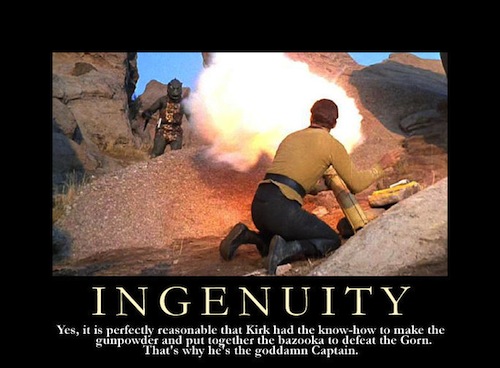
As we all know, there’s nothing better for a young mind than some good science fiction, so we’ve been watching Original Series Star Trek. The blend of action, humor, science, sociology, and good old silliness is what makes the program a classic. It’s hard to pick which episodes are the most fun for kids, so I gathered a panel of experts (i.e., my Facebook friends) and asked them. It turns out many parents agree on the best episodes.
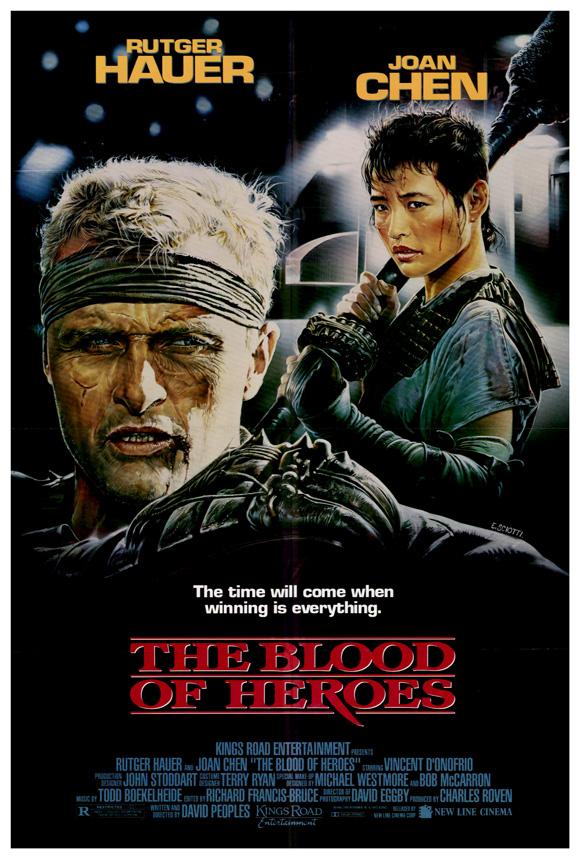
The 80s were quite a time for movies (word has even reached me that certain millennials have discovered the decade over at Tor.com), and some of my favorites are firmly rooted in that era — and one of my favorites from that decade is the 1989 Rutgur Hauer, Joan Chen, Vincent “REH” D’Onofrio effort The Blood of Heroes (BoH).
BoH stands both above and beside the many other dystopian movies for being a post-apocalyptic sports movie. And here’s the thing — that is ALL it is.
The apocalypse that put the world into such a sorry state? Not discussed — too busy trying to put a dog skull on a stake.
The high-tech dingus that will turn things around? That doesn’t happen in this movie — too busy winning matches in the hinterlands.
The guy-who-knows-the-only-weakness-of-Lord Motherraper? Also does not happen. Gotta win matches in the hinterlands to get into the Red City match.
But surely Joan Chen is going to get revenge on Lord Motherraper for murdering her family when he was roaming the world for steel and they wouldn’t name another target, a military target.
NO! Her family is alive and well, she just wants more out of her life than sustenance farming. And that means being a kwik for a team of juggers, sticking dog skulls on stakes in the hinterlands to win enough matches to play in the Red City and the big leagues!
Reboots are awesome. There you go. I’ve said it. Call blasphemy all you want, but I’m a fan of (some) adaptations, and 80s cartoons are high on my list of “Yes, please adapt.” It’s not just that modern companies are making the storylines better; they’re quite frankly making some of them make sense. Not in all cases, but in a heck of a lot of them.
I’m a child of the 80s. I grew up on these cartoons, and enjoyed their adaptations. I followed their various incarnations, too, but now is a golden age for storylines, with plenty flourishing.
Teenage Mutant Ninja Turtles
Knee pads are a ninja’s BFF.
I’ve always been a fan of witty repartee, martial arts and turtles. Combine all three and you’ve sold me. Easily.
TMNT started as a rather dark comic book, grew into a 10-year long cartoon show in the 80s, then a 6-year run starting in 2003. Nickelodeon bought the rights in 2012, and BOOM, started everything up again.
IDW has two new comics lines, one based on the new cartoon show and one more based on the old comics (and much darker. I love it). I struck that out because they just repeated one of my least favorite storylines ever (spoiler link). No conclusion on that yet, so I’m no longer including it (take that, IDW!) Let’s also ignore anything live action, because there is absolutely no winning there.
Anyway, back to the new cartoon. What makes the new turtles unique? Their personalities are more defined.
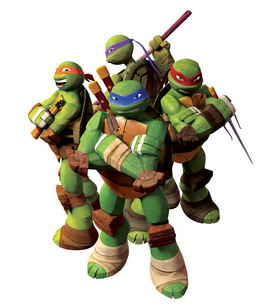
Michelangelo, the party one, is now more funny than annoying. Donatello gets more chances to shine (he’s my fave). Leonardo, the poor always responsible lead turtle, is now a geek and gets excited about Space Heroes (a riff off Star Trek: The Animated Series). Raphael is still angry and one of the most loyal and, although he pretends to be a hard-ass, he’s one of the more sensitive.
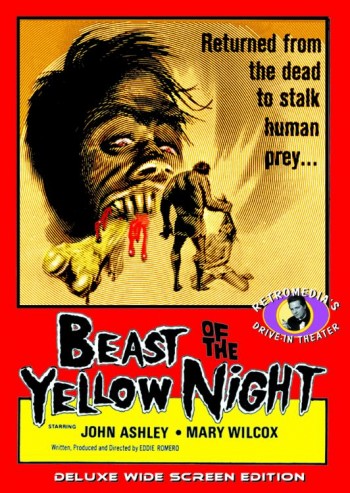
This week Nick Ozment and David Manning team up to track down the Beast of the Yellow Night (1971) in another installment of Manning’s Manly Movies…
[MANNING] Look what I’ve got.
[OZ] Another Mill Creek Entertainment 20-movie pack, huh? “Beyond the Grave.” Why? Why do you keep buying these things?
Why? Why not, my friend? Twenty movies for seven bucks on sale at Shopko — think of all the monsters and mayhem and manliness for a measly 35 cents a movie!
Or, looked at from a slightly different angle, you paid seven dollars to squander away approximately thirty hours of your life.
Not alone.
No! You don’t expect me to sit through those crappy movies, do you?
What do you think I’m paying you for?
You don’t pay me anything.
How much of my beer and whisky do you drink?
I have to tranquilize myself for these cinematic torture sessions.
For all of you who daydreamed about what could have been, as far as the Alien franchise goes, today I bring you official glad tidings.
But first I must take you back to those dark days in 1992, and again in 1997 (forgetting the whole Aliens vs. Predators thing for a moment) when, following the beleaguered Ellen Ripley’s escape from LV-426 and its Xenomorph inhabitants, she found nothing but continued misery in the form of Alien 3 and Alien: Resurrection respectively.
Ripley repeatedly saved mankind from not only corporate tyranny, but from having our collective intestine ripped out as human incubators. But did she ever get a moment’s peace or happiness. Or for that matter, did the fans?
That would be a great big “no way.”
However, hope now springs eternal.
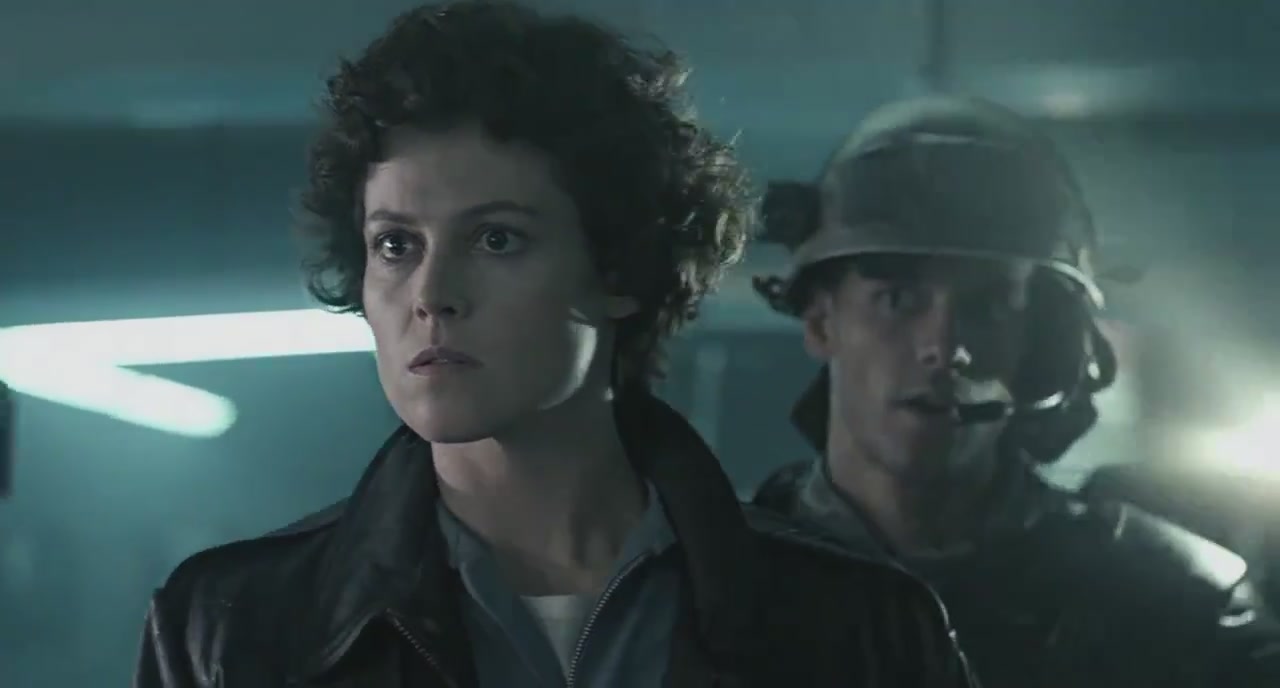
Last week Sigourney Weaver raised a collective cheer when she publicly announced the Alien franchise was now in the capable hands of District 9 director Neill Blomkamp; then doubled our joy by saying she’s looking forward to returning to her signature role of Ellen Ripley in a new installment of the science-fiction series.
But first, I’d like to ask readers a very important question:
Do Tolkien’s Elves have pointy ears?
This came up after my last post, in which I wondered why Anderson and Tolkien (and many other fantasy writers) agree that elves are tall and have pointy ears. After reading this, Frederic S. Durbin contacted me to say,
Does Tolkien ever say that the elves have pointed ears? To my knowledge, he never does. Please correct me if I’m wrong! This is a bone I had to pick a few years back, when some writer somewhere described hobbits as having “hairy toes and pointed ears.” I think this misconception about Tolkien’s elves and hobbits has come from artwork. Artists need to have a way of making magical races look different from humans, so they go for the ears. We need Spock to look different from humans in a cheap and easily-reproducible way from day to day in the studio, so we give him pointed ears. People have been seeing illustrations of pointy-eared elves and hobbits for so long that they’ve begun to believe Tolkien described them that way. I don’t think it’s true. (Again, I’m willing to stand corrected if someone shows me a passage!)
So there you have it, folks! Please help! Is there a passage anywhere in Tolkien’s writings that suggest that Elves (or even Hobbits) have pointy ears?
And now let’s turn our attention to Poul Anderson’s Virgin Planet.
A few months back, I was (ever so gently) castigated for not giving proper credit to the screenwriter of the Michael York / Oliver Reed rendition of The Three Musketeers. That man was George MacDonald Fraser, he who wrote the Flashman books, a series into which I had never delved.
That has now been corrected, and just in time, too: no lesser a light than Ridley Scott (Alien; Blade Runner) is developing a reboot of Flashman with 20th Century Fox. As the fool on the hill once opined, everything old is new.
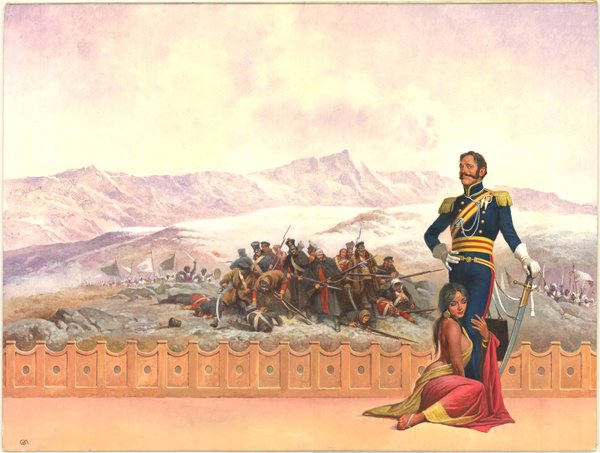
So let’s set aside fantasy for just a moment and allow for historical action-adventure as a sideline of the vast cultural behemoth that is now Black Gate. Swords, after all, form a big part of heroic fantasy, and in Flashman (first published in 1969, never out of print), swords of many types are on display and put to use. Lances, too. Plus primitive rifles, dueling pistols, and cannons.
The only thing missing? The heroism of our anti-hero, Harry Paget Flashman. He’s a survivor, and an accurate judge of other people’s character and abilities, but beyond that, he’s the very definition of reprehensible. He’s a cad, a coward, and an unrepentant racist; he’s treacherous, larcenous, and vindictive besides. Let’s leave off his appalling treatment of women, at least for now, and accept him for what he’s best at: looking sharp in military regalia. Ah, if only looks could kill…
Zombies continue their relentless, feet-shuffling domination of all things pop culture – proof (we continue to hope) that sparkly, angsty, Seattle vampires with sappy theme songs are staked for good.
One of many indications that our infectious love of the undead shows no signs of a cure is the proliferation of Walker Stalker Con, a convention spawned by and primarily dedicated to, AMC’s hit TV show The Walking Dead.
What started in Atlanta, GA (near where the show films) as a small fan convention organized by fanboy pod-casters James Frazier and Eric Nordhoff, then spread to Chicago in 2014 and has now grown to a seven-city tour.
Walker Stalker Con is more than a standard fan convention. In the two Chicago events we have attended, Frazier and Nordhoff have managed to secure a sizable chunk of the cumulative cast of the show’s five seasons and space for “the talent” accounts for more than half of the convention floor.
In addition, the organizers strive to ensure all guests “come away feeling like they’ve had an amazing experience and became part of a greater community of zombie lovers!”
Jupiter Ascending has gotten a great deal of attention since its release. Generally not the kind of attention most movies want, especially when they come with a price tag that eclipses the annual budgets of some nations. It has been eviscerated by critics while quickly gaining cult status and a loyal fandom. In short, everyone has an opinion on this one. And far be it from me to stay out of an argument.
I’m not going to try and convince you of the quality of Jupiter Ascending. It is indisputably gorgeous. It is also indisputably plagued with plot holes that wouldn’t make it past a Creative Writing 101 professor. It’s a love note to The Fifth Element, Flash Gordon, and Barbarella while presenting women viewers (the film’s most ardent fans at this point) with something we don’t usually get: wish fulfillment aimed at us. But in the midst of this beautiful mess is a subversive meaning that goes deeper than most critics realize. Some commentary describes the movie as having an “anti-corporate” message, and while I think that’s accurate it’s also an understatement.
Jupiter Ascending doesn’t have an anti-corporate subtext. The entire piece is a manifesto against modern corporate capitalism. That message is such an integral part of the movie that it is often the very thing that undermines the story. Let’s face it: there are two critical storytelling rules that are commonly broken by very successful artists. The first is Never Outgrow Your Editor (George, JK, I’m looking at you.) The second is Never Let the Metaphor Run the Movie. All sci-fi, and really all fiction, has meaning beyond the bare story on the page. But when the message becomes the story, things go awry. In this case, that means plot holes have been left intact to preserve the metaphor to the detriment of the overall product.
(And here comes the obligatory warning: here there be spoilers.)
Over at Tor.com, Leah Schnelbach is having entirely too much fun ranking the major fantasy films of the 1980s. Here she is on Krull, which she ranks an abysmal 17 (out of 18):
What this movie’s actually about is the Glaive, but it only gets like ten minutes of screentime. This film was developed as a starring vehicle for the Glaive, the five-bladed boomerang-like weapon wielded by the hero. Unfortunately, the Glaive’s career never really took off: After one too many brawls at the Viper Room, and one two many sunrises spent waking up on the lawns of strangers, the weapon checked itself into a much-needed stint at Hazelden. Deciding that the Hollywood lifestyle just wasn’t enough to fill the void in its soul, the Glaive finally retired to Oregon, where it raises alpacas, and is said to be very happy.
I’m pretty sure her article is a lot more fun than watching Krull all over again.
If there was a decade of fantasy film tailor-made for impassioned fan debate, it’s the 80s. It’s ten years of classics, and stinkers, and classic stinkers, like The Beastmaster, Dragonslayer, Highlander, and many more. Schnelbach is hilarious, and even Excalibur doesn’t escape her snarky commentary (“Have you heard of an actor from Ireland or England? Yeah, he’s in this movie.”)
The article isn’t perfect (um, where’s the timeless S&S classic The Sword & the Sorcerer?) But she does give real movie fans the true gift of being dead wrong on several occasions (Master of the Universe is better than Highlander? Willow and Clash of the Titans both rank above Excalibur??), and we all know movie fans cherish nothing as much as a good debate.
Read the complete article at Tor.com, and leave your impassioned defense of Labyrinth or the original version of Conan the Barbarian in the comments.