Browsed by
Category: Magazines

Lackington’s Issue 11 Now Available
Lackington’s Issue 11 Now Available

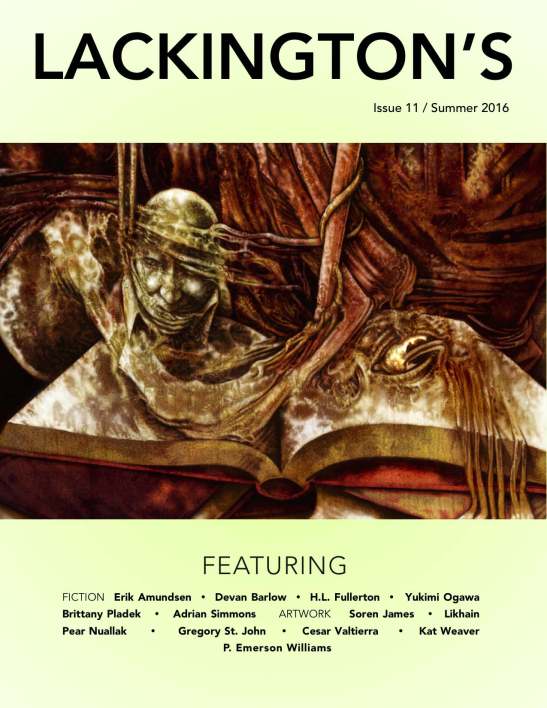
Lackington's Summer 2016-rackAdrian Simmons is one of the editors of the highly-regarded Heroic Fantasy Quarterly magazine. But he’s also a fine writer in his own right, as Charles Payseur reminds us this week, in his review of the Summer 2016 issue of Lackington’s magazine, containing Adrian’s short story “How I Came to Be Raised by Balniwan the Fool.”

Just ahead of the release of their next issue, Lackinton’s has dropped the paywall on their Possessions issue and it’s a great collection of rather dark stories… there are a lot of ways that these tales circle around what it is to have possessions, and what it is to be possessed. Most of the pieces are solidly fantasy, the magic alive and well and further complicating the theme but also giving it a wild fire that casts some wicked shadows…

This story takes an interesting angle on the idea of possessions, focusing on a child living in a world defined by violence. Under the rule of their father, Alebeg, the children as possessions, less than people. He scares them and he awes them and he lives a bit like a cult leader on a hill, though with a rather Norse feel to it. So as I read [the] main possession of the story is that of the main character, who is treated more like property than a person… It’s certainly a visceral story that comes with the taste of blood and the bitterness of being someone powerless in the face of force and power. A fine way to kick off the issue!

Read Charles’ complete review here.

Every issue of Lackington’s has a theme, which gives the magazine an interesting focus. The theme this issue is “Possessions.”
Read More Read More

October 2016 Lightspeed Magazine Now Available

October 2016 Lightspeed Magazine Now Available

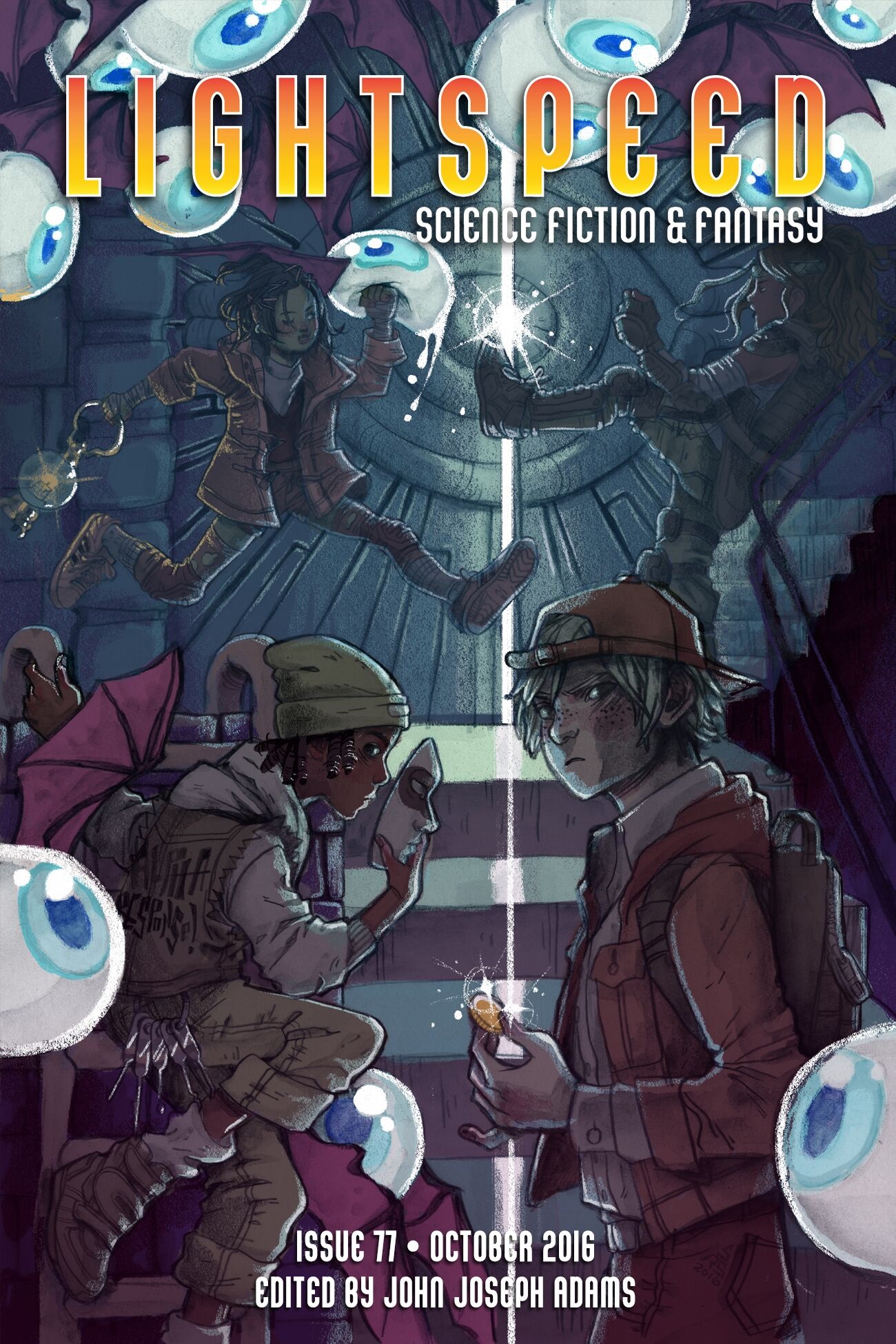
lightspeed-october-2016-smallJeremiah Tolbert has had a pretty impressive short fiction career — in the last few years he’s been published in Asimov’s SF, Giganotosaurus, Interzone, the sword & sorcery Cthulhu anthology Swords Vs Cthulhu, and other fine places. Some of you will also remember his very fine story in Black Gate 15, “Groob’s Stupid Grubs.” His latest tale for Lightspeed is “The Cavern of the Screaming Eye,” a futuristic role-playing tale which he describes thusly:

The first in the Dungeonspace sequence of stories, “Cavern” involves the story of a boy struggling with the legacy of his dead brother, a great d-space crawler lost to one of the most deadly dungeon anomalies the City has ever seen – The Black Hole.

His mother will kill him if he takes up d-space adventuring – she can’t bear to lose another son to the high-risk world of dungeon crawling. But an addiction to the thrill of adventure might just be in his blood, and now he find himself embroiled in the new kid’s dungeoneering schemes. Will they survive… the Cavern of the Screaming Eyes?

Here’s Charles Payseur’s summary from Quick Sip Reviews.

This story imagines a future fantasy world where young people can enter into d-space, a sort of dungeon-crawling game, only one where the stakes are life and death. The main character, Ivan, has recently lost his brother to the game, a brother who was a hero to many but a terror to Ivan. His home life a mess, Ivan is surprised when a new kid at his school offers friendship and, more than that, an opportunity to get involved in dungeon delving… This also feels like the start or something larger, because the story introduces many things that don’t exactly pay off. But it does create the sense of a larger world and a larger mystery which Ivan is just discovering, that will undoubtedly have huge implications for him, his family, and his new friends. It’s an entertaining piece and light but with a lifting optimism and fun that makes it a pleasant read and a fine story!

Read Charles’ complete review of the October issue here.

This month editor John Joseph Adams offers us original fantasy by Jeremiah Tolbert and Kat Howard, and fantasy reprints by Aliette de Bodard and Will Kaufman, plus original science fiction by Stephen S. Power and Mary Anne Mohanraj, along with SF reprints by Karen Joy Fowler and Fran Wilde.

Read More Read More

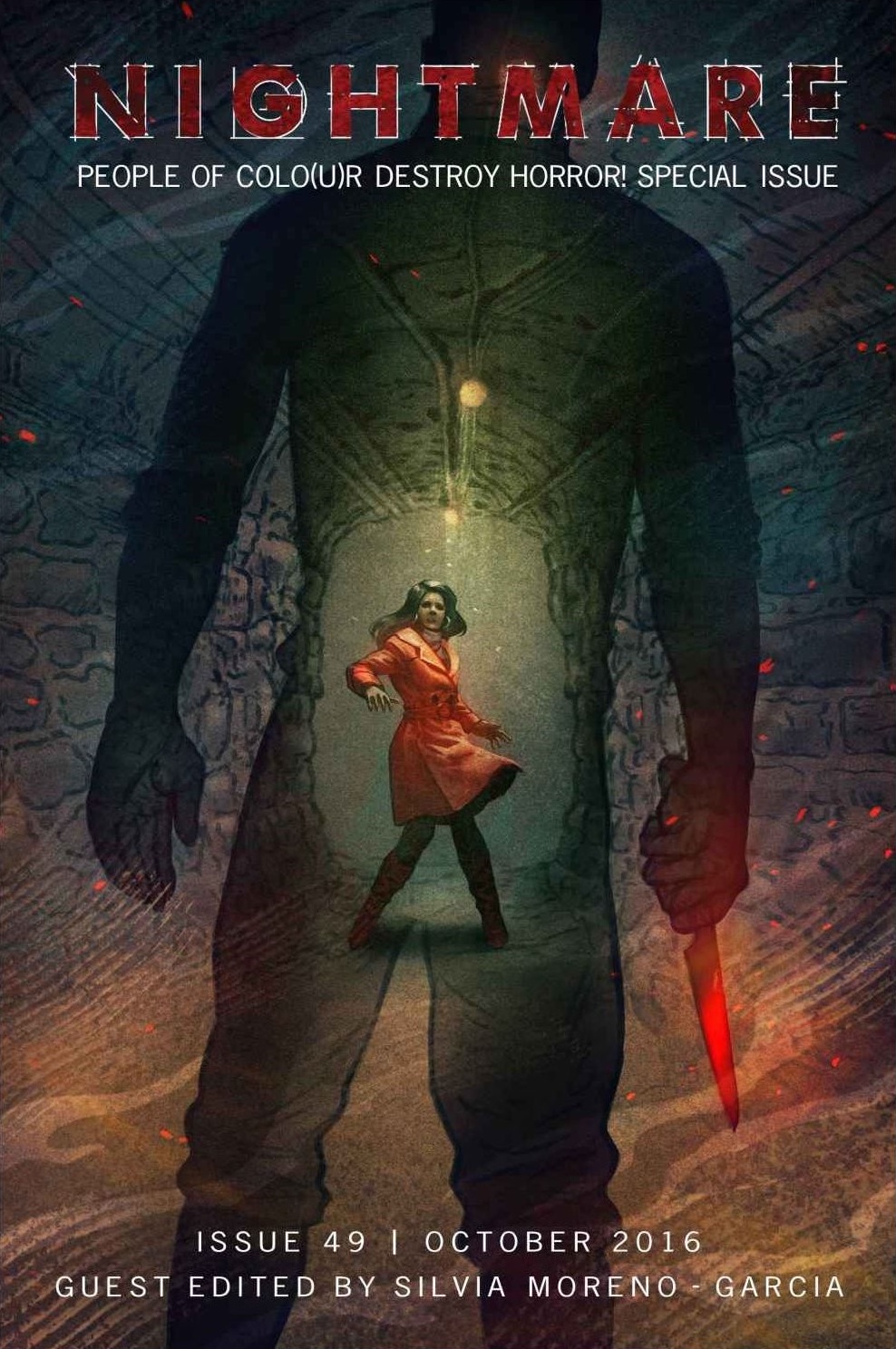
October 2016 Nightmare Magazine, People of Colo(u)r Destroy Horror! Special Issue, Now on Sale

October 2016 Nightmare Magazine, People of Colo(u)r Destroy Horror! Special Issue, Now on Sale

nightmare-magazine-49-smallUber-editor John Joseph Adams has had enormous success with his Kickstarter-funded DESTROY special issues of Lightspeed, Fantasy, and Nightmare. The original idea sprung from the ludicrous Alt-Right claim that women were destroying science fiction; that gave birth to the brilliant and groundbreaking Women Destroy Science Fiction! special issue of Lightspeed, a massive 479-page issue released in 2014.

Since then there have been multiple successful iterations, including Queers Destroy Science Fiction in June of last year, and People of Colo(u)r Destroy Science Fiction, in June of this year. The People of Colo(u)r Destroy Fantasy! special issue of Fantasy will be published in December, and The People of Colo(u)r Destroy Horror! special issue of Nightmare magazine arrived this month. Here’s the description from the website.

Nightmare was founded on the core idea that all horror is real horror. The whole point of this magazine is that horror fiction is vast. It is inclusive. Horror is about all people and for all people.

The People of Colo(u)r Destroy Horror! special issue exists to relieve a brokenness in the genre that’s been enabled time and time again by favoring certain voices and portrayals of particular characters. Here we bring together a team of POC writers and editors from around the globe to present horror that explores the nuances of culture, race, and history. This is horror for our present time, but also — most of all — for our future.

People of Colo(u)r Destroy Horror! is 100% written and edited by people of color, and is lead by guest editor Silvia Moreno-Garcia, with editorial contributions from Tananarive Due, Maurice Broaddus, Arley Sorg, and others. It features four original, never-before-published short stories, from Valerie Valdes, Nadia Bulkin, Gabriela Santiago, and Russell Nichols. Plus, there’s four classic reprints by Nisi Shawl, Priya Sharma, Terence Taylor, and Pulitzer Prize-winning author Junot Díaz. On top of all that, we also have an array of nonfiction articles and interviews, from Alyssa Wong, Chesya Burke, Rochita Loenen-Ruiz, Jayaprakash Satyamurthy, and Chinelo Onwualu, as well as original illustrations by Kimberly Wengerd, SainaSix, Maggie Chiang, and Reiko Murakami.

Enjoy the destruction!

Here’s the complete TOC for this special issue.

Read More Read More

Uncanny Magazine Issue 12 Now on Sale

Uncanny Magazine Issue 12 Now on Sale

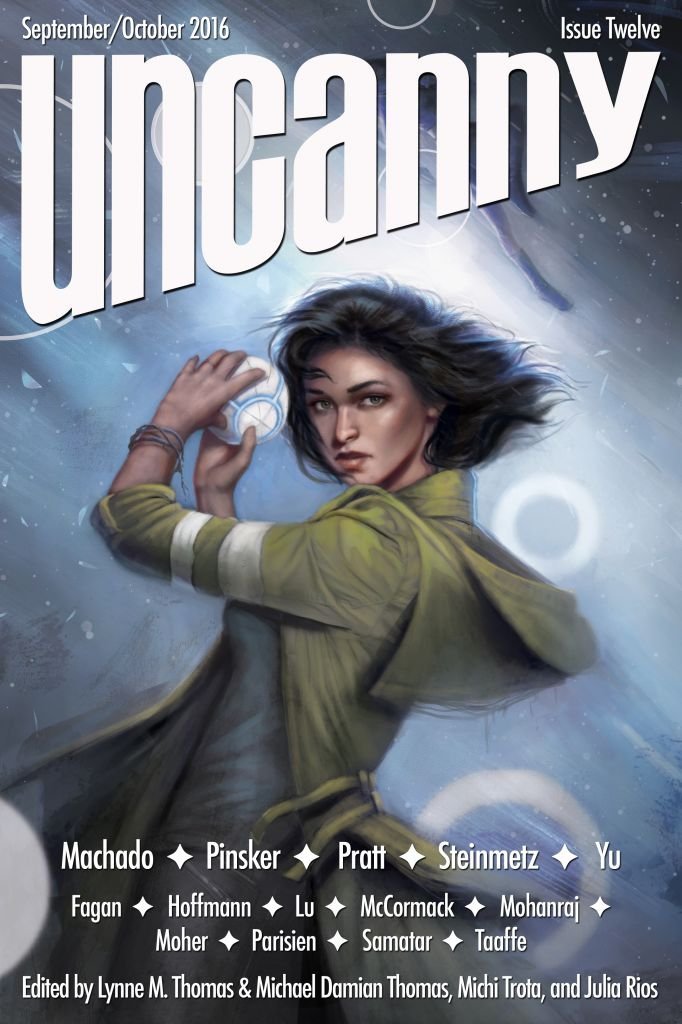
uncanny-issue-12-september-october-smallCharles Payseur at Quick Sip Reviews has some high praise for the latest issue of Uncanny,

This month’s offerings from Uncanny Magazine bring a bit of everything. Two original fiction pieces, two poems, and two works of nonfiction covering fairy tales and AI insurrections and ghosts and desires and distorted realities and lineages of SFF. The fiction is gripping and challenging, difficult and unflinching. The poetry is moving and all about desire and nostalgia and looking back. And the nonfiction is about perception and how it can be changed, either in the brain or by those around you, and how that can effect the inroads to SFF. It’s a full month and a nice balance of the strange, the heartbreaking, and the affirming….

“The Witch of Orion Waste and the Boy Knight” by E. Lily Yu (5,868 words)

This story takes an interesting look at fairy tale tropes and humanizes them in interesting ways, casting a goose girl as a witch and a cursed boy as a knight and weaving a complex tale of hope and disappointment and longing. The story does an excellent job capturing the feel of the witch, who is blown across her own life, going where inclination leads. She is inquisitive and never truly satisfied and when given the opportunity to be a witch she jumps on it, only to find that not all things are what she expects. She ends up following a knight on his quest, hoping to keep him safe and also stay with him, but the way that power and curses work in this story is strange and interesting. It twists things. And that’s part of what I love about it.

Read his complete review here

The issue includes fiction by Sarah Pinsker, Carmen Maria Machado, Tim Pratt, E. Lily Yu, Ferrett Steinmetz, and a reprint by Sofia Samatar, and non-fiction by Una McCormack, Mary Anne Mohanraj, Dominik Parisien, and Aidan Moher, plus poetry, interview, and an editorial. All of the content became available for purchase as an eBook (PDF, EPUB, MOBI) on September 1, 2016.

Read More Read More

October/November 2016 Asimov’s Science Fiction Now on Sale

October/November 2016 Asimov’s Science Fiction Now on Sale

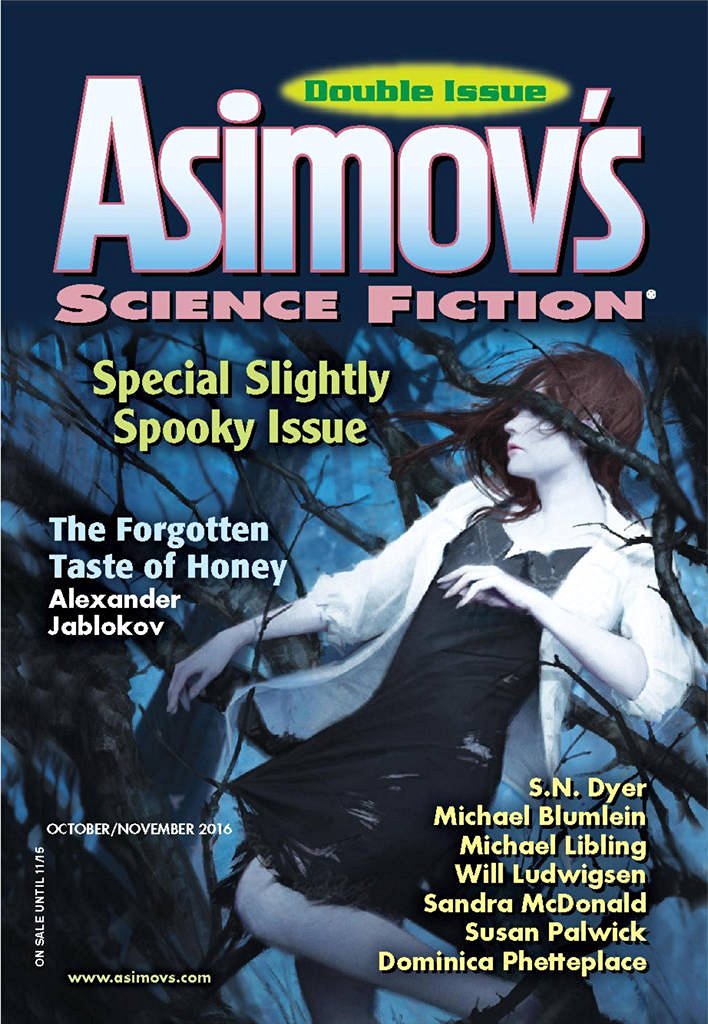
asimovs-sf-october-november-2016-smallThe October/November double issue of Asimov’s Science Fiction is the annual “Slightly Spooky” Halloween special, “jam-packed with stories about ghosts, angels, demons, souls, curses, and a couple of aliens.” Here’s Sheila’s full description:

October/November is our traditional “slightly spooky” issue, and the 2016 edition is no exception. The magazine is jam-packed with stories about ghosts, angels, demons, souls, curses, and a couple of aliens. Alexander Jablokov’s bold new novella brings us a tale of death and danger, a woman with a rather unusual occupation, and “The Forgotten Taste of Honey.”

Sandra McDonald’s cheerful tone belies the horror that lurks for “The People in the Building”; the souls of the damned are captured in Susan Palwick’s poignant “Lucite”; death and another odd job play a part in Michael Libling’s amusing and irreverent tale of “Wretched the Romantic”; “Project Extropy” uncovers new mysteries in Dominica Phetteplace’s ongoing series; S. N. Dyer draws on history and folklore to explain what happens “When Grandfather Returns”; seeds of hurt and mistrust are sewn in Rich Larson’s “Water Scorpions”; new author Octavia Cade invites us to spend some time “Eating Science With Ghosts”; Will Ludwigsen examines the curse of “The Leaning Lincoln”; and Michael Blumlein’sheartfelt novella asks us to “Choose Poison, Choose Life.”

Robert Silverberg’s Reflections column dabbles in some “Magical Thinking”; James Patrick Kelly’s On the Net prepares to “Welcome Our Robot Overlords!”; Norman Spinrad’s On Books takes on “Short Stories” in a column that features the Nebula Awards Showcase anthologies as well as The Fredric Brown Megapack and Harlan Ellison’sCan & Can’tankerous; plus we’ll have an array of poetry and other features you’re sure to enjoy.

The cover is fabulous, but I couldn’t find any info anywhere on the website on who painted it. It’s by Karla Ortiz (karlaortizart.com/illustration).

In her editorial, Sheila Williams talks about the annual tradition of the “slightly spooky” issue, saying that she saves the best creepy stories each year for Halloween. She also talks about some of her favorites over the years.

Read More Read More

Beneath Ceaseless Skies 210 Now Available

Beneath Ceaseless Skies 210 Now Available

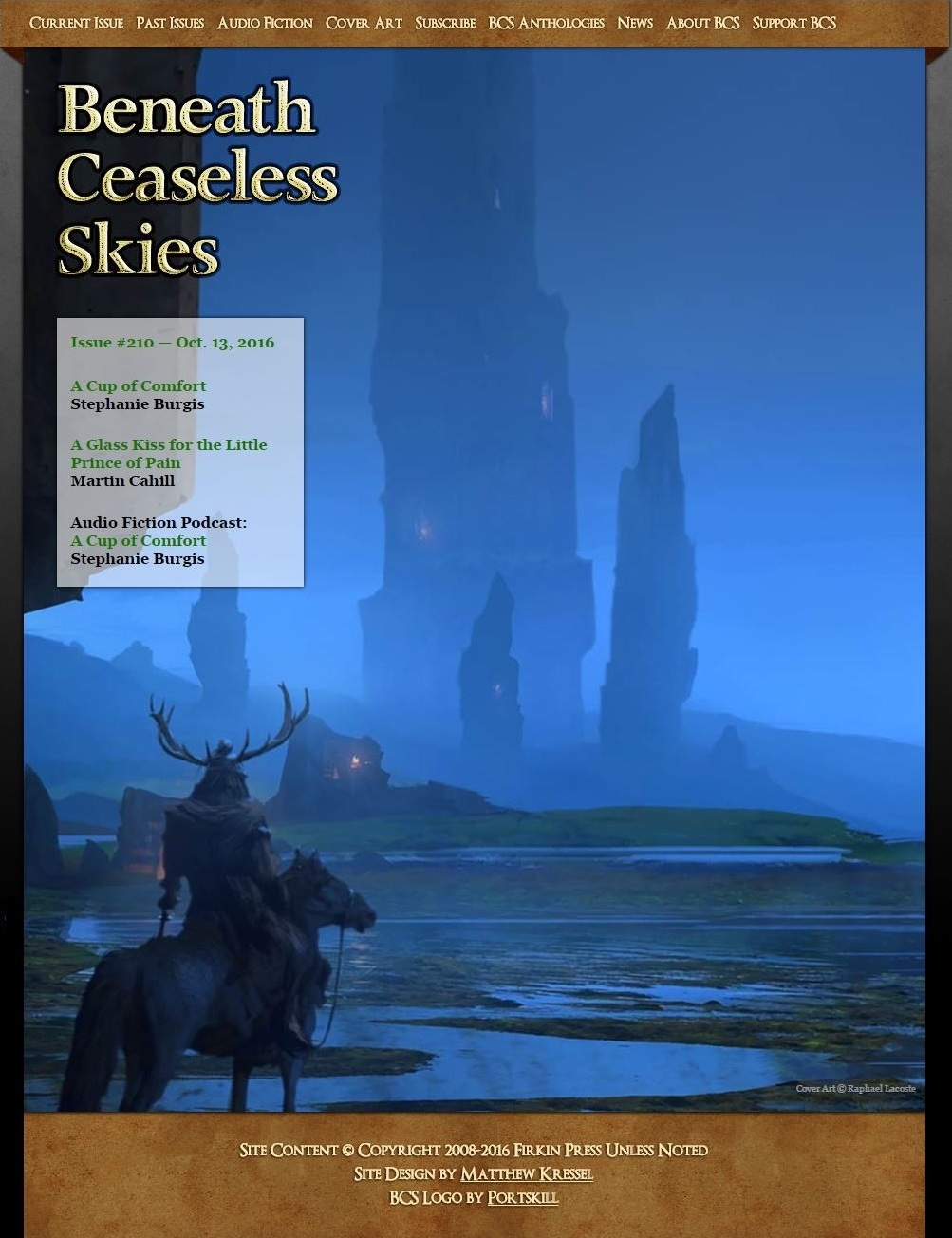
beneath-ceaseless-skies-210-smallIssue #210 of Beneath Ceaseless Skies is now available, completely free on their website. It is dated October 13 and features fiction by Stephanie Burgis and Martin Cahill, a podcast by Stephanie Burgis, and a reprint by Siobhan Carroll. Here’s the complete Table of Contents.

A Cup of Comfort” by Stephanie Burgis
“Of course I will come,” said the Dragon Queen. Her voice was muted beneath the layers of dark cloth that covered her, but a ripple of amusement sounded as she added, “I should hope my old friend has not forgotten my favorite blend, after all these decades. I shall be disappointed if there isn’t a fresh pot awaiting me.”

A Glass Kiss for the Little Prince of Pain” by Martin Cahill
His grip tightens. He looks up at me with an honesty reserved for saints and the soon to be executed. “If you do this, it’ll ruin you. Please, come back with me to the school, give up this alliance with the Empress, and together we can find a way to save the boy. Armila, please, this kind of murder, to one so young? You can’t come back from that kind of corruption.”

Audio Fiction Podcast

A Cup of Comfort” by Stephanie Burgis (Duration: 28:08 — 19.32MB)
“Nonsense. You are my guest.” The dragon reached out with long, sharp, delicately curving claws and tipped the teapot.

From the Archives

In the Gardens of the Night by Siobhan Carroll
If the General wants her dead, he must agree to my requests.

Read issue 210 online completely free here.

Read More Read More

How to Be a Doomed Meddler

How to Be a Doomed Meddler

occult-detective-quarterly-banner-small

I was always a Carnacki man, staunch and true. An Edwardian adventurer, willing to admit that I was afraid, but determined to stiffen that lip and see the game through. And as a follower of William Hope Hodgson’s Carnacki the Ghostfinder, I quickly took to games like Call of Cthulhu when it first came out in the eighties. The dedicated investigator pitted against almost indescribable horrors had an obvious appeal. It turned out to be a shock, because unlike our usual, intriguing fantasy RPG campaigns, in CoC we died a lot. A real lot. We were, generally, doomed.

So when we decided that we would launch a new magazine, Occult Detective Quarterly, we knew what we wanted. Someone even suggested that Doomed Meddler Quarterly would be a good alternative name. We wanted tales of psychic detectives, amateur supernatural sleuths, embittered foes of the Dark, and people who ended up having to investigate malevolent forces against their wills. New Lovecraftian terror was welcome, as was old-fashioned pluck. Stories from Carnacki to Constantine, with terrified innocents thrown in along the way.

We held an open call for stories over the Summer, and we even received quite a few tales where the protagonist didn’t die, not yet. He or she survived with a modicum of sanity, which counts as a major victory in this sort of area. Not only did we get stories from people unknown to us, but tales from seasoned fantasy and weird fiction authors.

Read More Read More

October 2016 Clarkesworld Now Available

October 2016 Clarkesworld Now Available

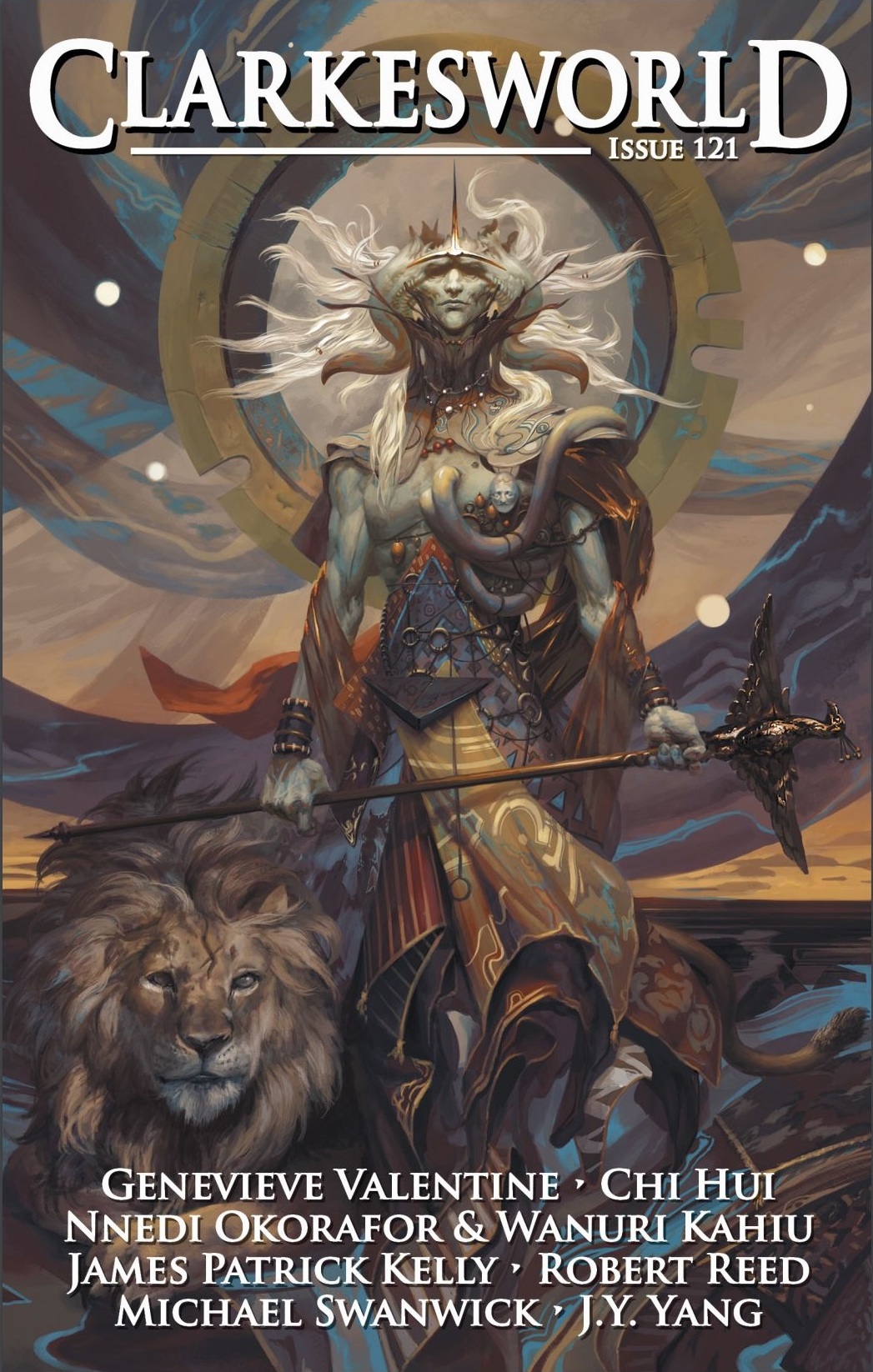
clarkesworld-121-smallOkay, I’ve settled into a routine now. I drop by Charles Payseur’s Quick Sip Reviews to see what he thinks of this month’s crop of magazines, read what he has to say about Clarkesworld, and then make a beeline to the Clarkesworld website. The guy knows how to whet your appetite for good fiction.

Here he is on Genevieve Valentine’s 9,000-word tale, “Everyone from Themis Sends Letters Home.”

So this is a rather heartbreaking story about a place that doesn’t even exist. Not exactly. It’s about a woman who has been unfortunate all her life finally being a part of something that she loves, that makes her feel…okay, and then having to find out that it’s been not only a lie but a cruel one… It’s also about a game, a game that comes to be something more than that, mired in the horror of what it did but also in the good that came of it. The story is brilliantly told through letter, at first between Marie and a mysterious other person, then drawing out to include other people… The story does a terrific job of selling the idea of the game and then exploring how the game abused its test subject. How a corporation teamed with a prison to use people and how no one cared. The story flits from person to person but only through letters, so that the story is in some ways the evidence being gathered by the main character, by Benjamina, to turn over to expose what has happened. And it’s completely believable that such treatment of inmates would happen. It points to how we treat the incarcerated, how we treat those we’ve deemed criminal. How powerless they become and how easy they are to use, even when it leaves permanent damage. It’s a wrenching story and I love how it plays out, the guilt and the pain and the yearning. It uses form to great effect and you should definitely read this one. Go!

Read Charles’ complete review of the issue here.

The October Clarkesworld, issue #121, is packed with new fiction by Robert Reed, James Patrick Kelly, Chi Hui, and Nnedi Okorafor & Wanuri Kahiu, and reprints by Jy Yang and Michael Swanwick.

Here’s the complete list of stories.

Read More Read More

The October Fantasy Magazine Rack

The October Fantasy Magazine Rack

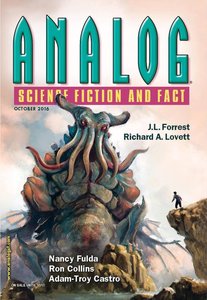
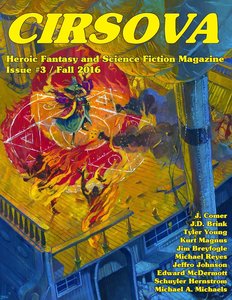
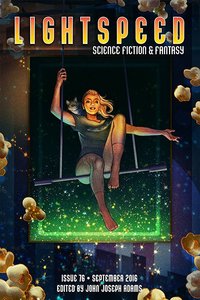
analog-science-fiction-october-rack cirsova-3-rack interzone-266-rack lightspeed-september-2016-rack
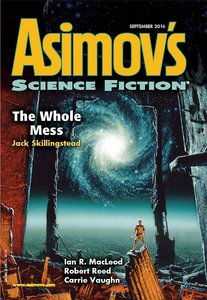
asimovs-science-fiction-september-2016-rack postscripts-36-37-the-dragons-of-the-night-rack skelos-issue-1-rack the-magazine-of-fantasy-and-science-fiction-september-october-2016-rack

We added two new magazines to our regular coverage this month: Skelos, the Journal of Weird Fiction and Dark Fantasy, edited by Mark Finn, Chris Gruber, and Jeffrey Shanks, and Postscripts, edited by Nick Gevers, which is more of a regular anthology series, but it publishes short fiction and has numbered issues, so what the hell. Welcome aboard.

We also have lots of interest for vintage fiction fans, including retro reviews by Rich Horton and Matthew Wuertz of the July 1953 issue of Galaxy Science Fiction (with stories by Clifford D. Simak, James H. Schmitz, C. L. Moore and Henry Kuttner, Fritz Leiber, and Pulitzer Prize-winner Michael Shaara), the November and December 1963 Fantastic (John Jakes, Neal Barrett, Jr., Ursula K. Le Guin, Keith Laumer, and Edmond Hamilton) and the May 1963 Amazing (Henry Slesar, Leigh Brackett, Albert Teichner, and Robert F. Young).

Check out all the details on the magazines above by clicking on the each of the images. Our September Fantasy Magazine Rack is here.

As we’ve mentioned before, all of these magazines are completely dependent on fans and readers to keep them alive. Many are marginal operations for whom a handful of subscriptions may mean the difference between life and death. Why not check one or two out, and try a sample issue? There are magazines here for every budget, from completely free to $35/issue. If you find something intriguing, I hope you’ll consider taking a chance on a subscription. I think you’ll find it’s money very well spent.

Read More Read More

Galaxy Science Fiction, July 1953: A Retro-Review

Galaxy Science Fiction, July 1953: A Retro-Review

galaxy-science-fiction-july-1953-smallThe July, 1953 issue of Galaxy Science Fiction is bereft of a serialized novel, so a curious reader could jump into it without feeling a need to commit to something larger. I suggested the same thing for the June, 1953 issue as well, so here are two issues to choose between. Or read them both.

“Kindergarten” by Clifford D. Simak — Peter lives in the country, having moved out of the city after being diagnosed with cancer. He lives a simple life until he discovers a strange machine on his property. When he touches it, it dispenses a remarkable piece of jade.

Other people discover the machine soon enough, and with each touch, it dispenses an item specific to the person. As word spreads, the police become involved, followed by the military. The machine, though clearly alien, isn’t too disturbing until it begins laying a foundation for something much larger.

Simak’s story works really well. I think he did a good job with Peter’s character — showing his pain with cancer. And I like that the source of his pain or why he lived in the country didn’t come out immediately. I expected after reading it that nothing else in the issue would top this story, but I later found something else that edged it out as my favorite.

“Caretaker” by James H. Schmitz — An exploring party visits the planet, Cresgyth. A man named Hulman crashed on it over twenty years ago — the lone survivor of his crew. He was saved by other humans — the only humans known to exist beyond Earth. Those humans, however, are threatened by other humanoid creatures that Hulman calls snakes. The humans won’t fight back, and Hulman believes the humans will become extinct unless something is done about the snakes.

Read More Read More