Browsed by
Category: Magazines

Scheherazade’s Bequest 11 now Online
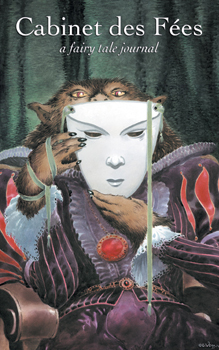
Scheherazade’s Bequest 11 now Online

cabinet-2So I’ve discovered this cool thing called Scheherezade’s Bequest. It happened while reading C.S.E’s LiveJournal, when I should have been working.  Right next to a pic of a young woman kissing a horse is this entirely C.S.E-like comment:

OH, SEE!!! Scheherezade’s Bequest 11 is up at www.cabinetdesfees.com! And [info]cucumberseed‘s story is there, and [info]shvetufae‘s got a thing in it, and I wish I weren’t at work, so I could REEEEEAAAAAAD IT!!!

To conceal my curiosity about the horse (not to mention my obvious guilt at having less self-control than she during work hours), I asked C.S.E. to explain Scheherezade’s Bequest to me.

Because she knows everybody (and I mean everybody), C.S.E. passed my request along to co-editor Erzebet YellowBoy, who kindly explained that Scheherezade’s Bequest is the online component of the altogether splendid Fairy Tale Journal Cabinet des Fées, which explores the fairy tale in fiction and fact.


Read More Read More

Beneath Ceaseless Skies Celebrates Two Years

Beneath Ceaseless Skies Celebrates Two Years

bcs1The relentless Beneath Ceaseless Skies published their 52nd issue last week (Sept. 23, 2010).

I continue to be amazed at this magazine. Issues appear online every two weeks like clockwork — and if you do the math, issue 52 issue marks exactly two years since they published their first, back in early October 2008. 

Each issue contains two original works of literary adventure fantasy, and the magazine’s artwork and production values remain top-notch.  Over the past two years Editor-in-Chief

Richard Parks. They’ve also published Brian Dolton, Chris Willrich, Catherine Mintz, Marie Brennan, Vylar Kaftan, Yoon Ha Lee, Saladin Ahmed, and many others.

Issue 52 includes “The Guilt Child” by Margaret Ronald, and “Invitation of the Queen” by Therese Arkenberg. Over at Torque Control, there’s a spirited discussion — and plenty of praise — for Margaret Ronald’s earlier “A Serpent in the Gears” (BCS #34), set in the same world as “The Guilt Child.” Cover art this issue is by Andreas Rocha.

Beneath Ceaseless Skies is completely free, but they appreciate your support, and they’re well worth it. Their latest issue is here. Drop by and check them out.

Interzone #229 Arrives

Interzone #229 Arrives

interzone229And by arrives, I mean I finally found a local bookstore — Barnes & Noble, in Champaign, Illinois — that carries it at a reasonable price ($7.50 US).

I like Interzone. This British science fiction magazine has had a long and illustrious history, and has published some terrific work. They’ve also had some really great covers, especially in the last few years. (Okay this issue, with the Lego Road Warriors look, maybe isn’t the best example.) If I could find a domestic distributor, I’d subscribe in a heartbeat.

Still, it’s worth the hunt every two months. The full-color interiors and top-notch design give the zine a distinct look and real appeal. My favorite features are frequently the non-fiction — including Nick Lowe’s Mutant Popcorn film column, Tony Lee’s Laser Fodder DVD articles, David Langford SF gossip column Ansible Link, and especially the book reviews, which provide an often tantalizing look at British SF and fantasy titles. 

Fiction this issue is by Jim Hawkins, Rochita Loenen-Ruiz, Toby Litt, Antony Mann, and Paul Evanby. There’s also an interview with Finch author Jeff VanderMeer, and an editorial.

Interzone is published by TTA Press, and edited by Andy Cox and Andy Hedgecock.  Their website is here.

Adventure Tales #6 Arrives

Adventure Tales #6 Arrives

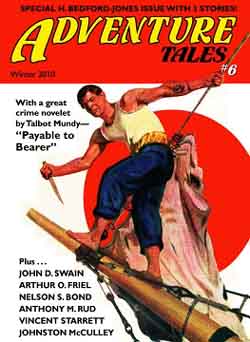
adventure-6Wildside Press continues their excellent pulp reprint series with the sixth issue of Adventure Tales, presenting tales of classic fiction from Nelson S. Bond, Arthur O. Friel, Talbot Mundy, and Zorro creator Johnston McCulley, and poetry by Poul Anderson and Clark Ashton Smith, among others. The issue is cover-dated Winter 2010, but the publication date on the copy we received was September 13.

This is a special H. Bedford-Jones issue, with three complete stories from the pulp master. As usual the issue is handsomely illustrated, with finely detailed reproductions of the original accompanying artwork. It also includes a reprint of the complete first issue of George Scithers’ legendary Sword & Sorcery fanzine Amra, which is pretty darn cool, and I hope future issues of Adventure Tales  keep up this tradition.

John Betancourt’s editorial laments the loss of Scithers, one of the most accomplished editors in our field. Scithers was founding editor of Asimov’s Science Fiction and edited both Amazing and Weird Tales in a long and varied career. He was a typesetter and Assistant Editor at Wildside until his death at 80 (and perhaps the loss of George’s keen eye explains the rather unfortunate back cover credit to “Frits Leiber,” for the poem “The Gray Mouser: 1” )

Overall this is a very handsome package, typical for Wildside’s pulp reprints, and there were brief fisticuffs atop the Black Gate rooftop headquarters to determine who would take home our sole review copy.  John Fultz sucker-punched Bill Ward and had me in a headlock when Howard Andrew Jones unleashed an evil trained chicken who swooped in and scored the prize. Howard retreated to Indiana and, in his latest mocking transmission back to headquarters, claims to be already at work on a review.

Adventure Tales is 152 pages and is now available directly from Wildside for just $12.95.

Mortals, meet Demon Lovers: A review of Goblin Fruit Magazine, Part II

Mortals, meet Demon Lovers: A review of Goblin Fruit Magazine, Part II

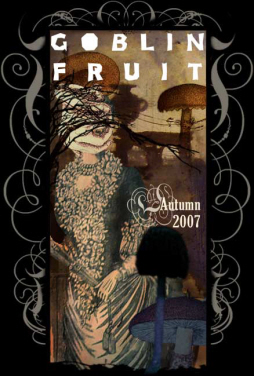
goblin-fruit-autumn2Okay, this is the Age of the Internet, so you’ve probably had this experience.
Say you’ve met a couple of like-minded ladies at a few writing conventions (as described in Part I). Say these conventions were World Fantasy 2007 and WisCon 2008 respectively. Say you’ve set about exchanging a million emails with these ladies, the occasional phone call, friending them on LiveJournal and Facebook, and rediscovering, happily, the merits of snail mail. These ladies just happen to be the two editors of Goblin Fruit Magazine.

Fantastic! You send them your really long rhyme-y poems nobody else wants, and sometimes they even take them, and even when they don’t, they seem to like you anyway. Life is totally Utopian.

You all read fantasy, right? What happens after Utopia?

DOOM!

Read More Read More

Adventures in Pulp Awesomeness, Part Deux: Planetoids of Peril

Adventures in Pulp Awesomeness, Part Deux: Planetoids of Peril

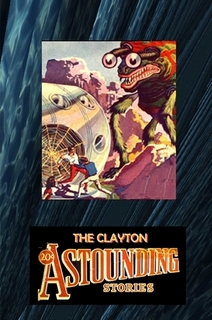
clayton-astounding1Back in April we told you about the first volume of this excellent new Clayton Astounding reprint series, compiled by Dark Worlds editor G.W. Thomas: Vagabonds of Space.

Vagabonds collected the best Space Opera from the Clayton years, the first three years of the most honored science fiction magazine in history: January 1930 – March 1933, when it was briefly owned by Clayton Magazines. This was the era before the pulp magazine was renamed Analog in 1960; even before the name was changed to Astounding Science Fiction — when it bore its original title, Astounding Stories of Super-Science, and was edited by Harry Bates, a skilled writer and editor whose landmark 1940 Astounding story “Farewell to the Master” was adapted as the classic film The Day the Earth Stood Still.

The Clayton years preceded the so-called Golden Age of Astounding when, under legendary editor John W Campbell, it discovered and promoted the work of young new writers such as Isaac Asimov, Robert A. Heinlein, and Hal Clement. The fiction in the Clayton Astounding was raw, undiluted Buck Rogers stuff; the tales that first established the genre and defined for the American public what science fiction was all about.

G.W. Thomas followed Vagabonds with Out of the Dreadful Depths, pulp tales of undersea adventure, and now comes the third volume, Planetoids of Peril:

Not the Golden Age Astounding of John W. Campbell but the fun, Bug-Eyed-Monster-filled pulp of SF adventure. This volume is filled with tales of planets and moons covered with alien monsters and terrible chills. Featuring work by Anthony Pelcher, Sewell Peaslee Wright, Edmond Hamilton, Charles W. Diffin, Paul Ernst and Robert H. Wilson. With introductions and commentary by G. W. Thomas.

The Clayton Astounding: Planetoids of Peril is available from Lulu, priced at$13.99 for 218 pages. It’s also available in electronic format for just $4.99.

Fantasy & Science Fiction: Sept/Oct issue

Fantasy & Science Fiction: Sept/Oct issue

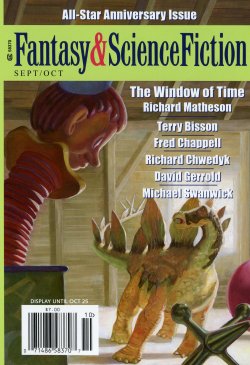
fsf-sept-oct10I love these big double issues of Fantasy & Science Fiction (and when did it drop “The Magazine of…” from its name on the cover?  A quick look through the back issues I have handy shows it was at least a decade ago, maybe longer. Wow. Thank God my job does not rely on razor-honed powers of observation.)
Why do I love them? For one thing, these big double issues are BIG.  This All-Star Anniversary Issue is 258 pages; including “Orfy,” a big new novella from Richard Chwedyk in his “saur” series about sentient dinosaur toys; four big novelets from Dale Bailey, Fred Chappell, and others; and a big selection of short stories from Michael Swanwick, Terry Bisson, Richard Matheson, and others — including the hilarious “F&SF Mailbag” by David Gerrold, crafted as a series of letters from Gerrold to editor Gordon van Gelder, which opens:

Dear Gordon,

Re: Your recent announcement that you will be outsourcing the jobs of domestic science fiction writers to cheaper-working authors in parallel dimensions.

I take pen in hand to object most strenuously.

Figures Gordon would scoop us — I only wish I’d thought of it first.  Speaking of Gordon, when we asked about the issue he told us:

I edited the Sept/Oct issue from the veranda of my palatial estate on Barsoom, where I was watching filming of a new movie. Tried to get Terry Bisson to come visit but he was busy with a political rally. Rich Chwedyk friended me on Facebook and I was surprised to learn that his “saur” stories are nonfiction, location of the real house is undisclosed. The letters cited in the intro to David Gerrold’s story are all real.

The only part I don’t believe is the bit about the letters.  You can buy copies at better bookstores for $7, or order a subscription to [The Magazine of] Fantasy & Science Fiction and experience some of the best our field has to offer here.

Locus Reviews Black Gate 14

Locus Reviews Black Gate 14

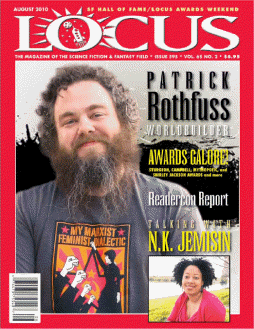
locus-595aThe August issue of Locus, the Magazine of the Science Fiction & Fantasy Field, contains a review of our latest issue by Contributing Editor Rich Horton.
Black Gate‘s Winter issue is positively huge… and it delivers excellent value. There are three novellas, all entertaining. My favorite was Robert J. Howe’s “The Natural History of Calamity,” which is basically urban fantasy, but with quite a clever central idea. Debbie Colavito is a private detective with a difference: she detects what’s wrong with someone’s “karmic flow” and restores the balance. In this story she takes a case for a nice young man whose equally nice girlfriend has just dumped him. Was it something he did wrong, some bad karma? Or is it something to do with her new boyfriend, a nasty piece of work who, by coincidence, has some history with Debbie? The central idea is pretty intriguing and could, I think, support a series. Nicely done, with some well-handled twists.

Rich also enjoyed “Devil on the Wind” and “The Word of Azrael”:

Devil on the Wind,” by Michael Jasper & Jay Lake concerns a group of magicians whose power arises from their own suicides (and revivals). One such witch is sent to a nearby Prince to enforce the rule of these magicians. But she learns that her allies have plans that don’t include her… Even better is Matthew [David] Surridge’s “The Word of Azrael.” It concerns Isrohim Vey, who sees the Angel of Death on a battlefield and as a result is spared — more a curse than a blessing — to search again for the Angel. His search almost takes the form of a catalog of sword & sorcery tropes, his many adventures told briefly but with style and an ironic edge. Surridge both celebrates and winks at the genre. It’s very entertaining, clever, and even thought-provoking.

The online counterpart to Locus magazine is the excellent Locus Online, edited by Mark R. Kelly.

Short Fiction Roundup: And the winners are…

Short Fiction Roundup: And the winners are…

cw_48_3001

The 2010 Hugo Award winners for various short fiction categories:6a00d8341ce22f53ef0105365ac432970c-200wi1

Best Novella: “Palimpsest” by Charles Stross (Wireless)

Best Novellette: “The Island” by Peter Watts (The New Space Opera 2)

Best Short Story: “Bridesicle” by Will McIntosh (Asimov’s 1/09)

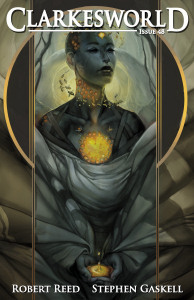
And the best semiprozine goes to an online pub: Clarkesworld, edited by Neil Clarke, Sean Wallace, & Cheryl Morgan, the current issue of which features stories by Robert Reed and Stephen Gaskell.

Mortals, Meet Goblins: A Review of Goblin Fruit Magazine (Part I)

Mortals, Meet Goblins: A Review of Goblin Fruit Magazine (Part I)

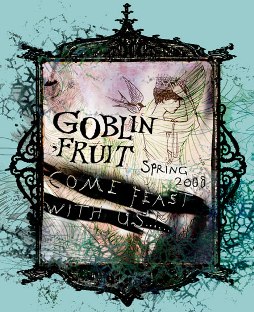
gobspr08cropIt was a cool November night in 2007. It was, in fact, All Souls Night.

Two friends and I had driven all day from Chicago, Illinois to Saratoga Springs, New York for the World Fantasy Convention. The Open Mic Poetry Reading I wanted to attend started at 10 PM, so there was barely enough time to dump our things in our room and slide into Broadway 1, all bedraggled and a bit unnerved.

The room was crowded, the poets plenteous and eager. I’d planned to recite “Sedna,” which is one doozy of a story-poem, but as the moderator was looking slightly harassed at her list of readers, I assured her I’d go at the end, and only if there was time. The mood I was in, I’d probably have been happy just to tuck tail and run.

Then the poetry began.

Read More Read More