Browsed by
Category: Magazines

Uncanny Magazine Issue 1 Now on Sale
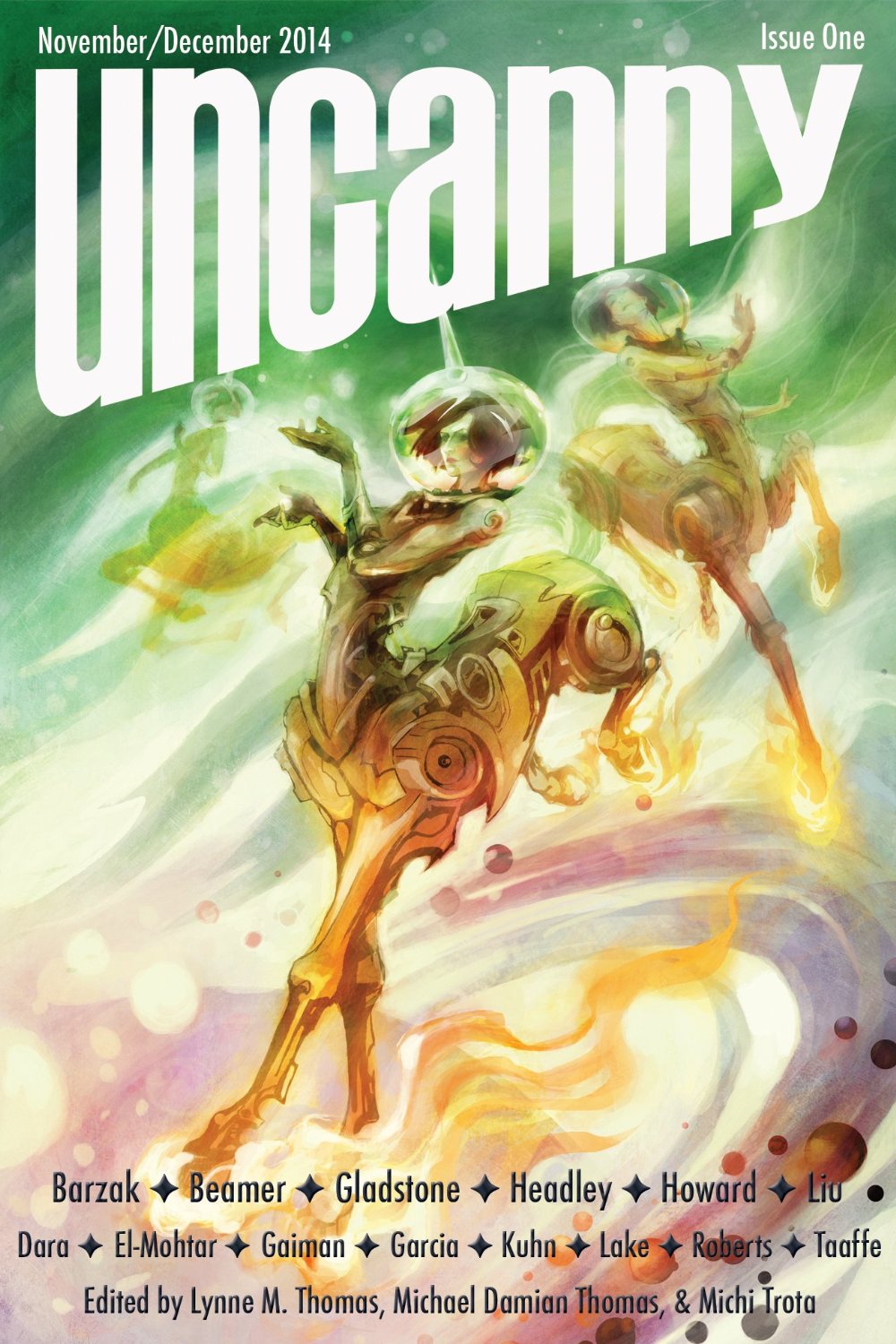
Uncanny Magazine Issue 1 Now on Sale

Uncanny Magazine Issue 1-smallWith all the bad news swirling around genre magazines over the past few years, I can’t tell you how uplifting it is to celebrate the arrival of a brand new magazine — especially one as promising as this.

Uncanny is a bimonthly magazine of science fiction and fantasy, showcasing original fiction from some of the brightest stars in the genre, as well as reprints, poetry, articles, and interviews. The first issue, cover-dated November/December 2014, is on sale today. It contains new fiction by Maria Dahvana Headley, Kat Howard, Max Gladstone, Amelia Beamer, Ken Liu, and Christopher Barzak, plus a reprint from Jay Lake. There’s also articles by Sarah Kuhn, Tansy Rayner Roberts, and Christopher J Garcia, and a special Worldcon Roundtable featuring Emma England, Michael Lee, Helen Montgomery, Steven H Silver, and Pablo Vazquez. The issue also contains poetry by Neil Gaiman, Amal El-Mohtar, and Sonya Taaffe, and interviews with Maria Dahvana Headley, Deborah Stanish, Beth Meacham on Jay Lake, and Christopher Barzak.

If that’s not enough, the magazine’s staff has also produced two stellar podcasts. Episode 1, released today, features the Editors’ Introduction, Maria Dahvana Headley’s “If You Were a Tiger, I’d Have to Wear White” and Amal El-Mohtar’s poem “The New Ways” (both read by Amal), as well as an interview with Maria conducted by Deborah Stanish. Episode 2 (coming December 2) will contain an Editors’ Introduction, Amelia Beamer reading her story “Celia and the Conservation of Entropy,” Sonya Taaffe’s poem “The Whalemaid, Singing” (as read by Amal El-Mohtar), and an interview with Amelia conducted by Deborah Stanish.

Uncanny was funded by a successful Kickstarter campaign that had over 1,000 backers and raised over $36,000 (surpassing its goal by over $10,000.) The magazine is available for purchase as an eBook in PDF, EPUB, and MOBI formats. If you’re the type of buyer who needs to sample things first, the website features free content that will be released in two stages — half on November 4 and half on December 2.

Uncanny is published and edited by Lynne M. Thomas and Michael Damian Thomas. The first issue is priced at $3.99; order directly from the website. The cover is by Galen Dara.
Amazing Stories, July 1962: A Retro-Review

Amazing Stories, July 1962: A Retro-Review

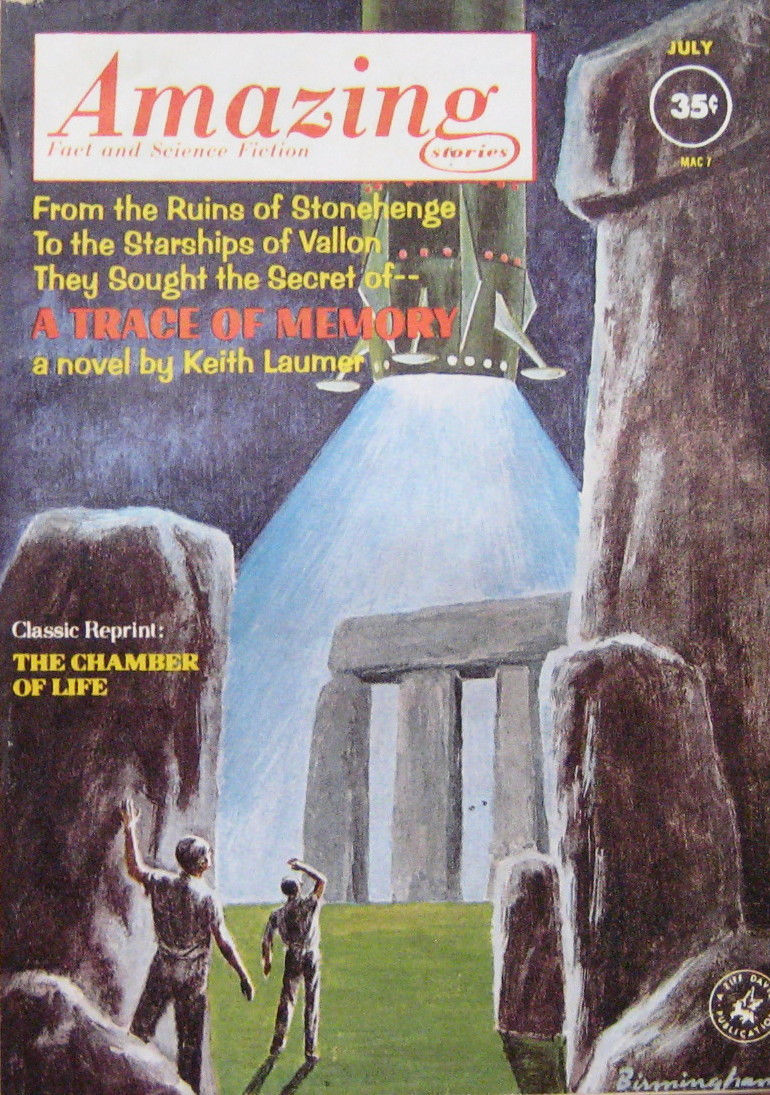
Amazing Stories July 1962-smallBack to Cele Goldsmith’s tenure at Amazing/Fantastic. This is a pretty strong issue, with, notably and perhaps surprisingly, a strong “Classic Reprint” novelet, and a strong serial opener. (The shorter fiction is less impressive.)

The cover is by Lloyd Birmingham, a semi-regular at Amazing/Fantastic throughout the ’60s, who also had one cover for Analog, one for an Ace Double, and a couple more. But he was never well-known in the field. It illustrates the serial in this issue, part one of Keith Laumer’s A Trace of Memory, competently but not particularly specially. Interiors are by Birmingham again, Leo Summers, Virgil Finlay, Dan Adkins, and Austin Briggs.

Norman Lobsenz’s editorial discusses some evidence that may or may not support the Big Bang theory. (This was a couple of years before the discovery of the 3 degree background radiation of the universe.) The lettercol, “ … or So you Say”, features a long letter by Julian Reid complaining about two recent Mark Clifton stories (“Hang Head, Vandal!” and the serial Pawn of the Black Feet), following a very long defense of his work by Clifton himself.

This response may be the last thing Clifton ever published. (He died in 1963, and I am sure he published no more stories after “Hang Head, Vandal!”) I think Clifton gets the better of the argument, pointing out for one thing that Pawn of the Black Fleet (aka When They Come From Space) is a spoof, which Reid took altogether too seriously.

S. E. Cotts’s book review column, “The Spectroscope,” covers Damon Knight anthology A Century of Science Fiction, with very high praise for the stories, but some quibbling about Knight’s categorization of different aspects of the field; and J. F. Bone’s The Lani People, which Cotts considers not very original, but quite fun. There is a very brief “Benedict Breadfruit” squib by “Grandall Barretton” (Randall Garrett) … these are decidedly sub-Feghootian to begin with and this one is worse than usual. Ben Bova (or “Ben Ben Bova” as the TOC has it) contributes an article on “The Three Requirements of Life in the Solar System,” second in a four-article series on the possibilities of alien life, this one covering possibilities for life on other planets in our system.

Read More Read More

Michael Bishop on Tom Hanks’ Story in The New Yorker

Michael Bishop on Tom Hanks’ Story in The New Yorker

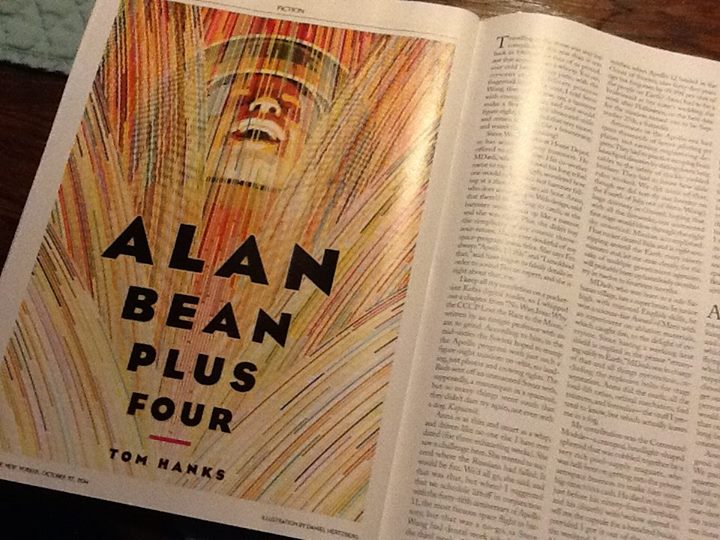
Tom Hanks in The New Yorker-smallMichael Bishop, Nebula Award-winning author of No Enemy But Time, Ancient of Days, and Philip K Dick Is Dead, Alas, has posted a brief review of Tom Hanks science fiction story in The New Yorker magazine.

Yes, Tom Hanks has a story in The New Yorker. And yes, it’s science fiction. It’s titled “Alan Bean Plus Four.” Yes, the Tom Hanks who played Forrest Gump and Captain Phillips. Look, just read what Michael said.

I read it with some initial skepticism. Sure, Hanks is an Academy Award-winning actor, but can he write?

Well, yes, he can. This tale works at the level that Hanks shoots for, and the prose, pointedly colloquial and science-savvy, shows him to have a fine command of 21st-century English as well as of current cultural, social, and technological innovations. I really like it.

You can read the complete story online here. There’s even an audio version on the same page (read by Tom Hanks. How cool is that?).

Read Michael Bishop’s complete comments on his Facebook page.

See a 1942 Pulp Magazine Rack in All Its Glory

See a 1942 Pulp Magazine Rack in All Its Glory

1942 pulp magazine rack picture-small

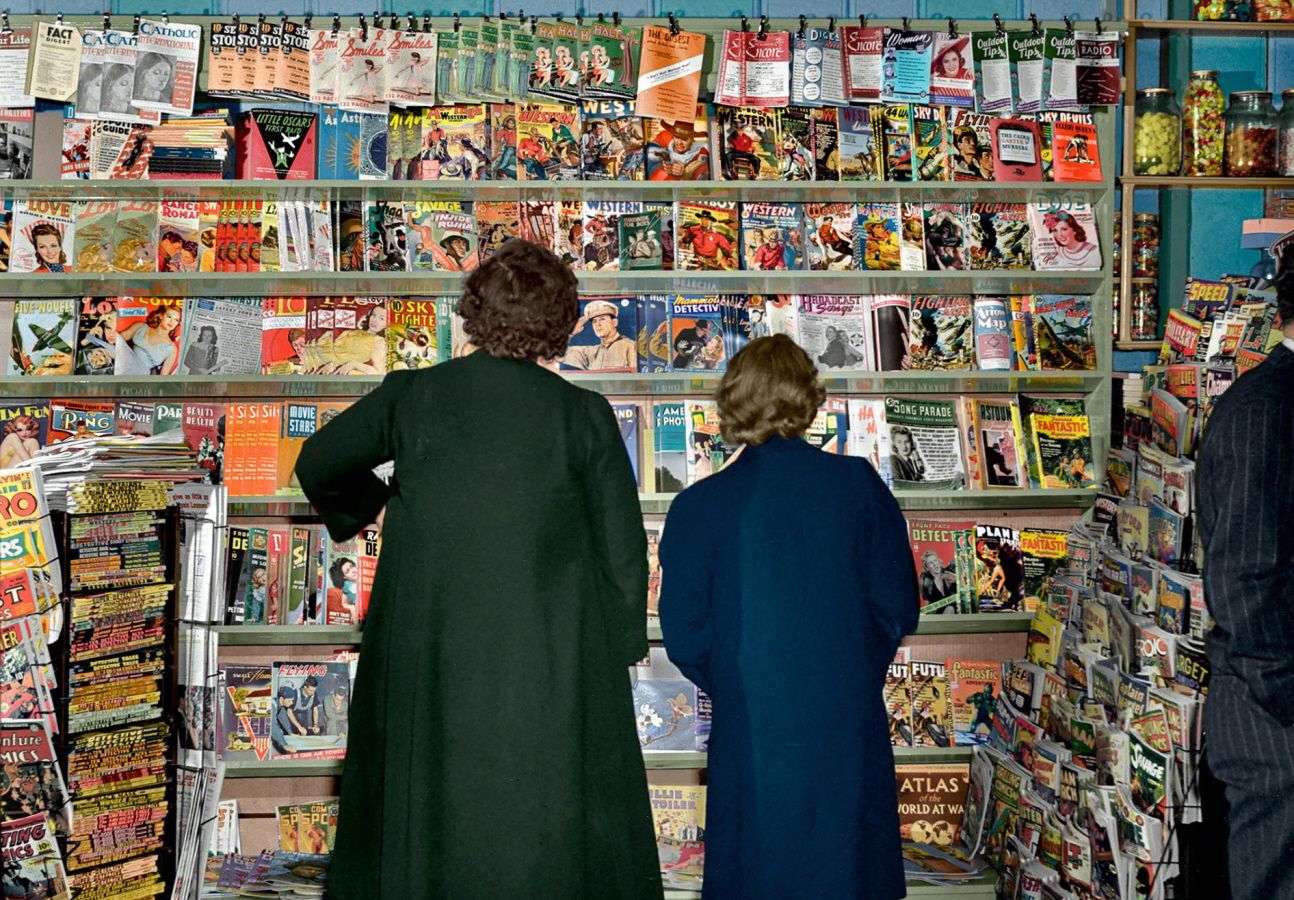
The Shorpy Historic Picture Archive, a terrific photo blog which posts vintage high-definition pics from the 1850s to 1950s, has posted an absolutely gorgeous picture of a 1942 magazine rack, crammed to overflowing with pulp magazines, slicks, comics, and much more. It’s a reminder of what newsstands were like in the heyday of the pulps. Visible in the (much reduced) image above are Astounding, Planet Stories, Famous Fantastic Mysteries, Future, Fantastic Adventures, and nearly a hundred others.

What’s truly unusual about this image is that it’s in color. The original image, however, is black and white — the finished product was hand colorized after nearly a year of painstaking detective work, matching the pulp images in the racks (sometimes barely visible) to actual covers. See the complete tale of the research involved here, and see the astounding high-resolution original (all 4.2 million pixels) here.

Art of the Genre: Owning a Time Machine

Art of the Genre: Owning a Time Machine

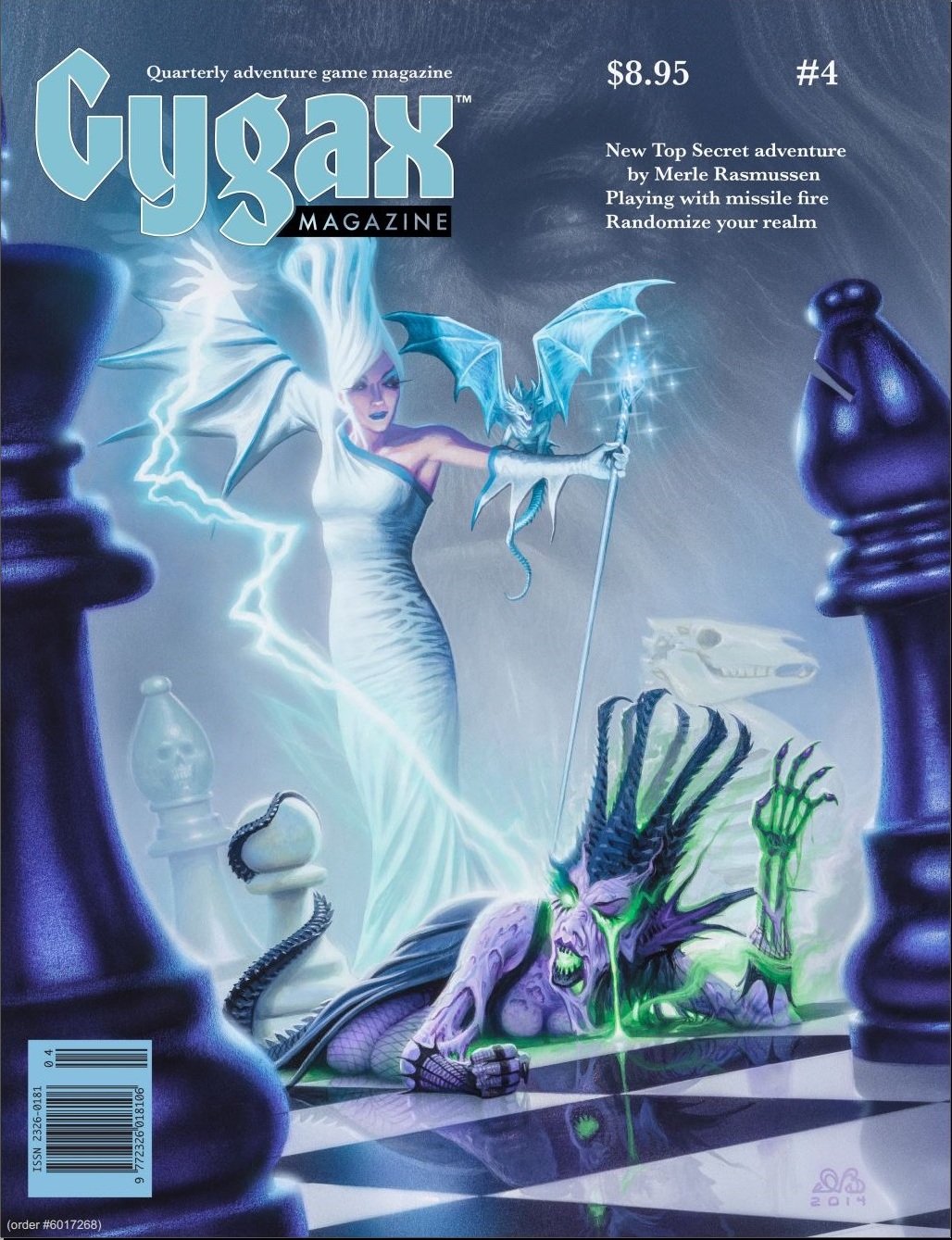
Working with artist Den Beauvais on a new Chess cover was a thrill beyond words for an old art geek like me!

It’s true, in a sense. You see, I work as the Art Director for Gygax Magazine, and as such I’m tasked with trying to recreate the artistic feel of Dragon Magazine circa 1984. So, I spend my days not only going over old art, but also trying my best to discover new talent that somehow reflects some of the best aspects of the OSR.

Certainly, there have been others that have tried this type of nostalgia-based marketing. Goodman Games comes to mind with their initial line of Dungeon Crawl Classics, and the same could be said for Rob Kuntz and his Pied Piper Press in the mid-2000s.

Still, it isn’t as easy as it sounds. You can’t simply plug in old artists and make everything perfect. Talents evolve, and in some cases erode, and working with established artists who have trademark styles sometimes limits your ability to direct them inside a product.  Egos must be taken into account, as well as their vision versus yours, and finally how a price point that satisfies everyone can be achieved.

It can be a position of highs and lows, and I’ve had some great successes as well as failures along the way, but never once did I say ‘this just isn’t worth it.’

Why?  Because I love the art.  I love the artists, and having gone so deep into their world, I understand all too well the struggles they face on a daily basis. Each time I get the opportunity to pick up a phone, call an artist, and offer them work is what gives my job meaning.

Gygax provides this incredible vehicle to do just that, and when you finally get to hold the magazine in your hands, feel it just like you did that Dragon Magazine when you were in your teens, you understand just how special it really is.

Read More Read More

Robert Silverberg on Cannon Propulsion in Space

Robert Silverberg on Cannon Propulsion in Space

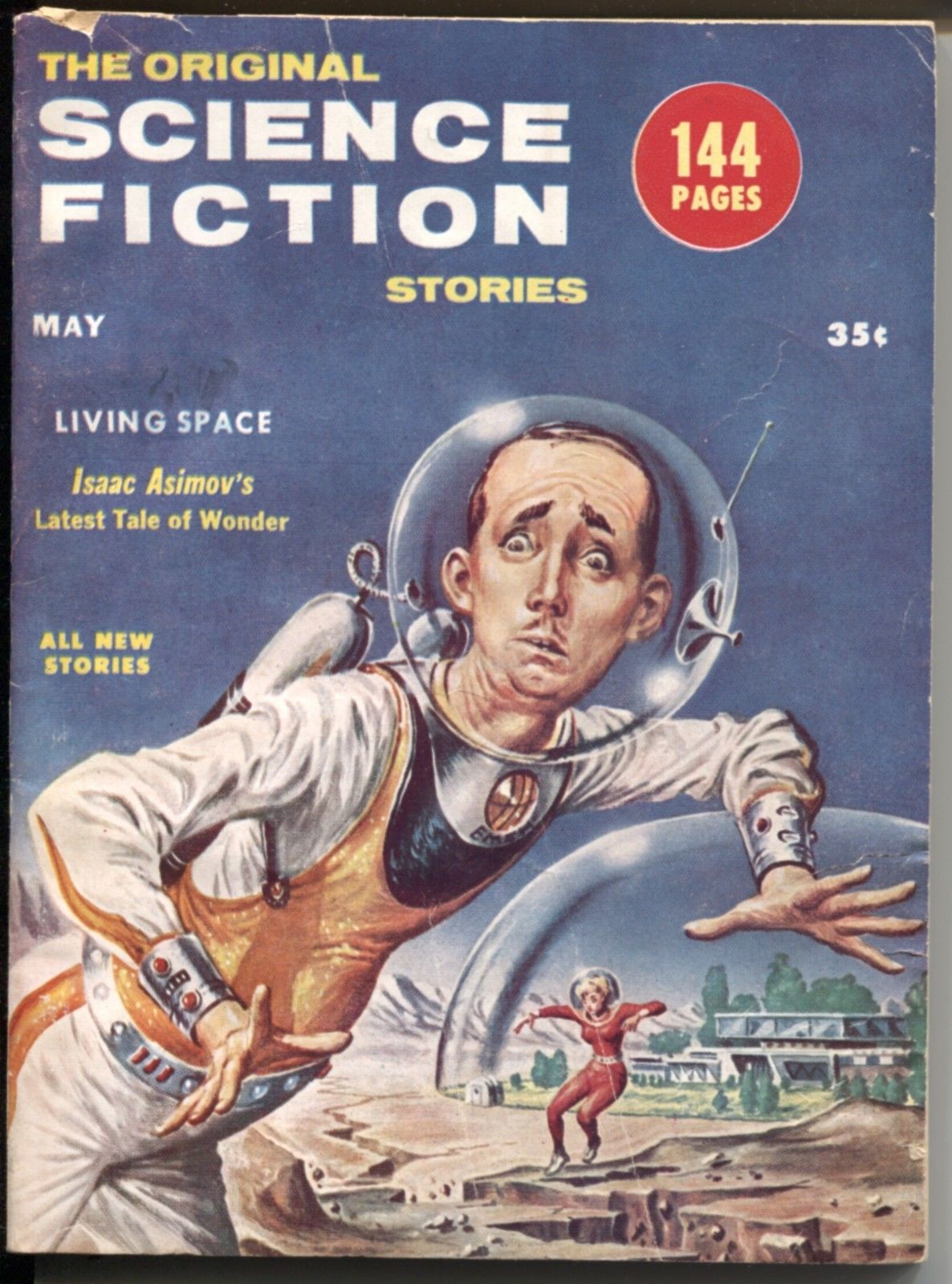
The Original Science Fiction Stories February 1959-smallIn my Sunday article on The Art of The Original Science Fiction Stories magazine, I called out the bizarrely goofy February 1959 cover (right), illustrating “Delivery Guaranteed” by Calvin M. Knox (Robert Silverberg). It’s the kind of gonzo image that only could have fit on a 1950s science fiction digest; but I was dying to know if Bob’s story actually had an intrepid couple piloting a cannon-powered wooden raft in space, and how the cover came about. Bob was gracious enough to answer; here’s what he said:

I often worked with Ed Emsh to produce cover/cover story combos for [editor Robert] Lowndes. Ed would come into the office with an idea, I would wrap a plot around it, Ed would go home and paint a picture, and I would write the story. It was Ed who thought a cannon might be sufficiently Newtonian to provide reaction mass in space; I agreed in delight, and that was how “Delivery Guaranteed” happened. (Randall Garrett sometimes wrote cover stories too, and one time Ed turned in a painting showing the drive room of a spaceship, with his signature, EMSH, on the base of the biggest gizmo. Randy promptly dubbed the gizmo “the Remshaw Drive” and made it clear that the four visible letters were part of the manufacturer’s label.)

I also asked about the cover of the November 1955 issue, illustrating Clifford D. Simak’s “Full Cycle,” which was re-used on the March 1959 issue of Double-Action Detective and Mystery Stories. (See the full article for details.)

In the case of the Simak/Silverberg story, Bob Lowndes was just being thrifty toward the end of the life of his magazine group, and recycled that Simak painting to use with my story in his crime mag a couple of years later.

Read the complete article here. And thanks to Robert Silverberg for being gracious enough to solve those mysteries for us!

Alien Quakes, Space Birds, and Door-to-Door Salesmen in Space: The Art of The Original Science Fiction Stories

Alien Quakes, Space Birds, and Door-to-Door Salesmen in Space: The Art of The Original Science Fiction Stories

The Original Science Fiction Stories May 1956-small The Original Science Fiction Stories January 1957-small The Original Science Fiction Stories November 1958-small

I recently bought a small collection of The Original Science Fiction Stories, a 1950s digest magazine that lasted for only 36 issues. I paid $18 for a dozen issues (including shipping), which was more than I usually pay for SF digests — but still a bargain, especially considering the great shape they were in. I was willing to pay a little more because I’ve had a hard time finding copies. Analog, Galaxy, F&SF — they’re all pretty easy to obtain in the same vintage. But Original Science Fiction Stories has done a good job of eluding me.

When they finally arrived, I was immediately struck by the cover art. It was vibrantly colorful and frequently gorgeous. But more than that, it was downright playful. Most SF magazines of the era took themselves very, very seriously, with intrepid, square-jawed explorers and sleek spaceships on their covers. But The Original Science Fiction Stories featured much more prosaic images, frequently showcasing less-than-heroic characters. They featured very ordinary-looking space pioneers reacting to an alien earthquake, a man on a remote planet hiding from a door-to-door salesmen, and a space-suited explorer dealing with an unexpected alien threat — a bird pecking at his air hose (all images above by Emsh).

Read More Read More

Art of the Genre: The Top 10 Dragon Magazine Covers of the 1970s & 80s

Art of the Genre: The Top 10 Dragon Magazine Covers of the 1970s & 80s

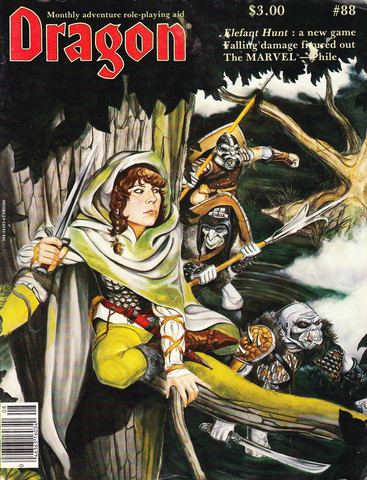
Dragon_88_Cover_largeToday would have been the 56th birthday of artist Keith Parkinson, and so I dedicate this post to his memory.

Over on my own Art of the Genre site, I talk a lot about Dragon Magazine.  And why not, there are tons of them, and most are filled with great artwork. Typically, I review at least one Dragon a week, and after doing this for a couple of years I felt it was high time I composed one of my infamous ‘Top 10’ lists here on Black Gate, this time around ‘The Top 10 Dragon Magazine Covers of the 1970s & 80s!’

First off, apologies to the 1990s and 2000s, but you all didn’t make the cut for this list and I’ll have to address those two decades in a later post.

Now, for me, finding 10 ‘top’ covers is a hard list to make, primarily because so many Dragon magazine paintings have strong feeling of nostalgia attached to them. The greatest of these, of course, would be the very first Dragon magazine I ever saw, #88, with cover by Jim Holloway. That, in my book, is #1, but I’ll do my best to take a step back, evaluate with a more critical eye, and see what that list actually shakes out as.

And remember, I’ve been blogging Art of the Genre for five years, am approaching a quarter of a million unique page views, all for free, so please don’t troll my list, I think I’ve earned the right to post it, but feel free to share memories or your own favorites!

So, without holding you hostage any further, I present my list of the Top 10 Dragon Magazine Covers from the 1970s & 80s!

Read More Read More

Black Static #41 now on Sale

Black Static #41 now on Sale

Black Static 41-smallLast month, I reported on the first issue of Black Static magazine I ever purchased, issue 40. I was very impressed.

Good thing, too, because I took a chance and bought issue #41 at the same time. I have no idea why two issues of the same magazine were simultaneously on the stands, but I’m glad they were.

On the magazine’s website is this friendly but blunt request:

Magazines like Black Static cannot survive without subscriptions and always needs more support than it gets. If you enjoy it please blog about it, review it, tell your friends, and encourage other people to subscribe. Thank you!

Truer words were never spoken. Magazines like Black Static are completely dependent on fans and readers to keep them alive. I hope this magazine survives for a good long time — but it won’t without reader support. In that spirit, I am very happy to shine a spotlight on Black Static here on the blog. If it sounds intriguing, I hope you’ll consider buying an issue next time you find yourself browsing the magazine rack.

Black Static is a British magazine of dark fantasy and horror, edited by Andy Cox. It used to be called The 3rd Alternative, until that magazine went on hiatus in 2005. It was acquired by TTA Press, the publishers of Interzone and Crimewave, and in 2007 it was relaunched as Black Static.

Read More Read More

Selling Short Fantasy, Science Fiction and Horror Fiction, Part I

Selling Short Fantasy, Science Fiction and Horror Fiction, Part I

Asimov's Science Fiction February 2014-smallA little while ago, I blogged about The Economics of Short Fiction and feedback was that there’s interest in a short series (no pun intended) on the selling of short fiction, which is a fascinatingly complex topic.

To be clear, this won’t be about the craft of writing. I’ve got lots of thoughts on creativity and the craft, some of which came out in an interview I gave to the excellent podcast the Creative Writer’s Tool Box.

In this first post on selling short fiction, I want to tackle three important pieces: (1) finding markets, (2) knowing the markets, and (3) knowing yourself.

So let’s assume you’re reading this post because you’ve written a short story, of say 5,000 words, and you’ve never looked at markets before. That’s where I was about eleven years ago.

Finding markets

There are a few places that compile market information on publishers of short fiction. I know some people swear by others for their multifunctionality [like www.duotrope.com or The (Submission) Grinder], but I find www.ralan.com far easier to use because independent of filters, there’s a list I can just browse. I’ve donated money to Ralan because I find this site so useful.

At Ralan, under the banner, you’ll see links to click on Pro markets, Semi-Pro markets, Pay markets, and Token markets (which I believe was once called 4-the-luv markets, which seemed more evocative to me). Pro markets pay SFWA rates, which are 6 cents a word and more. Semi-pro markets pay 3-5 cents a word, pay markets pay 1-2 cents, and token markets are anything below that. Ralan also shows you the lengths they publish and any sub-genres (ex.: sf/f/h means they take science fiction, fantasy and horror).

Read More Read More