Swords and Sorcery at its Pinnacle: A Look Back at The Fantastic Swordsmen
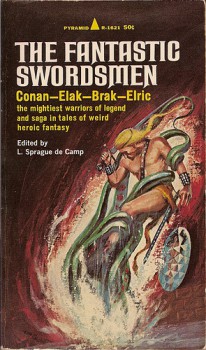
For those who put entertainment first, heroic fantasy offers it in its purest form.
— L. Sprague de Camp, The Fantastic Swordsmen
Although many of its foundational writers had already sailed into the west, swords and sorcery reached a Weird peak in the 1960s. In 1961 Fritz Leiber coined the term “swords and sorcery” in the journal Ancalagon. The Swordsmen and Sorcerer’s Guild of America (can I get a membership, please?) began the first of its secretive meetings. And the Lancer published, L. Sprague De Camp and Lin Carter-edited Conan series with its splendid Frank Frazetta covers was everywhere. These were heady times for the genre. Although the mass-produced works of the era can still be readily found and enjoyed today, I can only imagine when books like The Swords of Lankhmar could be found in drugstore wire spinner racks and the like.
In that strange time of tie-dye and Tolkien, when shining kingdoms lay spread across the pages of paperback books, Pyramid Books published four swords and sorcery anthologies. Edited by fantasy/science fiction author L. Sprague de Camp, the series began with Swords and Sorcery (1963) and concluded with 1970’s Warlocks and Warriors.
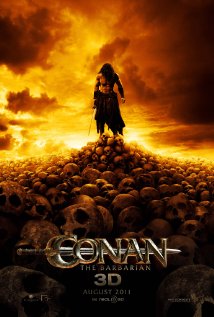
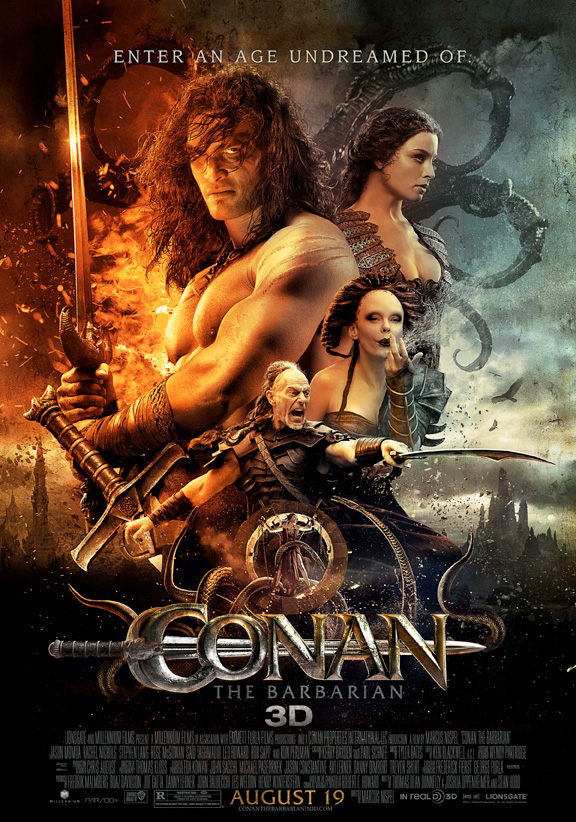 Friends, Bloggers, Conan Fans, lend me your ears! I come not to defend the new CONAN movie, but to present an informal overview that examines what works and what doesn’t work. To begin, I’ve seen a lot better movies … and I’ve seen a LOT worse movies.
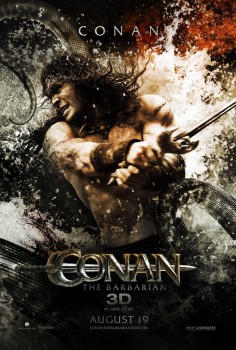 I’ve refrained from talking about Conan the Barbarian (2011) until now, despite my love for Robert E. Howard’s works. But now that we’re poised on the eve of its U.S. release, I thought I’d weigh in with my personal hopes—and fears—regarding the film.
 Imagine Conan in Shadizar, meeting with a beautiful woman calling herself Fortuna who pays him to find Thuris, the man who kidnapped her younger sister. Conan accepts the woman’s coin but finds himself in the middle of double and triple crosses as Fortuna — known as Brigid the Bold in the underworld — seeks for the Falcon of Maltus along with her betrayed confederates, Jubliex Cairo, Wilmer the Younger, and Gutmar.
  As usual, the kind of stories I was reading and writing bled into the kind of games I was playing, and this took me down a path I did not expect. I ended cobbling together a system that was purpose built to play “sword noir.” In order to do that, I had to define the term.
 It couldn’t have been easy for Novalyne Price Ellis to write One Who Walked Alone: Robert E. Howard the Final Years (Donald M. Grant Publisher, Inc., 1986). Price Ellis’ memoir of her relationship with Howard (roughly 1934-36) is illuminating in its raw honesty. It’s also painful, at turns disappointing and downright frustrating. We might find escape in Howard’s sword and sorcery tales but there is none to be found here.