Browsed by
Category: Comics

Goth Chick Crypt Notes: Nightmare World

Goth Chick Crypt Notes: Nightmare World

image0043I don’t know about you, but I never got a really clear look at horror comics as a kid, which may be why they still intrigue me to this day.

Back then, the acquisition of such contraband was generally via my older male cousins who were smart enough, even at that tender young age, to secret them inside the cover of The Archies. The comic would then be stashed between my mattress and box springs to be removed only after I had heard my parents go to bed. At this magic time, the comic would be quietly pulled out (don’t crinkle the pages too much, parents can hear that from the other side of the house) and read under a mound of stifling covers by the glow of a dimming flashlight.

The upshot of reading banned material was that I would scare myself silly and fall asleep clutching the flickering flashlight until the batteries went dead. It always seemed that the shadows cast under the covers and against the pages muted the comic book colors and make the icky stuff inside come to life.

Thus the reason horror comics were verboten.

Which, I suspect, is how I gained a lifelong addiction to horror comics and likely also the cause of ever-increasingly strong contact lenses as an adult.

Read More Read More

Fright: The Forgotten Dracula Comic

Fright: The Forgotten Dracula Comic

untitledsonofdraculaMost comic fans are aware that while the Marvel Age of Comics may have begun with the 1961 publication of the first issue of The Fantastic Four, the imprint actually began in 1939 when Timely Comics published the first issue of Marvel Comics with the Golden Age Human Torch on the cover. In the 1950’s, Timely Comics became Atlas Comics who continued to publish Cold War adventures of Timely’s Golden Age favorites as well as horror anthology titles and westerns. Far fewer comic fans recall that Atlas Comics was briefly revived in the mid-seventies as a rival to Marvel under the auspices of estranged family members of Marvel’s publisher and editor-in-chief. They stole Marvel talent and did their best to give the industry giant a real run for its money.

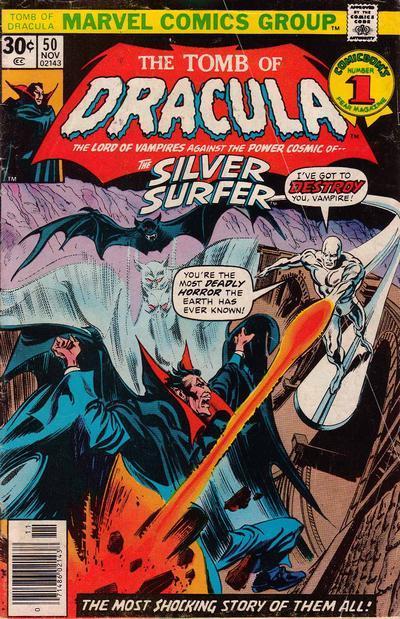
At the time, Marvel had taken advantage of the loosening of the Comics Code Authority and produced the award-winning horror title, The Tomb of Dracula. The dark look and tone of the book combined with the consistently strong scripting by Marv Wolfman and stunning art work by Gene Colan (inked by Tom Palmer) made the 70-issue run of the original series one of the biggest artistic and commercial success stories of the decade. While Marvel has never quite managed to bottle lightning with the title a second time, revivals are frequent while sales of reprints remain strong nearly forty years after the fact. While the book was busy collecting industry awards for the exceptional talent of its creators and the level of maturity they brought to the title, the newly-revived Atlas Comics prepared their answer in the form of the first and (as it turned out) only issue of Fright featuring The Son of Dracula in the spring of 1975.

Read More Read More

Art of the Genre: Star Frontiers

Art of the Genre: Star Frontiers

Star Frontiers Alpha Dawn Cover Copyright WotC

It’s summer intern time here at Black Gate L.A., John having flown in Sue ‘Goth Chick’ Granquist to help break them in. She’s not in love with the beach and the sun, but I must say seeing her in a black one-piece, Jackie-O glasses, and a hat right out of Vampire Hunter D, I had to take a shot with my iPhone because Ryan Harvey [who was struggling with a deadline instead of taking in some sun] would have never believed it otherwise.

That picture, snapped at a moment’s notice, got me thinking about technology and the crazy almost science fiction world we live in. When I was in junior high, way back in the early 80s, my love affair with D&D was in full bloom, and TSR was expanding its brand with new genres like the 1920s prohibition classic Gangbusters, the Bond-like Top Secret, and my personal favorite the space opera Star Frontiers.

Read More Read More

Art of the Genre: Special Critical Hit

Art of the Genre: Special Critical Hit

Homage
Homage
Two weeks ago I posted a small piece on the passing of Jim Roslof. Afterward I spoke to several people concerning some kind of tribute art, but nothing developed until I came across an idea for The Critical Hit concerning Jim.

So, this is both my, and Jeff Laubenstein’s, tribute to Jim and his body of work. For all you old folks out there, you need no introduction, but anyone else, I’ll post the original art we’re referencing as well.

This tribute to Roslof can be seen as perhaps a threefold homage, co-authors David C Sutherland III passing away in 2005, and Gary Gygax in 2008. Q1 Queen of the Demonweb Pits debuted in a tournament edition for Origins in 1979. It was scripted by artist/writer Sutherland and completed by Gygax before being turned into the culmination adventure of the G-1-2-3, D 1-2-3 adventure path.

A cut above.  The classic Q1.
A cut above. The classic Q1.
The adventure revolves around a party going into ‘the demonweb pits’, the 66th level of the Abyss controlled by the Drow goddess Lolth. There, they must overcome her minions, deal with the labrynth of corridors and gates involved, and finally deal with Lolth herself. I’ve had the pleasure of DMing this module once and playing in it twice, and for me I think it is a wonderful end to perhaps the greatest set of gaming modules ever produced.

Today, Fleetwood the Fighter and Grumbltash the Wizard, along with three trusty NPCs, have fallen into the same scene as that fateful party in 1980. I’d say wish them luck, but it looks like Fleetwood is familiar with the module and monster stats already…

Anyway, I’d like to say once again to Jim, David, and Gary, thanks for all the fond memories!

Crawling From the Wreckage: Grant Morrison’s Doom Patrol

Crawling From the Wreckage: Grant Morrison’s Doom Patrol

Doom Patrol 19Grant Morrison’s Doom Patrol needs no context to be enjoyed; it is its own strange, powerful creature. But describing the context of the thing helps to throw into relief the accomplishment of the work. And for those who may not know the comic, explaining what it came out of may help to explain what it is itself.

The Doom Patrol was a group of characters created for DC Comics in the early 60s, as the Silver Age of comics was getting underway; their first appearance, in My Greatest Adventure #80, hit the stands just before the first issue of Marvel’s X-Men. The two groups were famously similar: both were led by wheelchair-bound geniuses, and more significantly, both were a little stranger, a little darker, than other supergroups. The Patrol consisted of the Chief, the aforementioned scientific genius; Cliff Steele, AKA Robotman, whose brain had been transplanted into a metal body following a terrible accident; Negative Man, or Larry Trainor, a pilot wrapped in bandages who controlled a strange black ‘negative spirit’; and Elasti-Girl, Rita Farr, who could increase or decrease her size tremendously. Besides the similarity to the X-Men, the group vaguely resembled another Marvel team: the scientist leader, the orange-hued strongman (Robotman), the flying energy-controller (Negative Man), the woman who could disappear (by shrinking out of sight).

Read More Read More

Rediscovering the Ubiquitous Donald F. Glut

Rediscovering the Ubiquitous Donald F. Glut

frank_kindleDonald F. Glut is best associated with his 1980 novelization of The Empire Strikes Back. Some may recall his name today if they are between the ages of 40 and 45 and the movie was a touchstone of their childhood. I was not yet nine years old when the film was first released and read and re-read the paperback over and over again at a time when Star Wars meant as much to me as The Clone Wars does to my kids. The difference was, at age eight, I already recognized the name Donald F. Glut and knew him for a mysterious individual to be respected and admired because he wrote everything I wanted to read.

I was an avid comic book junkie as a kid and adored classic horror and science fiction films of decades past like many that grew up in the 1970s. Donald F. Glut was not a name like Stan Lee or Roy Thomas or even Len Wein or Marv Wolfman that I associated with specific titles that I eagerly devoured each month. Glut appeared where I least expected to find him – which in his case was nearly everywhere.

1An early 1978 issue of Marvel’s Star Wars, a stray issue of Marvel’s adaptation of Robert E. Howard’s Kull the Conqueror that somehow made it past my Mom and into my hands, an Incredible Hulk mini-storybook that I picked up at Woolworth’s – they all bore his credit as author. It didn’t end with comic books. In those days before the internet, libraries were treasure houses for information and non-fiction books on the Frankenstein Monster or dinosaurs that I pulled off the shelf with trembling hands were also from the pen of the amazing Mr. Glut.

Read More Read More

Goth Chick News: Barnabas Collins Rises

Goth Chick News: Barnabas Collins Rises

image0061Though I would normally start this post by ranting about the lack of originality in Hollywood and threaten to stick my thumbs in the Black Gate blender if yet one more remake crawls into a theater near me, I’m brought up short by news of a project with a serious pedigree.

Dark Shadows is slated to start production this Spring for an early 2012 release.

If you tell me you aren’t acquainted with Mr. Barnabas Collins I will first need to inquire how the weather here compares with your home in the Congo, and did you have a pleasant flight into civilization yesterday? I would then go on to tell you that Dark Shadows was a first-of-its-kind gothic soap opera dealing primarily with supernatural themes and if, like me, you were to discover it for the first time while watching contraband reruns at a 10-year-old’s birthday sleepover, it would have scared the crap out of you.

First impressions, no matter how traumatic, can stick with a person for a lifetime and Dark Shadows clearly stuck with a large segment of the population.

Read More Read More

Graphic Noir: A Random Sample

Graphic Noir: A Random Sample

peter-gunn-dell-4colorNoir comics have bubbled under the surface for decades. Even the mainstream success of the Dick Tracy newspaper strip failed to bring hardboiled detectives to the forefront of the medium. Batman started off as a noir title before quickly eschewing dark corners for brightly-colored superhero theatrics for decades. TV and movie tie-in’s, usually one-off’s from publishers like Dell popped up here and there but failed to be anything more than curios.

playback1A quick look at Dell’s Peter Gunn one-shot from 1959 is a perfect example. The television series was strictly adult fare in its day with a 9:30 PM time slot so it’s strange to see a kid-friendly comic with Pete tracking down a maker of counterfeit postage stamps as the lead story.

Dell fared much better with the simultaneous publication of a TV tie-in novel by the author of the Peter Chambers series, Henry Kane. That book managed to aim for a more sophisticated audience than late fifties network television standards would allow making Dell’s dime comic all the more strange in comparison.

The advent of the graphic novel was really the medium that allowed noir titles to flourish. Darker, more adult and frequently self-contained, the graphic novel was the perfect vehicle to bring hardboiled detectives into the graphic medium. Jim Steranko may have been the first to exploit the combination with Red Tide (1976) featuring the adventures of a gumshoe named Chandler in an appreciative nod to the creator of Philip Marlowe. That seminal work was the first graphic noir in the United States, Europe having got the drop on us first.

Read More Read More

Goth Chick News: “Slasher Films”… Really?

Goth Chick News: “Slasher Films”… Really?

image0043I was right on the verge of having a field day with this and it couldn’t have come at a better time.

It starts with today being exactly 24 hours past my usual Black Gate deadline. The events leading up to this would appear to be insignificant, but trust me when I say their aggregated affect — culminating in the toilet set being left up (again) in the “unisex” Black Gate bathroom — had wreaked utter havoc with my normally cheery disposition.

But then a ray of sunshine penetrated the underground bunker of the Goth Chick offices; a statement so rife with possibilities that I was mentally riffing on it before the final syllable was spoken.

“Slash is starting a horror movie production company.”

Oh yes, it was going to be a good day after all.

Let me back up and color this in a bit for you.

The year is 1988 and a hair band out of Los Angeles called Guns n’ Roses finally scores a number one hit with “Sweet Child o’ Mine.” There’s a guy with a wild mass of long, frizzy black locks, banging away on lead guitar who was christened Saul Hudson when he was born in Hampstead, England but was now know by the far cooler name “Slash.”

Yep, that Slash.

Read More Read More

Wizard and ToyFare Magazines Cease Publication

Wizard and ToyFare Magazines Cease Publication

wizard-issue-234Longtime comic magazine Wizard, once one of the most popular publications in the industry, has folded. Its sister magazine ToyFare, dedicated to pop-culture toys and action figures, has also ceased publication. Both magazines were owned by Wizard Entertainment.

Wizard was launched in 1991, near the height of the “speculator boom,” fueled by the arrival of Image Comics and the rise of superstar artists such as Todd McFarlane and Jim Lee. Dedicated to covering news, pricing trends, and personalities in the field, Wizard quickly captured a large readership and brought real production values — including glossy paper, full-color interiors, and rock-star journalism — to comic fandom for the first time.

With its regular Wizard Top 10 and Market Watch columns, which reported on the “hottest back issues” of the month and predicted future price trends, Wizard catered to a new generation of fans and buyers who purchased comics chiefly for their collectability and perceived future value.

It also shared much of the blame when the comic marketplace collapsed as those speculators, burned by numerous bad investments, fled the market in the late 90s.

toyfare-16111Two-thirds of comic book stores across the country closed between 1993 and 1997,  many major publishers were driven out of business, and even Marvel Comics declared bankruptcy in 1997.

For most of its life every issue of Wizard also had a price index, allowing collectors to track the price of their latest hot comics month-to-month (but I only read it for the articles).

At the peak of its popularity Wizard sold over 110,000 copies/month through Diamond alone.  With its final issue, that number had dropped to 17,000.

Publisher Wizard Entertainment made this announcement yesterday:

Wizard Entertainment is ceasing publication of the print magazines Wizard and ToyFare. Wizard World, Inc. will begin production of the online publication ‘Wizard World’ beginning in February. We feel this will allow us to reach an even wider audience in a format that is increasingly popular and more readily accessible.”

Wizard Entertainment continues with its other ventures, including the Chicago Comic Con and many other conventions. Their website is here.