Browsed by
Category: Books

Last Night I Finished This Crooked Way

Last Night I Finished This Crooked Way

thiscrookedway
Last night I finished This Crooked Way, by James Enge.

I was on the train, halfway home. There is very little more irritating than finishing a book when you’re just halfway to your destination. Luckily, I had George R.R. Martin’s Fevre Dream in my backpack, the first two chapters of which were quite good, so I didn’t suffer long. And anyway, good as it was, I kept being drawn back to thoughts of This Crooked Way, connecting dots, remembering the heights, the depths, the scaffolding of each story, and how it made me laugh – out loud – so often that I surprised myself.

There are some books that make me read them aloud – mostly their dialogue, but also certain killer phrases or descriptions. It’s my actor’s training, I suppose. Plays are not meant to be read on the page; you have to voice them lest they lose vibrancy and dimension. Some books, my favorite kind of books, leap into my throat and start declaiming themselves. And it doesn’t matter if I’m on a public train, or tromping to work in the snow with my fingers freezing, because I’ve left off my gloves, because it’s hard to turn pages with gloves on – none of that matters, because the words are just that important.

And This Crooked Way is like that.

Read More Read More

Reading Goals in the New Year

Reading Goals in the New Year

book_stackAs some of you may know, I’ve been talking and thinking and blogging (not necessarily in that order) about reading more, and reading better over the course of the last year. Today being New Year’s Day, the day of resolutions and goal-setting, I thought I’d link to some of the posts I’ve written on the subject for those interested in focusing on ratcheting up their reading in the coming year.

Firstly, something of a summary of my reading posts can be found in a three part article that has recently gone up at Grasping For the Wind called ‘Ramp Up Your Reading.’ In the first part, ‘More and Faster‘ I go over ways to try to get more reading hours shoehorned into the day. In ‘Do It Better‘ I focus more on the quality of one’s reading, and how slowing things down can often be a more efficient use of time than trying to skim through a lot of books. Finally, in ‘Expand Your Horizons,’ I talk a bit about challenging yourself to read outside your comfort zone or in a more focused way. That post grew out of starting my own experiment in the form of a Five Book Challenge, in which a friend of mine and I each assigned one another five books to read in the coming year.

Regular readers of the Black Gate blog will have read some of my posts on reading in the past that pertain to increasing one’s reading output. Both my post on keeping reading lists and “speed reading” focus on trying to get more read over time. I’ve also talked about reading ruts and obsession in Specialist and Generalist Readers. Beyond the practical, my paen On Bookmarks may be of interest, as might my celebration of browsing in a brick-and-mortar bookstore: Books Best Appreciated in Their Natural Habitat. Any way you slice it, a nice, fresh, new year is the perfect time to decide you are going to read that fat classic or epic series you always wanted to, or set some goal for yourself like reading a book a week or shooting for 100 books in a year. Whatever your personal goals, it’s always satisfying to to do something different and new — after all, it is a New Year, and I think it’s worth trying to keep it ‘new’ as long as we can.
__________
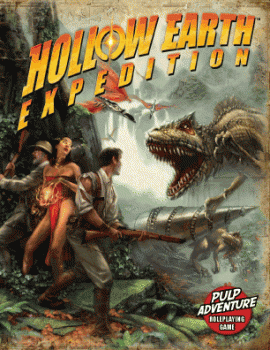
BILL WARD is a genre writer, editor, and blogger wanted across the Outer Colonies for crimes against the written word. His fiction has appeared in numerous magazines and anthologies, as well as gaming supplements and websites. He is a Contributing Editor and reviewer for Black Gate Magazine, and 423rd in line for the throne of Lost Lemuria. Read more at BILL’s blog, DEEP DOWN GENRE HOUND.

IMARO: The Naama War by Charles Saunders

IMARO: The Naama War by Charles Saunders

naama-warBack when Black Gate‘s editor John O’Neill lived in Ottawa in the early 80s, he was a member of a small SF fan club.  His first meeting featured a reading from the editor of an excellent local fanzine, Stardock, who had just completed his first novel.  The author was Charles Saunders, the novel was Imaro, and the reading he never forgot.

DAW released the first three Imaro novels between 1981 and 1985, then dropped the series for reasons arising from textbook bad marketing decisions, a lawsuit from the Edgar Rice Burroughs estate over a poorly chosen cover quote (“The Epic Novel of a Black Tarzan”), and publishing delays.

For the whole sordid tale, read Charles de Lint’s introduction to the Night Shade edition of the first novel.

Night Shade books released the first two books, Imaro and The Quest for Cush, in handsome new editions in 2006 & 2007, and Saunders self-published the third volume, The Trail of Bohu, through his Sword & Soul Media press last year.

The true tragedy of the saga of Imaro is that the fourth novel has never been published – until now.

Read More Read More

Pastisches ‘R’ Us: Conan the Unconquered

Pastisches ‘R’ Us: Conan the Unconquered

conan-the-unconqueredConan the Unconquered
Robert Jordan (Tor, 1983)

Moving on with my Conan/Robert Jordan double-feature. . . .

With Conan the Unconquered, Robert Jordan’s third book in the series, the author seems settled with his style of writing the Hyborian Age. Some of the flaws in Conan the Defender are subdued, although the story is the average “meat ‘n’ potatoes” Conan pastiche material. The book has a feeling of comfort food: neither challenging nor surprising, but providing decent sword-and-sorcery entertainment.

The plot of Conan the Unconquered follows the Middle Eastern fantasy playbook, set around the Vilayet Sea in the Kingdom of Turan, with an excursion across the waters to Hyrkanian lands. Conan is not yet in his twenties, and has arrived in the Turanian city of Aghrapur. A compatriot from his thieving days, Emilio from Corinth, approaches Conan with the offer to join in stealing a necklace from a compound outside the city. The compound belongs to the Cult of Doom, whose members may be responsible for many assassinations occurring in the city. (The Cult of Doom sounds as if Jordan is swiping from the recent movie Conan the Barbarian.) Emilio’s lover, Davinia, is the one who wants the necklace stolen. Conan no longer wants to dabble in thievery, but after the astrologer Sharak casts a chart for the barbarian, he changes his mind and seeks out Emilio from the stewpots of Aghrapur.

As usual with pastiches, Conan has slender reason to stay in the story; the device of Sharak’s chart is a flimsy one (and Sharak as a plot device hangs around far longer than he’s needed) to keep Conan interested in the Cult of Doom and its necromancer leader Jhandar. Jordan manages to coax Conan into the story faster than in Conan the Defender with some sleight-of-hand that makes both Conan and Jhandar believe the other must die for them to live. Conan allies with a vengeance-minded Turanian sergeant, a group of Hyrkanians chasing after Jhandar for the desolation he brought to their land, and the beautiful Yasbet who keeps her parentage a secret.

Read More Read More

The cure for Trilogy Fatigue: Brandon Sanderson’s Warbreaker

The cure for Trilogy Fatigue: Brandon Sanderson’s Warbreaker

warbreaker-smallAnyone familiar with the Mistborn series knows Sanderson is expert at spinning fantasy stories packed with memorable characters, crisply detailed settings, unique magic, and major helpings of intrigue. Lately he’s been feted as the writer continuing Robert Jordan’s Wheel of Time series. While I realize that from a purely professional standpoint, the deal was a no-brainer, I hope cleaning up the WoT‘s loose ends won’t keep this talented author from giving us more of his own marvelous work.

Those suffering from “trilogy fatigue” will be happy to learn that Warbreaker is a stand-alone story. Welcome to Hallandren, a vast and mighty empire ruled by God King Susebron. The Hallandren capital T’Telir is a city of wonders and dangers, thanks to the Awakeners, sorcerers who use the color of everyday objects to control the life force called Breath and feed their BioChromatic magic.

Appalled at the innocent lives spent to fuel the Awakeners’ magic, the true ruling family of Hallandren escaped to remote Idris. No one wears color in pious Idris. No one weaves bright tapestries, paints lush landscapes, or glazes pots to a rich sheen, all for fear of Awakener magic. And Idrians born with Awakener abilities strive to hide them at any cost.

But things are about to change.

Read More Read More

Harry Connolly’s Child of Fire

Harry Connolly’s Child of Fire

childoffireHarry James Connolly made his first fiction sale with “The Whoremaster of Pald,” way back in issue 2 of Black Gate. 

It was the most popular piece in the issue by a fair margin, and not just because the title grabbed readers’ attention (although, speaking as the person who picked it out of the submissions pile, the title definitely didn’t hurt).

Since then Harry has appeared frequently in our pages and his fourth story, “Eating Venom,” will be in BG 15.  But he hasn’t spent all his efforts on short fiction, as evidenced by the arrival of his first novel, Child of Fire.

Child of Fire is described as “a contemporary fantasy in the tone and style of a crime thriller,” and it’s received a lot of great press — including a mention on the Publishers Weekly’s Best Books of 2009 list. 

Here’s what bestselling author Jim Butcher says about it:

“Excellent reading… has a lot of things I love in a book: a truly dark and sinister world, delicious tension and suspense, violence so gritty you’ll get something in your eye just reading it, and a gorgeously flawed protagonist. Take this one to the checkout counter. Seriously.”

And here’s the publisher’s blurb:

Ray Lilly is just supposed to be the driver. Sure, he has a little magic, but it’s Annalise, his boss, who has the real power. Ray may not like driving her across the country so she can hunt and kill people who play with dangerous spells­especially summoning spells­but if he tries to quit he’ll move right to the top of her hit list.

Unfortunately, Annalise’s next kill goes wrong and she is critically injured. Ray must complete her assignment alone­he has to stop a man who’s sacrificing children to make his community thrive, and also find the inhuman supernatural power fueling his magic.

 I finally got my hands on a copy, and I can’t wait to dig in.
 
Win a Copy of This Crooked Way!

Win a Copy of This Crooked Way!

thiscrookedway_mechJames Enge’s Morlock stories have been some of the most popular fiction we’ve published in Black Gate.  His first Morlock novel, Blood of Ambrose, published by Pyr in April, was very warmly received, and described as “A future classic… this novel succeeds beautifully” (The Great Geek Manual) and “Like Conan as written by Raymond Chandler” (Paul Cornell).

The second volume, This Crooked Way, went on sale October 6th.  More than just a collection of previously published Morlock fiction, This Crooked Way has 15 chapters, only 5 of which have previously appeared.  We’ve received a small number of advance copies, and we want to give them to you.

We’ve asked James Enge to compile a list of questions, the answers to which lie in the five Morlock stories that have appeared in Black Gate.  The first five readers to fill out and submit the quiz below with the correct answers will receive a copy of This Crooked Way, compliments of Black Gate, James Enge, and Pyr.

The usual legal disclaimers apply: Offer void where prohibited.  No purchase necessary.  Must be 18 to enter.  Judges decisions are final.  Postage costs outside the US are the responsibility of the winner.  Additional disclaimers apply as we think of them.  Eat your vegetables.

Read More Read More

Why I Like Lin Carter

Why I Like Lin Carter

enchantress-small3Linwood Vrooman Carter (1930-1988) was one of the heroes of my youth. In the decades since his death his reputation has wallowed in the aftermath of the Last Great Sword & Sorcery Boom. He helped start it, with the Conan books he and L. Sprague de Camp brought back into print, edited, and in many cases wrote, as with the Ballantine Adult Fantasy Series of works he edited and thus brought back into print. (Not adult fantasy as in sex, but adult fantasy as in great classic works that weren’t kid stuff). Books by Lovecraft and Clark Ashton Smith and James Branch Cabell; title I never would’ve read in a million years otherwise, but books which shaped the tastes of many another fantasy enthusiast, myself among them.

Despite the vast number of books written in the Sword & Sorcery genre in the past 80 years, when I found myself again turning an eye toward them, one of the first people I sought out was Carter. I distinctly remember the day, age 13, when I bought his Enchantress of World’s End off the spin rack at the Wal-Mart in Harrison, Ark.

The bare-bosomed, bright red beauty on the cover caught my eye, as did the unpronounceable names (Northern YamaYamaLand, Dzimdazoul’s Deep – not to mention the Ethical Triumvirs of Chx!), and of course the cast: Ganelon Silvermane, muscle-clad hero with the mind of a child, his master the Illusionist of Nerelon, face always hidden behind veil of purple mist, and the delightful, freckled, long-legged and sexy Xarda, Knightrix of Jemmerdy.

Read More Read More

Writing Book Reviews — How and Why

Writing Book Reviews — How and Why

pile-of-books3I’ve been in reviewer overload lately, reading, taking notes, and penning reviews for the next issue of Black Gate. But, more than that, I’ve also been coordinating our crop of reviewers this time out, and thinking in terms of what exactly it is that ought to be in the review section of the magazine, not just in the reviews I put up on my own website. Having done over 50 reviews in the last year and a half or so, I think I’ve learned a few things, and I’d like to share my thoughts on what a good review should consist of. And at the end of this essay I’ll also offer some practical advice to anyone that wants to become a web reviewer themselves and share the reasons behind just why someone would want to take the time to review a book in the first place.

The first distinction we need to make is between a book review and a book report. Reviews are critiques that take a lot of factors into consideration and demand a certain level of knowledge and discernment from the reviewer. Book reports are those bland plot summaries you used to have to write in school to prove to the teacher you actually did your assigned reading. I’ve seen so-called reviewers whose work falls squarely into the later category but, aside from generating web content for google, such work holds little real value.

Read More Read More

Who Gods There?: “The Elder Gods” by Don A. Stuart

Who Gods There?: “The Elder Gods” by Don A. Stuart

Unknown October 1939I’m guest-blogging this week at Babel Clash, along with fellow Pyr author Matt Sturges, and for the past couple days we’ve been kicking around the topic of our influences and anti-influences. It’s not always the biggest books or the best that are influences, though. For instance…

Don A. Stuart‘s “The Elder Gods” is a fantasy novella from the late 1930s that reads a lot like the science fiction being written around the same time. That’s no accident: the author behind the pseudonym is John W. Campbell, once a leading light in the “super science” stories of the 1930s, later a pioneer of a more sophisticated form of speculative fiction, and (by the time the work under review appeared) he was well into his third and longest career as the influential editor of Astounding Science Fiction–and the new fantasy magazine Unknown, in which “The Elder Gods” first appeared. (I reread it in a rather battered copy of the 1970s Ace reprint of The Moon is Hell; but there’s a NESFA edition of Campbell’s Stuart stories, including “The Elder Gods”. That’s what I’d recommend seeking out, if you’re interested, as there are some typographical glitches in the Ace edition; plus, it may be harder to find; plus, I’ve always thought “The Moon Is Hell” was a stupid title.)

In Unknown, Campbell didn’t want to create yet another knockoff of Weird Tales; the tagline for the paper-covered anthology From Unknown Worlds was “Fantasy Stories for Grown Ups”–by which he seems to have meant the serious grownups who were reading Astounding. Lots of his Astounding writers crossed over to write for Unknown, and “The Elder Gods” was apparently his how-to-do-it example, applying the Astounding method of speculative fiction to fantasy.

[ Spectacular Stories of Scientific Theology beyond the jump.]

Read More Read More