Browsed by
Category: Books

Losing My Way to Ray
Losing My Way to Ray

100Revisiting the stories of Ray Bradbury has been a lot like sitting down to revisit Twilight Zone episodes. I don’t just mean the twist ending, though there is that. I mean the other things – the misanthropic critic/hero/rebel who talks for a long while, perhaps too long, about the troubles of society, of humanity. The mirror held up to show us ourselves as we once were when all men wore hats and all women wore dresses. The sad realization that while there are cool and brilliant bits, our sense of pacing has changed, and that having experienced enough of these stories, we get the sense of how an unfamiliar one will end.

I loved Ray Bradbury’s stories as a child. I remember the thrill of picking up one of his short story collections because you’d never know what you’d get, story to story, and the titles rarely told you. Would it be a horror story, something from ancient China? A space adventure? Would the ending be dark, or light? In grade school, it was always a profound relief to find a Ray Bradbury tale in the school literature readers, for you knew you’d be transported to some interesting place.

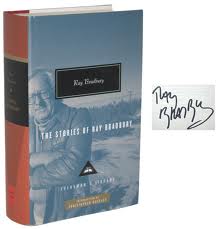
Fired by nostalgia, wanting to celebrate my first favorite author, I read The Martian Chronicles for the first time in 30 years, and then I began to work my way through The Stories of Ray Bradbury, which collects 100 tales, many of which I’d never read.

And I discovered that I couldn’t go home again. I keep setting the book aside, then coming back to try just one more, to see if I could recapture the old thrill.

It’s not Bradbury who changed – the words are still threaded together with that same poetic skill. The messages are still poignant or powerful, depending upon the tale. Yet I can’t lose myself in them anymore. I want to – God, how I want to – but I just can’t fall through the words and get lost in the wonder. I must have found him at just the right age. And now, I think, I must have gotten old. Morosely, I have set the book aside, and I am not sure I will return.


Howard Andrew Jones is the author of the historical fantasy novels The Desert of Souls, and the forthcoming The Bones of the Old Ones, as well as the related short story collection The Waters of Eternity, and the Paizo Pathfinder novel Plague of Shadows. You can keep up with him at his website, www.howardandrewjones.com, and keep up with him on Twitter or follow his occasional meanderings on Facebook.
A Dance With Dragons wins the 2012 Locus Award for Best Fantasy Novel

A Dance With Dragons wins the 2012 Locus Award for Best Fantasy Novel

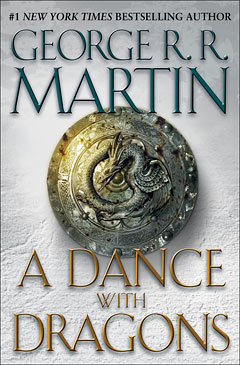
a-dance-with-dragonsThe winners of the 2012 Locus Awards were announced today:

Fantasy Novel — A Dance with Dragons, George R.R. Martin
Science Fiction Novel — Embassytown, China Miéville
First Novel — The Night Circus, Erin Morgenstern
Young Adult Book — The Girl Who Circumnavigated Fairyland in a Ship of Her Own Making, Catherynne M. Valente
Novella — “Silently and Very Fast,” Catherynne M. Valente (WSFA; Clarkesworld)
Novelette — “White Lines on a Green Field”, Catherynne M. Valente (Subterranean Fall ’11)
Short Story — “The Case of Death and Honey”, Neil Gaiman (A Study in Sherlock)
Anthology — The Year’s Best Science Fiction: Twenty-eighth Annual Collection, edited by Gardner Dozois
Collection — The Bible Repairman and Other Stories, Tim Powers
Non-fiction — Evaporating Genres: Essays on Fantastic Literature, Gary K. Wolfe
Art Book — Spectrum 18, Cathy Fenner & Arnie Fenner
Artist — Shaun Tan
Editor — Ellen Datlow
Magazine — Asimov’s Science Fiction
Publisher — Tor

The Locus Awards are presented annually to winners of Locus Magazine’s readers’ poll. The award was first given in 1971; last year’s fantasy winner was Kraken, by China Miéville. We reported on the 2011 awards here.

Congratulations to the winners, and special congratulations to Cat Valente for sweeping three categories: Young Adult Book, Novelette  and Novella.

Complete details on the 2012 winners, including all the nominees, are available at Locus Online.

New Treasures: Dungeons & Dragons Into the Unknown: The Dungeon Survival Handbook

New Treasures: Dungeons & Dragons Into the Unknown: The Dungeon Survival Handbook

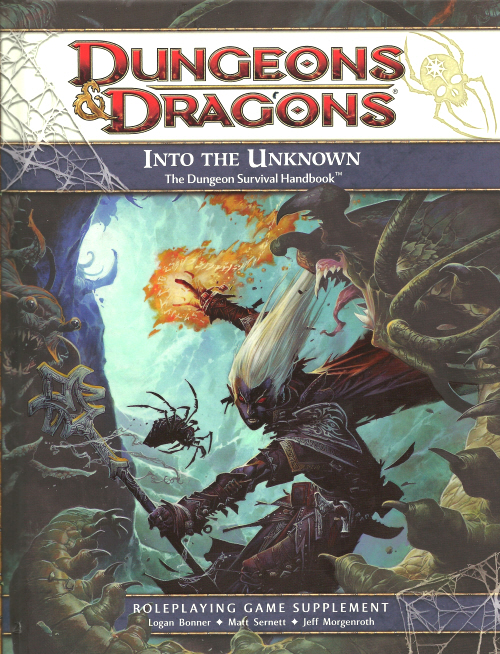
into-the-unknownI don’t get to play D&D as much as I’d like these days. Which means that my enjoyment of the latest supplements chiefly depends on how fun they are to read. By that measure, Into the Unknown: The Dungeon Survival Handbook is one of the best books to come from Wizards of the Coast in a while.

What makes this one stand out? On the surface it’s pretty lightweight, described as

A guide for players and Dungeon Masters who want to play in a Dungeons & Dragons game that explores dungeons and plumbs the blackest reaches of the Underdark… Players will find an assortment of new powers, equipment, feats, character themes, and player races, including the kobold and the goblin. For Dungeon Masters, the book is a trove of dungeon-building advice and details, including lore on classic dungeon monsters, some quirky companions for adventurers, a few timeless treasures, and tips for incorporating players’ character themes into an adventure.

Yeah, we’ve seen this book a few times over the decades. A collection of vague dungeoneering advice, some monsters that didn’t make the cut for other modules, and a few new feats. Reminiscent of the 1986 title that finally convinced me I could ignore future TSR hardcovers, The Dungeoneer’s Survival Guide.

At least, that’s what I thought until I opened it.

My favorite section is a 17-page chunk of Chapter 2 titled “Infamous Dungeons,” which takes a detailed look at some of the most popular publications in D&D history, from Castle Ravenloft to The Temple of Elemental Evil to The Gates of Firestorm Peak. Not half-hearted marketing pieces, but warts-and-all descriptions of classic dungeons alongside pics of the original modules. Here’s a brief excerpt from the assessment of 1980’s The Ghost Tower of Inverness:

That publication was preceded by a tournament version that one could purchase only at WinterCon VIII in 1979 in a zip bag containing 40 loose-leaf pages. But even its more professionally published form, the adventure’s tournament pedigree was on full display. Discussions of scoring the players’ efforts riddle the adventure text, which presents an oftentimes nonsensical dungeon full of desperation-inducing challenges… Since then, the Ghost Tower of Inverness has appeared from time to time in various products. Most recently, it was featured in the D&D Encounters season March of the Phantom Brigade.

Read More Read More

The Wise Man’s Fear by Patrick Rothfuss wins the David Gemmell Legend Award

The Wise Man’s Fear by Patrick Rothfuss wins the David Gemmell Legend Award

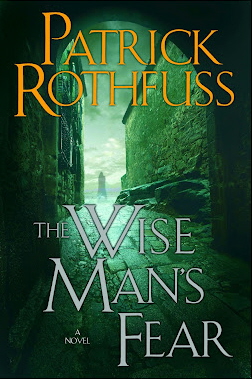
the-wise-mans-fear1Patrick Rothfuss’s The Wise Man’s Fear, the second volume of The Kingkiller Chronicles, has won the David Gemmell Legend Award for Best Fantasy Novel of 2011.

The David Gemmell Legend Award is a fan-voted award administered by the DGLA. The Legend Award for Best Fantasy Novel was first granted in 2009, to Andrzej Sapkowski’s Blood of Elves; in 2010 the winner was Graham McNeill’s Empire: The Legend of Sigmar, and last year’s was Brandon Sanderson’s The Way of Kings.

The nominees for the 2012 award also included The Heroes by Joe Abercrombie, Blackveil by Kristen Britain, Warhammer: Blood of Aenarion by William King, and The Alloy of Law by Brandon Sanderson.

The Morningstar Award for Best Fantasy Debut was awarded to The Heir of Night by Helen Lowe.

The Ravensheart Award for best Fantasy Book Jacket/artist went to the cover for Warhammer: Blood of Aenarion, done by Raymond Swanland.

Complete details are available at the DGLA website.

Congratulations to all the winners!

Christopher Paul Carey on Philip José Farmer’s World of Khokarsa

Christopher Paul Carey on Philip José Farmer’s World of Khokarsa

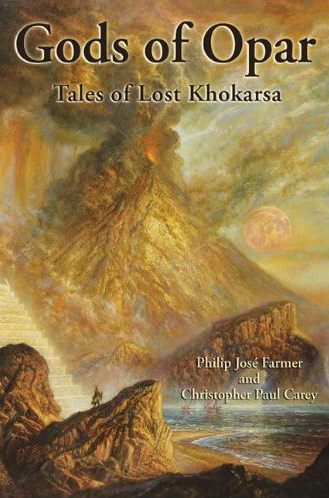
gods-of-opar2With the publication of Gods of Opar: Tales of Lost Khokarsa, I thought I’d take the opportunity to give Black Gate readers a taste of the world of Khokarsa, which serves as the setting for Philip José Farmer’s epic series of adventure and historical fantasy. It’s a world I’ve been immersed in for the past several years as I worked to complete The Song of Kwasin, the concluding book in the Khokarsa trilogy, as well as other related projects set in Farmer’s prehistoric empire.

Farmer’s achievement in the first two Khokarsa novels — written and first published in the 1970s, and now available in the Gods of Opar omnibus — is impressive. And part of the reason these thirty-some-year-old books hold up so well is the lengths to which the author went to carefully construct a believable world for his prehistoric heroes, heroines, and villains.

The rich level of cultural and descriptive detail in both Hadon of Ancient Opar and its sequel Flight to Opar make them prime examples of fantastic world building. Set twelve thousand years ago in ancient Africa against the backdrop of a civil war between the priestesses and the priests in the empire of Khokarsa, the books unveil a complex pantheon of gods and goddesses.

First and foremost is Kho, known also as the Mother Goddess, the White Goddess, and the Mother of All. She is the central deity of the Khokarsan people. Carefully balanced against Kho is her son Resu, god of the sun, rain, and war. While Resu has been declared the equal of his mother, most Khokarsans still regard Resu as secondary to Kho.

At the time Hadon of Ancient Opar begins, the priests of Resu have been locked in a delicate struggle for supremacy with the priestesses of Kho for over eight hundred years.

Read More Read More

New Treasures: The Fantasy Fan

New Treasures: The Fantasy Fan

the-fantasy-fanLast month, I got a great e-mail from Black Gate blogger Barbara Barrett. In between her entertaining comments on The Avengers, Arthur Machen, and re-discovering comic books, was this fascinating tidbit:

I’ve started reading The Fantasy Fan — a fan’s tribute to Hornig.  It’s a book containing a compilation of all the Fantasy Fan magazines… I’m only on the first zine but I’m amazed how closely the format matches that of Black Gate. Is this a *coincidence*? The first zine was published in September 1933 and it’s chilling because I keep in mind Robert E.Howard was still alive at that point… the breadth and depth of authors, articles and stories are wonderful. It’s definitely a page out of Living History.

Among fantasy collectors The Fantasy Fan is legendary. The world’s first fanzine dedicated to weird fiction, it lasted for 18 issues, from September 1933 to February 1935. Its contributors included some of the most famous names in the genre — H.P Lovecraft, Clark Ashton Smith, Robert E. Howard, Bob Tucker, Julius Schwartz, Forry Ackerman, Robert Bloch, August Derleth, Eando Binder, and many others — and its young editor Charles Horning so impressed Hugo Gernsback that he hired him to edit Wonder Stories in 1933, at the age of 17. While at Wonder Stories he published Stanley G. Weinbaum’s “A Martian Odyssey” and many other famous pulp stories.

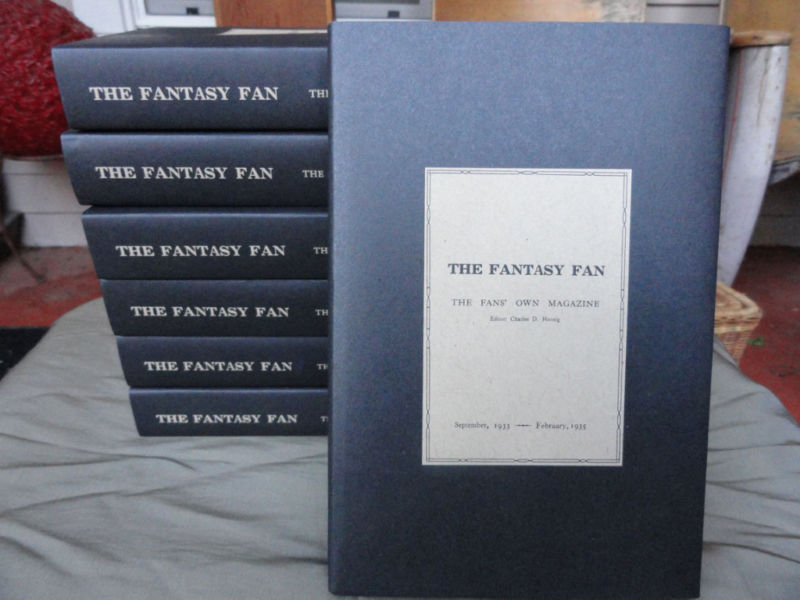
Barbara’s reference to a compilation of The Fantasy Fan was so intriguing I had to track down a copy for myself, and it finally arrived last week. Copies of the original fanzine are so rare that I’ve never even seen one, so to hold a facsimile reprint of all 18 issues in my hands was rather breathtaking. The man behind the book is Lance Thingmaker, and here’s what he says in his introduction:

These fragile gems were so unique. They were simple little fanzines, but were filled with stories, articles and comments by history’s most important weird fiction writers and fans. I felt like I was looking back in time… Since they are extremely hard to find, it seemed many others probably never had the chance to check out the world’s first weird fiction zine. I wanted to make it happen.

The end product is a top-notch piece of work. The magazines are presented in facsimile format, with painstaking restoration of the original barely legible pages, hand printed and hand-bound in hardcover by Thingmaker. The book is over 300 pages, including the complete text of H.P. Lovecraft’s famous essay “Supernatural Horror in Literature,” which was being serialized when the magazine folded. It is limited to 100 copies and sold for $50. Thingmaker’s next project, due to ship later this month, is a facsimile reprint of all four issues of the ultra-rare pulp Marvel Tales.

You can find a detailed breakdown of the contents of The Fantasy Fan here. My thanks again to Barbara for alerting me to this before it sold out!

Andrea Grennan reviews The Infernals

Andrea Grennan reviews The Infernals

the-infernalsThe Infernals
John Connolly
Atria Books (309 pp, $22.00, 1st Hardcover Edition, October 2011)
Reviewed by Andrea Grennan

Almost-Armageddon books are a marvelous niche in the fantasy market, ranging from serious examinations and thrillers to horror and gore. One of this reviewer’s favorites is the lighter side of Armageddon, as seen in Neil Gamain and Terry Pratchett’s Good Omens or Richard Kadrey’s Sandman Slim series.

John Connolly’s approach fits right into this niche, with a marvelous blend of suburban London quirk and the Large Hadron Supercollider in Cerne, Switzerland.

Sound a bit on the these-two-things-don’t-go-together side? Relax, set aside your concerns, and go for ride with Samuel Johnson and his faithful dog Boswell through the looking glass and straight to Hell.

Read More Read More

Vintage Treasures: Poul Anderson’s After Doomsday

Vintage Treasures: Poul Anderson’s After Doomsday

after-doomsdayI’m putting away all the paperbacks that arrived with my two Philip K. Dick lots, and I stumbled across the fabulous artifact at right.

After Doomsday was published by Ballantine Books in 1962, two years before I was born. It was originally serialized in Galaxy magazine (as The Day after Doomsday) between December 1961 and February 1962.

What truly makes it fabulous isn’t just the great cover art by Ralph Brillhart, with a bug-eyed alien stumbling on some guy surveying a road during his evening constitutional. No no no. It’s this wonderful description on the back cover:

CARL DONNAN was a space engineer — a man of action who did his job well and didn’t think much beyond that — but now his home planet was destroyed and he found himself with two burning ambitions:

– FIND the beings who blew up the Earth.

– SEARCH the galaxies until they located another Starship with female humans aboard.

BOTH PROJECTS were vital to the survival of the human race — and both were monumental tasks.

THIS was the time when the galaxies discovered how grim and purposeful a handful of homo sapiens could be.

A starship with “female humans” aboard. I think the first task for this guy Carl should be to look up “female humans,” find out they’re called “women,” and then put an ad on Craig’s List. The survival of the species is on your shoulders, dude. Time to put down that survey equipment and pick up a clean shirt. And maybe some mouthwash.

There’s a lengthy plot synopsis of After Doomsday here. Don’t expect it to be as entertaining as that back cover copy, though.

Selling Philip K. Dick

Selling Philip K. Dick

the-simulacra-philip-k-dickAlmost exactly a year ago this weekend I was in downtown Chicago, selling books and Black Gate magazines at the Printer’s Row book fair. It was hot and I got sunstroke, and I had to cancel dinner plans with the charming and beautiful Patty Templeton. Stupid, stupid sunstroke.

But I learned something fascinating. Well, two fascinating things. The second was that no one wants print fiction magazines anymore. I can’t tell you how many people picked up copies of Black Gate 15, dazzled by the look and heft of the thing, asking “What is this?” The moment they learned it was a magazine, they put it down and wandered over to the booth selling travel books.

But the first fascinating thing I learned is that vintage Philip K. Dick paperbacks sell at almost any price.

I learned this mostly by accident. I had a few hundred recently-acquired vintage paperbacks bagged up, but didn’t have time to price them. The night before the show they were spread out in stacks on our bed, all with cheerful blank price stickers, and Alice was threatening to sleep on the couch.

So I just priced them at random. Most I listed at 2 – 3 bucks, occasionally as high as 10. When I got to the more valuable stuff, like the Philip K. Dick , I wrote “$35” on most of ’em, even the stuff I’d only paid a buck or two for. I figured I’d do my homework and re-price everything that didn’t sell later.

Instead, I sold all the Philip K. Dick in less than two days.

Obviously, this was an unusual test case. For one thing, this wasn’t an SF convention and my buyers generally weren’t science fiction readers. They were book collectors who knew just enough about Philip K. Dick to know he’s in demand. There was a lot of impulse buying, and hardened rare book collectors are maybe less reluctant to fork over $30 – $40 on impulse than a typical SF reader.

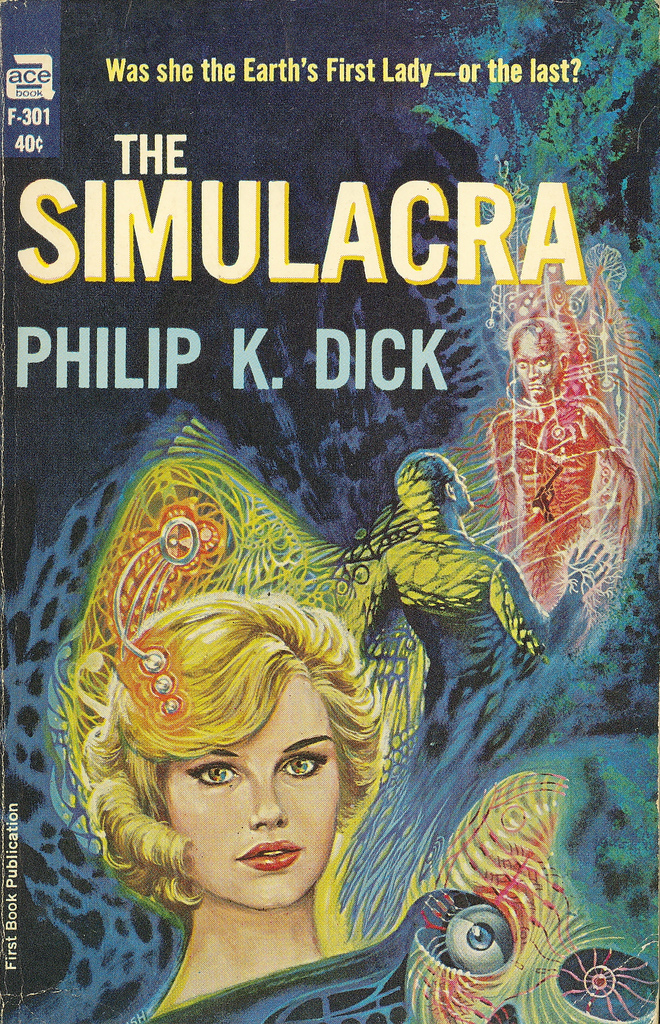
Still, it was very educational. Dick was one of the only authors browsing customers frequently asked about (the others were Samuel R. Delaney and Ursula K. LeGuin), and if I could put a book in their hands, it was a short step to a sale. It didn’t hurt that many of his paperbacks look terrific, like the Emsh cover on the 1964 Ace edition of The Simulacra, above.

I don’t sell much anymore, but I do have two tables reserved for Chicon 7, the World Science Fiction convention coming up this Labor Day here in Chicago. In preparation, I’ve been accumulating as many Philip K. Dick titles — and other vintage SF paperbacks — as I can find. eBay is one fertile hunting ground, especially if you’re willing to buy larger lots. Last week I purchased lots containing The Simulacra and Dr. Bloodmoney (plus 10 other mixed SF paperbacks) for $6.05 each. I’m pretty sure I can re-sell the Dick titles alone for a lot more than that.

Just how much more remains to be seen. I’ll let you know after Chicon.

Steampunk Spotlight: Cherie Priest’s Ganymede

Steampunk Spotlight: Cherie Priest’s Ganymede

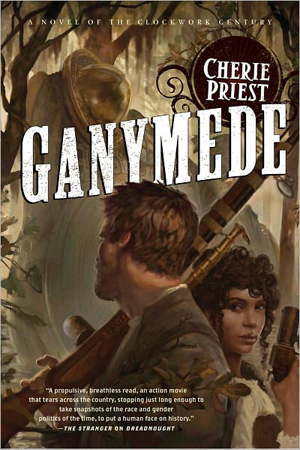
Ganymede by Cherie PriestGanymede (Amazon | B&N)
Cherie Priest
Tor (350 pp., $14.99, October 2011)
Reviewed by Jackson Kuhl

On the eve of the fall and subsequent occupation of New Orleans by the Union in 1862, lawyer and amateur engineer Horace L. Hunley, along with his two investment partners, scuttled their submarine Pioneer in a canal to prevent its seizure by the Federals. They may, or may not, have likewise scuttled a second submarine near Lake Pontchartrain; there are no records for this sub and its design departs from Hunley’s other efforts. The trio fled to Mobile, Alabama, to build another sub, which sank, and yet another, the H.L. Hunley, which drowned its namesake, then successfully torpedoed the Union blockade ship Housatonic before itself swamping in Charleston Harbor during its return.

In the alternate history of Cherie Priest’s latest Clockwork Century novel, Hunley and his partners constructed a fifth submersible, the titular Ganymede, which sank near New Orleans. The Civil War has stretched into the late nineteenth-century and the city is occupied by the Confederate-allied Republic of Texas. Now a team of pro-Union guerrillas has recovered Ganymede and, hopeful the machine can end the war in the Union’s favor, intends to transport it down the Mississippi River — past the Texians searching for it — to a waiting U.S. battleship in the Gulf. All of this is orchestrated by freedom fighter Josephine Early, a black whorehouse madam and Union agent. With no one experienced enough to pilot the sub, Early hires airship captain Andan Cly (who also happens to be her ex-lover, natch) to “fly” Ganymede under the river and the Texians’ noses to the rendezvous.

Priest has cooked together espionage, a rich setting, intriguing characters, and a plot that could have been stolen from Alistair Maclean. It’s a great gumbo — providing you ignore there’s not an ounce of suspense to be tasted. Spoilers ahoy!

Read More Read More