Vintage Treasures: The Blind Spot, by Austin Hall and Homer Eon Flint
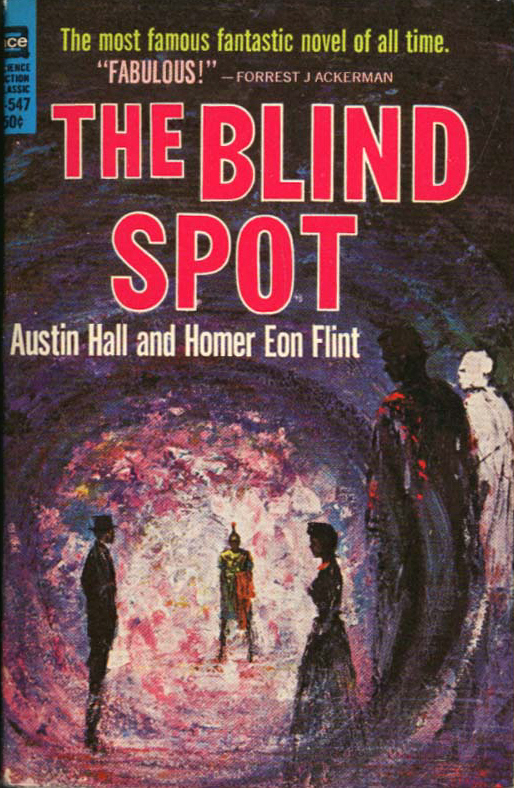 All right. Listen up, all you young fantasy punks. I know you’re out there, devouring contemporary fantasy by the truckload, while I’m trying to school you on the forgotten classics of the past. I know you’re not listening, because I rarely paid attention to the crotchety old-timers who tried to get me to read forgotten fantasy classics 30 years ago. I was too busy with Lord of Light, Bridge of Birds, Watership Down, and Swords Against Death.
Eventually, of course, I learned the error of my ways. I began to listen to my elders, and appreciate the glory of the pulp era of fantasy. I read the books they passed to me, and gradually became wiser, more worldly, healthier, and better looking, with fuller and more lustrous hair and better posture.
Mostly. I didn’t read, like, everything they foisted on me. Because Star Trek was on in the afternoon, and Dr. Who in the evenings (the Tom Baker episodes, naturally), and a lad needs some down time.
Now, these Vintage Treasures articles are my vehicle to pass along the accumulated knowledge and wisdom of a fabulously well-read generation (i.e. old people) to the eager and outstretched hands of the readers of tomorrow (you lot). That’s admittedly harder to do with the great classics of fantasy I haven’t read yet. Theoretically though, it might be possible to duck some of my personal responsibility by passing them along instead.
In short, skipping a generation and cutting out the middleman. Now pay attention, because this is where you come in.
I am tasking you with a sacred undertaking, upon which the very future of our beloved genre rests: to read, appreciate and evangelize the great works of 20th Century pulp fantasy. The ones I never got around to, anyway. So I can get back to that Season Two Star Trek DVD which arrived last week. Appreciate it.
Let’s start with The Blind Spot, by Austin Hall and Homer Eon Flint. What’s it about? I have no idea. If you were paying attention, you’d have clued in to that. But right there on the cover Ace Books calls it “The most famous fantastic novel of all time,” and the esteemed Forrest J. Ackerman shouts out the word “Fabulous!” That should be good enough for you.
The Blind Spot was published in 1921 as a serial in Argosy-All Story Weekly, and reprinted by Ace Books in 1964, with a doubtlessly fascinating and informative introduction by Ackerman that would have made writing this post a lot easier if I’d known about it 15 minutes ago. It is 318 pages in paperback for 50 cents. Finding a copy is left as an exercise to the reader (I got my copy on eBay for under a buck.) And get a move on, the cultural heritage of fantasy is at stake. But no pressure.
 Writing about fantasy fiction seems sooner or later to involve writing about myth. The two aren’t the same, but have a connection difficult to articulate. Similarities and contrasts both feel obvious and yet are hard to nail down. Perhaps it’s fair to say both fantasy and myth challenge consensus reality. But that they differ in the relation they have to truth, or to what is to be taken as truth.

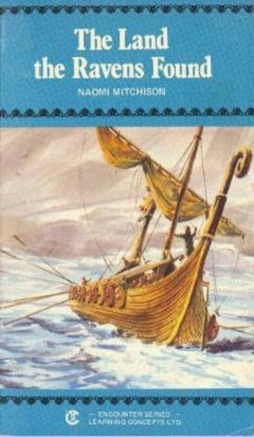 One of the joys you get to have as a reader is the discovery of a new writer, or a new old writer, with a back catalogue of work out there waiting for you. A little while ago, my girlfriend Grace and I were at a book fair when Grace came across a children’s novel called The Land the Ravens Found. First published in 1955, the copy she’d found was a fourth edition, from 1966, suggesting there’d been some demand for the book over the years. It was a story of Viking times and the founding of a settlement in Iceland, written by a woman named Naomi Mitchison. Neither of us had heard of her, but after reading the book, Grace was impressed enough to recommend it to me; after reading it myself, and learning a bit about Mitchison online, I thought it’d be worth writing a little here on both book and author.