Browsed by
Category: Books

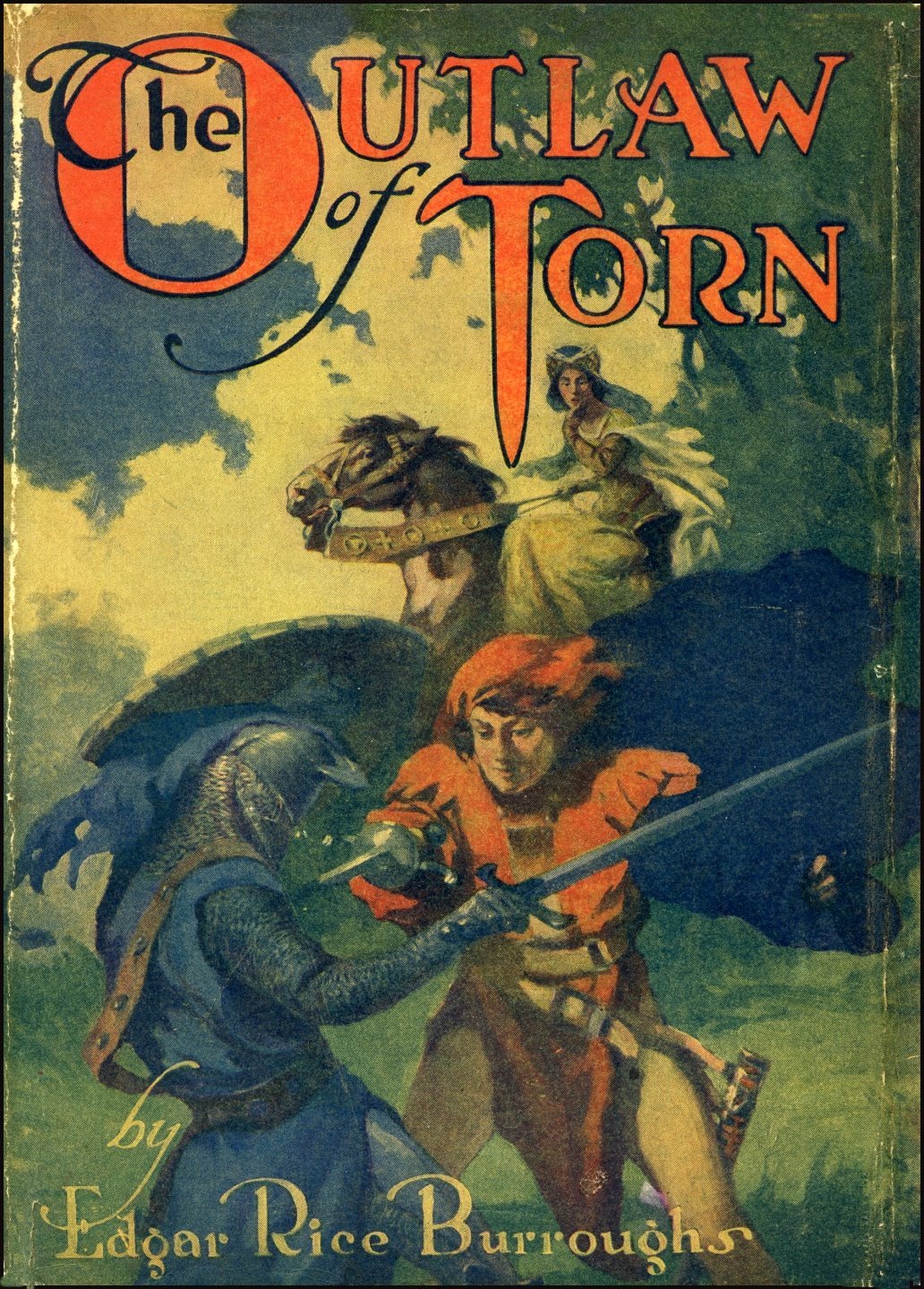
Romance and Revisions: The Outlaw of Torn by Edgar Rice Burroughs
Romance and Revisions: The Outlaw of Torn by Edgar Rice Burroughs

Outlaw of Torn 1st ed“Not since Arthur of Silures kept his round table hath ridden forth upon English soil so true a knight as Norman of Torn.” –Joan de Tany

“I am very doubtful about the story. The plot is excellent, but I think you worked it out all together too hurriedly.” –Thomas Newell Metcalf, letter to Edgar Rice Burroughs, 19 December 1911

“I am not prone to be prejudiced in favor of my own stuff, in fact it all sounds like rot to me…” –Edgar Rice Burroughs, letter to Metcalf, 14 March 2012

In Irwin Porges’s groundbreaking and Chartres Cathedral-sized biography, Edgar Rice Burroughs: The Man Who Created Tarzan (Brigham Young University Press, 1975), only two of ERB’s books have solo chapters dedicated to them: Tarzan of the Apes, of course — and The Outlaw of Torn.

Unless you are a hardheaded Burroughs devotee, I’ll wager a ducat you have never crossed paths with the title The Outlaw of Torn. Considering that chronologically it is squashed between his two most famous books, A Princess of Mars and Tarzan of the Apes, it makes sense that The Outlaw of Torn gets overlooked. That it belongs to the genre of Medieval Romance, a mite mustier than high Martian adventure or swinging times in the African rainforest, compounds the issue.

But this Middle Ages adventure deserves the primacy that Porges awarded it. Burroughs’s second novel taught him hard truths about the business of writing and what he was capable of. ERB was one of the first writer-businessmen; the long labor getting his second book to work and sell schooled him in the reality of making a living as an author of popular adventure.

The Outlaw of Torn also turned out, after all the toil put into it, a flat work manufactured too obviously as a copy of earlier romances. Burroughs thought highly of the book, and in 1927 wrote to his publisher: “I think it is the best thing I ever wrote, with the possible exception of Tarzan of the Apes, and next to it, I believe will rank The War Chief of the Apaches.” But instead of embracing further stories in this style, Burroughs turned and ran for the jungle with his next outing. A lesson learned, even if he could not admit it years later.
Read More Read More

Blue Sonja: The Last Red Sonja Post

Blue Sonja: The Last Red Sonja Post

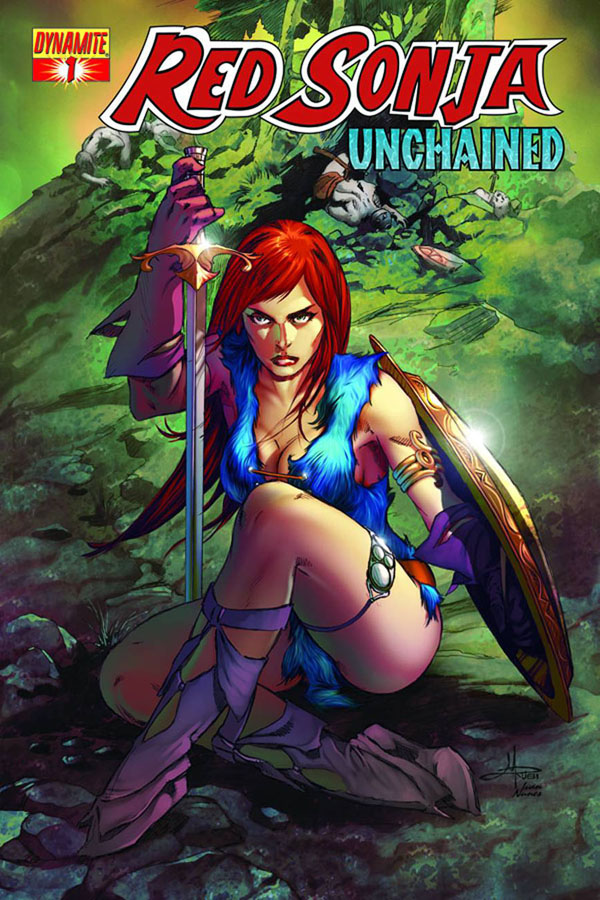
Unchained 1 BlueI started this series of posts with the intention of only writing one. “In Defense of Red Sonja” was meant to be a stand-alone post about how the character was more than just a female version of Conan the Barbarian, more than just a fan-service redhead in a chain mail bikini, more than a misogynist rape-challenge. I’ve been collecting comics from the “Bronze Age” (approximately 1970 through 1985) for years and Red Sonja wasn’t the only female character to pop up. There was Spider-Woman, She-Hulk, Ms. Marvel … all clearly starting as female versions of established male heroes and all eventually transcending those limits to become their own concepts.

That first post quickly grew in size, reaching over three-thousand words before even going into her appearances in Marvel Feature or her self-titled book. As it covered three distinct themes (how she differed from Conan, where the bikini came from, what the vow meant), I thought it would be better to break it into three separate articles. By the time the third post came out, I’d gotten enough positive reaction that I thought it might be nice to keep exploring how the character grew over the course of her own title. It was at this point that I realized just how much humor got slipped in to various panels of the title, which got me in the habit of highlighting a couple images each week. The novels and film were good ways to show how the character translated into other media, as well as how she was still evolving. And it was all a lot of fun.

So why is this the end? There were two more Marvel Comics series in the early eighties, as well as two Dynamite Entertainment series (Red Sonja and Queen Sonja) currently running. Not to mention a slew of one-shots and mini-series. I’ve got enough material to easily keep this column running at least another three years. And it is tempting to try.

Read More Read More

New Treasures: Iron Kin, by M.J. Scott

New Treasures: Iron Kin, by M.J. Scott

Iron KinWe work in a genre ruled by series. It makes for some tough choices sometimes.

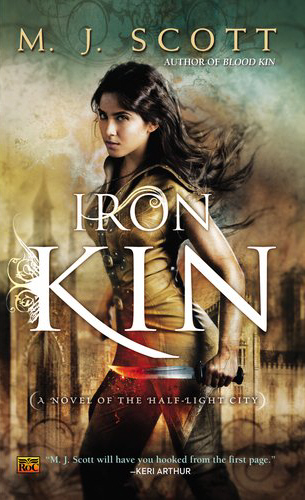
Case in point: I just received a review copy of M.J. Scott’s new novel Iron Kin. It looks like a fun, quick read with an intriguing setting and what could be a genuine POC on the cover:

Imagine a city divided. Fae and human mages on one side, vampire Blood Lords and shape-shifting Beast Kind on the other. Between these supernatural forces stands a peace treaty that threatens to shatter at the slightest provocation….

I was raised to do the right thing. But to my family that means staying safe behind the walls of human society. To be a respectable metalmage and never put myself at risk. But the treaty is faltering. And if it fails, nothing is safe. To help save the city and everyone I care about, I will use whatever means I can to ensure the negotiations to renew the treaty are successful — even if that means forging an alliance with a man who is the very opposite of the right thing….

Fen is trouble. Wild. He would rather bind himself in iron and drink himself into oblivion than learn to master the visions that come to him. Those visions might just hold the key to peace, and it seems that my power might hold the key to his control — if I can keep it around him….

Normally I’d plop down in my big green chair with my dog Pepper at my feet, and give it a try. Except for these tiny words at the bottom: A novel of the Half-Light City.

In the fantasy world, that’s code for: This isn’t the first book, dummy. According to a hasty Amazon search, Iron Kin is actually the third book, following Shadow Kin (2011) and Blood Kin (2012), neither of which I have.

And that brings us to those tough choices I mentioned. Do I set it aside and set out on a quest for the first one? Or do I settle in with Iron Kin, and figure things out as I go?

Read More Read More

What Makes a True Hero? Announcing the Winners of the Writing Fantasy Heroes Contest

What Makes a True Hero? Announcing the Winners of the Writing Fantasy Heroes Contest

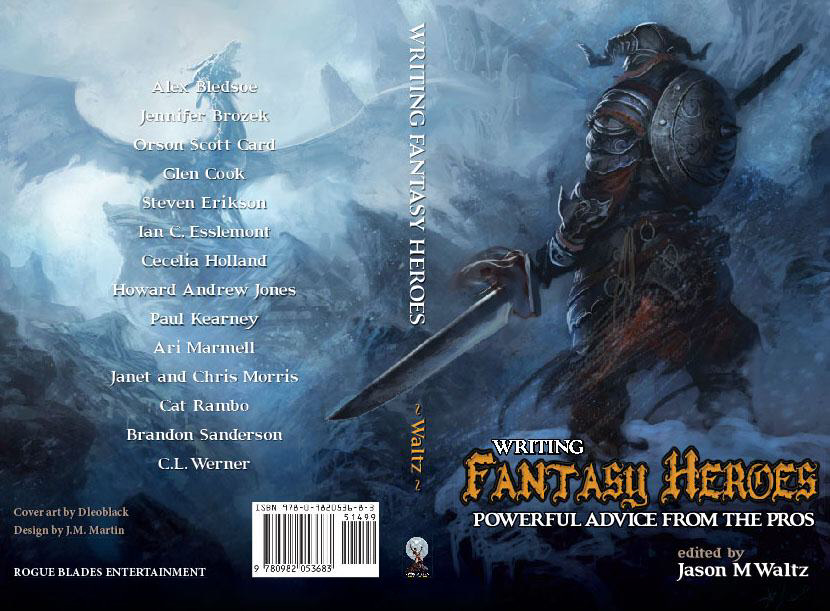
Writing Fantasy HeroesThree weeks ago, we asked Black Gate readers to tell us about their ideal hero in one paragraph or less. It could be a fictional character, or a general description of those qualities that make a hero ideal.

In return, we offered to award a copy of the new book, Writing Fantasy Heroes, edited by Jason Waltz and published by Rogue Blades Entertainment, to three lucky winners.

Those three winners will be randomly drawn from the list of all the entrants.

Before we announce the winners, let’s have a look at some of the best entries. As much as we’d like to, we can’t reprint all the entries we received, so we’ll limit it to the 20 we found most insightful, well written, or original. We’ll start with Daran Grissom, who tells us an ideal hero is:

Someone who, when confronted by the possibility of adventure, enters into it reluctantly, but with determination. A man or woman with a unique trait or skill who is delivered, by fate or vocation, to a place where he or she chooses to go above and beyond what is reasonably asked of them. An exceptional person, in exceptional circumstances, doing exceptional things. That is a hero.

A fine summary, and we’ll see plenty of examples in the next 19 entires — including Han Solo, Conan, Kane, The Gray Mouser, and of course John Wayne.

Read More Read More

What About Second Breakfast?

What About Second Breakfast?

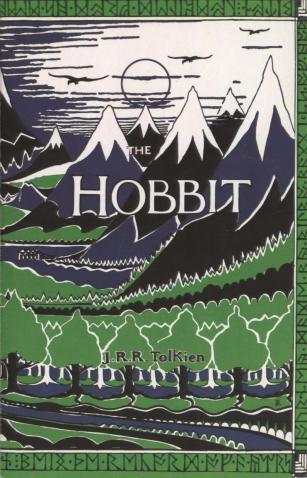
hobbit-book-coverThere are seven official mealtimes in Spain. The important one for our purposes is “segundo desayuno,” or second breakfast. Now, I can’t prove that this is where Tolkien got the idea, but I like to think so.

Last week we were talking about food and drink in Fantasy and SF, and how it can be used to give details of setting and character. Since the LOTR films, the term “second breakfast” is always going to be associated with Hobbits, with their lifestyle, and their attitudes to the world around them. Not that it started with the movie. Think about what we learned about Middle Earth in general, and Hobbits in particular – food, social customs, and etiquette – from the dining scene in The Hobbit.

It’s been suggested that we find more mention of eating and drinking in Fantasy than in SF. I don’t think that’s necessarily so, but it’s true that including food and drink in secondary world fantasy doesn’t require much in the way of technological invention or extrapolation – though it does require a little research. Most secondary fantasy worlds are facsimile versions of the past of our world – medieval era, renaissance, etc. –  whether the  basic setting is western European, Aboriginal, Middle Eastern or Asian. Pre-industrial is a pretty good way to think of it.

Food and drink is just as useful in giving necessary details of setting and character here as it is in any SF story or primary world fantasy. Maybe even more so. Besides, our characters still need something to do while they’re talking to each other, and travelling from place to place.

Read More Read More

Secret Identities and the Gothic: That Demmed, Elusive Pimpernel

Secret Identities and the Gothic: That Demmed, Elusive Pimpernel

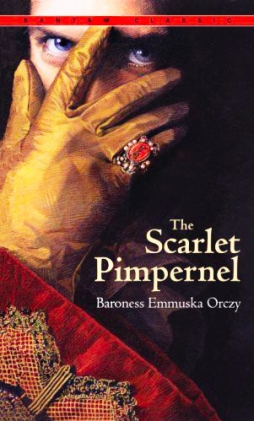
The Scarlet PimpernelOne of the strangest and most distinctive elements of a super-hero is a secret identity. It’s so distinctive we don’t even think about how strange it is. Or, more precisely, how strange the heroic identity is. There’ve been disguises and alter-egos throughout fiction, whether Odysseus showing up at his home incognito before killing his wife’s suitors, or the heroines of Shakespearean comedy dressing up as men and taking male names, or Sherlock Holmes ferreting out clues while masquerading as a humble old book-seller or opium addict. But the super-hero identity, in its classic form, is less a person than an idea: a being known by a code-name, who does not pretend to be a specific person, but instead wears a mask or cloak, and who exists only for one reason — usually to defend against some injustice, to right wrongs, or generally to fight crime. The super-hero identity is not a person or a personality; it’s the idea of a person, the dream of an identity. Much has been written about the symbolic presentation of masculinity the dual identity implies, a weak or nerdy exterior hiding a powerful secret persona. It’s interesting, then, that the idea seems to have been created by a woman.
They’re not scholarly sources, but both Wikipedia and Tvtropes suggest that the first true heroic secret identity was the Scarlet Pimpernel, who was the title character of a 1903 stage play and a better-known 1905 novel written by Baroness Emma Magdolna Rozália Mária Jozefa Borbála “Emmuska” Orczy de Orczi, better known as Baroness Orczy. I can’t think of an earlier example myself. The French character Rocambole first appeared in 1857, but (so far as I can tell) only had the one identity. The villainous Fantômas and the heroic Nyctalope first appeared (separately) in 1911. Zorro was introduced in 1919, The Shadow was given a background and real name in 1931, the Lone Ranger debuted in 1933, the Phantom in 1936, the Clock — the first masked hero in comic books — also in 1936, and Superman came along in 1938 — seventy-five years ago tonight, in fact. I suspect (but am not at all sure, if someone would care to put me out of my ignorance) the first woman with a secret identity was Domino Lady in 1936. Orczy, born in 1865, would go on to publish 11 Pimpernel novels before her death in 1947, along with two collections of short stories and several spin-off novels dealing with the hero’s ancestors and descendants. But to say “hero” here is slightly misleading. The Pimpernel is not the hero of the first book, in the sense of being the protagonist.

Read More Read More

Michael Moorcock’s Von Bek: A Review

Michael Moorcock’s Von Bek: A Review

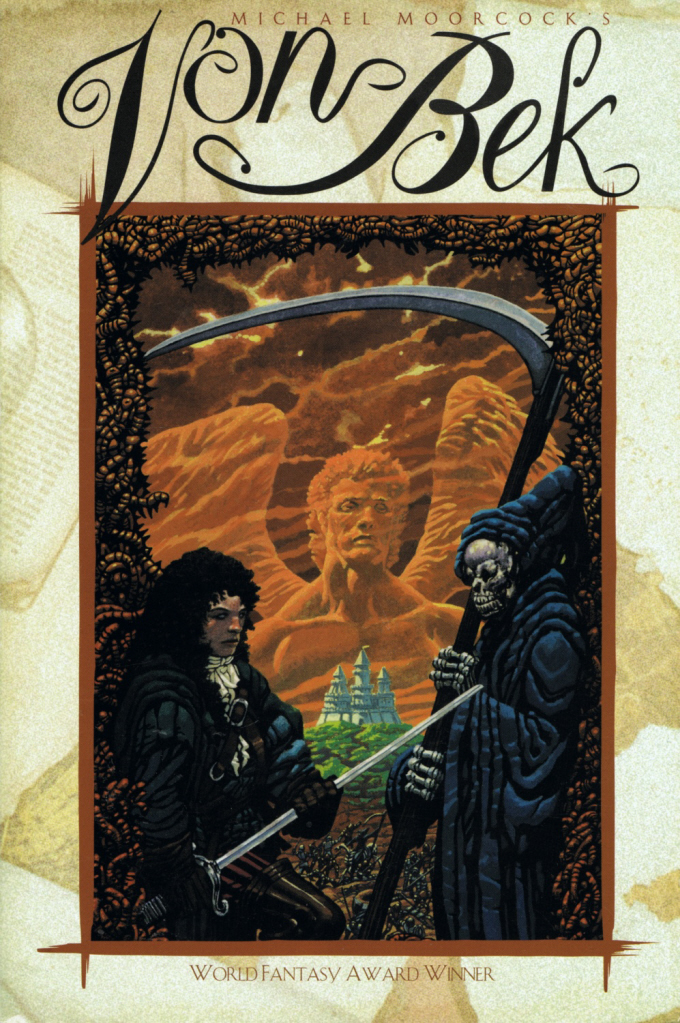
Von BekNo matter what your opinion of Michael Moorcock, you can’t deny that he’s a versatile writer; from the pulpy adventures of Dorian Hawkmoon to the sophisticated high literature of Mother London, this man seems capable of writing anything, and Von Bek, a collection of three stories that focus around the family of the same name and their quest for the Grail, is proof.

This is especially true of the first book: The Warhound and the World’s Pain, which focuses on Ulrich Von-Bek. Here you’ll encounter the same Gothic tones and deep melancholy of the Elric books, the gung-ho adventure of Hawkmoon alongside another healthy dose of Moorcock’s boundless imagination. It is at once questioning and original, daring and clever; unafraid to show the ravages of war, but still enjoyable as simple, leave-your-brain-at-the-door adventure.

A hard to attain but perfect combination. In this tale Lucifer, wanting to redeem himself in the eyes of God, enlists Ulrich Von Bek to retrieve the Holy Grail, or, as he calls it, the ’cure to the worlds pain.’

All throughout this venture, he is hindered by Klosterheim, who has been ordered to prevent him from finding the Grail. Klosterheim’s arrogant nature, intolerable ignorance, and prejudice make him an apt and contemptible rival for our charismatic anti-hero.

I say anti-hero because Von Bek, much like Elric, is a far-cry from Conan or Aragorn in that, rather than having an immovable viewpoint on morals, Von Bek, at least at the beginning, has none. The fact that he only accepts the tangible and takes destruction in his stride makes him a compelling companion, and makes his quest — which surrounds religion and metaphysics — all the more apt, and therefore all the more interesting.

Read More Read More

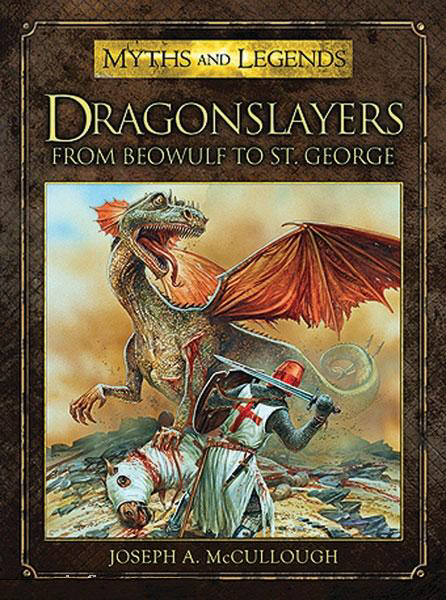
New Treasures: Dragonslayers From Beowulf to St. George, by Joseph A. McCullough

New Treasures: Dragonslayers From Beowulf to St. George, by Joseph A. McCullough

Dragonslayers from Beowulf to St. GeorgeJoseph A. McCullough has been a behind-the-scenes contributor to Black Gate for over a decade. He has a superb story sense, and put it to work as a submissions reader for us for many years, sifting through hundreds of short stories and sending the most promising my way.

That story sense has served him well in other arenas as well. A decade ago, Joe wrote what many consider the definitive modern essay on S&S, “The Demarcation of Sword and Sorcery,” originally published at Howard Andrew Jones’s SwordAndSorcery.org, and prominently referenced in the Wikipedia definition of the genre. It was eventually reprinted here and quickly became one of the most popular articles we’ve ever published. For years it was the backbone of the BG blog, drawing thousands of readers every month.

Joe is a fine writer in his own right (just check out his terrific adventure story “Stand at Llieva” in Black Gate 5). He also has the enviable task of guiding a publishing imprint, as Project Manager for Osprey Adventures, an imprint of Osprey Publishing — which he wrote about here.

Joe is occasionally able to combine vocations, and has now published a total of five books through Osprey, including Zombies: A Hunter’s Guide. His latest release, Dragonslayers From Beowulf to St. George, is a gorgeously illustrated look at some of the most famous heroes of legend.

Read More Read More

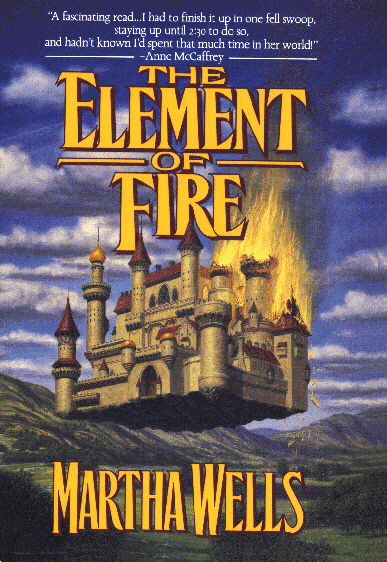
Sleeps With Monsters on Martha Wells’ The Element of Fire

Sleeps With Monsters on Martha Wells’ The Element of Fire

The Element of FireMartha Wells’s first novel, The Element of Fire, was published twenty years ago this July. It marked the debut of a major new fantasy writer.

The Element of Fire is a standalone novel set in the country of Ile-Rien, the setting for her Nebula-nominated The Death of the Necromancer (1998) and the Fall of Ile-Rien trilogy. Martha’s three contributions to Black Gate featuring her heroes Giliead & Ilias —  “Reflections,” “Holy Places,” and “Houses of the Dead” — helped put the magazine on the map. They are part of her Ile-Rien stories, and fill in some of the gaps between the novels.

Over at Tor.com, Liz Bourke kicks off an extended examination of Martha’s novels with a look at The Element of Fire:

It’s one of the best books I’ve ever read… and as a debut novel it is singularly accomplished.

The court of Ile-Rien, around which the action of The Element of Fire centers itself, is a complicated place. King Roland, recently come to his majority, is a weak ruler, warped by the abuse of his years-dead father. The court’s real power remains the Dowager Queen, Ravenna…

Wells’ deftness of characterization is delicate, precise and astute. An outside attack doesn’t lead to all the court’s factions banding together under capable leadership: rather it intensifies the amount of politicking and the coming-to-fruition of treasonous plots…. Wells has a fantastic touch for conjuring personality in all of her work…

I think it a fantastic book. In its honor, the next few installments of Sleeps With Monsters will focus on a selection of Martha Wells’ other works: the Fall of Ile-Rien trilogy and Wheel of the Infinite, at least, and possibly a surprise or two as well.

The Element of Fire was published in July 1993 by Tor Books. It is 413 pages in hardcover. Read Liz Bourke’s complete review here, and get the scoop on Martha’s  latest novel, Emilie and the Hollow World, here.

David Wesley Hill’s At Drake’s Command Available Free in Kindle Format — Today and Tomorrow Only

David Wesley Hill’s At Drake’s Command Available Free in Kindle Format — Today and Tomorrow Only

At Drake's CommandEditor’s aren’t supposed to have favorites — or we’re not supposed to admit to favorites, anyway. So I’ll temper what I wanted to say and just say this: I published two short stories by David Wesley Hill in Black Gate, and they were both so brilliant and unusual that I considered renaming the magazine David W. Hill’s Magazine of Fantasy.

It’s probably best that I didn’t, since David has since gone on to a successful career as a novelist, and I’d be stuck with a magazine that didn’t have any short stories in it. But I do urge you to check out “Far From Laredo” in Black Gate 4, in which gunslinger Charles Duke is hired to rid a town of three troublesome demons, and “The Good Sheriff” (BG 13), in which Duke finds himself up against a maimed god in a mining town full of sorcerers and demons.

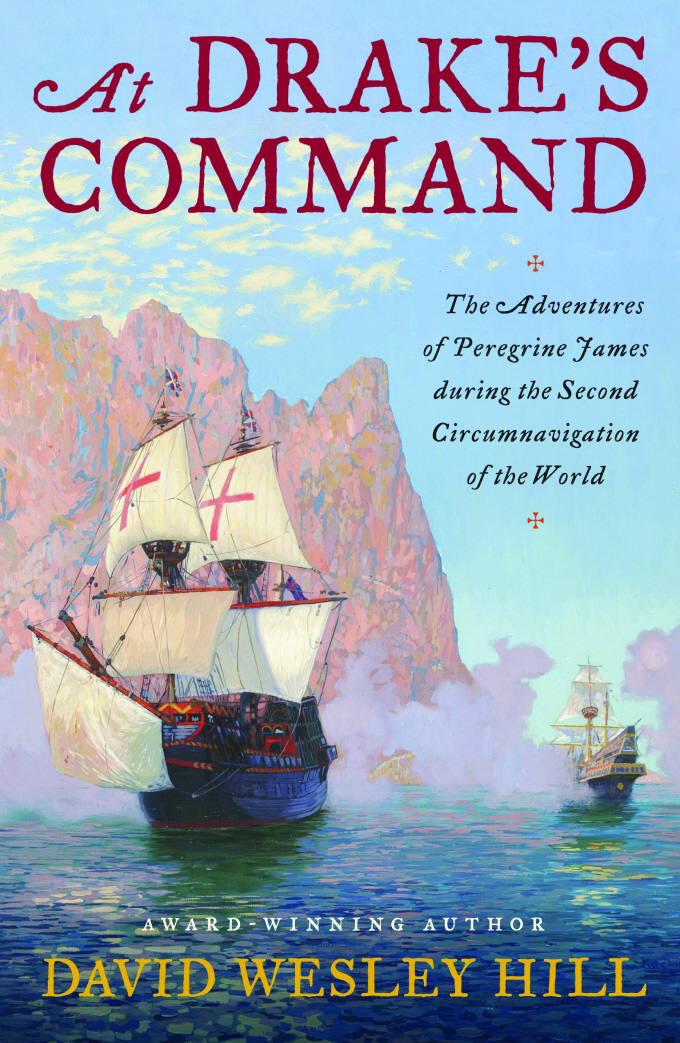
Or, if you happen to have a Kindle, you could try David’s latest adventure novel, the tale of young cook Peregrine James on an expedition under Francis Drake, for free:

It was as fine a day to be whipped as any he’d ever seen but the good weather didn’t make Peregrine James any happier with the situation he was in. Unfairly convicted of a crime he had not committed, the young cook was strung from the whipping post on the Plymouth quayside when he caught the eye of the charismatic sea captain Francis Drake, who agreed to accept Perry among his crew despite the stripes of a thief on his back.

Soon England was receding in their wake and Perry was serving an unsavory collection of sea dogs as the small fleet of fragile wood ships sailed across the deep brine. Their destination was secret, known to Drake alone. Few sailors believed the public avowal that the expedition was headed for Alexandria to trade in currants. Some men suspected Drake planned a raid across Panama to attack the Spanish in the Pacific. Others were sure the real plan was to round the Cape of Storms to break the Portuguese monopoly of the spice trade. The only thing Perry knew for certain was that they were bound for danger and that he must live by his wits if he were to survive serving at Drake’s command.

David’s previous novel was the SF adventure Castaway on Temurlone.

At Drake’s Command was published November 1, 2012 by Temurlone Press. It is 424 pages, priced at $14.95 for the trade paperback, and $2.99 for the digital edition. For today and tomorrow, you can get the Kindle edition for free here.