Dragons + Napoleon = MIGHTY FINE READING!
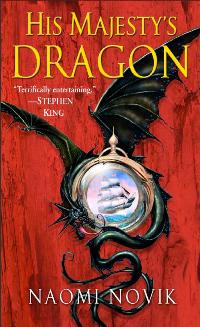 Oh, gosh! I’ve been reading Naomi Novik’s Temeraire books. My buddy (and dread Goblin Queen) Jessica Wick has been telling me I should read them for ages. And then the most fair and perilous Patty Templeton chimed in. And then my cool co-worker Janelle “I’m totally surviving the Zombie Apocalypse” McHugh started harping about them too, and I finally got a clue.
So I was all like, “FINE! I will read your 19th Century Dragons-as-Aerial-Calvalry in the year ‘O6 book, and I will see if it’s REALLY as good as all y’all are saying it is.”
Oh, it is. It is. Sea battles! Sea Serpents! Terrible storms! Travels to China! To Prussia! Blockades! Border patrols! Abolitionists and Assassins and fire-breathing Kazilik dragons, oh my!
I ordered His Majesty’s Dragon through Amazon.com and then I sort of ate it. And then I wheedled Patty (who works at a library to which I have no card) into checking out the next three books (Throne of Jade, Black Powder War and Empire of Ivory) for me (the latter of which I’m currently on). Last week, in anticipation of running out, I batted my not terribly impressive eyelashes at Janelle (who happened to be going to the library that day) and asked if she might, just might, be willing to check out Victory of Eagles for me.
In the meantime, I ordered them all for our bookstore, so that I can hand-sell them to unsuspecting customers in search of something bright and new and rambunctiously scrumptious in Fantasy. They’re sitting on my Employee Recommendation Shelf, right beside James Enge’s The Wolf Age, Terry Pratchett’s Nation, and Robin McKinley’s Sunshine. So they’re in good company!
Now, I’ve actually read (and watched) Patrick O’Brian’s Master and Commander, and also I love Susanna Clarke’s work, so I knew whereof Stephen King spoke when he wrote:
“Is it hard to imagine a cross between Susanna Clarke, of Norrell and Strange fame, and the late Patrick O’Brian? Not if you’ve read this wonderful, arresting novel.”
Only, see, I liked these books even better than Master and Commander, coz there were actually WOMEN in the pages. Female dragons as well as pilots — and boy, does that disturb our doughty protagonist Will Laurence! Before he got accidentally bonded to his Imperial Dragon Temeraire, he was just your ordinary, average (awesome) naval captain, with all that being British, a guy, and a naval captain in the 19th century implies. His time with the Aerial Corps, but most especially with Temeraire, works on him, until by the fourth book in, Laurence thinks and acts in ways that surprise even himself. It’s wonderful!
But really. I’m not here to write an in-depth review. I’m just here to alert you. You can be stubborn like me and wait a year or three before taking my advice and reading these books. YOUR LOSS THOUGH!
 Only a short post today, following up on
  It’s a great week for lovers of fantasy fiction!

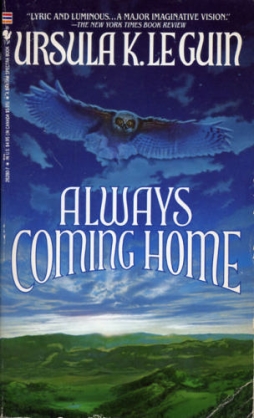 These past two weeks I’ve found myself writing here about science fiction, or speculative fiction, as the literature of ideas. It seems to me that ‘the literature of ideas’ implies something other than what we normally find in sf; I feel that it suggests writing that uses ideas to establish the structure of a work, instead of relying on traditional narrative. I’ve found a couple of early examples in Olaf Stapledon’s Star Maker and Jack London’s The Iron Heel. As a way to wrap up the discussion, I thought this week I’d look at a more recent example of what I mean by the literature of ideas: Ursula Le Guin’s Always Coming Home.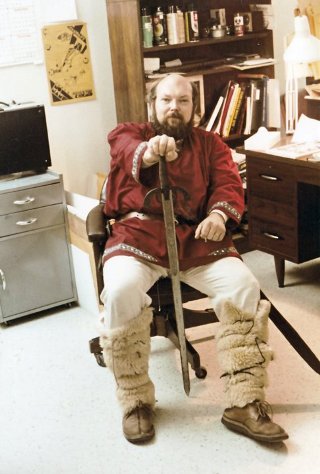

 Here is how this morsel describes himself: