Browsed by
Category: Blog Entry

Art of the Genre: Maps and World-Building

Art of the Genre: Maps and World-Building

MERP made a map that started it all for me, and Tolkien only explored about a quarter of it!

Way back in the day, I remember collecting I.C.E.’s Middle-Earth Role-Playing Game. If anyone ever bought those initial MERP supplements, they know that I.C.E. put a photo collection of what products were available on the back [much like TSR listed their products series on the backs of their early modules]. I was young, probably thirteen of fourteen at the time, and didn’t have much money, but I went out and collected everything represented on the back except three things, two of which were the campaign modules, Umbar Haven of the Corsairs and The Court of Ardor in Southern Middle Earth. Both were VERY early in the production line, probably out of print before I even started collecting, and the final piece was the MERP map set. Years later, I managed to purchase both Umbar and Ardor [actually my wife bought me Ardor after my first professional sale], but even though I’ve studied the image on that back cover a hundred times, and longed for the map beneath, I’ve never laid hands on a copy. The concept of that map laid the groundwork for my love of cartography and maps in general.

Read More Read More

Vincent N. Darlage Reviews Blackdirge’s Dungeon Denizens

Vincent N. Darlage Reviews Blackdirge’s Dungeon Denizens

blackdirge1I’ve had the privilege of reviewing several excellent supplements from Goodman Games over the years, but this particular one somehow slipped by me. Fortunately, Vincent N. Darlage provided a wonderful review of it in Black Gate #14, making the case that this supplement is superior to the official D&D 4th edition Monster Manual:

Blackdirge’s Dungeon Denizens

Aeryn Rudel
Goodman Games (144 pages, hardcover, $24.99)
Reviewed by Vincent N. Darlage

Laid out in easy to read black and white, this book was reminiscent of old school 1st edition AD&D. The artwork was evocative and not overblown like so much modern role-playing art. Dungeon Denizens is well- organized and easier to use than the 4th edition core monster book. The fonts are easier to read, the artwork more interesting, and the monsters are easier to find and understand. In the front, a list of different ways to look up the monsters is offered, giving lists of monsters by origin, type, and by keyword.

The book’s full of good stuff. The monsters are interesting and come with more background and information than the core monster book offers. One of my biggest complaints about the core book is the lack of information – this book has information in spades and is a real top notch effort. I could see these monsters in games I might run.

Aside from not knowing (or really caring) who or what Blackdirge is, I found this a superior monster volume. If I were to stick with 4th Edition, I would probably use this book more often than the core book. It has my unqualified recommendation.

Writers of the Future: I Got an Illustration . . . and an Interpretive Dance!

Writers of the Future: I Got an Illustration . . . and an Interpretive Dance!

with-framed-acolyte-illustration1chelsea-as-hallett-1I have returned after a two-week hiatus from Black Gate. It was a — busy time.

To get this out of the way first: Yes, I gave a shout out to Black Gate in general, with John O’Neill, Howard Andrew Jones, and Bill Ward in particular, when I accepted my award at the Writers of the Future Ceremony on 15 May 2011 at the Hollywood Roosevelt Hotel. (Here is the video of my section of the event, starting with the dance.)

When I started to write with the aim of publication — I don’t remember the exact moment when my love of writing began to seem like a possible profession, but it occurred about fifteen years ago — I liked to imagine a time when a professional artist would make an illustration of one of my books or stories. However, I never imagined that professional acrobats and dancers would create an interpretive dance of one of my stories as well.

I received many great gifts from my time at the Writers and Illustrators of the Future Workshop in Hollywood last week. Some are the tangibles like publication in a major anthology, a gala awards ceremony, my first official book signing, and payment. Some gifts are social, like a new network with the other winners as well as with the many celebrated writers and illustrators who make up the judging panel and the workshop teachers. All of us at the workshop will carry away a lifetime’s worth of advice, on everything from story construction to the best way to avoid getting a cold while on a book-promotion tour, from people such as Tim Powers, Robert J. Sawyer, Gregory Benford, K. D. Wentworth, Eric Flint, Dr. Yoji Kondo, Kristine Kathryn Rusch, Nina Kiriki Hoffman, Kevin J. Anderson, Dave Wolverton, Rebecca Moesta, and Mike Resnick.

There’s plenty for me to say about the experience of the workshop and getting published in Writers of the Future Vol. XXVII, and I will say more in future posts. But for this post, I am going to delve into the purely emotional and personal high points: the picture, and the dance. The first I knew was coming — and it was better than I could have imagined. The second I did not expect — and no surprise could have been more sublime.

Read More Read More

Tales of the Magatama

Tales of the Magatama

mirror-sword1I bumped into the talented Nick Mamatas at the 2010 World Fantasy Convention and discovered that he was editor for the Haikasoru line of translated Japanese fantasy novels for Viz Media. I might be well-read in foundational sword-and-sorcery texts, but I was pretty uninformed about the fantasy of Japan, and what Nick had to say was quite interesting. I was especially curious about a series of books by Noriko Ogiwara, The Tales of the Magatama, which are hugely popular in Japan, and have won numerous awards.

The second novel in the series, Mirror Sword and Shadow Prince, has just been released by Viz, so I thought it high time to talk with Nick to find out more about the series. He was kind enough to answer a number of questions, which I’ve included below.

Read More Read More

Two Reviews

Two Reviews

hfNo doubt somewhere someone is writing a vampire series based on Hamlet (there is, alas, a Romeo and Juliet and Vampires novel) but, for now, they are separate categories for two of my reviews posted on the current (mid-May) SF Site.

The first is Orson Scott Card’s retelling of Hamlet, which pretty much follows the play’s plot, but with a twist at the end I suspect the original author no more would have thought of than, well, making Hamlet a vampire.

bs4The second is Cherie Priest’s kickoff of an “urban fantasy” (a term which I take to mean “vampires who live and suck blood in cities”) called Bloodshot, featuring Raylene Pendle (aka Cheshire Red), and thief for hire who also happens to be a slightly neurotic vampire.

It’s not Shakespeare, but it is fun.

Blogging Marvel’s The Tomb of Dracula, Part Two

Blogging Marvel’s The Tomb of Dracula, Part Two

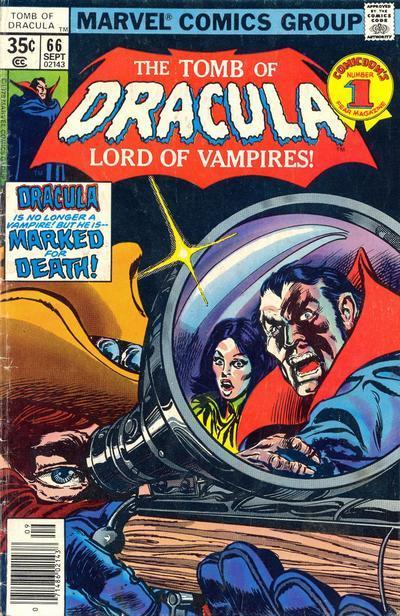
tomb-of-dracula-7tomb-of-dracula-8Marv Wolfman took over scripting duties on Marvel’s The Tomb of Dracula with Issue 7. Despite the name, Wolfman was an unlikely choice for a horror title as he had never been much of a horror fan and had limited exposure to the character outside of Stoker’s original novel. Nonetheless, the decision to pair Wolfman with artist Gene Colan and inker Tom Palmer elevated the series to classic status and insured its reputation for decades to come.

Issue 7 quickly sets the stage with the introduction of Quincy Harker and his daughter Edith. Quincy is the son of Jonathan and Mina Harker born at the end of Stoker’s novel. Here he is a nearly blind old man confined to a wheelchair with his daughter and faithful dog Saint as his constant companions. He functions as a mentor to Rachel Van Helsing and Taj Nital and has welcomed Frank Drake into the fold. Quincy is an amateur inventor whose vampire hunting gadgets give the story a Bondian edge that works very well. Wolfman’s sense of history and character instantly deepens the story and gives the reader a reason to empathize beyond the immediate sense of good vs. evil.

His innate understanding of people as an amalgamation of family history, mistakes, joys, and tragedies is Wolfman’s greatest strength as an author. Even his Dracula, for all of his cruelty and savagery, is imbued with such humanity and dignity that one can’t help hoping all of them can find peace. Wolfman may be the first writer since Stoker to successfully treat the characters as real people that readers recognize as something other than stereotypes. Finding the key to that empathy is what elevates his take on the property above so many others.

Read More Read More

R. Scott Bakker: Not the Anti-Tolkien, After All

R. Scott Bakker: Not the Anti-Tolkien, After All

lord-of-the-ringsAre you a Tolkien imitator? A riffer? A rejector? One way or the other, if you’re writing epic fantasy, the Oxford professor is sitting on your shoulder, sniggering and blowing dirty pipe smoke up your nose.

It doesn’t matter that you’ve never read Lord of the Rings; declaring Conan the Cimmerian to be your only true love won’t save you. The man with two “R”s didn’t invent the field, but he dominates it to the extent that we all write in his shadow.

Read More Read More

Goth Chick News: Outpost 13 – A Very Early Peek at a New Film from Pirate Pictures

Goth Chick News: Outpost 13 – A Very Early Peek at a New Film from Pirate Pictures

image010Welcome to the Cool Kids Club; you’ve officially arrived.

How do I know?

Because uber-edgy indy film maker Wyatt Weed (Pirate Pictures) has decided that Black Gate is where he wants to leak a little insider information about his upcoming sci-fi release, Outpost 13.

I’ve seen an amazing secret clip which I can’t share just yet, but allow me to assure you that snotty posers would never be allowed this kind of access.

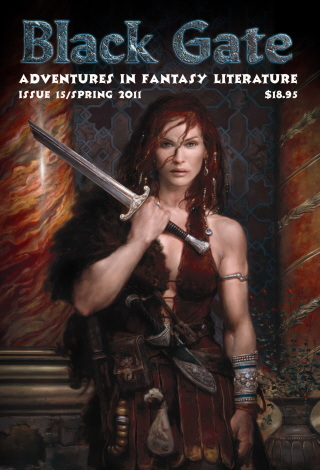
I begged, pleaded and finally promised Wyatt that I’d send him my personal copy of Black Gate 15 (hey John, you’re not going to charge me for a replacement copy are you?) and he agreed to sneak us a little information about the project, along with some production stills.

Read More Read More

This Page is Half Empty: The Five Horsemen of Literary Apocalypse

This Page is Half Empty: The Five Horsemen of Literary Apocalypse

428px-durer_revelation_four_riders1Right now, as I type this — and as you read it — I’ve got a new manuscript half done. For a writer, this is sort of like me saying that at this very moment I’m not wearing anything under all of my clothing. Well, duh, most people are thinking, while trying to not involuntarily imagine me naked. For writers, the thought continues, there’s always the current project.

The process of forging the first draft is much like any other relationship between the mind and the will. Romance, for instance. There’s the initial flare of interest, the slower “getting to know you” stage, and a much longer “I know you, now” period. These are all easy to navigate, because they are exciting and interesting. They are effortless, and writers know the feeling of a Work-In-Progress crush.

But this infatuation period cannot last. While in it, there’s always the potential that your feelings are mercurial, diaphanous dream-fluff that make no sense when you try to go deeper. To your shock, you realize that perhaps your burning love isn’t the stuff of ages, but mere puppy love. Your ardor has brought you no glamour, but instead made those around you somewhat uncomfortable, hoping, for your sake, that it will all end soon without you getting hurt too badly.

Am I just a puppy-lover? you find yourself asking.

Read More Read More